
Navigating the Digital Aisles: Finding Your Ideal AI Shopping Assistant
Discover how AI is revolutionizing online and in-store shopping experiences.
Key Highlights
- AI shopping assistants are transforming both online and in-store retail by providing personalized recommendations, automating tasks, and enhancing customer service.
- A wide array of AI tools are available, ranging from chatbots and personalized recommendation engines to visual search tools and automated checkout systems.
- Major players in finance and retail, such as Visa, Mastercard, and Amazon, are actively integrating AI into their platforms to offer more seamless and intelligent shopping journeys.
The Rise of the AI Shopping Assistant
In the rapidly evolving landscape of retail, artificial intelligence (AI) is emerging as a transformative force, fundamentally changing how consumers interact with brands and make purchasing decisions. AI shopping assistants, in particular, are becoming increasingly prevalent, acting as virtual concierges that guide users through the complexities of online and even physical stores. These intelligent tools leverage advanced algorithms and machine learning to understand user preferences, analyze product information, and provide tailored recommendations, ultimately streamlining the shopping process and enhancing the overall customer experience.
What is an AI Shopping Assistant?
An AI shopping assistant is a digital tool powered by artificial intelligence designed to help consumers find, research, compare, and purchase products. These assistants can take various forms, including chatbots on e-commerce websites, dedicated shopping apps, or integrated features within broader platforms. Their core function is to provide personalized assistance, mimicking the experience of interacting with a knowledgeable human sales associate but with the speed, efficiency, and data analysis capabilities of AI.
Reactive AI is often the foundation for many AI shopping assistants. This type of AI responds to specific inputs with preprogrammed actions, making it ideal for handling common customer queries, providing product details, and assisting with basic troubleshooting. However, more sophisticated AI shopping assistants are increasingly incorporating generative AI and machine learning to offer more dynamic and personalized interactions.
How AI Shopping Assistants are Reshaping Retail
The integration of AI shopping assistants is poised to embed artificial intelligence into the heart of our shopping experiences, forever changing the retail landscape. For businesses, these tools offer significant advantages, including increased operational efficiency, improved customer engagement, and higher conversion rates. By automating customer support, providing personalized product recommendations, and optimizing various aspects of the sales funnel, AI assistants allow retailers to reduce costs and enhance profitability.
For consumers, the benefits are equally compelling. AI shopping assistants can save time and effort by quickly sifting through vast product catalogs, comparing prices from different vendors, and offering relevant suggestions based on individual needs and preferences. They can also help users discover new products they might not have found otherwise and provide valuable insights from product descriptions and customer reviews.
A Spectrum of AI Shopping Tools
The market for AI shopping tools is diverse and expanding, with solutions catering to various aspects of the retail journey. These tools can be broadly categorized by their primary function, although many assistants combine multiple capabilities.
Personalized Product Recommendations and Discovery
One of the most common applications of AI in shopping is providing personalized product recommendations. Platforms like Bloomreach and Nosto utilize AI to analyze customer behavior, preferences, and purchase history in real-time, delivering highly targeted suggestions across websites, mobile apps, and email campaigns. Wisepops also offers a solution for recommending products to increase e-commerce sales, providing multi-channel placements for recommendations.
Visual search tools, such as Google Lens, are also revolutionizing product discovery by allowing customers to find products by simply taking a picture. This bridges the gap between online and offline shopping and improves discoverability for niche or hard-to-describe items.
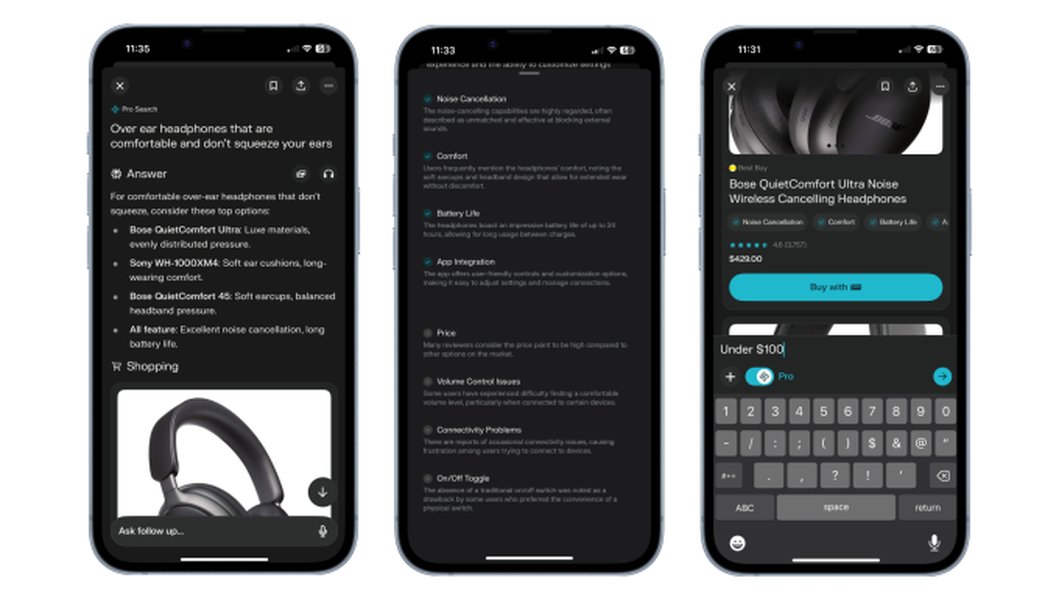
Perplexity Shopping on mobile offers a visual and chat-based AI shopping experience.
Automated Customer Support and Engagement
AI-powered chatbots are becoming a standard feature on e-commerce websites, offering instant, 24/7 customer support and shopping assistance. Tools like Lyro by Tidio and Intercom AI Chatbot can answer frequently asked questions, provide information about orders, and guide customers through the purchasing process. Giosg is another sales acceleration solution that automates live chat using AI chatbots and interactive content to engage shoppers.
Some AI shopping assistants go beyond basic Q&A, offering conversational shopping experiences where users can describe their needs in natural language. Buysmart.ai, for example, uses a category system and asks questions to help users find the right item. App0 provides an AI-powered expert for real-time, interactive product comparisons.

Mira AI Shopping Assistant provides conversational support to online shoppers.
Efficiency and Operational Tools
AI is also being used to improve operational efficiency for e-commerce businesses. Tools can automate product uploads, manage inventory, and provide demand forecasting to help businesses avoid overstocking or understocking issues. For instance, some AI tools integrate with e-commerce platforms like Shopify and WooCommerce to ensure real-time stock level updates and efficient order processing.
AI can also assist with content creation for marketing and product descriptions, with tools like Copysmith, Writesonic, and Jasper.ai. Image editing tools like Gigapixel AI and Pixlr use AI to enhance product images, making online presentations more professional and appealing.
Comprehensive AI Shopping Platforms
Some platforms aim to provide a more comprehensive AI-driven shopping experience. Perplexity, for example, has launched an AI shopping assistant that combines chat-based search, visual recognition, and cross-platform price comparison. This allows users to research and purchase products within a single platform. Amazon's Rufus is another AI shopping assistant being rolled out, designed to help shoppers find and buy products within the Amazon ecosystem.

Amazon's Rufus AI Shopping Assistant provides guidance within the Amazon app.
Even payment processing giants like Visa and Mastercard are integrating AI into their platforms to facilitate AI-powered shopping experiences. Visa Intelligent Commerce allows users to ask an AI system to perform tasks like organizing holidays or booking tickets, with the AI agents capable of finding, shopping, and buying based on user preferences. Mastercard's Agent Pay offering integrates payments into tailored recommendations provided by conversational platforms.
Notable AI Shopping Assistant Tools
Several AI shopping assistant tools are available, each with its own strengths and features. Here's a look at some prominent examples:
| Tool Name | Key Features | Target User |
|---|---|---|
| Shop.app AI (by Shopify) | Chat and shopping panels, quick results, tracks past conversations, price range slider. Primarily focuses on Shopify stores. | Online shoppers on Shopify stores |
| Buysmart.ai | All-in-one tool for finding products and learning about them, category-based search, detailed product recommendations, natural language understanding. | Online shoppers seeking detailed product information and recommendations |
| Claros | Detailed Amazon shopping assistant, question-based search. | Amazon shoppers |
| ShopGuru | Chrome extension for Amazon, AI answers questions. | Amazon shoppers using a desktop browser |
| Rufus (by Amazon) | Integrated into Amazon's ecosystem, provides suggestions and recommendations in the search bar, offers insights into product details and reviews. | Amazon shoppers |
| Perplexity Shopping | Combines chat-based search, visual recognition, cross-platform price comparison, unbiased product cards. | Users who want a comprehensive research and shopping tool |
| alby | AI Product Assistant for e-commerce businesses, anticipates and answers product questions, personalized recommendations, integrates with existing platforms. | E-commerce businesses |
| App0 | AI-powered expert for real-time interactive product comparisons, works with support teams, category-specific assistance. | E-commerce businesses |
| Zevi | AI-powered search and discovery platform, neural search technology, ChatGPT-like shopping assistant. | E-commerce businesses |
| RetailRocket | AI-driven personalized product recommendations, email marketing automation. | E-commerce businesses |
These tools demonstrate the variety of approaches to AI-powered shopping, from consumer-facing assistants that help with product discovery and comparison to business-focused tools that optimize operations and customer engagement.
The Future of AI in Shopping
The integration of AI into shopping is still in its early stages, but the potential for future development is vast. We can expect to see even more sophisticated AI assistants that can handle complex tasks, such as planning entire shopping trips, negotiating prices, or even making autonomous purchases based on pre-set preferences, as envisioned by Visa Intelligent Commerce. Smart shopping carts utilizing AI technology are also being developed for physical stores, offering self-scanning and a personalized in-store experience.
The future of e-commerce belongs to businesses that can make online shopping feel as natural as walking into your favorite store and having a knowledgeable assistant help you find exactly what you need. AI shopping assistants are becoming the standard for businesses serious about customer experience and conversion rates.
Frequently Asked Questions about AI Shopping Assistants
What are the main benefits of using an AI shopping assistant?
AI shopping assistants offer several benefits, including personalized product recommendations, faster product discovery, price comparison, 24/7 customer support, and the ability to understand natural language queries. They can save time and effort while helping users make more informed purchasing decisions.
Are AI shopping assistants only for online shopping?
While many AI shopping assistants are focused on online retail, the technology is also being applied to enhance the in-store shopping experience through innovations like AI-powered smart shopping carts.
How do AI shopping assistants provide personalized recommendations?
AI shopping assistants use machine learning algorithms to analyze user behavior, preferences, past purchases, and even demographic information to provide personalized product recommendations. Some also consider real-time data like browsing activity and current trends.
Can AI shopping assistants help me find the best deals?
Yes, many AI shopping assistants can compare prices across different websites and notify users about price drops or deals on specific items, acting like a personal shopping spy for savings.
What are some concerns about using AI shopping assistants?
Concerns about AI shopping assistants often include data privacy and security, as these tools collect and process personal information. There are also questions about the potential impact on traditional retail jobs and the possibility of biased recommendations based on the data the AI is trained on.
References
Last updated May 9, 2025