
Do Missiles Collide with a Celestial Ceiling, Creating Sky Waves?
Unpacking the ancient concept of the firmament and the science behind rocket launch phenomena.
The idea of a solid "firmament" overhead, a concept rooted in ancient cosmology, sometimes surfaces in discussions about modern technology, particularly regarding rockets and observed atmospheric effects. Does a missile streaking towards orbit actually strike this celestial barrier, causing visible "wake-like" patterns in the sky? Let's delve into the historical understanding of the firmament, the physics of rocket launches, and the real causes behind those captivating visual displays.
Highlights: Key Insights
- The Firmament is Historical, Not Physical: The concept of a solid firmament or dome separating Earth from the heavens originates in ancient Near Eastern and biblical cosmology, not modern astronomy or physics.
- Rockets Traverse Atmosphere, Not Collide with Barriers: Spacecraft pass through Earth's progressively thinning atmospheric layers to reach orbit or outer space; they do not encounter or hit a solid celestial barrier.
- Visual Patterns Explained by Physics: "Wake-like" patterns, spirals, or plumes seen during missile launches are attributable to aerodynamic effects, exhaust gas interactions with the atmosphere, condensation trails, and sometimes rocket malfunctions or specific maneuvers, not collisions with a non-existent firmament.
Understanding the "Firmament": From Ancient Skies to Modern Science
A Ceiling Above the World?
The term "firmament" (from the Hebrew 'raqiya') features prominently in ancient cosmologies, including the creation account in the Book of Genesis. It was often conceived as a solid, dome-like structure arching over the Earth, separating the "waters above" from the world below. This celestial vault was thought to hold the stars, sun, and moon, serving as a physical boundary between the terrestrial realm and the heavens.
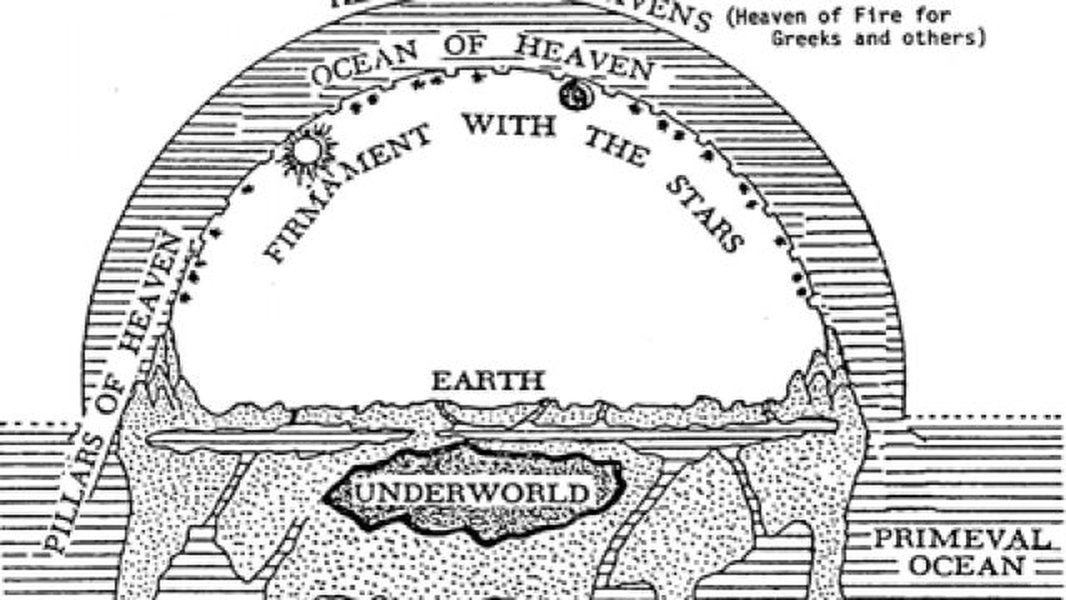
An illustration depicting an ancient cosmological model featuring a solid firmament above a flat Earth.
The Scientific View: Layers of Gas
Modern science, through centuries of observation and experimentation, has revealed a vastly different picture. What lies above us is not a solid dome but Earth's atmosphere – a complex system of gaseous layers held in place by gravity. These layers (troposphere, stratosphere, mesosphere, thermosphere, exosphere) gradually decrease in density with altitude, eventually merging into the near-vacuum of space. There is no physical, solid barrier corresponding to the ancient concept of the firmament.
Space itself is generally considered to begin around the Kármán line, approximately 100 kilometers (62 miles) above sea level, where the atmosphere becomes too thin to support aeronautical flight. Rockets and missiles designed for orbit or deep space travel are engineered to pass through these atmospheric layers, overcoming gravity and air resistance to achieve the necessary velocity.
Decoding the Patterns: What Causes Visual Effects During Launches?
If missiles aren't hitting a firmament, what causes the sometimes spectacular and unusual visual phenomena observed during their ascent, including patterns described as "wake-like" or spirals?
The Physics of Flight and Exhaust
The primary causes lie in the interaction between the high-speed vehicle, its powerful exhaust plume, and the varying conditions of the atmosphere:
- Exhaust Plumes: Rocket engines expel hot gases at high velocity. The appearance of this plume changes dramatically with altitude as the ambient air pressure drops. In the near-vacuum of the upper atmosphere, the exhaust expands significantly, sometimes creating vast, glowing clouds illuminated by sunlight (especially during twilight launches).
- Aerodynamic Shocks: As a vehicle travels at supersonic or hypersonic speeds through the atmosphere, it generates shock waves – abrupt changes in pressure, density, and temperature. These can sometimes be visible or interact with the exhaust plume in complex ways.
- Contrails: Similar to aircraft, rockets can produce condensation trails (contrails) under specific atmospheric conditions (temperature and humidity). Water vapor present in the exhaust or the ambient atmosphere rapidly freezes into ice crystals, forming visible trails. These can persist and be sculpted by upper-atmospheric winds, sometimes taking on wavy appearances.
- Atmospheric Interactions: The composition and density variations between different atmospheric layers can affect how light scatters and how exhaust plumes behave, contributing to visual peculiarities.
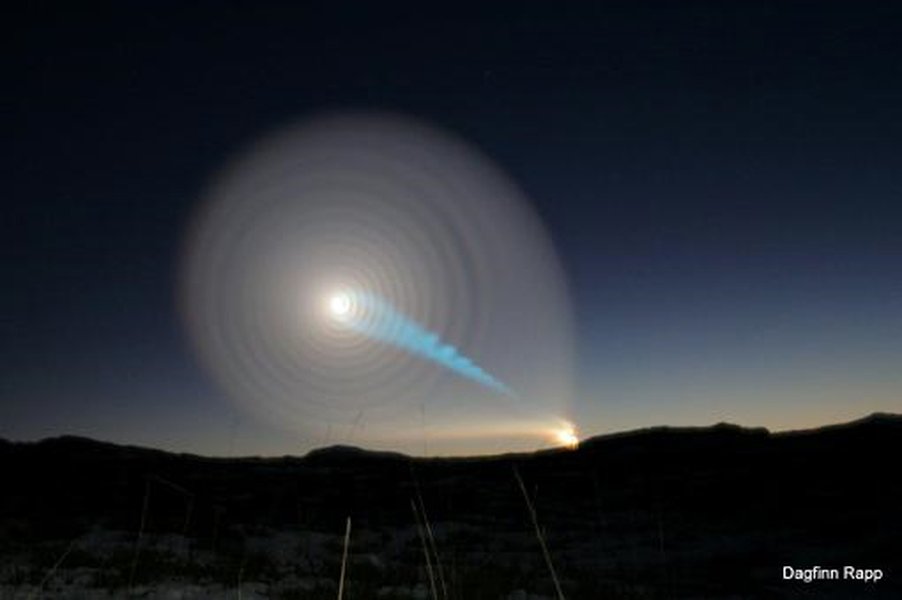
A striking spiral pattern observed over Norway in 2009, caused by a malfunctioning Russian Bulava missile spinning out of control and venting fuel.
Operation Fishbowl and High-Altitude Tests
Some interpretations linking missiles to the firmament reference Operation Fishbowl, a series of high-altitude nuclear tests conducted by the US in 1962. Missiles carried nuclear devices to altitudes ranging up to 400 kilometers, where they were detonated. These tests produced dramatic artificial auroras, electromagnetic pulses, and radiation belts.
While some proponents of firmament theories suggest these tests were attempts to "break through" or interact with a celestial barrier, the official and scientific explanation is that they were designed to study the effects of nuclear explosions in the upper atmosphere and near-space environment, particularly concerning potential impacts on communications and missile defense systems. The observed phenomena were consistent with nuclear physics and plasma interactions in the ionosphere and magnetosphere, not a collision with a solid structure.
Alternative Interpretations vs. Scientific Consensus
Discussions within flat Earth communities or certain conspiracy theory circles sometimes interpret unusual rocket launch visuals, atmospheric phenomena, or historical events like Operation Fishbowl as evidence for a physical firmament. Videos purportedly showing rockets "hitting" or "scraping" a barrier are sometimes cited. However, these interpretations consistently conflict with established physics and aerospace engineering principles. Often, the cited visual evidence can be explained by known phenomena like:
- Atmospheric refraction or lens effects.
- Normal stage separation events.
- Exhaust plume expansion and interaction with sunlight at high altitudes.
- Specific maneuvers like yo-yo de-spin (a technique used to slow the rotation of some spacecraft stages by deploying weighted wires, which can affect the exhaust trail).
- Vehicle malfunctions leading to uncontrolled flight paths or fuel venting (as in the Norway spiral).
There is no credible scientific evidence supporting the existence of a physical firmament being impacted by missiles.
Comparing Cosmological Models
The understanding of our world and the cosmos above has evolved dramatically. Here's a comparison between the ancient firmament concept and the modern scientific view:
| Feature | Ancient Firmament Concept | Modern Scientific Understanding |
|---|---|---|
| Nature of the Sky | Solid dome or vault-like barrier | Gaseous atmosphere thinning into space |
| Composition | Often described as crystalline, metal, or ice | Layers of gases (Nitrogen, Oxygen, Argon, etc.) |
| Boundary | Physical barrier separating Earth from "waters above" or heavens | Gradual transition to the vacuum of space (e.g., Kármán line) |
| Celestial Objects | Embedded within or attached to the firmament | Located vast distances away in space, governed by gravity |
| Interaction with Projectiles | (In some interpretations) Physical impact possible | Passage through atmospheric layers, subject to aerodynamic forces |
| Supporting Evidence | Based on naked-eye observation, mythology, religious texts | Based on extensive observation, experimentation, mathematical models (physics, astronomy, aerospace engineering) |
Factors Influencing Rocket Launch Visuals
This chart evaluates the relative contribution of various factors to the visual phenomena observed during rocket launches, contrasting scientific explanations with the unsupported "firmament collision" idea.
As illustrated, established physical and atmospheric factors overwhelmingly account for the visual effects seen during rocket launches. The notion of a firmament collision holds negligible explanatory power within the scientific framework.
Mapping the Concepts: Firmament, Rockets, and Sky Patterns
This mind map visually summarizes the key concepts discussed: the historical idea of the firmament, the reality of missile trajectories through the atmosphere, the scientific explanations for visual patterns, and the alternative interpretations.
(Troposphere, Stratosphere, etc.)"] id2c["Reaches Space (Above Kármán Line)"] id2d["Orbital Mechanics (Velocity vs. Gravity)"] id2e["Does NOT Hit a Physical Dome"] id3["Causes of Visual Patterns ('Wake-like', Spirals)"] id3a["Exhaust Plume Interactions"] id3a1["Expansion at Altitude"] id3a2["Sunlight Illumination (Twilight Effect)"] id3b["Atmospheric Physics"] id3b1["Aerodynamic Shocks (Supersonic)"] id3b2["Contrails (Ice Crystal Formation)"] id3b3["Interaction with Different Layers"] id3c["Vehicle Factors"] id3c1["Stage Separation"] id3c2["Malfunctions (e.g., Spinning)"] id3c3["Specific Maneuvers (e.g., Yo-Yo Despin)"] id4["Alternative Interpretations (Unsupported)"] id4a["Flat Earth/Conspiracy Theories"] id4b["Claim: Missiles Hit/Test Firmament"] id4c["Misinterpretation of Operation Fishbowl"] id4d["Misinterpretation of Visual Anomalies"] id4e["Lacks Scientific Evidence"]
Frequently Asked Questions (FAQ)
What exactly was Operation Fishbowl?
Operation Fishbowl was a series of high-altitude nuclear weapons tests conducted by the United States in 1962 over the Pacific Ocean. Missiles carried nuclear warheads to altitudes ranging from tens to hundreds of kilometers before detonation. The primary goals were to understand the effects of nuclear explosions in the upper atmosphere and near-space environment, including their impact on radio communications, radar systems, missile defense capabilities, and the creation of artificial radiation belts. While visually spectacular, the effects were consequences of nuclear physics interacting with Earth's magnetic field and atmospheric gases, not attempts to breach a physical firmament.
Is there any kind of barrier in space above Earth?
While there isn't a solid physical barrier like the ancient firmament, Earth is surrounded by regions with distinct properties. The Van Allen radiation belts are zones of energetic charged particles trapped by Earth's magnetic field. These belts can pose a hazard to satellites and astronauts, requiring shielding or specific trajectories to minimize exposure. Recently, observations suggested a sharp boundary or "impenetrable barrier" within the Van Allen belts that prevents the most energetic electrons from reaching lower altitudes, likely due to interactions with low-frequency plasma waves like "plasmaspheric hiss." However, this is a feature of Earth's magnetosphere, a region of plasma and magnetic fields, not a solid wall in the sky.
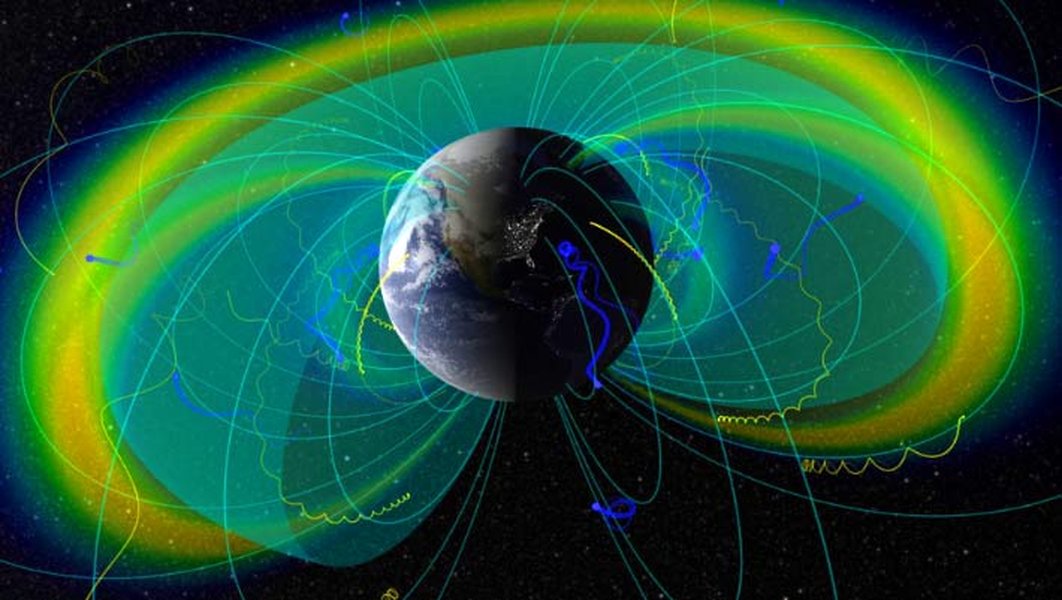
Diagram showing the Van Allen radiation belts and the observed "impenetrable barrier" for ultra-relativistic electrons within them.
Why do some people still believe missiles hit a firmament?
Belief in a physical firmament often stems from literal interpretations of ancient religious texts or adherence to alternative cosmological models like flat Earth theory. Visual anomalies during rocket launches (like unusual plumes, spirals from malfunctions, or effects from high-altitude tests like Operation Fishbowl) are sometimes interpreted through this lens as evidence of interactions with a celestial barrier, especially when scientific explanations involving complex atmospheric physics or aerospace engineering are not readily understood or accepted. Online communities and videos promoting these ideas also contribute to their persistence.
What happens visually if a rocket launch fails?
Rocket launch failures can produce a variety of dramatic visual effects depending on the altitude and nature of the failure. An explosion at lower altitudes might result in a large fireball and debris falling back to Earth. A failure at higher altitudes, like a loss of control or structural breakup, could lead to erratic flight paths, tumbling, and the venting of fuel or oxidizer. This venting, combined with spinning, can create striking patterns like spirals (as seen in the 2009 Norway incident). These are consequences of the vehicle breaking apart or losing control and releasing materials into the atmosphere, not impacting a barrier.
Recommended
- What are the layers of Earth's atmosphere and how do rockets travel through them?
- Detailed explanation of Operation Fishbowl high-altitude nuclear tests
- What causes contrails and exhaust plumes from rockets at high altitude?
- Scientific explanations for flat Earth claims about the firmament
References
Last updated April 27, 2025