
Decoding the "Fish Eye Stone": More Than Meets the Eye?
Exploring the diverse components, from mineral structures to optical phenomena, behind this intriguing term.
Key Insights Unveiled
- Multiple Meanings: The term "fish eye stone" most commonly refers to specific minerals like Apophyllite or patterned Agates, but can also describe an optical flaw in diamonds.
- Defining Components: The "components" of mineral fish eye stones are their chemical compositions (e.g., silicates, potassium, calcium) and physical structures (e.g., crystal systems, concentric banding) that create their unique appearance.
- Beyond the Stone: Understanding "fish eye stone" involves distinguishing between natural gemstones valued for their beauty and metaphysical properties, and the "fisheye effect," an undesirable characteristic in diamond cutting.
Unveiling the "Fish Eye Stone": A Multifaceted Term
The term "fish eye stone" isn't a single, universally defined entity in the world of gemology or mineralogy. Instead, it encompasses a range of fascinating natural stones, specific visual characteristics, and even cultural references. The "component" of a fish eye stone, therefore, depends heavily on the specific context. This exploration delves into the primary interpretations, breaking down their constituent parts, from chemical makeup and structural attributes to the causes of distinct visual effects.
The Mineralogical Realm of Fish Eye Stones
Several distinct minerals and gemstone varieties are often referred to as "fish eye stones" due to their appearance or traditional names. Their components are rooted in their unique geology and chemistry.
Apophyllite: The Quintessential "Fisheye Stone"
Apophyllite is perhaps the mineral most frequently associated with the term "fisheye stone." Its name itself hints at its tendency to exfoliate or flake when heated (from Greek "apophylliso," meaning "it leafs apart"). The "fish eye" connection comes from the pearly to vitreous luster on the basal pinacoid (the flat top of the crystal), which can resemble the reflective eye of a fish, especially in well-formed crystals.
Chemical Makeup: The Building Blocks
Apophyllite is a complex phyllosilicate mineral group. The primary chemical components that form its structure include potassium, calcium, silicon, oxygen, and often fluorine or hydroxyl groups, along with significant water content. A general chemical formula for members of the apophyllite group (specifically fluorapophyllite-(K), the most common member) is \( \text{KCa}_4\text{Si}_8\text{O}_{20}(\text{F,OH}) \cdot 8\text{H}_2\text{O} \). These components arrange themselves into a layered silicate structure.
- Potassium (K) and Calcium (Ca): These alkali and alkaline earth metals are crucial for the mineral's formation and stability.
- Silicon (Si) and Oxygen (O): These form the fundamental silicate \( (\text{Si}_8\text{O}_{20}) \) sheets.
- Fluorine (F) or Hydroxyl (OH): These occupy similar positions in the crystal lattice, influencing the specific type of apophyllite.
- Water (H₂O): Apophyllite is a hydrated mineral, meaning water molecules are incorporated into its crystal structure. This water content can affect its transparency and luster.
Structural Features and Appearance
Apophyllite typically crystallizes in the tetragonal system, forming prismatic or tabular crystals, often terminated by pyramids or pinacoids. The characteristic "fish eye" reflection is most prominent on the basal pinacoid surfaces, which can exhibit a pearly luster. Crystals are often transparent to translucent and can be colorless, white, or tinted green, pink, yellow, or brown due to trace impurities. They frequently occur as druses or clusters in volcanic rock cavities (amygdules) or geodes.
Fisheye Agate and Other Orbicular Varieties
Certain types of agate, a cryptocrystalline variety of silica, are also known as "fisheye agate" or "eye agate." This is due to the presence of concentric, eye-like patterns or "orbs" within the stone.
Composition of Agate "Eyes"
The primary component of agate is silicon dioxide ( \( \text{SiO}_2 \) ), typically in the form of chalcedony. The distinctive "eyes" are not chemically different in their core composition but are formed by variations in the deposition process. These patterns arise from:
- Concentric Banding: Layers of silica gel or mineral-rich solutions depositing sequentially within a cavity, often around a nucleus or irregularity.
- Inclusions: Trapped mineral particles, organic matter (as in "Fossil Fisheye Agate"), or variations in porosity and crystal size create the contrasting bands of color and translucency that form the eye-like pattern. Trace elements like iron, manganese, or titanium oxides contribute to the diverse colors.
The Allure of Patterns
Fossil Fisheye Agate, for instance, showcases these eye-like formations that can be due to the silicification of organic material or simply the way silica gel solidified in layers. Each layer can have slightly different impurity content or crystalline structure, leading to the visible rings that resemble an eye. These stones can be translucent or opaque and come in a wide array of earthy tones.
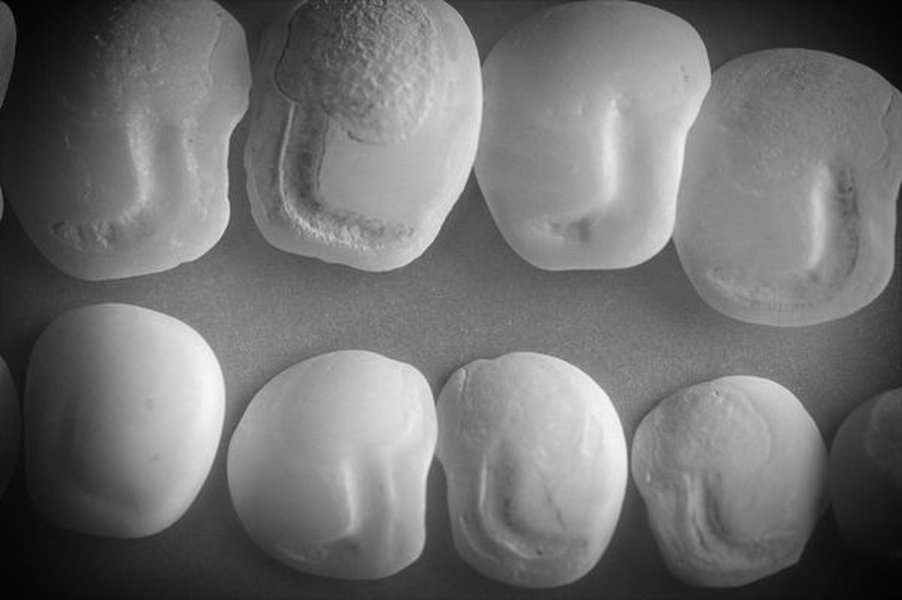
Otoliths, or 'lucky stones,' are fish ear bones that exhibit an eye-like appearance, sometimes associated with traditional 'fish stones' or items believed to bring good fortune.
Ocean Jasper: Eyes of the Sea
Ocean Jasper, a trade name for a spherulitic variety of chalcedony found in Madagascar, is renowned for its vibrant colors and distinctive orbicular patterns. While not always called "fish eye stone," its prominent "eyes" or orbs are a defining characteristic. These orbs are spherical inclusions of chalcedony or quartz that grew radially. The "components" are again primarily \( \text{SiO}_2 \), with various mineral impurities (like iron oxides) providing the rich coloration and patterns that can resemble eyes, ripples, or abstract underwater scenes.
Machh Mani: The Rare Fish Pearl
Machh Mani, also known as Fish Pearl or Matsya Mani, is a rare organic gemstone said to form inside the head or mouth of certain fish species. Unlike mineral stones, its "components" are primarily calcium carbonate or other organic compounds, similar to traditional pearls from mollusks. It's revered in some cultures, particularly in Vedic astrology, and is noted for an iridescent shimmer that can resemble a fish's eye. Its rarity and unique origin make it a curious outlier in the "fish eye stone" category.
The "Fisheye Effect" in Gemology: A Diamond's Flaw
Separate from any specific mineral, the term "fisheye effect" in gemology refers to an undesirable optical phenomenon in faceted gemstones, most notably diamonds. This is not a "component" of the stone's material but rather a consequence of its cut proportions.
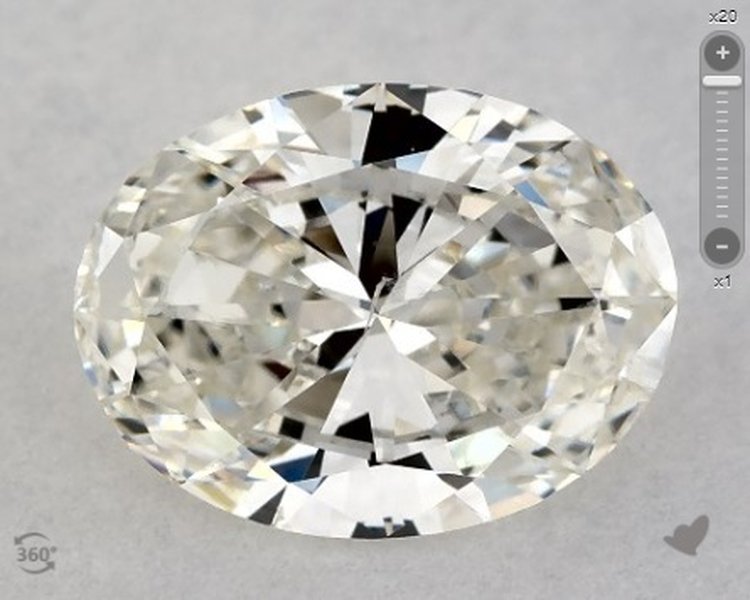
Visual representation of the 'fisheye effect' in a poorly cut diamond, where the girdle is reflected through the table facet.
A fisheye appears as a circular, greyish or whitish reflection of the diamond's girdle (its outer edge) visible through the table facet (the large, flat facet on top). This distracts from the diamond's brilliance and scintillation, creating a dull or "lifeless" spot in the center of the stone.
The Culprits: Cut Proportions
The primary "components" or causes of the fisheye effect are related to how the diamond is cut, specifically:
- Shallow Pavilion Angle: The pavilion is the lower part of the diamond. If its angle is too shallow (typically below 40 degrees, depending on other proportions), light that enters the diamond will leak out through the pavilion instead of being reflected back up to the viewer's eye. This leakage also allows the girdle to be reflected internally.
- Large Table Percentage: A very large table facet (relative to the diamond's diameter) can make the fisheye effect more prominent and easier to see.
- Thick Girdle: While not a primary cause, a very thick girdle can make the reflection more obvious and unsightly if a fisheye is present due to pavilion issues.
Comparative Analysis: Understanding the Differences
The various interpretations of "fish eye stone" possess distinct characteristics. The radar chart below offers a comparative glance at Apophyllite, Fisheye Agate, and the Diamond Fisheye optical phenomenon across several attributes. "Material Hardness" refers to the Mohs scale rating of the actual material. "Characteristic 'Fish Eye' Visual" rates how strongly the visual feature aligns with a fish-eye appearance. "Primary Material Complexity" considers the chemical intricacy. "Traditional Metaphysical Significance" reflects common beliefs. "Desirability/Value Factor" indicates general market or collector interest (with the Diamond Fisheye being undesirable).
Visualizing the Connections: A Mind Map of "Fish Eye Stone"
To better understand the different facets of the "fish eye stone" term, the following mind map illustrates the primary categories and their key defining components or characteristics. It helps to navigate the relationships between these varied interpretations.
(\( \text{KCa}_4\text{Si}_8\text{O}_{20}(\text{F,OH}) \cdot 8\text{H}_2\text{O} \))"] Feature1["Feature: Pearly luster on basal pinacoid,
sparkling crystal surface"] Property1["Metaphysical: Stress relief, intuition"] Agates["Agate Varieties (e.g., Fossil Fisheye, Eye Agate)"] Component2["Component: Silicon Dioxide (\( \text{SiO}_2 \)) with inclusions"] Feature2["Feature: Concentric orbicular patterns,
'eye' formations"] Property2["Metaphysical: Grounding, protection"] OceanJasper["Ocean Jasper"] Component3["Component: Spherulitic Chalcedony (\( \text{SiO}_2 \)) with impurities"] Feature3["Feature: Prominent 'eyes' or orbs,
vibrant colors"] MachhMani["Machh Mani (Fish Pearl)"] Component4["Component: Organic Gem (Calcium Carbonate, etc.)"] Feature4["Feature: Rare, from fish, iridescent shimmer"] GemologicalEffect["Gemological (Optical Effect)"] DiamondFisheye["Diamond Fisheye Effect"] Cause["Cause: Poor cut proportions
(e.g., shallow pavilion angle)"] Effect["Effect: Girdle reflection visible
through table, dullness"] FictionalCultural["Fictional / Cultural"] DragonsDogma["Dragon's Dogma (Game)"] Nature["Nature: In-game collectible item"] DescriptionDD["Description: Petrified eyeball of a Saurian"] OtherSymbolism["General Symbolism"] EyeMotif["Eye Motif: Protection, intuition"]
A Closer Look: Apophyllite's Unique Effect
The following video showcases Apophyllite, often dubbed a "fish eye stone," providing a visual understanding of its crystal structure and the characteristic sheen that gives it this intriguing nickname. It helps to see the stone in motion to appreciate the subtle play of light that evokes the imagery of a fish's eye.
As demonstrated, Apophyllite's unique luster, particularly on certain crystal faces, is a key reason for its association with the "fish eye" term. This visual quality, combined with its typical formation in clusters of well-defined crystals, makes it a favorite among mineral collectors and those interested in crystal aesthetics.
Other Contexts: Beyond Minerals and Gems
The term "fish eye stone" also appears in contexts outside of geology and gemology, highlighting its evocative nature.
Fisheye Stone in Popular Culture
One notable example is its appearance in video games. In *Dragon's Dogma*, "Fisheye Stone" is a collectible material described as the "petrified eyeball of a saurian." Here, the "component" is fictional – a monstrous body part used for crafting or enhancement within the game's world. This usage plays on the literal imagery of an eye turned to stone, rather than any mineralogical property.
Summary Table: Distinguishing "Fish Eye Stone" Manifestations
To consolidate the different meanings and their core components, the table below provides a quick reference:
| Context/Type | Primary "Component(s)" / Defining Feature | Description/Nature | Origin/Cause |
|---|---|---|---|
| Apophyllite | Hydrated potassium calcium silicate ( \( \text{KCa}_4\text{Si}_8\text{O}_{20}(\text{F,OH}) \cdot 8\text{H}_2\text{O} \) ) | Mineral with pearly luster on certain faces, resembling a fish's eye. | Natural crystallization in volcanic rocks. |
| Fisheye Agate / Eye Agate | Silicon Dioxide ( \( \text{SiO}_2 \) ) with concentric banding/inclusions. | Variety of chalcedony with eye-like patterns. | Layered deposition of silica in cavities. |
| Ocean Jasper | Spherulitic Chalcedony ( \( \text{SiO}_2 \) ) with mineral impurities. | Jasper with distinct orbicular (eye-like) patterns. | Specific geological conditions leading to radial growth of silica spheres. |
| Machh Mani (Fish Pearl) | Organic compounds (e.g., calcium carbonate). | Rare gem-like concretion said to form in fish. | Biological process within certain fish species. |
| Diamond "Fisheye Effect" | Girdle reflection visible through the table. | An optical flaw in cut gemstones, reducing brilliance. | Poor cut proportions (e.g., shallow pavilion angle, large table). |
| Fisheye Stone (Dragon's Dogma) | Fictional: "Petrified eyeball of a saurian." | In-game collectible item. | Dropped by specific creatures in the game. |
Frequently Asked Questions
What is the main chemical component of Apophyllite, often called a "fish eye stone"?
Apophyllite is primarily a hydrated potassium calcium silicate. Its general chemical formula is often represented as \( \text{KCa}_4\text{Si}_8\text{O}_{20}(\text{F,OH}) \cdot 8\text{H}_2\text{O} \). The key components are potassium, calcium, silicon, oxygen, fluorine (or hydroxyl groups), and water.
What causes the "fish eye" pattern in Fisheye Agates?
The "fish eye" or orbicular patterns in Fisheye Agates are primarily formed by the concentric deposition of silica ( \( \text{SiO}_2 \) ) layers, often around a central point or nucleus. Variations in mineral inclusions, impurities (like iron oxides), and the conditions during formation create the distinct, contrasting bands that resemble an eye.
Is the "fisheye effect" in diamonds a desirable feature?
No, the "fisheye effect" in diamonds is an undesirable optical flaw. It appears as a reflection of the girdle seen through the table facet, creating a dull or distracting circular area in the diamond's center. It is caused by poor cut proportions, specifically a shallow pavilion angle, and significantly reduces the diamond's brilliance and value.
Are there metaphysical properties associated with mineral "fish eye stones" like Apophyllite or Agate?
Yes, in crystal healing and metaphysical traditions, stones like Apophyllite and various Agates with eye-like patterns are often attributed with specific properties. Apophyllite is commonly associated with spiritual connection, stress relief, enhancing intuition, and purifying energies. Eye Agates are often believed to offer protection (like an "evil eye" talisman), grounding, and emotional balance. These properties are based on traditional beliefs and anecdotal experiences rather than scientific proof.
Recommended Further Exploration
- What is the detailed chemical composition of different minerals within the Apophyllite group?
- How do the unique orbicular patterns in agates and jaspers actually form geologically?
- Beyond the fisheye effect, how do various diamond cut proportions influence its overall light performance and brilliance?
- What is the cultural and historical significance of gemstones with eye-like patterns in different global traditions?
References

Last updated May 14, 2025