
Biodiesel Production from Low-Temperature Fish Oil
Exploring the Feasibility of Converting 5000 Liters of Fish Oil to Renewable Biodiesel
Key Highlights
- Feasibility: Even when washed at 5°C, fish oil remains a viable raw material for biodiesel production.
- Process Considerations: Extraction, purification, and transesterification are essential stages in converting fish oil to biodiesel.
- Factors for Quality: Free fatty acid content, storage condition, and fatty acid composition must be evaluated to optimize conversion efficiency.
Introduction
The concept of utilizing fish oil, particularly waste oil, for biodiesel production has garnered interest due to its potential benefits in sustainability and waste management. In the specific scenario where 5000 liters of fish oil, which was washed out of fish meat at a low temperature of 5°C, are considered for biodiesel production, several technical and chemical aspects need to be reviewed. This detailed analysis examines the process steps, challenges, and benefits to provide an in-depth understanding of how such an oil can be effectively converted to biodiesel and the underlying conditions that influence its feasibility.
Understanding Fish Oil Characteristics
Optimal Temperature and Its Effects
The extraction of fish oil at 5°C might initially raise concerns regarding the efficiency of oil extraction and the subsequent processing stages, however, the low temperature has several advantageous effects:
Preservation of Quality
Washing or extracting the oil at 5°C helps minimize oxidative degradation. In cooler conditions, the reactive oxidation processes are slowed down, which maintains the integrity of the oil’s fatty acids. Low temperature also limits the enzymatic activity that could potentially begin decomposition or hydrolysis of the oil, preserving the quality necessary for successful biodiesel conversion.
Maintaining Liquid State
Despite the low extraction temperature, the nature of fish oil’s composition generally allows it to remain in a liquid or semi-solid state. This is due to the dominance of unsaturated fatty acids that have lower melting points as opposed to many other fats. The liquid state is essential for the efficient processing of the oil in subsequent steps.
Chemical Composition and Free Fatty Acid Content
For biodiesel production, the fatty acid composition of the oil is critical, as it informs the process efficiency and quality of the final fuel. Fish oil typically consists of a mixture of fatty acids such as palmitic, oleic, linoleic, and various polyunsaturated fatty acids. Key considerations include:
Free Fatty Acids (FFAs)
The content of free fatty acids (FFAs) is a significant determinant in the selection of the biodiesel production strategy. High levels of FFAs can interfere with the conventional transesterification process by creating soap when reacting with alkali catalysts. However, if the FFA content is high, an additional esterification step is often introduced before transesterification. This two-step process mitigates challenges related to saponification and ensures that the subsequent conversion proceeds with high yield.
Fatty Acid Profile Impact
The presence of polyunsaturated fatty acids (PUFAs) presents both challenges and benefits. While PUFAs are prone to oxidation leading to potential issues with fuel stability, they also contribute to favorable combustion characteristics, such as higher cetane numbers. Thus, a precise evaluation of the fish oil’s fatty acid profile is crucial. This can be accomplished through analytical methods such as gas chromatography, ensuring that the oil is well-suited for biodiesel production.
The Biodiesel Production Process
Overview of the Production Process
Converting 5000 liters of fish oil into biodiesel involves multiple rigorous steps that include extraction, purification, transesterification, and post-processing. Each step must be carefully controlled in order to uphold the quality and efficiency of the final product.
Step-by-Step Process Analysis
Extraction and Purification
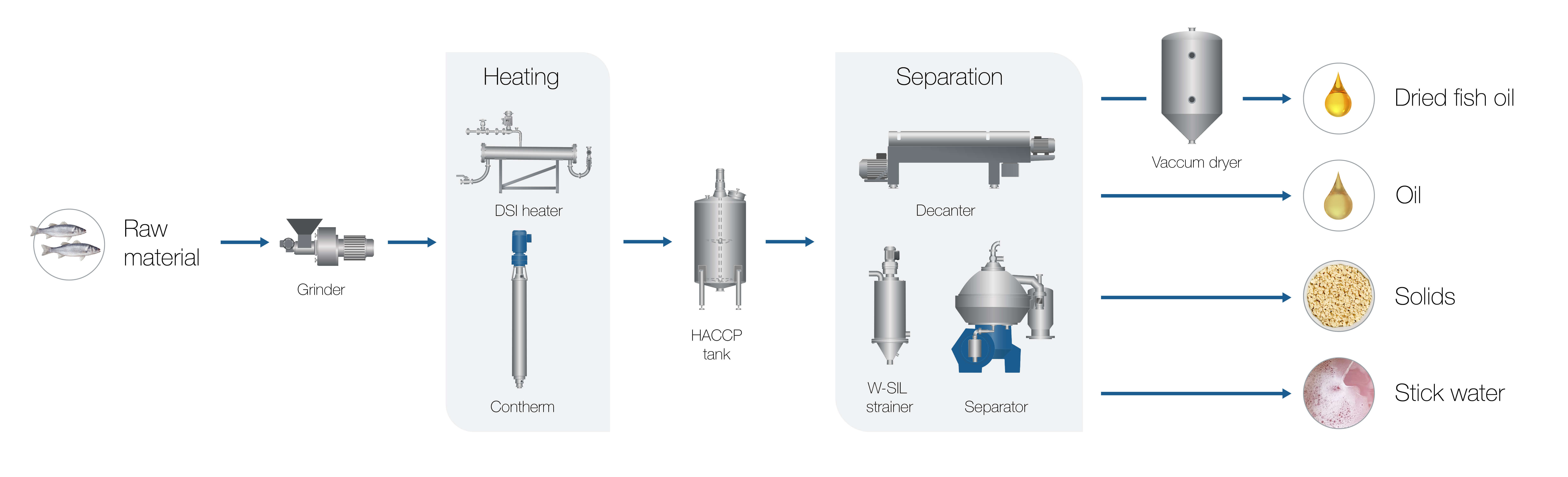
The initial stage involves the extraction of the oil from the fish meat. Given that the oil has already been washed out at 5°C, it is typically in a cleaner state, though some contaminants like proteins, water, and particulate matter may still be present. The following methods and parameters are customary:
- Filtration: The oil is passed through filters to remove solid particles.
- Settling and Centrifugation: These techniques help further separate any suspended impurities.
- Refinement and Degumming: Additional purification may involve degumming to remove phospholipids which could otherwise affect reaction kinetics.
The purification stages ensure that the oil achieves the quality required for efficient transesterification.
Esterification (If Needed)
In cases where the FFA content is high, direct transesterification can lead to soap formation, diminishing biodiesel yield and complicating the process. Esterification is then employed as a pre-treatment step:
- The process converts FFAs into esters through an acid-catalyzed reaction, typically using methanol and an acid catalyst (e.g., sulfuric acid).
- This step reduces the acid value of the oil and prepares it for the more efficient transesterification reaction.
Transesterification
This is the pivotal reaction stage where the purified or pre-treated fish oil is converted into biodiesel. The process involves the use of an alcohol, most commonly methanol, and a catalyst, such as sodium hydroxide (NaOH) or potassium hydroxide (KOH):
Chemical Reaction: The transesterification reaction can be summarized as:
\( \text{Triglyceride} + 3 \text{Methanol} \rightarrow 3 \text{Fatty Acid Methyl Ester (FAME)} + \text{Glycerol} \)
Optimizing factors include the methanol-to-oil ratio, reaction temperature, and catalyst concentration. These variables together determine the efficiency and yield of biodiesel, with yields often reported in the range of 95% to 99%.
Post-Processing
Once the reaction is complete, the mixture separates into biodiesel and glycerol. Post-processing steps include:
- Washing: This removes residual catalysts and soap.
- Drying: Eliminating water content to improve fuel quality.
- Quality Testing: Ensuring the biodiesel meets the required industry standards (e.g., ASTM D6751 or EN 14214).
These steps are necessary to ensure the biodiesel is suitable for commercial or industrial applications.
Technical and Economic Considerations
Quality Control and Testing
The feasibility of converting fish oil to biodiesel not only depends on the basic process chemistry but also on the level of quality control established throughout production. Key aspects include:
Analytical Assessments
Prior to processing, laboratory analyses should be conducted to determine:
- The FFA content, which helps decide if a pre-treatment esterification step is necessary.
- The fatty acid composition to assess overall fuel quality potential.
- Impurities such as water content, which may affect the transesterification reaction.
Yield Efficiency and Process Optimization
From a production standpoint, the yield efficiency of biodiesel obtained from fish oil is highly dependent on:
- The initial quality of the oil. Well-filtered and low-FFA fish oil, even if initially washed at 5°C, tends to yield a high conversion rate.
- The control of reaction conditions. For instance, maintaining a stable reaction temperature and an optimal methanol-to-oil ratio.
- Catalyst performance and concentration.
When these parameters are carefully managed, the conversion efficiency is not only technically feasible but also economically attractive as it utilizes a waste product while producing a renewable fuel.
Environmental and Economic Benefits
Utilizing waste fish oil for biodiesel production has several environmental and economic benefits:
- Waste Management: Using fish oil waste helps reduce the environmental burden by recycling by-products from the fish processing industry.
- Reduced Emissions: Biodiesel typically exhibits lower emissions of particulates, carbon monoxide, and sulfur dioxide compared to conventional diesel. This results in improved air quality and reduced greenhouse gas emissions.
- Cost-Effectiveness: As waste fish oil is generally available at a lower cost than virgin oils or other feedstocks, converting it into biodiesel can lead to significant cost savings and economic viability, especially when integrated into local energy production strategies.
Comparative Analysis
Fish Oil Biodiesel vs. Conventional Biodiesel Feedstocks
To better understand the strategic value of using fish oil for biodiesel production, it is beneficial to compare it with more conventional feedstocks such as vegetable oils. The following table summarizes key aspects:
| Parameter | Fish Oil | Vegetable Oil |
|---|---|---|
| Raw Material Cost | Low (waste material) | Higher (edible material) |
| FFA Content | Potentially High | Generally Low |
| Environmental Impact | Reduces waste; sustainable | May compete with food supply |
| Processing Requirements | Possible two-step reaction (esterification then transesterification) | Standard transesterification |
| Fuel Quality | High cetane number; may have stability challenges | Established properties; consistent quality |
The table highlights that while fish oil may require additional processing steps to manage its FFAs, it offers significant advantages in terms of cost and environmental sustainability.
Operational Considerations and Best Practices
Process Control and Monitoring
Ensuring efficient biodiesel production from fish oil requires strict process control and monitoring throughout:
- Temperature Regulation: Since the fish oil is initially washed at 5°C, storage and processing must maintain low oxidation levels. Temperature control throughout purification and reaction stages can help preserve oil quality.
- FFA Management: Regular testing for free fatty acids helps determine whether additional pre-treatment is necessary.
- Catalyst Optimization: Choosing the right catalyst and optimizing its concentration ensures a high conversion rate with minimal side reactions.
- Quality Assurance: Post-reaction testing to verify fuel properties against biodiesel standards such as viscosity, cetane number, and density is essential.
Risk Mitigation and Troubleshooting
Potential challenges during biodiesel production include soap formation due to high FFA content and low reaction yields if process parameters are not properly controlled. Effective risk mitigation strategies include:
- Conducting thorough pre-processing analyses.
- Adjusting reaction conditions based on real-time monitoring data.
- Adopting a stepwise approach where esterification is performed if FFAs exceed acceptable levels.
Future Perspectives and Industrial Relevance
Scaling Up Biodiesel Production
From a commercial perspective, employing 5000 liters of fish oil for biodiesel production aligns with the broader goals of sustainable energy and circular economy principles. Scaling up involves:
- Integrating quality control laboratories to monitor oil characteristics.
- Investing in process automation systems that ensure consistent temperature and pressure control.
- Research and development initiatives that explore catalyst innovations and process optimization techniques.
Economic Impact
The conversion of fish processing waste into biodiesel not only diverts waste from landfills but also provides a cost-effective alternative to traditional diesel fuels. Economically, this approach minimizes reliance on food-grade vegetable oils for fuel production, thereby contributing to food security and reducing overall production costs. Moreover, the environmental credits earned through reduced emissions add additional financial incentives for industries considering this transition.
Conclusion
In summary, converting 5000 liters of fish oil that was washed out of fish meat at 5°C into biodiesel is not only technically feasible but also economically and environmentally beneficial. The low-temperature extraction preserves the quality of the fish oil, ensuring that it remains a viable raw material for biodiesel production. Critical process steps—including purification, potential esterification to manage free fatty acids, and the transesterification reaction—must be carefully monitored and optimized. When these steps are executed with precision, the resulting biodiesel can meet stringent fuel quality standards, offering favorable properties such as high cetane numbers and reduced emissions compared to conventional diesel.
This innovative use of fish oil waste can play a significant role in sustainable energy strategies. It enables the valorization of otherwise discarded by-products from the fish processing industry, cutting down on environmental waste and contributing to a renewable energy portfolio. Optimized processing parameters and rigorous quality control are the keystones to converting low-temperature fish oil into a high-quality biodiesel, thereby providing a dual benefit of environmental stewardship and economic savings.
References
-
Production of Biodiesel and High-Protein Feed from Fish Processing Waste - PMC
- Fish Waste: A Potential Source of Biodiesel - MDPI
- Biodiesel Production from Fish Oil - Taylor & Francis Online
-
Biodiesel production from fish oil with high free fatty acid content - ScienceDirect
-
Life Cycle Assessment Perspective on Biodiesel Production from Fish Waste - ScienceDirect
- Use of Waste Fish Oil Biodiesel Blended with Aluminium Oxide Nanoparticles - Nature
Recommended Queries
Last updated February 22, 2025