
Unveiling the Tapestry of Life: How New Species Emerge Through Five Evolutionary Pathways
Delve into the intricate processes of allopatric, peripatric, parapatric, sympatric, and artificial speciation that drive biodiversity.
Speciation is a fundamental evolutionary process that leads to the creation of new, distinct biological species. It occurs when a group within an existing species becomes reproductively isolated from other members of that species, accumulates genetic differences over time, and eventually can no longer interbreed to produce fertile offspring. Understanding the mechanisms behind speciation is crucial for comprehending the vast diversity of life on Earth. Biologists generally recognize five primary modes of speciation, primarily distinguished by the role of geographic separation and the specific factors driving reproductive isolation and genetic divergence.
Key Insights into Speciation
- Geographic Isolation is a Major Driver: Many forms of speciation, notably allopatric and peripatric, hinge on physical barriers that prevent gene flow between populations, allowing them to evolve independently and accumulate distinct genetic traits.
- Speciation Can Occur Without Physical Separation: Sympatric speciation illustrates that new species can arise even when populations inhabit the same geographic area, driven by mechanisms such as polyploidy, shifts in host preference, or sexual selection.
- Human Influence Can Accelerate Speciation: Artificial speciation demonstrates that human activities, particularly selective breeding and genetic modification, can intentionally or unintentionally lead to the formation of new varieties or even species, mirroring natural evolutionary processes but often on an accelerated timescale.
The Five Primary Types of Speciation
The journey from a single ancestral species to multiple distinct descendant species can occur through various pathways. These pathways are broadly categorized based on the geographical context in which speciation occurs and the mechanisms that lead to reproductive isolation.
1. Allopatric Speciation
Definition and Mechanism
Allopatric speciation, from the Greek words 'allos' (other) and 'patra' (homeland), is considered the most common form of speciation. It occurs when a population is divided into two or more geographically isolated subgroups by a physical barrier. Such barriers can include mountain ranges, rivers, oceans, glaciers, or even unfavorable habitat. Once separated, these isolated populations cease to exchange genetic material (gene flow is interrupted). Over time, they independently accumulate genetic differences due to various evolutionary forces:
- Mutation: Random changes in DNA introduce new genetic variations.
- Natural Selection: Different environmental pressures in the isolated habitats favor different traits.
- Genetic Drift: Random fluctuations in allele frequencies, especially pronounced in smaller populations.
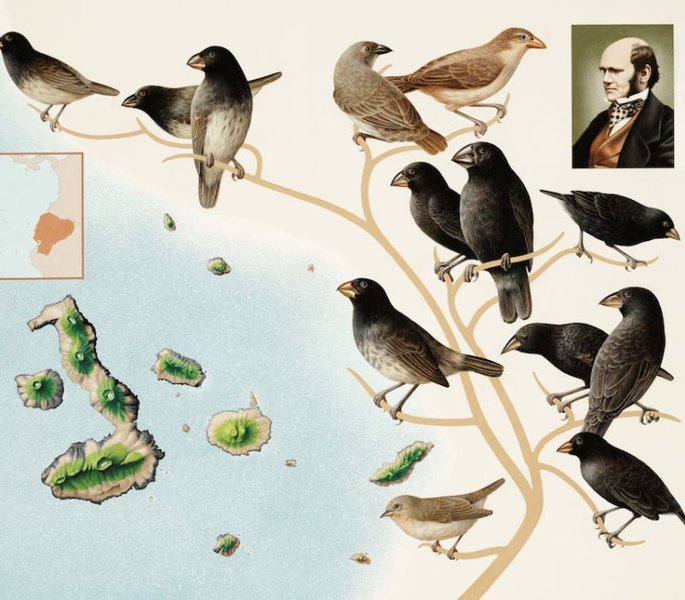
Darwin's finches on the Galápagos Islands are a classic example of allopatric speciation, where different island populations evolved distinct beak shapes adapted to specific food sources.
Examples
A classic example is Darwin's finches on the Galápagos Islands. Different finch populations became isolated on various islands with distinct ecological niches. This led to the evolution of different beak shapes and sizes, adapted to the specific food sources available on each island. Another example is the Kaibab squirrel and the Abert's squirrel, which are thought to have diverged after being separated by the Grand Canyon.
Key Characteristics
- Requires complete geographic isolation.
- Evolution occurs independently in separated populations.
- Can lead to significant morphological and genetic divergence.
2. Peripatric Speciation
Definition and Mechanism
Peripatric speciation, from 'peri' (near) and 'patra' (homeland), is a special case of allopatric speciation. It occurs when a very small group of individuals breaks off from a larger main population and becomes isolated at the periphery of the original population's range, often by colonizing a new, isolated niche (like an island or a remote habitat). Due to the small size of this new "founder" population, two factors become particularly significant:
- Founder Effect: The new population may have a non-representative sample of the alleles from the parent population, leading to different allele frequencies from the start.
- Genetic Drift: Random changes in allele frequencies can have a much stronger impact and can lead to rapid fixation or loss of alleles.
Examples
Examples include populations of insects or birds that colonize remote islands. For instance, the London Underground mosquito (*Culex molestus*) is thought to have evolved from an above-ground ancestor (*Culex pipiens*) after becoming isolated in the London Underground railway system. Some biologists also point to certain island-dwelling species that originated from a few mainland individuals.
Key Characteristics
- A small peripheral population becomes isolated.
- Strong role of genetic drift and founder effect.
- Can lead to rapid speciation.
3. Parapatric Speciation
Definition and Mechanism
Parapatric speciation, from 'para' (beside) and 'patra' (homeland), occurs when a species is spread out over a large geographic area, but speciation happens without a complete physical barrier to gene flow. Instead, populations are adjacent to each other, and there is some limited gene flow between them, typically across a "hybrid zone." Speciation is driven by differing selection pressures across an environmental gradient (e.g., changes in climate, soil type). Individuals are more likely to mate with their geographic neighbors than with individuals from distant parts of the range. This can lead to the development of distinct characteristics and partial reproductive isolation at the extremes of the range, even if a continuous distribution exists. If hybrids formed in the contact zone have reduced fitness, this can further reinforce reproductive isolation.
Examples
Grasses like *Anthoxanthum odoratum* (sweet vernal grass) that have evolved tolerance to heavy metals in soils contaminated by mining activities provide an example. Populations growing on contaminated soil are adjacent to populations on uncontaminated soil. They can interbreed, but selection against hybrids in either environment can lead to divergence. Certain ring species, where populations are arranged in a ring and can interbreed with adjacent populations but not with populations at the ends of the ring, can also involve parapatric processes.
Key Characteristics
- No complete geographic barrier; populations are adjacent.
- Differing selection pressures across an environmental gradient.
- Formation of a hybrid zone where interbreeding occurs.
- Gene flow is reduced but not entirely absent.
4. Sympatric Speciation
Definition and Mechanism
Sympatric speciation, from 'sym' (same) and 'patra' (homeland), is perhaps the most debated type as it occurs when new species arise within a single, continuous population in the same geographic area, without any physical separation. Reproductive isolation evolves due to other factors, such as:
- Polyploidy: This is a common mechanism in plants. An error during meiosis can lead to an increase in the number of chromosome sets (e.g., diploid to tetraploid). Polyploid individuals are often reproductively isolated from the original diploid population because their hybrid offspring would have an odd number of chromosomes and be sterile.
- Host Preference or Niche Differentiation: If subgroups within a population begin to specialize on different resources or habitats within the same area (e.g., different food sources, nesting sites), this can reduce gene flow between them.
- Sexual Selection: Changes in mate preferences (e.g., for certain colors or courtship displays) can lead to reproductive isolation between groups even if they live side-by-side.
Examples
The apple maggot fly (*Rhagoletis pomonella*) in North America is a classic, though still studied, example. Originally, these flies laid eggs exclusively on hawthorn fruits. However, when apples were introduced, a subset of the population began to lay eggs on apples. These two groups now show preferences for their respective host fruits and have different mating times, reducing gene flow between them and leading to genetic differentiation. Many plant species, like wheat, have arisen through polyploidy.
Key Characteristics
- Occurs within the same geographic area.
- No physical barriers to gene flow.
- Mechanisms include polyploidy, habitat differentiation, and sexual selection.
5. Artificial Speciation
Definition and Mechanism
Artificial speciation is not a natural mode but rather one induced by human intervention. Humans drive the divergence of populations through selective breeding (also known as artificial selection) or genetic engineering. By intentionally selecting individuals with desired traits to breed, or by directly modifying an organism's genome, humans can create new breeds or varieties that may become reproductively isolated from the original population or other human-created varieties. While the "species" status can be debated for domesticated breeds (as many can still interbreed if allowed), the processes mimic natural speciation by creating distinct, heritable differences and sometimes reproductive barriers.
Examples
The vast diversity of dog breeds (e.g., Chihuahuas and Great Danes) derived from a common wolf ancestor is a prime example. Though biologically capable of interbreeding, practical reproductive isolation often exists due to size differences or human management. Many domesticated crops, such as different varieties of corn or cabbage (all derived from wild mustard), also result from artificial selection. Laboratory experiments have also sometimes led to the creation of new, reproductively isolated populations of organisms like fruit flies.
Key Characteristics
- Driven by human intervention.
- Involves selective breeding or genetic engineering.
- Can occur relatively rapidly.
- Results in domesticated breeds, crop varieties, or laboratory-derived populations.
Comparative Summary of Speciation Types
The different modes of speciation can be summarized by their key features, providing a quick overview of how they contrast and relate to one another. The following table highlights these distinctions:
| Type of Speciation | Geographic Setting | Key Mechanism(s) | Gene Flow | Primary Driver(s) of Divergence | Example(s) |
|---|---|---|---|---|---|
| Allopatric | Populations geographically separated by a physical barrier | Barrier prevents gene flow; independent evolution | Absent between separated groups | Natural selection, genetic drift, mutation | Darwin's finches, Kaibab/Abert's squirrels |
| Peripatric | Small peripheral population isolated from a larger central population | Founder effect; genetic drift in small isolate | Absent between isolated group and main population | Genetic drift, new selective pressures, founder effect | Island colonizers (e.g., some birds, insects), London Underground mosquito |
| Parapatric | Populations are adjacent with a continuous distribution; no complete barrier | Divergence across an environmental gradient; hybrid zone forms | Limited, reduced fitness of hybrids may reinforce isolation | Varying selection pressures, non-random mating | Metal-tolerant grasses, some ring species |
| Sympatric | Populations co-occur in the same geographic area | Intrinsic reproductive barriers arise (e.g., polyploidy, host shift, sexual selection) | Initially present, but reduced by evolving isolating mechanisms | Polyploidy, niche differentiation, sexual selection, disruptive selection | Apple maggot fly, polyploidy in plants (e.g., wheat) |
| Artificial | Controlled by humans (can be allopatric or sympatric in setup) | Selective breeding, genetic engineering | Controlled or prevented by humans | Human selection for specific traits | Domestic dog breeds, agricultural crops |
Visualizing Speciation Dynamics
To further illustrate the distinctions and overlaps between these evolutionary pathways, the following radar chart compares the five types of speciation across several key factors. Each axis represents a different characteristic influencing the speciation process, with values rated on a scale from 1 (low) to 10 (high), indicating the relative importance or degree of that factor for each speciation type. A value of 1 does not mean absence but rather a lower typical influence compared to other types or factors. This comparison helps illustrate how varying degrees of geographic separation, genetic mechanisms, and selective pressures contribute to the divergence of new species.
Conceptual Map of Speciation Types
The following mindmap provides a conceptual overview of the five types of speciation, branching out from the central theme of 'Speciation.' Each branch highlights a distinct type, connecting to its core mechanisms or illustrative examples, offering a quick visual summary of how these evolutionary processes are categorized and understood.
Geographic barrier splits population"] id1a["Darwin's Finches"] id1b["Independent Evolution"] id2["Peripatric
Small peripheral isolate"] id2a["Founder Effect"] id2b["Rapid Divergence"] id2c["Island Colonizers"] id3["Parapatric
Adjacent populations, partial barrier"] id3a["Environmental Gradient"] id3b["Hybrid Zone"] id3c["Metal-Tolerant Grasses"] id4["Sympatric
Within same geographic area"] id4a["Polyploidy (Plants)"] id4b["Host Shift (Apple Maggot Fly)"] id4c["Sexual Selection"] id5["Artificial
Human-induced"] id5a["Selective Breeding"] id5b["Dog Breeds"] id5c["Agricultural Crops"]
Speciation in Action: A Visual Exploration
Visual media can greatly enhance our understanding of complex biological processes like speciation. The following video provides an engaging overview of how new species arise, discussing various mechanisms and examples, including some of the types detailed above. It helps contextualize the theoretical concepts with dynamic explanations.
This Crash Course Biology video explains speciation using examples like finches, ligers, and dogs, covering core concepts relevant to the formation of new species.
The video effectively illustrates that speciation isn't just an abstract concept but a dynamic, ongoing process. It touches upon reproductive isolation, the biological species concept, and how different factors can lead to the divergence of populations, reinforcing the idea that the diversity of life is a product of these evolutionary mechanisms. The examples provided, such as ligers (hybrids of lions and tigers) and mules (hybrids of horses and donkeys), highlight the concept of reproductive barriers, which are central to defining species.
Frequently Asked Questions (FAQ)
What is the main difference between allopatric and sympatric speciation?
The primary difference lies in the geographical context. Allopatric speciation occurs when populations are geographically separated by a physical barrier, which prevents gene flow between them. This isolation allows them to diverge independently. In contrast, sympatric speciation occurs when new species arise within the same geographic area, without any physical separation. In sympatric speciation, reproductive isolation evolves through other mechanisms like polyploidy, habitat differentiation, or sexual selection, even while individuals are in physical proximity.
How does genetic drift contribute to speciation, especially in peripatric speciation?
Genetic drift refers to random fluctuations in allele frequencies from one generation to the next, and its effects are most pronounced in small populations. In peripatric speciation, a small group becomes isolated from a larger parent population. This small "founder" population may have allele frequencies that are, by chance, different from the main population (the founder effect). Furthermore, due to its small size, genetic drift can lead to rapid changes in allele frequencies, potentially causing some alleles to become fixed (reach 100% frequency) and others to be lost. This rapid genetic divergence, driven by chance rather than solely by natural selection, can contribute significantly to the evolution of reproductive isolation and the formation of a new species.
Can speciation be reversed?
Yes, under certain circumstances, speciation can be "reversed" or undone, particularly if reproductive isolation is not yet complete. This process is sometimes called "despeciation" or "species fusion." If two recently diverged populations or incipient species come back into contact and can still interbreed to produce viable, fertile offspring, extensive gene flow between them can erode the genetic differences that were accumulating. This can lead to the merging of the two groups back into a single species. This is more likely if the selective pressures that drove their initial divergence are no longer present or if the hybrids are not at a disadvantage.
Why is polyploidy a more common mechanism for sympatric speciation in plants than in animals?
Polyploidy (having more than two sets of chromosomes) is a significant mechanism for sympatric speciation, particularly in plants, for several reasons:
- Self-fertilization: Many plants can self-fertilize. If a polyploid individual arises, it can potentially reproduce on its own, establishing a new polyploid lineage. Animals, with separate sexes, would require two polyploid individuals of opposite sexes to arise and mate, which is much less likely.
- Asexual Reproduction: Many plants can reproduce asexually (vegetatively). This allows a newly formed polyploid individual to propagate even if it cannot immediately find a polyploid mate.
- Tolerance to Genetic Changes: Plants often have more flexible developmental pathways and can tolerate the large-scale genetic changes associated with polyploidy better than most animals, which often have more complex and tightly regulated developmental processes. Errors in chromosome number in animals frequently lead to sterility or inviability.
Recommended Further Exploration
To deepen your understanding of speciation, consider exploring these related topics:
- Explore the role of reproductive isolation mechanisms in speciation.
- Investigate real-world examples of ongoing speciation events.
- Learn about the genetic basis of speciation and how scientists study it.
- Discover the impact of climate change on speciation rates and biodiversity.
References
This response was synthesized using information from several authoritative sources. For further reading, please consult:
Last updated May 11, 2025