
Unraveling the Blueprint: The Flavivirus Genome and Its Crucial Open Reading Frame
Delving into the remarkable genetic organization of flaviviruses, from genome size to the single, vital coding region.
Key Insights into Flavivirus Genomics
- Single-Stranded Positive-Sense RNA: Flaviviruses possess a highly efficient RNA genome that functions directly as messenger RNA (mRNA) upon host cell entry.
- Optimal Genome Length: The genome is typically around 10 to 11 kilobases (kb), a concise size that encodes all necessary viral components for replication and infection.
- Unified Open Reading Frame (ORF): A singular, long ORF dictates the production of a large polyprotein, which is subsequently processed into distinct structural and non-structural viral proteins.
Flaviviruses, a genus within the family Flaviviridae, are a group of medically significant pathogens responsible for diseases such as dengue, Zika, West Nile fever, and yellow fever. Their success as infectious agents is largely attributed to the compact and highly organized structure of their genome. This genetic blueprint provides all the necessary information for viral replication, assembly, and interaction with host cellular machinery.
The Genetic Core: Flavivirus Genome Characteristics
The flavivirus genome is a fascinating example of genetic efficiency. It is a single-stranded, positive-sense RNA molecule, meaning its sequence can be directly translated by host ribosomes into proteins. This characteristic eliminates the need for an intermediate RNA replication step before protein synthesis, allowing for immediate initiation of the viral life cycle upon infection.
Precision in Length: The Kilobase Measurement
The length of the flavivirus genome is remarkably consistent across its diverse species, typically falling within a narrow range. While the broader Flaviviridae family can exhibit genome lengths from approximately 9.0 to 13 kilobases (kb), most canonical flaviviruses, including well-known pathogens like Dengue virus (DENV) and Zika virus (ZIKV), have genomes specifically around 10 to 11 kb. Some sources pinpoint this range even more precisely, suggesting a length of about 10.5 kb to 11,000 nucleotides. This optimized size ensures that the virus carries enough genetic information for its complex life cycle without being overly burdensome for replication.
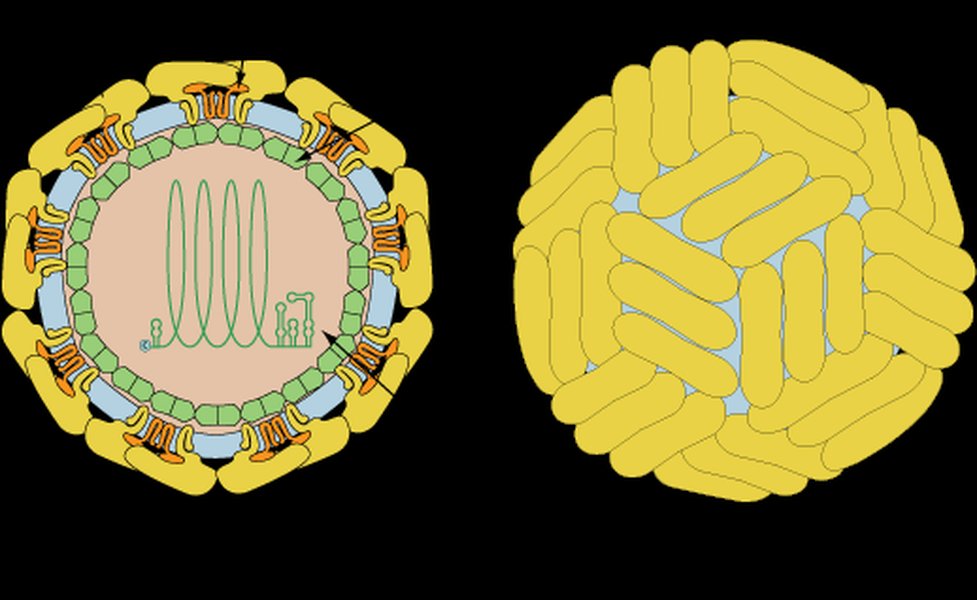 A conceptual illustration of a flavivirus virion, showcasing its overall structure.
The Central Command: Single Long Open Reading Frame (ORF)
A hallmark feature of the flavivirus genome is the presence of a single, long open reading frame (ORF). This continuous coding sequence is responsible for encoding a single, large polyprotein. Once translated by the host cell's ribosomes, this polyprotein undergoes precise co- and post-translational cleavage by a combination of viral and host proteases. This sophisticated processing mechanism yields approximately ten mature proteins, each with specialized functions critical for the viral life cycle.
Dissecting the Polyprotein: Structural vs. Non-Structural Proteins
The proteins derived from the single ORF are broadly categorized into two groups:
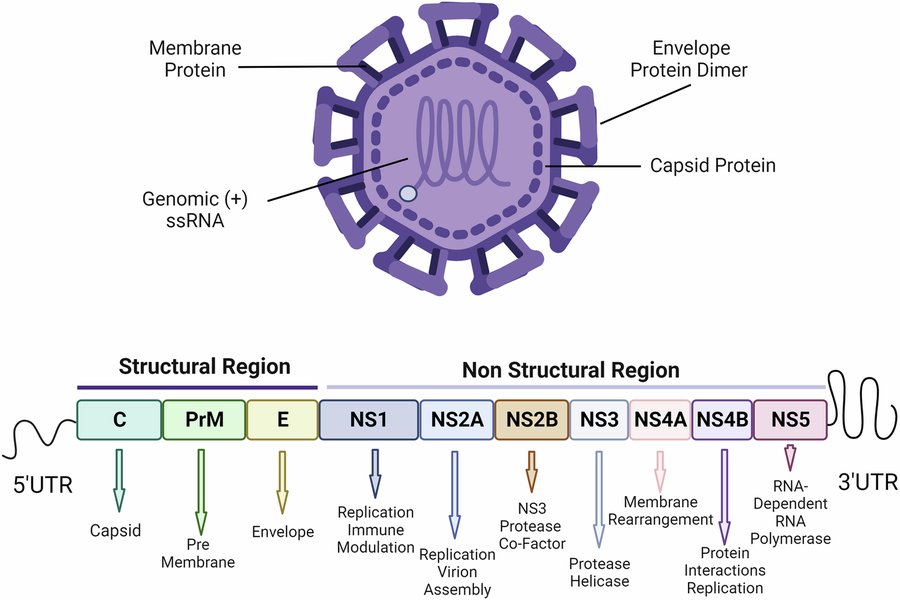
- Structural Proteins: These are located at the 5′ end of the coding region and are essential components of the mature virus particle (virion). They include:
- Capsid (C): Forms the nucleocapsid, which encloses the viral RNA genome.
- Precursor Membrane (prM): Involved in virion assembly and maturation, protecting the Envelope protein from premature fusion.
- Envelope (E): The primary surface protein responsible for receptor binding, cell entry, and fusion with host membranes. It is a major target for neutralizing antibodies.
- Non-Structural Proteins (NS): These are located at the 3′ end of the coding region and primarily function in viral replication, assembly, and host immune evasion. They include:
- NS1: Involved in RNA replication and immune evasion.
- NS2A, NS2B: Play roles in polyprotein processing and viral assembly.
- NS3: A multi-functional enzyme with helicase, NTPase, and protease activities, crucial for RNA unwinding and polyprotein cleavage.
- NS4A, NS4B: Involved in the formation of replication complexes and membrane remodeling.
- NS5: The viral RNA-dependent RNA polymerase (RdRp) and methyltransferase, responsible for genome replication and RNA capping.
Regulatory Flanks: Untranslated Regions (UTRs)
The single long ORF is strategically flanked by untranslated regions (UTRs) at both its 5′ and 3′ ends. These UTRs do not encode proteins but are highly structured and contain critical regulatory elements vital for genome replication, translation initiation, and viral pathogenesis. They interact with both viral proteins and host factors to regulate these processes.
- 5′ Untranslated Region (5′ UTR): This region is relatively short, typically around 100 nucleotides in length. It is capped at its 5′ end, which enables cellular ribosomes to recognize and translate the viral RNA, similar to host mRNAs. This cap structure is essential for translation initiation.
- 3′ Untranslated Region (3′ UTR): Considerably longer than the 5′ UTR, ranging from approximately 340 to 800 nucleotides, with variations among specific flavivirus species. Unlike many cellular mRNAs, the flavivirus genome's 3′ end does not have a polyadenylated tail. Instead, it forms complex secondary structures, such as stem-loops and pseudoknots, which are crucial for viral RNA replication and packaging.
Visualizing the Flavivirus Genome Architecture
Understanding the intricate architecture of the flavivirus genome is crucial for grasping its functionality. While a direct image cannot be provided here, a textual description can help visualize its organization. Imagine a linear map representing the entire RNA strand:
5' Cap
  |
  v
[ 5' UTR (~100 nt) ] - [ Single ORF (~10,284 nt) ] - [ 3' UTR (400–700 nt) ]
                        |                            |
                Structural proteins             Non-structural proteins
             (C - prM - E)                    (NS1 - NS2A - NS2B - NS3 - NS4A - NS4B - NS5)
Simplified textual representation of the flavivirus genome organization.
This schematic highlights how the entire coding capacity is concentrated within the single ORF, flanked by the regulatory UTRs that govern its expression and replication. The precise order of structural proteins at the 5' end and non-structural proteins at the 3' end of the ORF is highly conserved across flaviviruses, reflecting their shared evolutionary strategies.
Delving Deeper: Replication and Molecular Interactions
Once the flavivirus genome enters the host cell, its positive-sense nature allows it to immediately serve as mRNA for translation. This initial translation produces the polyprotein, which is then cleaved to release the individual viral proteins. These proteins, particularly the non-structural ones, orchestrate the viral replication cycle.
Viral replication occurs in the cytoplasm, specifically on remodeled rough endoplasmic reticulum membranes, forming specialized membranous compartments. During this process, the viral RNA-dependent RNA polymerase (NS5) synthesizes a negative-sense RNA intermediate. This negative-sense strand then acts as a template for the production of new positive-sense genomic RNA molecules, which are either packaged into new virions or used for further rounds of translation.
 A detailed overview of the flavivirus replication cycle, illustrating key stages and cellular interactions.
The interactions between the UTRs and both host and viral proteins are crucial. For example, specific RNA structures within the UTRs can recruit host factors or viral enzymes, facilitating efficient replication and evading host antiviral responses. Recent research has even identified the translation of unrecognized upstream open reading frames (uORFs) in certain flaviviruses, such as Zika virus, which can influence virus replication in neural cells, adding another layer of complexity to their genetic expression.
Comparative Analysis of Flavivirus Genome Features
To further illustrate the key characteristics and their relative importance, consider this radar chart which qualitatively assesses various aspects of the flavivirus genome based on typical consensus within the scientific literature:
This radar chart visually represents the relative strengths of different aspects of the flavivirus genome. The 'Typical Flavivirus' dataset highlights the general consensus on genome length, the dominance of its single ORF, and the significant roles of its UTRs. The 'Highly Optimized Viral Genome' dataset offers a benchmark for comparison, demonstrating how flaviviruses align with or exceed expectations for efficient viral genetic systems. The chart reinforces that features like the single ORF and the regulatory UTRs are particularly optimized for the flavivirus life cycle, enabling efficient protein production and replication.
Genome Organization in Flaviviruses: A Mindmap Overview
To further illustrate the interconnectedness of the various genomic features, the following mindmap provides a hierarchical overview of the flavivirus genome organization, from its fundamental characteristics to the proteins it encodes and the functions of its untranslated regions.
This mindmap offers a hierarchical breakdown of the flavivirus genome's key components and their relationships. It illustrates how the central ORF, flanked by the critical UTRs, serves as the complete instruction set for producing all necessary viral proteins. The mindmap emphasizes the functional distinctions between structural and non-structural proteins, as well as the essential regulatory roles of the UTRs, providing a clear and comprehensive overview of the genome's architecture.
Understanding Flavivirus Replication: A Visual Deep Dive
The life cycle of flaviviruses, including how their genome is replicated and expressed, is a complex yet highly efficient process. The most relevant video for understanding this process is "Life Cycle of the Dengue Fever Virus — HHMI BioInteractive," as Dengue virus is a prominent member of the Flavivirus genus and serves as an excellent model for explaining the general flavivirus replication strategy.
This educational animation from HHMI BioInteractive meticulously details the journey of the dengue virus from initial host cell entry to the production of new viral particles. It vividly illustrates how the viral RNA genome, with its single long open reading frame, is translated into the polyprotein. The video then shows the subsequent cleavage of this polyprotein into individual structural and non-structural proteins. Crucially, it highlights the role of the non-structural proteins, particularly the RNA-dependent RNA polymerase (RdRp), in replicating the viral genome. The visualization of the replication complexes formed on the endoplasmic reticulum membranes provides a clear understanding of where and how new viral RNA strands are synthesized. This video is invaluable for grasping the dynamic processes that the flavivirus genome orchestrates within the host cell, from initial gene expression to the assembly and budding of progeny virions.
Summary of Flavivirus Genome Features
The table below consolidates the key characteristics of the flavivirus genome, providing a comprehensive overview of its structure and functional elements. This summary reinforces the central role of the single long ORF and the critical importance of the flanking untranslated regions.
| Feature | Detail |
|---|---|
| Genome Type | Single-stranded, positive-sense RNA (+ssRNA) |
| Genome Length | Approximately 10.5 to 11 kilobases (kb) |
| Open Reading Frame (ORF) | Single long ORF encoding a large polyprotein (~3400 amino acids) |
| 5′ Untranslated Region (5′ UTR) | ~100 nucleotides, contains a type 1 cap structure, involved in translation initiation and replication. |
| 3′ Untranslated Region (3′ UTR) | ~400-700 nucleotides, lacks a poly-A tail, forms complex loop structures, critical for replication and pathogenesis. |
| Proteins Encoded | 3 Structural proteins (Capsid, prM, Envelope) and 7 Non-structural proteins (NS1, NS2A, NS2B, NS3, NS4A, NS4B, NS5) |
| Replication Location | Cytoplasm, on remodeled endoplasmic reticulum membranes |
This table succinctly captures the essential details, providing a quick reference to the defining attributes of the flavivirus genome.
Frequently Asked Questions (FAQ)
What is the approximate length of a flavivirus genome?
Does a flavivirus genome have multiple open reading frames (ORFs)?
What are the main regions of the flavivirus genome?
Are flavivirus genomes polyadenylated at the 3' end?
Conclusion
The flavivirus genome is a remarkably compact and efficient genetic structure, meticulously designed to drive the viral life cycle within host cells. Its core features—a single-stranded, positive-sense RNA molecule of approximately 10 to 11 kilobases, dominated by a single, long open reading frame (ORF)—enable rapid and effective protein synthesis and genome replication. The flanking untranslated regions (UTRs), though not protein-coding, are critically important for regulating these processes through their intricate secondary structures and interactions with host and viral factors. This conserved genomic organization underpins the pathogenicity and widespread impact of significant human pathogens like Dengue, Zika, and West Nile viruses, making its understanding fundamental to developing effective antiviral strategies.
Recommended Further Exploration
- Explore the step-by-step mechanisms of flavivirus replication within host cells.
- Investigate the specific functions of each non-structural protein in the flavivirus life cycle.
- Delve into the complex RNA secondary structures within the 5′ and 3′ UTRs and their regulatory roles.
- Understand how flaviviruses use their genetic material to evade the host immune system.