
Unraveling Earth's Ancient Rivers: How Fluvial Facies Tell Tales of Bygone Landscapes
Discover the intricate processes by which rivers sculpt sedimentary layers, preserving clues to past environments, climates, and geological events.
The term "fluvial genesis of facies" refers to the complex processes involved in the origin and formation of sedimentary facies within environments shaped by rivers and streams. These facies, essentially distinct bodies of sediment or rock with recognizable characteristics, are the geological signatures left behind by ancient fluvial systems. Understanding their genesis allows scientists to reconstruct past landscapes, interpret climatic conditions, and even locate valuable natural resources. This exploration delves into the mechanisms of fluvial sediment deposition, the types of facies produced, and the factors controlling their development.
Essential Insights into Fluvial Facies Formation
- Dynamic Depositional Environments: Fluvial facies are formed through a variety of processes within distinct parts of a river system, including active channels, floodplains, levees, and crevasse splays, each leaving unique sedimentary imprints.
- Controlling Factors are Key: The characteristics of fluvial deposits are governed by a combination of external (allogenic) factors like climate, tectonics, and sea-level changes, and internal (autogenic) factors such as channel migration and sediment supply.
- Architectural Storytelling: The arrangement and stacking patterns of different lithofacies (rock types) and architectural elements (larger depositional units) reveal the style of the ancient river (e.g., meandering, braided) and its evolutionary history.
The Fundamental Processes of Fluvial Sedimentation
Fluvial facies are the direct result of sediments being eroded, transported, and deposited by flowing water. The energy of the river, its sediment load, and the local topography dictate the nature of these deposits.
Core Depositional Mechanisms
Channelized Flow
This is the primary mode of sediment transport and deposition within the confines of river channels. High-energy flows can move coarse materials like gravel and sand, leading to the formation of:
- Channel Fills: Sediments that accumulate within active or abandoned river channels.
- Point Bars: Characteristic of meandering rivers, these deposits form on the inner bends of meanders due to slower flow and consist of upward-fining sequences of sand and silt.
- Braid Bars: Found in braided rivers, these are mid-channel or lateral accumulations of coarser sediment (gravel and sand) formed in systems with high sediment loads and fluctuating discharge.
Overbank Flow
During floods, when water overtops the channel banks, it spreads out onto the adjacent floodplain. As the water loses energy, it deposits finer-grained sediments:
- Floodplain Fines: Extensive layers of silt and clay accumulate on the floodplain, often showing evidence of soil development (paleosols) during periods between floods.
- Crevasse Splays: When a river breaches its natural levee during a flood, it deposits a fan-shaped wedge of coarser sediment (sands and silts) onto the floodplain.
Sheet Floods
These are less common in perennial river systems but can be significant in ephemeral rivers or on alluvial fans. Sheet floods involve broad, unconfined flows of water and sediment, typically depositing sheet-like bodies of sand.
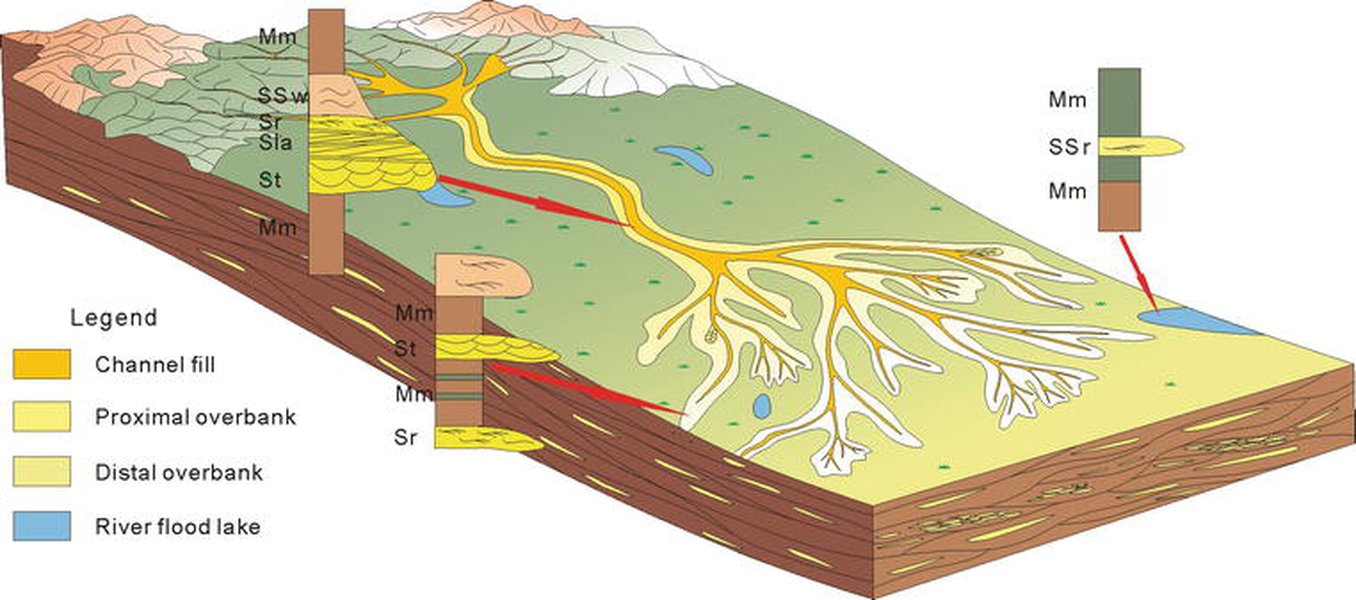
Illustrative diagram showing various fluvial depositional environments, such as meandering channels, point bars, and floodplain deposits.
Recognizing Fluvial Facies: Lithofacies and Architectural Elements
The interpretation of ancient river systems relies on identifying specific rock types (lithofacies) and their larger-scale arrangements (architectural elements).
Common Fluvial Lithofacies
Lithofacies are defined by their physical characteristics, including grain size, sedimentary structures, and composition.
- Conglomerates and Gravel Lags: Coarse-grained deposits, often found at the base of channels, representing the highest energy conditions and the transport of the heaviest sediment particles.
- Cross-Bedded Sandstones: Formed by the migration of dunes and ripples in channel environments. The scale and type of cross-bedding (e.g., trough, planar) provide clues about flow velocity and water depth.
- Horizontally Laminated Sandstones: Indicate rapid flow under upper plane bed conditions, typical of high-velocity currents.
- Ripple-Laminated Sandstones and Siltstones: Formed by lower energy currents or wave action in shallower parts of channels or on bar tops.
- Mudrocks (Shales and Siltstones): Fine-grained sediments deposited from suspension in low-energy environments such as floodplains, abandoned channels (oxbow lakes), and inter-channel areas. These may contain features like desiccation cracks, raindrop imprints, or evidence of ancient soils (paleosols).
Architectural Elements: The Building Blocks of Fluvial Systems
Architectural elements are three-dimensional bodies of sediment defined by their geometry, bounding surfaces, and internal facies arrangement. They represent the deposits of specific geomorphic features within the fluvial system.
- Channel Bodies (CH): Elongate, often ribbon-like or sheet-like deposits of sand and/or gravel, representing the preserved remnants of active river channels. Their internal structure can be complex, reflecting multiple episodes of fill and scour.
- Point Bars (PB): Crescent-shaped bodies of sediment that accrete laterally on the inner bends of meandering channels. They typically show an upward-fining trend and contain distinctive inclined surfaces called epsilon cross-stratification.
- Braid Bars (BB) / Longitudinal Bars (LB): Elongate bars within braided river channels, typically composed of coarser sediment.
- Crevasse Splay Deposits (CS): Lobate or sheet-like bodies of sand and silt deposited on the floodplain when a channel levee is breached.
- Levee Deposits (LV): Wedge-shaped deposits of fine sand and silt that accumulate along channel margins during overbank flooding.
- Floodbasin Fines (FF): Extensive, tabular bodies of fine-grained sediment (mud, silt) deposited on the floodplain away from the main channel. These often contain paleosols.
Fluvial Environments and Their Characteristic Deposits
The table below summarizes the key depositional environments within fluvial systems and their associated facies characteristics. Understanding these relationships is crucial for interpreting the geological record.
| Depositional Environment | Dominant Processes | Characteristic Facies/Architectural Elements | Typical Lithologies |
|---|---|---|---|
| Active Channel | Bedload transport, erosion, bar migration | Channel lags, channel fills, dunes, ripples, braid bars | Conglomerate, coarse to medium sandstone, cross-bedding |
| Point Bar (Meandering River) | Lateral accretion, decreasing flow velocity | Upward-fining sequences, epsilon cross-stratification | Sandstone (fining upwards to siltstone), trough and planar cross-bedding |
| Floodplain | Suspension settling from overbank flow, pedogenesis | Floodbasin fines, paleosols | Mudstone, siltstone, fine sandstone, root traces, desiccation cracks |
| Levee | Rapid deposition from overbank flow near channel | Wedge-shaped deposits, often laminated | Fine sandstone, siltstone |
| Crevasse Splay | Rapid, unconfined flow from levee breach | Lobate or sheet-like sand bodies | Sandstone, siltstone, often with climbing ripples |
| Abandoned Channel (Oxbow Lake) | Suspension settling, organic accumulation | Channel-shaped mud plugs | Mudstone, siltstone, organic-rich clays, peat |
Controls on Fluvial Facies Genesis and Architecture
The development and preservation of fluvial facies are governed by a complex interplay of factors operating at different scales.
Allogenic (External) Controls
These are factors originating outside the depositional system itself:
- Climate: Influences precipitation, vegetation cover, weathering rates, and thus sediment supply and discharge variability. Arid climates might produce ephemeral river deposits, while humid climates support perennial rivers with more stable floodplains. Seasonal variations in discharge can lead to distinct facies characteristics, such as those observed in tropical systems.
- Tectonics: Affects basin subsidence (creating accommodation space for sediment accumulation), uplift of source areas (influencing sediment supply and type), and valley gradient (controlling flow energy).
- Eustasy (Sea-Level Change): Primarily impacts fluvial systems near coastlines. Rising sea levels can cause rivers to aggrade (build up vertically), while falling sea levels can lead to incision (cutting down).
Autogenic (Internal) Controls
These factors are inherent to the fluvial system's internal dynamics:
- Channel Migration and Avulsion: The lateral movement (migration) of channels and abrupt shifts in channel course (avulsion) are fundamental processes that distribute sediment across the floodplain and create complex stacking patterns of channel and overbank deposits.
- Sediment Supply and Grain Size: The volume and type of sediment delivered to the river system dictate the nature of the deposits. High sediment supply can lead to aggradation and the formation of sand-rich systems.
- Discharge Variability: The range and frequency of flow events significantly influence sedimentary processes and the resulting facies. Rivers with highly variable discharge, such as those in some seasonal tropical settings, may produce deposits distinct from conventional models.
Visualizing Controlling Factors in Different River Systems
The radar chart below provides a conceptual illustration of how different controlling factors might vary in their relative importance across various fluvial system types. The values are illustrative and represent general tendencies rather than precise measurements. For instance, braided rivers are often strongly influenced by high sediment supply and variable discharge, while meandering rivers might be more sensitive to bank stability (influenced by climate and vegetation) and gradual accommodation changes.
Sequence Stratigraphy and Genetic Units in Fluvial Systems
Fluvial deposits can be analyzed within a sequence stratigraphic framework, which relates depositional patterns to changes in accommodation space (the space available for sediment to accumulate) and sediment supply over geological time. This approach helps in understanding the large-scale organization of fluvial successions.
Accommodation and Base Level
Changes in base level (the lowest point to which a river can erode) significantly influence fluvial deposition. A rise in base level increases accommodation space, potentially leading to aggradation and the preservation of thicker fluvial sequences. Conversely, a fall in base level can lead to incision and erosion, creating sequence boundaries.
Genetic Stratigraphic Sequences
Fluvial facies often form genetic units or sequences that correspond to specific phases of river activity and environmental conditions. These units are typically bounded by significant surfaces, such as those formed by major channel avulsions or periods of widespread floodplain stability and soil formation. Recognizing these sequences helps in correlating fluvial strata across a basin and understanding its depositional history.
Conceptual model showing fluvial sequence stratigraphy, highlighting relationships between accommodation space, sediment supply, and depositional patterns like incised valley fills and aggradational channel belts.
Conceptual Overview: The Interconnectedness of Fluvial Facies Genesis
The mindmap below illustrates the interconnected elements involved in the fluvial genesis of facies. It highlights how depositional environments, sedimentary processes, controlling factors, and resulting facies characteristics are all part of a complex, dynamic system. Understanding these relationships is fundamental to interpreting ancient river deposits.
Exploring Fluvial Environments Visually
Visual resources can greatly aid in understanding the complexities of fluvial systems. The video below provides an overview of fluvial depositional environments and their stratigraphic significance, covering concepts like facies models and sequence stratigraphy which are central to understanding the genesis of fluvial facies.
This video by GEO GIRL discusses fluvial depositional environments and stratigraphy, offering insights into how these systems are recorded in the geological record.
Frequently Asked Questions (FAQ)
What exactly are fluvial facies?
Fluvial facies are distinct bodies of sedimentary rock or sediment that were deposited by rivers or streams. Their characteristics (like grain size, sedimentary structures, and fossil content) reflect the specific depositional conditions and processes within the ancient river environment where they formed. They are the fundamental units geologists use to interpret past fluvial systems.
What are the primary processes that lead to the formation of fluvial facies?
The main processes include:
- Erosion: The picking up of sediment particles by flowing water.
- Transportation: The movement of sediment downstream, either as bedload (rolling, sliding along the bottom), suspended load (carried within the water column), or dissolved load.
- Deposition: The settling out of sediment when the water's energy decreases. This occurs in various parts of the river system, such as within channels (forming bars), on floodplains (during floods), or where levees are breached (forming crevasse splays).
How do different types of rivers (e.g., meandering vs. braided) influence the facies produced?
Different river types produce distinct facies assemblages:
- Meandering rivers (single, sinuous channel) typically create well-defined point bar deposits (often fining upwards sequences of sand and silt) and extensive floodplain fines. They have a higher proportion of fine-grained overbank deposits compared to channel deposits.
- Braided rivers (multiple, interconnected shallow channels separated by bars) are characterized by abundant coarse-grained channel deposits (sands and gravels forming braid bars) and relatively less floodplain material. They often result in sheet-like sandy bodies with a high sandstone-to-mudstone ratio.
- Anastomosing rivers (multiple, stable, interconnected channels separated by vegetated islands or floodbasins) tend to have distinct channel sand bodies encased in thick floodplain muds.
What external (allogenic) factors control fluvial deposition and facies architecture?
Several external factors significantly influence fluvial systems:
- Climate: Controls precipitation patterns, which dictate river discharge, seasonality, and sediment yield from weathering. Vegetation, also climate-dependent, affects bank stability and sediment trapping.
- Tectonics: Regional uplift or subsidence influences river gradients, sediment sources, and the creation of accommodation space (the space available for sediment to accumulate). For example, active faulting can create localized basins or alter river courses.
- Eustasy (Sea-Level Changes): Affects rivers close to the coast by changing their base level. A rise in sea level can cause rivers to deposit sediment further inland (aggradation), while a fall can lead to downcutting (incision).
Why is the study of fluvial facies genesis important?
Understanding fluvial facies genesis is crucial for several reasons:
- Paleoenvironmental Reconstruction: It allows geologists to reconstruct ancient landscapes, climates, and river systems, providing insights into Earth's history.
- Resource Exploration: Fluvial sandstones are often important reservoirs for oil, natural gas, and groundwater. Understanding their geometry, connectivity, and internal properties (derived from facies analysis) is vital for successful exploration and extraction. Fluvial gravels can also host placer deposits of valuable minerals.
- Hazard Assessment: Studying ancient fluvial deposits can help understand modern river behavior, including flood patterns and channel stability, aiding in natural hazard assessment and mitigation.
- Basin Analysis: Fluvial facies contribute significantly to the fill of sedimentary basins, and their study helps in understanding basin evolution and tectonic history.
Recommended Further Exploration
- How do tectonics and climate interact to control fluvial system architecture?
- What are the differences in facies models for meandering versus braided river deposits?
- How is sequence stratigraphy applied to interpret ancient fluvial successions?
- What are the key characteristics of fluvial deposits that make them good hydrocarbon reservoirs?
References
Last updated May 7, 2025