
Navigating China's Digital Mailbox: Top Free Email Services for Personal Use
Unlocking seamless communication in China with reliable and accessible email solutions for your personal needs.
Key Insights for Personal Email in China
- Local Dominance: Chinese providers like QQ Mail and 163.com are the most reliable and widely used, offering seamless access without VPNs due to their integration with local internet infrastructure.
- International Accessibility: While most global services like Gmail are blocked, Microsoft's Outlook (Hotmail) and Yahoo Mail often remain accessible without a VPN, offering a bridge for international communication.
- Communication Shift: Email is not the primary personal communication tool in China; instant messaging apps like WeChat are heavily preferred for daily interactions, suggesting a broader communication strategy may be beneficial.
For individuals seeking free email services in China for personal use, the digital landscape presents a unique set of considerations. Due to the country's internet regulations, including the Great Firewall, many widely used international email providers face significant accessibility challenges. Therefore, the most reliable and efficient options are often local Chinese services or select international providers that maintain consistent access.
This guide synthesizes expert recommendations and user experiences to provide a comprehensive overview of the best free email services tailored for personal use within China. We will explore prominent local choices, accessible international alternatives, and crucial factors to consider for a smooth communication experience.
Leading Local Email Providers in China
Chinese email providers are deeply integrated with the local internet ecosystem, offering high reliability and performance without the need for a Virtual Private Network (VPN). They are designed to comply with local regulations and user preferences, making them the most straightforward choice for personal communication within the country.
QQ Mail: Tencent's Communication Powerhouse
QQ Mail, operated by Tencent, stands out as one of the most popular free email services in China for personal use. Its widespread adoption is largely due to its seamless integration with the highly popular QQ instant messaging service. This synergy provides a convenient ecosystem for users to manage both their email and chat communications from a single platform.
QQ Mail offers a user-friendly interface available in both Chinese and English, making it accessible to a broader audience, including non-native Chinese speakers. Key features include generous free storage, support for standard email protocols such as POP3, IMAP, and SMTP, which allows for easy integration with various email clients. It also boasts robust spam filtering and additional functionalities like calendar integration and file sharing, enhancing its utility for daily personal tasks.
A significant advantage of QQ Mail is its consistent accessibility within China without the need for a VPN, ensuring reliable communication. While some users outside China may occasionally find emails from QQ Mail flagged as spam, its strong local presence makes it a primary choice for millions within China for sending personal messages, managing subscriptions, and connecting with friends and family.
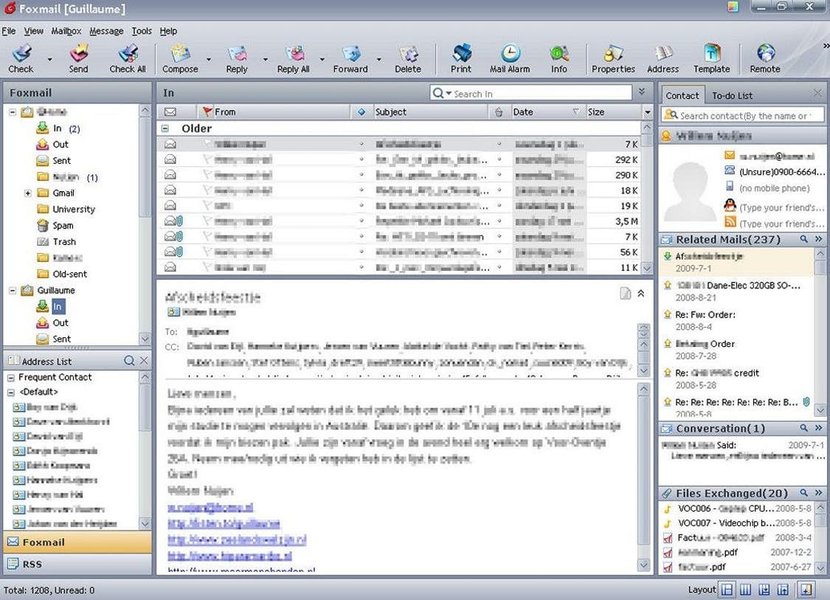
A visual representation of the QQ Mail interface, showcasing its design and features.
163.com Mail and 126.com Mail: NetEase's Reliable Duo
NetEase's 163.com Mail is another dominant player in the Chinese email market, widely favored for personal email accounts. Established in 1997, it offers a clean, intuitive web interface that prioritizes ease of navigation. Free accounts typically come with substantial storage, web-based access, and support for POP3/IMAP connectivity, making it versatile for various user preferences.
Users consistently praise 163.com for its stability and speed, which are optimized for the Chinese internet infrastructure. It includes essential features such as anti-spam tools, efficient folder organization, and mobile app support for on-the-go access. Its widespread use extends beyond personal communication to businesses and educational institutions, underscoring its reliability.
126.com Mail is a sister service to 163.com, offering similar reliability and functionality. Both are accessible directly in China without a VPN and are popular alternatives for users seeking stable and user-friendly email solutions.
This video provides a step-by-step guide on how to create a 163.com email account, highlighting its registration process relevant for new users in China.
This video focuses on the registration process for a 163.com email account. It's particularly relevant as it guides users through the necessary steps to set up an account, which often involves using a Chinese mobile number for verification. Understanding this process is crucial for anyone looking to establish a local email presence in China, as it ensures compliance with local digital identity requirements and facilitates seamless access to the service.
Other Notable Local Options
- Sina Mail (sina.com): Part of Sina Corporation, a major Chinese tech company, Sina Mail offers a free and straightforward email service. It supports webmail and standard email protocols, making it a popular choice for casual users.
- 21CN Email: Providing basic web-based access with POP3/IMAP support, 21CN offers a modest 6MB of storage. It's a no-frills option suitable for light personal use, prioritizing reliability and direct accessibility within China.
- 263.com Mail: Another widely used free email provider in China, 263.com offers web access, POP3, and SMTP support. It focuses on simplicity for managing emails, attachments, and contacts, and operates seamlessly within China.
- China.com Mail and HongKong.com Mail: These are web-based free email services suitable for personal use, with China.com being an older provider. They offer basic functionalities for sending and receiving emails and are generally accessible.
International Email Providers and Their Accessibility in China
While local providers offer the most reliable experience, some international email services can also be used in China, though often with caveats regarding accessibility and performance.
Outlook (Hotmail): A Reliable International Bridge
Microsoft's Outlook, formerly known as Hotmail, is consistently reported to work well in China without the need for a VPN. This makes it a dependable option for individuals who prefer an English-language interface and consistent communication with non-Chinese sites. Its accessibility contrasts sharply with other major international providers, positioning it as a viable choice for expats and locals alike.
Yahoo Mail: A Viable Backup
Yahoo Mail generally functions in China, although some users have reported occasional lags or slower performance. Despite these minor issues, it serves as a viable backup account for many, offering an accessible international alternative for personal email needs.
Challenges with Other Global Services
- Gmail: Google's Gmail is largely blocked in China. While a VPN can provide access, using a VPN for regular email access can be subject to government regulation. Some users forward Gmail emails to a local Chinese email provider as a workaround, but this doesn't enable sending from Gmail without a VPN.
- ProtonMail and Tuta Mail: These services are known for their strong encryption and privacy features. However, despite their claims of being unblocked, many users have reported difficulties accessing ProtonMail from Chinese IP addresses, suggesting they may also be subject to blocking. Their accessibility in China largely depends on the same factors affecting other foreign encrypted services.
Key Considerations for Personal Email Use in China
Choosing an email service in China involves more than just functionality. Understanding the local digital environment is crucial for a smooth and effective communication experience.
Internet Restrictions and VPN Use
The Great Firewall significantly impacts internet access in China. Services that are not approved or regulated by the government may be blocked or experience severe slowdowns. While VPNs can bypass these restrictions, their use is a gray area and can be subject to government crackdowns. For consistent and reliable personal email, relying on locally integrated services is generally safer and more practical.
Email Deliverability and Local ISP Limitations
Emails sent to and from China can face stricter filtering. This can lead to delays, unclickable links, or non-delivery, especially for emails with numerous images or complex formatting. To improve deliverability, it's advisable to limit images (ideally to no more than 40% of the email template) and use mobile-friendly content. Local Chinese ISPs, such as QQ and NetEase, often impose daily or monthly volume limitations on senders. Exceeding these limits can result in emails being directed to spam folders or outright blocked, impacting personal communication, especially if sending to many recipients.
The Shift Towards Instant Messaging
It's important to recognize that email is not the primary mode of personal communication in China. Instant messaging applications, most notably WeChat, dominate daily interactions. WeChat offers a multifaceted platform that extends beyond messaging to include payments, social networking, and various services. For personal communication within China, integrating WeChat into your communication strategy is often more convenient and effective than relying solely on email.
(Tencent)"] id3["Integrated with QQ App"] id4["Widely Used
for Personal Use"] id5["Accessible Without VPN"] id6["163.com Mail
(NetEase)"] id7["Clean Interface"] id8["Stable & Fast Performance"] id9["No VPN Needed"] id10["126.com Mail
(NetEase)"] id11["Sister to 163.com"] id12["Reliable Alternative"] id13["Sina Mail"] id14["Easy Sign-up"] id15["Basic Functionality"] id16["21CN Email"] id17["Modest Storage (6MB)"] id18["Direct Access"] id19["263.com Mail"] id20["Simple Interface"] id21["Standard Protocol Support"] id22["International Providers: Varying Accessibility"] id23["Outlook (Hotmail)
(Microsoft)"] id24["Often Works Without VPN"] id25["Good for International Communication"] id26["Yahoo Mail"] id27["Generally Works"] id28["Potential Lags"] id29["Gmail"] id30["Mostly Blocked"] id31["Requires VPN or Forwarding"] id32["Privacy-Focused Services
(e.g., ProtonMail, Tuta Mail)"] id33["Likely Blocked
Without VPN"] id34["Encryption Features"] id35["Key Considerations"] id36["Internet Restrictions"] id37["Great Firewall"] id38["VPN Legality"] id39["Email Deliverability"] id40["Strict Filtering"] id41["ISP Volume Limits"] id42["Shift to Instant Messaging"] id43["WeChat Dominance"] id44["Multi-functional Apps"] id45["Registration Requirements"] id46["Chinese Phone Number (Often Required)"]
This mindmap illustrates the various categories of free email services available in China for personal use, highlighting their characteristics, accessibility, and key considerations, providing a structured overview of the options.
Comparative Analysis of Email Service Attributes
To further assist in making an informed decision, the following table provides a comparative overview of the recommended free email services, highlighting their key features and considerations relevant for personal use in China.
| Service | Type | VPN Required for Access | Primary Language Interface | Key Features for Personal Use | Notes |
|---|---|---|---|---|---|
| QQ Mail | Local Chinese | No | Chinese, English | Integrated with QQ messaging, generous storage, POP3/IMAP/SMTP, spam filtering, calendar. | Highly popular, deeply integrated with local digital ecosystem. |
| 163.com Mail | Local Chinese | No | Chinese, English options | Clean interface, substantial storage, POP3/IMAP, anti-spam, mobile app. | Very reliable, widely used by individuals and institutions. |
| 126.com Mail | Local Chinese | No | Chinese, English options | Similar to 163.com, reliable performance, standard protocols. | Sister service to 163.com, good alternative. |
| Sina Mail | Local Chinese | No | Chinese | Easy sign-up, webmail access, basic email protocols. | Functional for casual personal use. |
| 21CN Email | Local Chinese | No | Chinese | Basic web-based access, POP3/IMAP, 6MB storage. | Suitable for very light personal use. |
| 263.com Mail | Local Chinese | No | Chinese | Web access, POP3/SMTP support, simple interface. | Reliable for basic personal communication. |
| Outlook (Hotmail) | International | Rarely | English, Many others | Familiar interface, good for international communication, often accessible without VPN. | Best international option for accessibility. |
| Yahoo Mail | International | Sometimes | English, Many others | Basic email functions, good as a backup. | May experience occasional lags. |
| Gmail | International | Yes (mostly) | English, Many others | Extensive features, cloud integration. | Generally blocked, requires VPN or forwarding workaround. |
| ProtonMail / Tuta Mail | International (Privacy-focused) | Likely Yes | English, Many others | Strong encryption, privacy features. | May be blocked, accessibility issues reported. |
Evaluating Email Service Performance and Accessibility
To provide a more nuanced understanding of each service's performance and suitability for personal use in China, we can use a radar chart. This chart will visually represent how different email providers score across key attributes such as local accessibility, feature richness, ease of use, security/privacy, and overall reliability without a VPN.
This radar chart evaluates various email services based on key criteria relevant to personal use in China, offering a visual comparison of their strengths and weaknesses.
This radar chart illustrates the strengths and weaknesses of various email providers for personal use in China across five key dimensions: Local Accessibility, Feature Richness, Ease of Use, Security & Privacy, and Reliability (No VPN). Local Chinese providers like QQ Mail and 163.com generally score high on 'Local Accessibility' and 'Reliability (No VPN)' due to their native integration within China's internet infrastructure. International services like Outlook (Hotmail) show a balanced performance, maintaining reasonable accessibility without a VPN. In contrast, Gmail and privacy-focused services like ProtonMail demonstrate high 'Feature Richness' and 'Security & Privacy' but significantly lower 'Local Accessibility' and 'Reliability (No VPN)' due to being blocked by the Great Firewall. This visualization helps users quickly grasp which services align best with their priorities, particularly emphasizing the critical role of local accessibility in China.
Frequently Asked Questions
What is the most reliable email service for personal use in China without a VPN?
Can I use Gmail or ProtonMail in China for personal email?
Is email the primary communication method for personal use in China?
Are there any storage limitations with free Chinese email services?
Do I need a Chinese phone number to register for local email services?
Conclusion
For individuals seeking a free email service for personal use in China, the most practical and reliable options are overwhelmingly local Chinese providers. Services like QQ Mail and 163.com Mail offer seamless integration with the local internet, robust features, and consistent accessibility without the need for a VPN. While international services like Outlook can serve as a bridge for communication with non-Chinese contacts, users should be aware that popular global platforms like Gmail are largely inaccessible without a VPN. Furthermore, understanding that instant messaging platforms like WeChat dominate personal communication in China is key to navigating the digital landscape effectively. By choosing a locally optimized service, users can ensure a smoother and more reliable personal email experience in China.
Recommended Further Exploration
- How to register for a WeChat account in China?
- What are the most reliable VPNs for accessing international services in China?
- What are the best tips for improving email deliverability to Chinese recipients?
- How does the Great Firewall of China impact internet access for personal use?