
Comprehensive Overview of Fructose Metabolism in Humans
Introduction
Fructose, a simple monosaccharide, is a significant component of the human diet, commonly found in fruits, honey, and added sugars such as high-fructose corn syrup. Unlike glucose, fructose metabolism exhibits distinct biochemical pathways and regulatory mechanisms, primarily occurring in the liver. Understanding the intricate processes involved in fructose metabolism is crucial for comprehending its impact on human health, including its role in metabolic disorders and liver diseases.
Absorption and Transport
Absorption in the Small Intestine
Upon ingestion, fructose is absorbed directly from the small intestine into the bloodstream. The absorption is facilitated by specific transporters:
- GLUT5 Transporter: Fructose is absorbed via the glucose transporter 5 (GLUT5) located in the apical membrane of enterocytes in the small intestine. GLUT5 has a high affinity for fructose, ensuring efficient uptake even at low concentrations.
- Passive Transport: The process of fructose absorption is passive and does not require energy, differentiating it from the active transport mechanisms used by other nutrients.
Transport to the Liver
Once absorbed, fructose enters the portal circulation and is transported to the liver. In hepatocytes, fructose uptake is mediated primarily by the glucose transporter 2 (GLUT2), which facilitates the bidirectional movement of fructose across the cell membrane. Additionally, GLUT8 may also contribute to fructose transport within the liver.
Hepatic Metabolism of Fructose
Phosphorylation
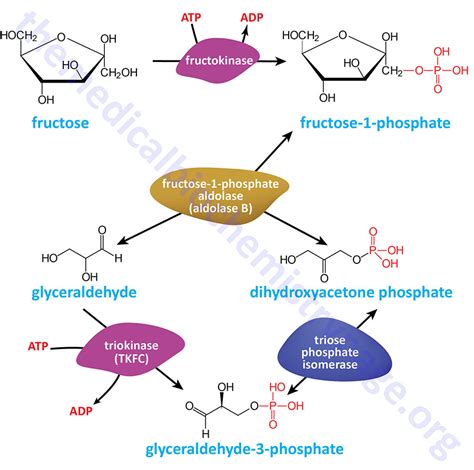
Inside hepatocytes, fructose undergoes rapid phosphorylation by the enzyme fructokinase (also known as ketohexokinase). This reaction converts fructose to fructose-1-phosphate (F-1-P) using adenosine triphosphate (ATP) as the phosphate donor:
$$\text{Fructose} + \text{ATP} \xrightarrow{\text{Fructokinase}} \text{Fructose-1-phosphate} + \text{ADP}$$
This phosphorylation step is notably rapid and lacks feedback inhibition, allowing continuous and unregulated metabolism of fructose irrespective of the energy state of the cell.
Aldolase B-Mediated Cleavage
Fructose-1-phosphate is subsequently cleaved by the enzyme aldolase B into two three-carbon intermediates:
- Glyceraldehyde: This molecule is further phosphorylated by triose kinase to form glyceraldehyde-3-phosphate (G3P), which can enter the glycolytic pathway.
- Dihydroxyacetone Phosphate (DHAP): DHAP is an intermediate in both glycolysis and gluconeogenesis, allowing it to be utilized in various metabolic processes.
Entry into Glycolysis and Other Pathways
Both G3P and DHAP are central intermediates in glycolysis. G3P can be further metabolized to pyruvate, ultimately contributing to ATP production via oxidative phosphorylation:
$$\text{Glyceraldehyde-3-phosphate} \rightarrow \text{Pyruvate} \rightarrow \text{Acetyl-CoA} \rightarrow \text{Citric Acid Cycle} \rightarrow \text{OXPHOS}$$
Alternatively, these intermediates can be diverted towards gluconeogenesis, leading to the synthesis of new glucose molecules, or towards the pentose phosphate pathway, which generates NADPH and ribose-5-phosphate for anabolic reactions.
De Novo Lipogenesis (DNL)
Excess fructose can drive de novo lipogenesis, the synthesis of fatty acids from non-lipid substrates. The acetyl-CoA generated from fructose metabolism serves as a substrate for fatty acid synthesis:
$$\text{Acetyl-CoA} + \text{Malonyl-CoA} \xrightarrow{\text{Fatty Acid Synthase}} \text{Fatty Acids}$$
This process contributes to the formation of triglycerides, which can be stored as fat or exported as very low-density lipoproteins (VLDL).
Uric Acid Production
Fructose metabolism also increases the production of uric acid. The rapid phosphorylation of fructose consumes ATP and leads to the degradation of adenine nucleotides, resulting in elevated levels of uric acid. Elevated uric acid is associated with conditions such as hyperuricemia and gout.
Regulation of Fructose Metabolism
Lack of Feedback Inhibition
One of the distinguishing features of fructose metabolism compared to glucose metabolism is the absence of significant regulatory controls. The initial phosphorylation by fructokinase is not subject to feedback inhibition by downstream metabolites, allowing fructose metabolism to proceed unabated regardless of the cell's energy status.
Bypassing Glycolytic Regulation
Fructose metabolism bypasses the key regulatory step of glycolysis catalyzed by phosphofructokinase-1 (PFK-1). By entering the glycolytic pathway downstream of this regulatory point, fructose can be metabolized independently of the hormonal and energy signals that regulate glucose metabolism.
Metabolic Fates of Fructose
Energy Production
Fructose oxidation contributes to ATP production similarly to glucose. However, the lack of regulatory steps means that fructose can lead to an uncontrolled flow of substrates into energy-producing pathways, potentially leading to an imbalance in cellular energy homeostasis.
Glycogen Storage
Some of the metabolites from fructose metabolism are channeled into glycogen synthesis. This storage form of glucose in the liver provides a reserve of energy that can be mobilized when needed.
Lactate Production
Approximately 25% of ingested fructose is converted to lactate. Lactate can be transported to other tissues, such as muscle, where it can be utilized as an energy source or converted back to glucose via the Cori cycle.
Fatty Acid and Triglyceride Synthesis
A minor portion of fructose is converted into fatty acids and subsequently into triglycerides through the process of de novo lipogenesis. This pathway is particularly active when fructose intake exceeds the liver's capacity to store glucose as glycogen.
Health Implications of Fructose Metabolism
Non-Alcoholic Fatty Liver Disease (NAFLD)
Chronic consumption of high levels of fructose is strongly associated with the development of NAFLD. The increased flux through de novo lipogenesis leads to the accumulation of triglycerides in the liver, contributing to liver steatosis.
Insulin Resistance and Type 2 Diabetes
Excessive fructose intake can promote insulin resistance, a condition where cells fail to respond effectively to insulin. Insulin resistance is a key precursor to the development of type 2 diabetes. The link between fructose metabolism and insulin resistance is mediated by the accumulation of lipids in non-adipose tissues, leading to metabolic dysregulation.
Dyslipidemia
Fructose-induced lipogenesis contributes to elevated levels of triglycerides and other lipids in the bloodstream. Elevated triglycerides are a risk factor for cardiovascular diseases, including atherosclerosis and coronary artery disease.
Gout and Hyperuricemia
The increase in uric acid production due to fructose metabolism can lead to hyperuricemia, increasing the risk of gout. Elevated uric acid levels are also associated with hypertension and kidney disease.
Obesity and Metabolic Syndrome
High fructose consumption is linked to weight gain and obesity, primarily through the promotion of lipogenesis and the storage of excess energy as fat. Obesity is a central component of metabolic syndrome, a cluster of conditions that increase the risk of heart disease, stroke, and diabetes.
Comparative Metabolism: Fructose vs. Glucose
Regulatory Differences
Glucose metabolism is tightly regulated by hormonal signals such as insulin and involves key enzymatic control points, notably phosphofructokinase-1 (PFK-1) in glycolysis. In contrast, fructose metabolism bypasses these regulatory steps, leading to unrestrained metabolic flux through glycolysis and lipogenesis.
Energy Yield and Utilization
Both glucose and fructose provide similar energy yields when oxidized. However, fructose metabolism requires additional ATP for phosphorylation and leads to different metabolic outcomes, such as increased lipogenesis and uric acid production.
Hormonal Responses
Glucose ingestion stimulates insulin release from the pancreas, promoting glucose uptake and storage. Fructose does not significantly stimulate insulin secretion, leading to different hormonal and metabolic responses that can contribute to metabolic dysregulation when fructose is consumed in excess.
Satiety and Appetite Regulation
Fructose has been shown to affect satiety signals differently compared to glucose. It does not effectively stimulate the release of satiety hormones such as leptin, potentially leading to increased caloric intake and weight gain.
Non-Hepatic Metabolism of Fructose
Limited Tissue Utilization
While the liver is the primary site of fructose metabolism, some tissues such as the kidneys and small intestine can metabolize fructose to a minor extent. However, in these tissues, the capacity for fructose metabolism is limited compared to the liver.
Extrahepatic Health Effects
Fructose metabolism in non-hepatic tissues can contribute to local metabolic changes, but the overall impact on systemic health is minimal compared to hepatic metabolism. Nonetheless, excessive fructose intake may still have indirect effects on other organs through systemic metabolic dysregulation.
Clinical Implications and Public Health Considerations
Dietary Guidelines
Given the metabolic consequences of excessive fructose intake, public health guidelines recommend limiting the consumption of added sugars, particularly those high in fructose such as high-fructose corn syrup. Emphasis is placed on reducing the intake of sugary beverages and processed foods to mitigate the risk of metabolic diseases.
Therapeutic Interventions
Interventions aimed at reducing fructose intake have been shown to improve metabolic health markers. Dietary modifications, such as adopting a low-sugar diet, can decrease hepatic lipogenesis, reduce insulin resistance, and lower uric acid levels.
Research Directions
Ongoing research continues to explore the detailed mechanisms by which fructose metabolism contributes to metabolic disorders. Understanding genetic variations in enzymes like fructokinase and aldolase B may also provide insights into individual susceptibilities to fructose-induced health issues.
Conclusion
Fructose metabolism in humans is a multifaceted process predominantly occurring in the liver. The rapid and unregulated nature of fructose metabolism distinguishes it from glucose metabolism, leading to significant implications for energy homeostasis and metabolic health. Excessive consumption of fructose is strongly associated with a range of metabolic disorders, including non-alcoholic fatty liver disease, insulin resistance, dyslipidemia, and obesity. Understanding the biochemical pathways and regulatory mechanisms involved in fructose metabolism is essential for developing effective dietary strategies and therapeutic interventions to combat the rising prevalence of metabolic diseases in modern societies.
Last updated January 1, 2025