
Unveiling Fryatt Ltd.'s Lease Liability: How Will It Appear on the Balance Sheet by 30 June 20X7?
A detailed breakdown of lease accounting principles and calculations for Fryatt Ltd.'s machinery lease.
Understanding how lease liabilities are presented on the statement of financial position (balance sheet) is crucial under modern accounting standards like IFRS 16 and ASC 842. This response will dissect the specifics of Fryatt Ltd.'s machinery lease to determine its balance sheet presentation as of 30 June 20X7, detailing the calculations and the underlying accounting principles.
Key Highlights: Fryatt Ltd.'s Lease Liability at 30 June 20X7
- Total Lease Obligation: As of 30 June 20X7, Fryatt Ltd.'s total remaining lease liability for the machinery amounts to approximately £50,331.
- Balance Sheet Classification: This total liability is segregated into two components:
- Approximately £23,967 is classified as a current liability, representing the principal portion due within the next 12 months.
- Approximately £26,363 is classified as a non-current liability, representing the principal portion due beyond the next 12 months.
- Accounting Standard Compliance: These figures are derived following the principles of prevalent lease accounting standards (IFRS 16/ASC 842), which mandate the recognition of a right-of-use asset and a corresponding lease liability measured at the present value of future lease payments.
Foundations of Lease Accounting: Understanding the Lease Liability
Before diving into Fryatt Ltd.'s specific scenario, let's establish what a lease liability represents and the accounting standards that govern its recognition and presentation.
What is a Lease Liability?
A lease liability is an obligation recognized by a lessee (the company using the asset, in this case, Fryatt Ltd.) to make lease payments over the term of a lease. It is calculated as the present value of all future lease payments that are not yet paid, discounted using an appropriate interest rate. This ensures that the balance sheet reflects the true financial obligations of the company arising from its lease agreements.
Governing Standards: IFRS 16 and ASC 842
International Financial Reporting Standard 16 (IFRS 16) and Accounting Standards Codification Topic 842 (ASC 842) are the primary accounting standards that have revolutionized lease accounting. Key principles include:
- Balance Sheet Recognition: For most leases (typically those with a term exceeding 12 months), lessees must recognize a Right-of-Use (ROU) asset, representing their right to use the leased asset, and a corresponding lease liability.
- Measurement: The lease liability is initially measured at the present value of the lease payments. The discount rate used is typically the interest rate implicit in the lease, if readily determinable; otherwise, the lessee's incremental borrowing rate is used.
- Subsequent Measurement: After initial recognition, the lease liability is increased to reflect the accretion of interest (interest expense) and decreased by lease payments made. The ROU asset is typically amortized over the lease term.
- Classification: The lease liability on the statement of financial position must be split into current and non-current portions. The current portion is the amount of the liability expected to be settled within 12 months of the reporting date, while the non-current portion is settled thereafter.
Calculating Fryatt Ltd.'s Lease Liability as at 30 June 20X7
Fryatt Ltd. entered a 3-year lease for machinery on 1 July 20X6, with annual payments of £29,000 made in arrears (at the end of each year). The interest rate implicit in the lease is 10%. We need to determine the lease liability presentation at 30 June 20X7.
Step 1: Initial Lease Liability at Commencement (1 July 20X6)
The initial lease liability is the present value of the three annual payments of £29,000, discounted at 10%.
Present Value Calculation
The present value (PV) of future lease payments can be calculated individually for each payment or using the present value of an ordinary annuity formula. The payments occur on 30 June 20X7, 30 June 20X8, and 30 June 20X9.
Individual Present Values at 1 July 20X6:
- Payment 1 (due 30 June 20X7): \( \frac{£29,000}{(1 + 0.10)^1} = \frac{£29,000}{1.10} = £26,363.64 \)
- Payment 2 (due 30 June 20X8): \( \frac{£29,000}{(1 + 0.10)^2} = \frac{£29,000}{1.21} = £23,966.94 \)
- Payment 3 (due 30 June 20X9): \( \frac{£29,000}{(1 + 0.10)^3} = \frac{£29,000}{1.331} = £21,788.13 \)
Total Initial Lease Liability at 1 July 20X6:
\[ PV = £26,363.64 + £23,966.94 + £21,788.13 = £72,118.71 \]Alternatively, using the annuity formula \( PV = P \times \left( \frac{1 - (1 + r)^{-n}}{r} \right) \):
\[ PV = £29,000 \times \left( \frac{1 - (1 + 0.10)^{-3}}{0.10} \right) = £29,000 \times \left( \frac{1 - 0.7513148}{0.10} \right) = £29,000 \times 2.486852 = £72,118.71 \]Step 2: Lease Liability Movement for the Year Ended 30 June 20X7
During the first year of the lease (1 July 20X6 to 30 June 20X7), interest accrues on the opening liability, and the first payment is made.
Interest Accrual
Interest expense for the year ended 30 June 20X7 is calculated on the opening liability balance:
\[ \text{Interest Expense (Year 1)} = £72,118.71 \times 10\% = £7,211.87 \]First Lease Payment
The first annual payment of £29,000 is made on 30 June 20X7. This payment comprises both the interest accrued and a reduction of the principal liability.
\[ \text{Principal Reduction (Year 1)} = \text{Payment} - \text{Interest Expense} = £29,000.00 - £7,211.87 = £21,788.13 \]Remaining Liability at 30 June 20X7
The lease liability balance at 30 June 20X7, after the first payment, is:
\[ \text{Closing Liability (30 June 20X7)} = \text{Opening Liability} - \text{Principal Reduction} = £72,118.71 - £21,788.13 = £50,330.58 \]Step 3: Classification of Lease Liability at 30 June 20X7
The total lease liability of £50,330.58 at 30 June 20X7 must be split into current and non-current portions.
Determining the Current Portion
The current portion is the amount of principal that will be repaid within the next 12 months (i.e., by 30 June 20X8 via the payment due on that date). To find this, we first calculate the interest for the second year (1 July 20X7 to 30 June 20X8) on the liability balance at the start of that year (£50,330.58).
\[ \text{Interest Expense (Year 2)} = £50,330.58 \times 10\% = £5,033.06 \]The principal portion of the £29,000 payment due on 30 June 20X8 is:
\[ \text{Principal Repayment (Year 2)} = £29,000.00 - £5,033.06 = £23,966.94 \]This principal repayment of £23,966.94 (approximately £23,967) constitutes the current liability at 30 June 20X7.
Determining the Non-Current Portion
The non-current portion is the total remaining liability less the current portion:
\[ \text{Non-Current Liability} = \text{Total Liability at 30 June 20X7} - \text{Current Liability} \] \[ \text{Non-Current Liability} = £50,330.58 - £23,966.94 = £26,363.64 \]Thus, the non-current liability at 30 June 20X7 is £26,363.64 (approximately £26,363).
Summary of Lease Liability Presentation at 30 June 20X7
Based on these calculations, the lease liability in Fryatt Ltd.'s statement of financial position as at 30 June 20X7 will be shown as:
- Current Lease Liability: £23,967
- Non-Current Lease Liability: £26,363
This aligns with Option A provided in the query: £26,363 as a non-current liability and £23,967 as a current liability.
Lease Amortization Schedule Overview
An amortization schedule provides a year-by-year breakdown of the lease liability, showing how each payment is allocated between interest and principal reduction. Below is the schedule for Fryatt Ltd.'s lease:
| Year Ending | Opening Liability (£) | Interest (10%) (£) | Annual Payment (£) | Principal Repayment (£) | Closing Liability (£) |
|---|---|---|---|---|---|
| 30 June 20X7 | 72,118.71 | 7,211.87 | 29,000.00 | 21,788.13 | 50,330.58 |
| 30 June 20X8 | 50,330.58 | 5,033.06 | 29,000.00 | 23,966.94 | 26,363.64 |
| 30 June 20X9 | 26,363.64 | 2,636.36 | 29,000.00 | 26,363.64 | 0.00 |
Example of an amortization schedule for a lease.
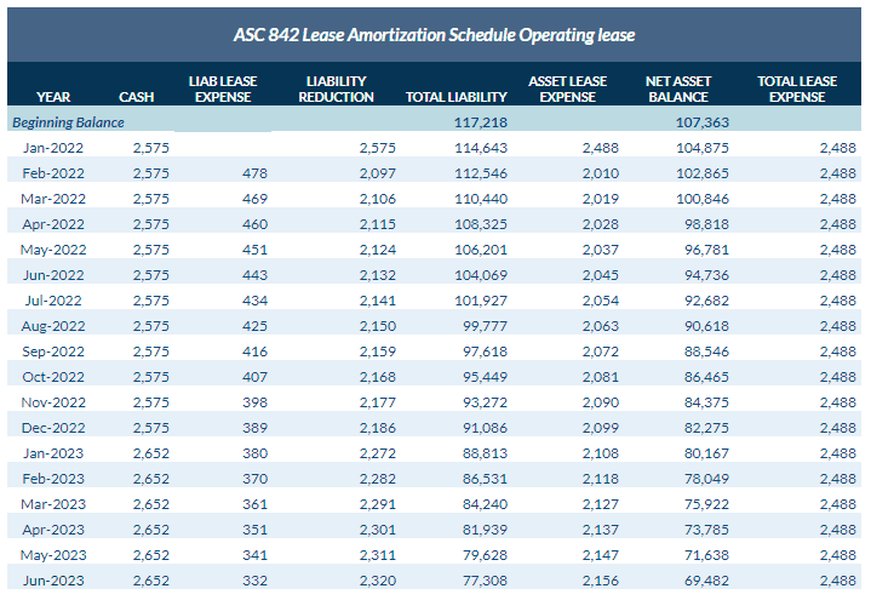
The image above illustrates a typical lease amortization schedule, similar to the one calculated for Fryatt Ltd.
Visualizing Fryatt Ltd.'s Lease Components
A radar chart can help visualize the key financial components of Fryatt Ltd.'s lease liability as of 30 June 20X7. This chart displays the relative magnitudes of the total liability, its current and non-current portions, the annual payment, and the interest component for the upcoming year.
The chart visually represents the significant liability Fryatt Ltd. carries and how it's structured between short-term and long-term obligations. The annual payment remains constant, while the interest portion decreases as the principal is repaid.
Mindmap: Core Concepts in Lease Accounting
This mindmap illustrates the interconnected concepts within modern lease accounting under IFRS 16 and ASC 842, leading to the classification of lease liabilities as demonstrated in Fryatt Ltd.'s case.
Lease Payments"] id1.2.2["Discount Rate:
Rate Implicit in Lease or
Incremental Borrowing Rate (IBR)"] id1.3["Subsequent Measurement"] id1.3.1["Accretion of Interest
(Effective Interest Method)"] id1.3.2["Reduction of Liability
by Lease Payments"] id1.4["Statement of Financial Position
Presentation"] id1.4.1["Current Portion of Lease Liability
(Due within 12 months)"] id1.4.2["Non-Current Portion of Lease Liability
(Due after 12 months)"] id2["Fryatt Ltd. Specifics (Machinery Lease)"] id2.1["Lease Terms:
3 Years, £29,000 Annual Payment (in arrears)"] id2.2["Interest Rate: 10% Implicit"] id2.3["Lease Liability at 30 June 20X7"] id2.3.1["Total Liability: approx. £50,331"] id2.3.2["Current Liability: approx. £23,967"] id2.3.3["Non-Current Liability: approx. £26,363"]
Broader Impact on Financial Statements
The recognition of lease liabilities and ROU assets under current standards has a significant impact on a company's financial statements:
Balance Sheet (Statement of Financial Position)
- Increased Assets and Liabilities: Both total assets (due to ROU assets) and total liabilities (due to lease liabilities) increase. This can affect key financial ratios such as:
- Debt-to-equity ratio (may increase)
- Current ratio (may decrease if current lease liabilities are substantial)
- Asset turnover ratios
- Enhanced Transparency: Previously, operating leases were often "off-balance sheet," potentially obscuring a company's true leverage. The new standards provide a more complete picture of financial obligations.
Income Statement (Statement of Profit or Loss)
- Expense Recognition Pattern: For finance leases (and all leases under IFRS 16 for lessees), the expense profile changes from a typically straight-line rent expense (under old operating lease rules) to a combination of:
- Depreciation/amortization expense on the ROU asset (often straight-line).
- Interest expense on the lease liability (higher in earlier years, declining as the liability reduces).
- Impact on EBITDA: Since depreciation and interest are typically presented below Earnings Before Interest, Taxes, Depreciation, and Amortization (EBITDA), EBITDA may appear higher compared to previous accounting where rent expense reduced it.
Statement of Cash Flows
- Reclassification of Payments: Lease payments are now split:
- The principal repayment portion is classified as a financing cash outflow.
- The interest portion is typically classified as an operating cash outflow (though IFRS allows classification as financing for interest paid).
Understanding Lease Liability Calculations: A Visual Guide
The following video provides a helpful explanation of how to calculate lease liabilities, which is fundamental to understanding the figures derived for Fryatt Ltd. It covers the core concepts of present value and the components needed for the calculation under IFRS 16.
This video, "How to Calculate the Lease Liability | Lessee | IFRS 16," discusses the three key inputs for calculating the present value of lease payments: the lease payments themselves, the lease term, and the discount rate. It reinforces the methodology applied in determining Fryatt Ltd.'s lease liability.
Frequently Asked Questions (FAQ)
What exactly is a lease liability?
A lease liability represents a lessee's obligation to make future lease payments under a lease agreement. It is recorded on the balance sheet at the present value of these future payments, discounted at an appropriate rate. This provides a more accurate reflection of a company's financial commitments.
Why is it important to split lease liabilities into current and non-current portions?
Separating lease liabilities into current (due within 12 months) and non-current (due after 12 months) portions is crucial for assessing a company's short-term liquidity and long-term solvency. It helps users of financial statements, like investors and creditors, understand the timing of these obligations and evaluate financial health more accurately (e.g., for calculating the current ratio).
What discount rate is used for lease calculations?
Lessees should use the interest rate implicit in the lease if it can be readily determined. This is the rate that causes the present value of the lease payments and any unguaranteed residual value to equal the fair value of the underlying asset plus any initial direct costs of the lessor. If the implicit rate cannot be readily determined, the lessee should use its incremental borrowing rate (IBR), which is the rate the lessee would have to pay to borrow funds necessary to obtain an asset of similar value over a similar term with similar security.
How do lease payments "in arrears" affect calculations?
Payments "in arrears" mean that each payment is made at the end of the period it covers (e.g., an annual payment for Year 1 is made at the end of Year 1). This is typical for ordinary annuities. When calculating the present value of these payments, each payment is discounted back to the lease commencement date based on when it occurs. If payments were "in advance" (at the beginning of each period), the discounting for each payment would be for one less period, resulting in a higher present value for the lease liability.
Does this accounting treatment apply to all leases?
While IFRS 16 and ASC 842 require most leases to be recognized on the balance sheet, there are some practical expedients or exemptions. For example, both standards allow (but do not require) lessees to elect not to recognize ROU assets and lease liabilities for:
- Short-term leases (typically leases with a term of 12 months or less at commencement, with no purchase option reasonably certain to be exercised).
- Leases for which the underlying asset is of low value (e.g., for personal computers, small office furniture). For these leases, payments can often be recognized as an expense on a straight-line basis.
Recommended Further Exploration
- How does lease accounting under IFRS 16 affect key financial ratios?
- What are the differences in lessee accounting between IFRS 16 and ASC 842?
- Explain the calculation of a Right-of-Use (ROU) asset and its subsequent amortization.
- What are the disclosure requirements for leases in financial statements under IFRS 16?
References
- Operating Lease: How It Works and Differs From a Finance Lease - Investopedia
- 14.2 Lessees - PwC Viewpoint
- IFRS 16 Leases: Summary, Examples, Entries & Disclosures - FinQuery
- Accounting for leases - ACCA Global
- Lease Liability Under ASC 842 and IFRS 16 - Trullion
- How to Calculate a Lease Liability and Right-of-Use Asset under IFRS 16 - Cradle Accounting
`, `
`, `
`, `
`, ``, `- `, `
`, `
` used.
Color styling for headings applied. MathJax delimiters used.
Image used with description and centered.
References formatted as requested.
Recommended queries formatted as requested.
Data slug included.
Token count should be appropriate. Let's check final thoughts.
Looks okay.
Unveiling Fryatt Ltd.'s Lease Liability: How Will It Appear on the Balance Sheet by 30 June 20X7?
A detailed breakdown of lease accounting principles and calculations for Fryatt Ltd.'s machinery lease.
Understanding how lease liabilities are presented on the statement of financial position (balance sheet) is crucial under modern accounting standards like IFRS 16 and ASC 842. This response will dissect the specifics of Fryatt Ltd.'s machinery lease to determine its balance sheet presentation as of 30 June 20X7, detailing the calculations and the underlying accounting principles.
Key Highlights: Fryatt Ltd.'s Lease Liability at 30 June 20X7
- Total Lease Obligation: As of 30 June 20X7, Fryatt Ltd.'s total remaining lease liability for the machinery amounts to approximately £50,331.
- Balance Sheet Classification: This total liability is segregated into two components:
- Approximately £23,967 is classified as a current liability, representing the principal portion due within the next 12 months.
- Approximately £26,363 is classified as a non-current liability, representing the principal portion due beyond the next 12 months.
- Accounting Standard Compliance: These figures are derived following the principles of prevalent lease accounting standards (IFRS 16/ASC 842), which mandate the recognition of a right-of-use asset and a corresponding lease liability measured at the present value of future lease payments.
Foundations of Lease Accounting: Understanding the Lease Liability
Before diving into Fryatt Ltd.'s specific scenario, let's establish what a lease liability represents and the accounting standards that govern its recognition and presentation.
What is a Lease Liability?
A lease liability is an obligation recognized by a lessee (the company using the asset, in this case, Fryatt Ltd.) to make lease payments over the term of a lease. It is calculated as the present value of all future lease payments that are not yet paid, discounted using an appropriate interest rate. This ensures that the balance sheet reflects the true financial obligations of the company arising from its lease agreements.
Governing Standards: IFRS 16 and ASC 842
International Financial Reporting Standard 16 (IFRS 16) and Accounting Standards Codification Topic 842 (ASC 842) are the primary accounting standards that have revolutionized lease accounting. Key principles include:
- Balance Sheet Recognition: For most leases (typically those with a term exceeding 12 months), lessees must recognize a Right-of-Use (ROU) asset, representing their right to use the leased asset, and a corresponding lease liability.
- Measurement: The lease liability is initially measured at the present value of the lease payments. The discount rate used is typically the interest rate implicit in the lease, if readily determinable; otherwise, the lessee's incremental borrowing rate is used.
- Subsequent Measurement: After initial recognition, the lease liability is increased to reflect the accretion of interest (interest expense) and decreased by lease payments made. The ROU asset is typically amortized over the lease term.
- Classification: The lease liability on the statement of financial position must be split into current and non-current portions. The current portion is the amount of the liability expected to be settled within 12 months of the reporting date, while the non-current portion is settled thereafter.
Calculating Fryatt Ltd.'s Lease Liability as at 30 June 20X7
Fryatt Ltd. entered a 3-year lease for machinery on 1 July 20X6, with annual payments of £29,000 made in arrears (at the end of each year). The interest rate implicit in the lease is 10%. We need to determine the lease liability presentation at 30 June 20X7.
Step 1: Initial Lease Liability at Commencement (1 July 20X6)
The initial lease liability is the present value of the three annual payments of £29,000, discounted at 10%.
Present Value Calculation
The present value (PV) of future lease payments can be calculated individually for each payment or using the present value of an ordinary annuity formula. The payments occur on 30 June 20X7, 30 June 20X8, and 30 June 20X9.
Individual Present Values at 1 July 20X6:
- Payment 1 (due 30 June 20X7): \( \frac{£29,000}{(1 + 0.10)^1} = \frac{£29,000}{1.10} = £26,363.64 \)
- Payment 2 (due 30 June 20X8): \( \frac{£29,000}{(1 + 0.10)^2} = \frac{£29,000}{1.21} = £23,966.94 \)
- Payment 3 (due 30 June 20X9): \( \frac{£29,000}{(1 + 0.10)^3} = \frac{£29,000}{1.331} = £21,788.13 \)
Total Initial Lease Liability at 1 July 20X6:
\[ PV = £26,363.64 + £23,966.94 + £21,788.13 = £72,118.71 \]
Alternatively, using the annuity formula \( PV = P \times \left( \frac{1 - (1 + r)^{-n}}{r} \right) \):
\[ PV = £29,000 \times \left( \frac{1 - (1 + 0.10)^{-3}}{0.10} \right) = £29,000 \times \left( \frac{1 - 0.7513148}{0.10} \right) = £29,000 \times 2.486852 = £72,118.71 \]
Step 2: Lease Liability Movement for the Year Ended 30 June 20X7
During the first year of the lease (1 July 20X6 to 30 June 20X7), interest accrues on the opening liability, and the first payment is made.
Interest Accrual
Interest expense for the year ended 30 June 20X7 is calculated on the opening liability balance:
\[ \text{Interest Expense (Year 1)} = £72,118.71 \times 10\% = £7,211.87 \]
First Lease Payment
The first annual payment of £29,000 is made on 30 June 20X7. This payment comprises both the interest accrued and a reduction of the principal liability.
\[ \text{Principal Reduction (Year 1)} = \text{Payment} - \text{Interest Expense} = £29,000.00 - £7,211.87 = £21,788.13 \]
Remaining Liability at 30 June 20X7
The lease liability balance at 30 June 20X7, after the first payment, is:
\[ \text{Closing Liability (30 June 20X7)} = \text{Opening Liability} - \text{Principal Reduction} = £72,118.71 - £21,788.13 = £50,330.58 \]
Step 3: Classification of Lease Liability at 30 June 20X7
The total lease liability of £50,330.58 at 30 June 20X7 must be split into current and non-current portions.
Determining the Current Portion
The current portion is the amount of principal that will be repaid within the next 12 months (i.e., by 30 June 20X8 via the payment due on that date). To find this, we first calculate the interest for the second year (1 July 20X7 to 30 June 20X8) on the liability balance at the start of that year (£50,330.58).
\[ \text{Interest Expense (Year 2)} = £50,330.58 \times 10\% = £5,033.06 \]
The principal portion of the £29,000 payment due on 30 June 20X8 is:
\[ \text{Principal Repayment (Year 2)} = £29,000.00 - £5,033.06 = £23,966.94 \]
This principal repayment of £23,966.94 (approximately £23,967) constitutes the current liability at 30 June 20X7.
Determining the Non-Current Portion
The non-current portion is the total remaining liability less the current portion:
\[ \text{Non-Current Liability} = \text{Total Liability at 30 June 20X7} - \text{Current Liability} \]
\[ \text{Non-Current Liability} = £50,330.58 - £23,966.94 = £26,363.64 \]
Thus, the non-current liability at 30 June 20X7 is £26,363.64 (approximately £26,363).
Summary of Lease Liability Presentation at 30 June 20X7
Based on these calculations, the lease liability in Fryatt Ltd.'s statement of financial position as at 30 June 20X7 will be shown as:
- Current Lease Liability: £23,967
- Non-Current Lease Liability: £26,363
This aligns with Option A provided in the query: £26,363 as a non-current liability and £23,967 as a current liability.
Lease Amortization Schedule Overview
An amortization schedule provides a year-by-year breakdown of the lease liability, showing how each payment is allocated between interest and principal reduction. Below is the schedule for Fryatt Ltd.'s lease:
Year Ending
Opening Liability (£)
Interest (10%) (£)
Annual Payment (£)
Principal Repayment (£)
Closing Liability (£)
30 June 20X7
72,118.71
7,211.87
29,000.00
21,788.13
50,330.58
30 June 20X8
50,330.58
5,033.06
29,000.00
23,966.94
26,363.64
30 June 20X9
26,363.64
2,636.36
29,000.00
26,363.64
0.00
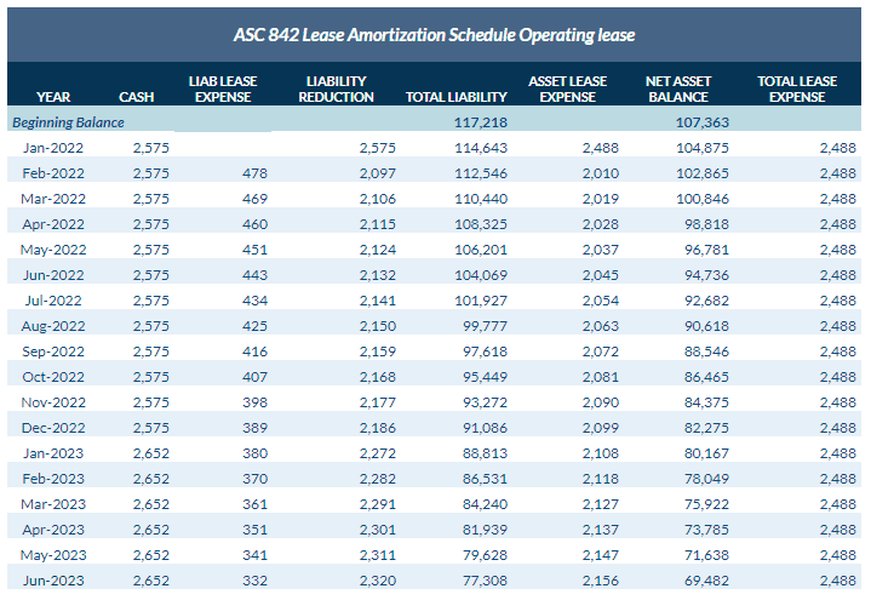
The image above illustrates a typical lease amortization schedule, similar to the one calculated for Fryatt Ltd.
Visualizing Fryatt Ltd.'s Lease Components
A radar chart can help visualize the key financial components of Fryatt Ltd.'s lease liability as of 30 June 20X7. This chart displays the relative magnitudes of the total liability, its current and non-current portions, the annual payment, and the interest component for the upcoming year.
The chart visually represents the significant liability Fryatt Ltd. carries and how it's structured between short-term and long-term obligations. The annual payment remains constant, while the interest portion decreases as the principal is repaid.
Mindmap: Core Concepts in Lease Accounting
This mindmap illustrates the interconnected concepts within modern lease accounting under IFRS 16 and ASC 842, leading to the classification of lease liabilities as demonstrated in Fryatt Ltd.'s case.
mindmap
root["Lease Accounting (IFRS 16 / ASC 842)"]
id1["Lessee Accounting Principles"]
id1.1["Recognition on Balance Sheet"]
id1.1.1["Right-of-Use (ROU) Asset"]
id1.1.2["Lease Liability"]
id1.2["Initial Measurement of Lease Liability"]
id1.2.1["Present Value of Future
Lease Payments"]
id1.2.2["Discount Rate:
Rate Implicit in Lease or
Incremental Borrowing Rate (IBR)"]
id1.3["Subsequent Measurement"]
id1.3.1["Accretion of Interest
(Effective Interest Method)"]
id1.3.2["Reduction of Liability
by Lease Payments"]
id1.4["Statement of Financial Position
Presentation"]
id1.4.1["Current Portion of Lease Liability
(Due within 12 months)"]
id1.4.2["Non-Current Portion of Lease Liability
(Due after 12 months)"]
id2["Fryatt Ltd. Specifics (Machinery Lease)"]
id2.1["Lease Terms:
3 Years, £29,000 Annual Payment (in arrears)"]
id2.2["Interest Rate: 10% Implicit"]
id2.3["Lease Liability at 30 June 20X7"]
id2.3.1["Total Liability: approx. £50,331"]
id2.3.2["Current Liability: approx. £23,967"]
id2.3.3["Non-Current Liability: approx. £26,363"]
Broader Impact on Financial Statements
The recognition of lease liabilities and ROU assets under current standards has a significant impact on a company's financial statements:
Balance Sheet (Statement of Financial Position)
- Increased Assets and Liabilities: Both total assets (due to ROU assets) and total liabilities (due to lease liabilities) increase. This can affect key financial ratios such as:
- Debt-to-equity ratio (may increase)
- Current ratio (may decrease if current lease liabilities are substantial)
- Asset turnover ratios
- Enhanced Transparency: Previously, operating leases were often "off-balance sheet," potentially obscuring a company's true leverage. The new standards provide a more complete picture of financial obligations.
Income Statement (Statement of Profit or Loss)
- Expense Recognition Pattern: For finance leases (and all leases under IFRS 16 for lessees), the expense profile changes from a typically straight-line rent expense (under old operating lease rules) to a combination of:
- Depreciation/amortization expense on the ROU asset (often straight-line).
- Interest expense on the lease liability (higher in earlier years, declining as the liability reduces).
This can result in a "front-loading" of total lease-related expenses compared to the old straight-line operating lease expense.
- Impact on EBITDA: Since depreciation and interest are typically presented below Earnings Before Interest, Taxes, Depreciation, and Amortization (EBITDA), EBITDA may appear higher compared to previous accounting where rent expense reduced it.
Statement of Cash Flows
- Reclassification of Payments: Lease payments are now split:
- The principal repayment portion is classified as a financing cash outflow.
- The interest portion is typically classified as an operating cash outflow (though IFRS allows classification as financing for interest paid).
This contrasts with old operating lease accounting where the entire payment was usually an operating cash outflow. Consequently, operating cash flows may appear higher, and financing cash outflows may increase.
Understanding Lease Liability Calculations: A Visual Guide
The following video provides a helpful explanation of how to calculate lease liabilities, which is fundamental to understanding the figures derived for Fryatt Ltd. It covers the core concepts of present value and the components needed for the calculation under IFRS 16.
This video, "How to Calculate the Lease Liability | Lessee | IFRS 16," discusses the three key inputs for calculating the present value of lease payments: the lease payments themselves, the lease term, and the discount rate. It reinforces the methodology applied in determining Fryatt Ltd.'s lease liability.
Frequently Asked Questions (FAQ)
What exactly is a lease liability?
A lease liability represents a lessee's obligation to make future lease payments under a lease agreement. It is recorded on the balance sheet at the present value of these future payments, discounted at an appropriate rate. This provides a more accurate reflection of a company's financial commitments.
Why is it important to split lease liabilities into current and non-current portions?
Separating lease liabilities into current (due within 12 months) and non-current (due after 12 months) portions is crucial for assessing a company's short-term liquidity and long-term solvency. It helps users of financial statements, like investors and creditors, understand the timing of these obligations and evaluate financial health more accurately (e.g., for calculating the current ratio).
What discount rate is used for lease calculations?
Lessees should use the interest rate implicit in the lease if it can be readily determined. This is the rate that causes the present value of the lease payments and any unguaranteed residual value to equal the fair value of the underlying asset plus any initial direct costs of the lessor. If the implicit rate cannot be readily determined, the lessee should use its incremental borrowing rate (IBR), which is the rate the lessee would have to pay to borrow funds necessary to obtain an asset of similar value over a similar term with similar security.
How do lease payments "in arrears" affect calculations?
Payments "in arrears" mean that each payment is made at the end of the period it covers (e.g., an annual payment for Year 1 is made at the end of Year 1). This is typical for ordinary annuities. When calculating the present value of these payments, each payment is discounted back to the lease commencement date based on when it occurs. If payments were "in advance" (at the beginning of each period), the discounting for each payment would be for one less period, resulting in a higher present value for the lease liability.
Does this accounting treatment apply to all leases?
While IFRS 16 and ASC 842 require most leases to be recognized on the balance sheet, there are some practical expedients or exemptions. For example, both standards allow (but do not require) lessees to elect not to recognize ROU assets and lease liabilities for:
- Short-term leases (typically leases with a term of 12 months or less at commencement, with no purchase option reasonably certain to be exercised).
- Leases for which the underlying asset is of low value (e.g., for personal computers, small office furniture). For these leases, payments can often be recognized as an expense on a straight-line basis.
The criteria for these exemptions should be carefully reviewed within the respective accounting standards.
Recommended Further Exploration
-
How does lease accounting under IFRS 16 affect key financial ratios?
-
What are the differences in lessee accounting between IFRS 16 and ASC 842?
-
Explain the calculation of a Right-of-Use (ROU) asset and its subsequent amortization.
-
What are the disclosure requirements for leases in financial statements under IFRS 16?
References
 viewpoint.pwc.com
14.2 Lessees - PwC Viewpoint
 accaglobal.com
Accounting for leases - ACCA Global
 trullion.com
Lease Liability Under ASC 842 and IFRS 16 - Trullion
 cradleaccounting.com
How to Calculate a Lease Liability and Right-of-Use Asset under IFRS 16 - Cradle Accounting
 iasplus.com
IFRS 16 — Leases - IAS Plus
viewpoint.pwc.com
4.2 Initial recognition and measurement – lessee - PwC Viewpoint
cradleaccounting.com
How to Calculate the Lease Liability and Right-of-Use (ROU) Asset for an Operating Lease under ASC 842
 wallstreetmojo.com
Lease Liability - Meaning, How To Calculate, Examples - WallStreetMojo
accaglobal.com
IFRS 16, Leases | F7 Financial Reporting - ACCA Global
 grantthornton.global
[PDF] Insights into IFRS 16 - Grant Thornton International
 clarknuber.com
Implementing the New FASB Lease Accounting Standard: Calculating the Lease Liability | Clark Nuber PS
 dart.deloitte.com
14.2 Lessee - Deloitte Accounting Research Tool (DART)
 houseofcontrol.com
How manufacturing companies can tackle unique IFRS 16 challenges
 analystprep.com
Finance vs. Operating Leases | CFA Level 1 - AnalystPrep
 tax.thomsonreuters.com
How to record the lease liability and corresponding asset
viewpoint.pwc.com
14.3 Lessors
 visuallease.com
ASC 842 Balance Sheet Guide with Examples | Visual Lease
 assets.kpmg.com
PDF
viewpoint.pwc.com
4.4 Subsequent recognition and measurement – lessee
 ifrs.org
IFRS - IFRS 16 Leases
 wolterskluwer.com
IFRS 16 (Lease Accounting) - Wolters Kluwer
visuallease.com
Accounting Changes: Lease Liabilities & ROUs
 ifrscommunity.com
Lessor Accounting (IFRS 16) - IFRS Community
Last updated May 14, 2025
`, `
` used. Color styling for headings applied. MathJax delimiters used. Image used with description and centered. References formatted as requested. Recommended queries formatted as requested. Data slug included. Token count should be appropriate. Let's check final thoughts. Looks okay.Unveiling Fryatt Ltd.'s Lease Liability: How Will It Appear on the Balance Sheet by 30 June 20X7?
A detailed breakdown of lease accounting principles and calculations for Fryatt Ltd.'s machinery lease.
Understanding how lease liabilities are presented on the statement of financial position (balance sheet) is crucial under modern accounting standards like IFRS 16 and ASC 842. This response will dissect the specifics of Fryatt Ltd.'s machinery lease to determine its balance sheet presentation as of 30 June 20X7, detailing the calculations and the underlying accounting principles.
Key Highlights: Fryatt Ltd.'s Lease Liability at 30 June 20X7
- Total Lease Obligation: As of 30 June 20X7, Fryatt Ltd.'s total remaining lease liability for the machinery amounts to approximately £50,331.
- Balance Sheet Classification: This total liability is segregated into two components:
- Approximately £23,967 is classified as a current liability, representing the principal portion due within the next 12 months.
- Approximately £26,363 is classified as a non-current liability, representing the principal portion due beyond the next 12 months.
- Accounting Standard Compliance: These figures are derived following the principles of prevalent lease accounting standards (IFRS 16/ASC 842), which mandate the recognition of a right-of-use asset and a corresponding lease liability measured at the present value of future lease payments.
Foundations of Lease Accounting: Understanding the Lease Liability
Before diving into Fryatt Ltd.'s specific scenario, let's establish what a lease liability represents and the accounting standards that govern its recognition and presentation.
What is a Lease Liability?
A lease liability is an obligation recognized by a lessee (the company using the asset, in this case, Fryatt Ltd.) to make lease payments over the term of a lease. It is calculated as the present value of all future lease payments that are not yet paid, discounted using an appropriate interest rate. This ensures that the balance sheet reflects the true financial obligations of the company arising from its lease agreements.
Governing Standards: IFRS 16 and ASC 842
International Financial Reporting Standard 16 (IFRS 16) and Accounting Standards Codification Topic 842 (ASC 842) are the primary accounting standards that have revolutionized lease accounting. Key principles include:
- Balance Sheet Recognition: For most leases (typically those with a term exceeding 12 months), lessees must recognize a Right-of-Use (ROU) asset, representing their right to use the leased asset, and a corresponding lease liability.
- Measurement: The lease liability is initially measured at the present value of the lease payments. The discount rate used is typically the interest rate implicit in the lease, if readily determinable; otherwise, the lessee's incremental borrowing rate is used.
- Subsequent Measurement: After initial recognition, the lease liability is increased to reflect the accretion of interest (interest expense) and decreased by lease payments made. The ROU asset is typically amortized over the lease term.
- Classification: The lease liability on the statement of financial position must be split into current and non-current portions. The current portion is the amount of the liability expected to be settled within 12 months of the reporting date, while the non-current portion is settled thereafter.
Calculating Fryatt Ltd.'s Lease Liability as at 30 June 20X7
Fryatt Ltd. entered a 3-year lease for machinery on 1 July 20X6, with annual payments of £29,000 made in arrears (at the end of each year). The interest rate implicit in the lease is 10%. We need to determine the lease liability presentation at 30 June 20X7.
Step 1: Initial Lease Liability at Commencement (1 July 20X6)
The initial lease liability is the present value of the three annual payments of £29,000, discounted at 10%.
Present Value Calculation
The present value (PV) of future lease payments can be calculated individually for each payment or using the present value of an ordinary annuity formula. The payments occur on 30 June 20X7, 30 June 20X8, and 30 June 20X9.
Individual Present Values at 1 July 20X6:
- Payment 1 (due 30 June 20X7): \( \frac{£29,000}{(1 + 0.10)^1} = \frac{£29,000}{1.10} = £26,363.64 \)
- Payment 2 (due 30 June 20X8): \( \frac{£29,000}{(1 + 0.10)^2} = \frac{£29,000}{1.21} = £23,966.94 \)
- Payment 3 (due 30 June 20X9): \( \frac{£29,000}{(1 + 0.10)^3} = \frac{£29,000}{1.331} = £21,788.13 \)
Total Initial Lease Liability at 1 July 20X6:
\[ PV = £26,363.64 + £23,966.94 + £21,788.13 = £72,118.71 \]Alternatively, using the annuity formula \( PV = P \times \left( \frac{1 - (1 + r)^{-n}}{r} \right) \):
\[ PV = £29,000 \times \left( \frac{1 - (1 + 0.10)^{-3}}{0.10} \right) = £29,000 \times \left( \frac{1 - 0.7513148}{0.10} \right) = £29,000 \times 2.486852 = £72,118.71 \]Step 2: Lease Liability Movement for the Year Ended 30 June 20X7
During the first year of the lease (1 July 20X6 to 30 June 20X7), interest accrues on the opening liability, and the first payment is made.
Interest Accrual
Interest expense for the year ended 30 June 20X7 is calculated on the opening liability balance:
\[ \text{Interest Expense (Year 1)} = £72,118.71 \times 10\% = £7,211.87 \]First Lease Payment
The first annual payment of £29,000 is made on 30 June 20X7. This payment comprises both the interest accrued and a reduction of the principal liability.
\[ \text{Principal Reduction (Year 1)} = \text{Payment} - \text{Interest Expense} = £29,000.00 - £7,211.87 = £21,788.13 \]Remaining Liability at 30 June 20X7
The lease liability balance at 30 June 20X7, after the first payment, is:
\[ \text{Closing Liability (30 June 20X7)} = \text{Opening Liability} - \text{Principal Reduction} = £72,118.71 - £21,788.13 = £50,330.58 \]Step 3: Classification of Lease Liability at 30 June 20X7
The total lease liability of £50,330.58 at 30 June 20X7 must be split into current and non-current portions.
Determining the Current Portion
The current portion is the amount of principal that will be repaid within the next 12 months (i.e., by 30 June 20X8 via the payment due on that date). To find this, we first calculate the interest for the second year (1 July 20X7 to 30 June 20X8) on the liability balance at the start of that year (£50,330.58).
\[ \text{Interest Expense (Year 2)} = £50,330.58 \times 10\% = £5,033.06 \]The principal portion of the £29,000 payment due on 30 June 20X8 is:
\[ \text{Principal Repayment (Year 2)} = £29,000.00 - £5,033.06 = £23,966.94 \]This principal repayment of £23,966.94 (approximately £23,967) constitutes the current liability at 30 June 20X7.
Determining the Non-Current Portion
The non-current portion is the total remaining liability less the current portion:
\[ \text{Non-Current Liability} = \text{Total Liability at 30 June 20X7} - \text{Current Liability} \] \[ \text{Non-Current Liability} = £50,330.58 - £23,966.94 = £26,363.64 \]Thus, the non-current liability at 30 June 20X7 is £26,363.64 (approximately £26,363).
Summary of Lease Liability Presentation at 30 June 20X7
Based on these calculations, the lease liability in Fryatt Ltd.'s statement of financial position as at 30 June 20X7 will be shown as:
- Current Lease Liability: £23,967
- Non-Current Lease Liability: £26,363
This aligns with Option A provided in the query: £26,363 as a non-current liability and £23,967 as a current liability.
Lease Amortization Schedule Overview
An amortization schedule provides a year-by-year breakdown of the lease liability, showing how each payment is allocated between interest and principal reduction. Below is the schedule for Fryatt Ltd.'s lease:
The image above illustrates a typical lease amortization schedule, similar to the one calculated for Fryatt Ltd.
Visualizing Fryatt Ltd.'s Lease Components
A radar chart can help visualize the key financial components of Fryatt Ltd.'s lease liability as of 30 June 20X7. This chart displays the relative magnitudes of the total liability, its current and non-current portions, the annual payment, and the interest component for the upcoming year.
The chart visually represents the significant liability Fryatt Ltd. carries and how it's structured between short-term and long-term obligations. The annual payment remains constant, while the interest portion decreases as the principal is repaid.
Mindmap: Core Concepts in Lease Accounting
This mindmap illustrates the interconnected concepts within modern lease accounting under IFRS 16 and ASC 842, leading to the classification of lease liabilities as demonstrated in Fryatt Ltd.'s case.
Lease Payments"] id1.2.2["Discount Rate:
Rate Implicit in Lease or
Incremental Borrowing Rate (IBR)"] id1.3["Subsequent Measurement"] id1.3.1["Accretion of Interest
(Effective Interest Method)"] id1.3.2["Reduction of Liability
by Lease Payments"] id1.4["Statement of Financial Position
Presentation"] id1.4.1["Current Portion of Lease Liability
(Due within 12 months)"] id1.4.2["Non-Current Portion of Lease Liability
(Due after 12 months)"] id2["Fryatt Ltd. Specifics (Machinery Lease)"] id2.1["Lease Terms:
3 Years, £29,000 Annual Payment (in arrears)"] id2.2["Interest Rate: 10% Implicit"] id2.3["Lease Liability at 30 June 20X7"] id2.3.1["Total Liability: approx. £50,331"] id2.3.2["Current Liability: approx. £23,967"] id2.3.3["Non-Current Liability: approx. £26,363"]
Broader Impact on Financial Statements
The recognition of lease liabilities and ROU assets under current standards has a significant impact on a company's financial statements:
Balance Sheet (Statement of Financial Position)
- Increased Assets and Liabilities: Both total assets (due to ROU assets) and total liabilities (due to lease liabilities) increase. This can affect key financial ratios such as:
- Debt-to-equity ratio (may increase)
- Current ratio (may decrease if current lease liabilities are substantial)
- Asset turnover ratios
- Enhanced Transparency: Previously, operating leases were often "off-balance sheet," potentially obscuring a company's true leverage. The new standards provide a more complete picture of financial obligations.
Income Statement (Statement of Profit or Loss)
- Expense Recognition Pattern: For finance leases (and all leases under IFRS 16 for lessees), the expense profile changes from a typically straight-line rent expense (under old operating lease rules) to a combination of:
- Depreciation/amortization expense on the ROU asset (often straight-line).
- Interest expense on the lease liability (higher in earlier years, declining as the liability reduces).
- Impact on EBITDA: Since depreciation and interest are typically presented below Earnings Before Interest, Taxes, Depreciation, and Amortization (EBITDA), EBITDA may appear higher compared to previous accounting where rent expense reduced it.
Statement of Cash Flows
- Reclassification of Payments: Lease payments are now split:
- The principal repayment portion is classified as a financing cash outflow.
- The interest portion is typically classified as an operating cash outflow (though IFRS allows classification as financing for interest paid).
Understanding Lease Liability Calculations: A Visual Guide
The following video provides a helpful explanation of how to calculate lease liabilities, which is fundamental to understanding the figures derived for Fryatt Ltd. It covers the core concepts of present value and the components needed for the calculation under IFRS 16.
This video, "How to Calculate the Lease Liability | Lessee | IFRS 16," discusses the three key inputs for calculating the present value of lease payments: the lease payments themselves, the lease term, and the discount rate. It reinforces the methodology applied in determining Fryatt Ltd.'s lease liability.
Frequently Asked Questions (FAQ)
What exactly is a lease liability?
A lease liability represents a lessee's obligation to make future lease payments under a lease agreement. It is recorded on the balance sheet at the present value of these future payments, discounted at an appropriate rate. This provides a more accurate reflection of a company's financial commitments.
Why is it important to split lease liabilities into current and non-current portions?
Separating lease liabilities into current (due within 12 months) and non-current (due after 12 months) portions is crucial for assessing a company's short-term liquidity and long-term solvency. It helps users of financial statements, like investors and creditors, understand the timing of these obligations and evaluate financial health more accurately (e.g., for calculating the current ratio).
What discount rate is used for lease calculations?
Lessees should use the interest rate implicit in the lease if it can be readily determined. This is the rate that causes the present value of the lease payments and any unguaranteed residual value to equal the fair value of the underlying asset plus any initial direct costs of the lessor. If the implicit rate cannot be readily determined, the lessee should use its incremental borrowing rate (IBR), which is the rate the lessee would have to pay to borrow funds necessary to obtain an asset of similar value over a similar term with similar security.
How do lease payments "in arrears" affect calculations?
Payments "in arrears" mean that each payment is made at the end of the period it covers (e.g., an annual payment for Year 1 is made at the end of Year 1). This is typical for ordinary annuities. When calculating the present value of these payments, each payment is discounted back to the lease commencement date based on when it occurs. If payments were "in advance" (at the beginning of each period), the discounting for each payment would be for one less period, resulting in a higher present value for the lease liability.
Does this accounting treatment apply to all leases?
While IFRS 16 and ASC 842 require most leases to be recognized on the balance sheet, there are some practical expedients or exemptions. For example, both standards allow (but do not require) lessees to elect not to recognize ROU assets and lease liabilities for:
- Short-term leases (typically leases with a term of 12 months or less at commencement, with no purchase option reasonably certain to be exercised).
- Leases for which the underlying asset is of low value (e.g., for personal computers, small office furniture). For these leases, payments can often be recognized as an expense on a straight-line basis.
Recommended Further Exploration
- How does lease accounting under IFRS 16 affect key financial ratios?
- What are the differences in lessee accounting between IFRS 16 and ASC 842?
- Explain the calculation of a Right-of-Use (ROU) asset and its subsequent amortization.
- What are the disclosure requirements for leases in financial statements under IFRS 16?
References
assets.kpmg.com
Last updated May 14, 2025