

Key Insights into Fusion Categories and the Drinfeld Center
- Fusion Categories: These are foundational algebraic structures, generalizing finite group representations and crucial for understanding quantum symmetries, topological phases of matter, and quantum computing.
- Drinfeld Center: A higher categorical generalization of the "center" concept, the Drinfeld center transforms a monoidal category into a braided monoidal category by introducing "half-braidings," which encapsulate internal symmetries.
- Profound Interconnection: When applied to a spherical fusion category, the Drinfeld center yields a modular tensor category, a structure with deep implications for topological quantum field theories and the classification of quantum systems.
Decoding Fusion Categories: The Building Blocks of Quantum Algebra
Fusion categories are robust mathematical constructs at the intersection of category theory, representation theory, and theoretical physics. At their core, they are defined as semisimple, rigid monoidal categories over an algebraically closed field, typically the complex numbers (\(\mathbb{C}\)), characterized by a finite number of simple objects and finite-dimensional Hom spaces. A crucial aspect is that their monoidal unit (tensor unit) must be simple. This definition makes them powerful generalizations of the representation categories of finite groups and quantum groups.
The term "fusion category" itself originates from instances where the canonical tensor product is referred to as a "fusion product," as seen in the representations of loop groups, Hopf algebras, and vertex operator algebras. They provide the algebraic framework for understanding "fusion rules" that dictate how elementary excitations (often called anyons in physics) combine, making them indispensable for characterizing topological phases of matter and studying topological quantum field theories (TQFTs).
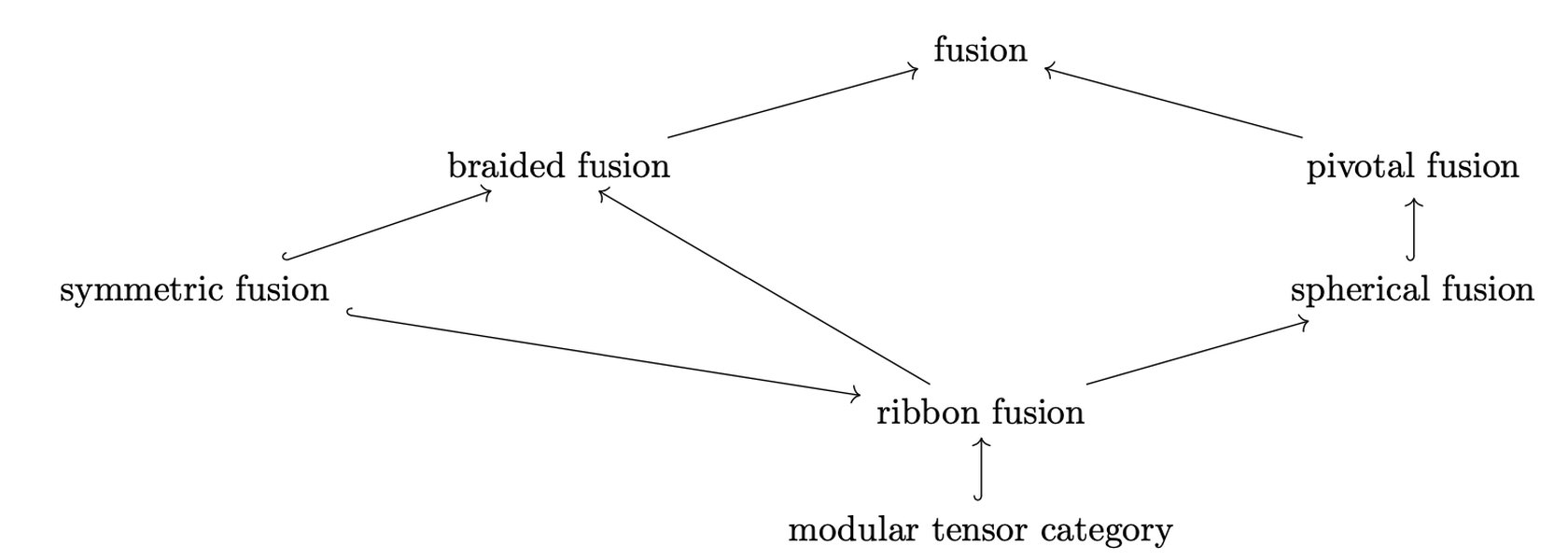
A diagram illustrating the interconnectedness of various structures within category theory.
Essential Characteristics of Fusion Categories
To truly grasp the significance of fusion categories, it's helpful to break down their defining properties:
- Semisimple: Every object in the category can be expressed as a direct sum of simple objects. This property ensures a well-behaved decomposition structure.
- Rigid: Every object possesses a dual, which is crucial for defining traces and dimensions within the category, mirroring concepts from linear algebra.
- Monoidal (Tensor) Category: Equipped with a tensor product operation that is associative (up to natural isomorphism) and a unit object. This structure allows for the "composition" of objects, much like multiplication in an algebra.
- Finitely Many Simple Objects: There are only a finite number of irreducible building blocks, simplifying classification and analysis.
- Finite-Dimensional Hom Spaces: The spaces of morphisms (arrows) between any two objects are finite-dimensional vector spaces, ensuring tractability.
These properties collectively make fusion categories the foundational objects for tensor-categorical approaches to quantum symmetries, providing a robust algebraic model for phenomena in quantum information and condensed matter physics.
The Drinfeld Center: A Categorified Notion of Symmetry
Named after the renowned mathematician Vladimir Drinfeld, the Drinfeld center \(Z(\mathcal{C})\) of a monoidal category \(\mathcal{C}\) is a powerful construction that elevates the concept of a "center" from monoids or algebras to the realm of categories. Conceptually, it captures the "commutative data" relative to all objects within the original category.
An object in the Drinfeld center consists of a pair \((X, \varphi)\), where \(X\) is an object in \(\mathcal{C}\) and \(\varphi\) is a natural isomorphism, known as a **half-braiding**. This half-braiding provides a consistent way to "commute" \(X\) past any other object \(Y\) in \(\mathcal{C}\): \[ \varphi_Y: X \otimes Y \to Y \otimes X \] This natural isomorphism must satisfy a specific hexagon coherence condition, which ensures its compatibility with the monoidal structure. The existence of such a half-braiding makes \(Z(\mathcal{C})\) a **braided monoidal category**, meaning it has a consistent way to interchange tensor factors.
David Reutter discusses higher fusion categories and their fusion rings, providing context for advanced categorical structures relevant to the Drinfeld center.
Key Attributes and Significance of the Drinfeld Center
The Drinfeld center possesses several profound properties, especially when \(\mathcal{C}\) is a fusion category:
- Braided Fusion Category: If \(\mathcal{C}\) is a fusion category, its Drinfeld center \(Z(\mathcal{C})\) is itself a fusion category, but with the added structure of a braiding. This braiding allows for non-trivial permutations of tensor factors, which is essential for encoding the statistics of particles in quantum systems.
- Dimension Squared: A remarkable property is the relationship between the categorical dimensions: \(\dim(Z(\mathcal{C})) = (\dim \mathcal{C})^2\). This indicates a significant increase in complexity and structure within the center.
- Modular Category: If the original fusion category \(\mathcal{C}\) is spherical (a fusion category with a compatible pivotal structure) and non-degenerate, its Drinfeld center \(Z(\mathcal{C})\) becomes a **modular tensor category**. Modular categories are paramount in topological quantum field theory for constructing invariants of 3-manifolds and are central to topological quantum computing due to their rich braiding and twist structures.
- Universal Recipient: The Drinfeld center acts as a universal construction. Any braided monoidal functor from \(\mathcal{C}\) will factor through its Drinfeld center.
- Categorification of Drinfeld Double: In the context of Hopf algebras, the Drinfeld center is a categorification of the Drinfeld double construction. This connection highlights its role in generalizing algebraic symmetries.
The Symbiotic Relationship: Fusion Categories and Their Drinfeld Centers
The interplay between fusion categories and their Drinfeld centers is not merely definitional; it's a dynamic relationship that unlocks deeper insights into mathematical structures and their physical manifestations. The Drinfeld center provides a canonical way to "braid" a monoidal category, transforming it into a more structured entity. This transformation is particularly potent for fusion categories, as it often elevates them to modular tensor categories, which are the algebraic backbones of (2+1)D topological quantum field theories.
Applications and Research Frontiers
The theoretical elegance of the Drinfeld center finds practical resonance in various fields:
- Topological Phases of Matter: The Drinfeld center provides a precise mathematical formulation for the boundary-bulk relation in (2+1)D anomaly-free topological orders. It helps classify gapped phases of matter, where its modular data describes the properties of emergent anyons.
- Conformal Field Theory (CFT): In (1+1)D rational CFTs, the "pointed Drinfeld center functor" offers a formulation for the boundary-bulk relation, extending its applicability to quantum field theory.
- Subfactor Theory: Fusion categories arising from subfactor theory are intimately linked to their Drinfeld centers, which aid in classifying small-index subfactors and understanding their modular data.
- Quantum Computing: Modular tensor categories, often obtained as Drinfeld centers of spherical fusion categories, are central to the mathematical framework of topological quantum computation, where their braiding properties can be harnessed for fault-tolerant quantum gates.
Computational Aspects and Algorithms
Recent advancements have focused on concrete computations of the Drinfeld center. Algorithms have been developed to explicitly compute the simple objects within the Drinfeld center of a given spherical fusion category. This allows for a more constructive approach to understanding these complex structures. The computations of modular data for Drinfeld centers, particularly for those derived from generalized subfactors, contribute significantly to the classification efforts in higher algebra.
A Glimpse into the Structure of the Drinfeld Center
The following mindmap illustrates the core components and key relationships associated with the Drinfeld Center:
Summary of Distinctions and Connections
The following table summarizes the key characteristics and relationships between fusion categories and their Drinfeld centers:
| Feature | Fusion Category (\(\mathcal{C}\)) | Drinfeld Center (\(Z(\mathcal{C})\)) |
|---|---|---|
| Core Definition | Semisimple, rigid monoidal category with finitely many simple objects over an algebraically closed field. | A category whose objects are pairs \((X, \varphi)\) (object \(X\) from \(\mathcal{C}\) and a half-braiding \(\varphi\)). |
| Primary Structure | Monoidal (tensor) category. | Braided monoidal category (always). |
| Relationship to Symmetries | Generalizes representation categories of finite groups/quantum groups. Captures algebraic symmetries. | Categorifies the "center" concept; encapsulates internal "commutative" symmetries and braiding. |
| Key Property | Fundamental in algebraic quantum field theory, subfactor theory. | If \(\mathcal{C}\) is spherical, \(Z(\mathcal{C})\) is a modular category (crucial for TQFTs). |
| Dimension Relationship | \(\dim \mathcal{C}\) | \(\dim(Z(\mathcal{C})) = (\dim \mathcal{C})^2\) |
| Applications Focus | Classifying topological phases, general quantum symmetries, algebraic structures. | Topological quantum computation, boundary-bulk relations, quantum invariants of 3-manifolds, classifying modular data. |
| Examples | Repesentations of finite groups, certain quantum groups. | Representation categories of Drinfeld doubles of Hopf algebras. |
Frequently Asked Questions (FAQ)
What is a semisimple category?
What is a half-braiding in the context of the Drinfeld center?
Why is the Drinfeld center important for topological quantum field theory?
How does the Drinfeld center relate to Hopf algebras?
Conclusion
Fusion categories and their Drinfeld centers are cornerstones of modern mathematics and theoretical physics, providing sophisticated tools for understanding symmetry, topology, and quantum phenomena. Fusion categories lay the groundwork as rich algebraic structures, generalizing familiar concepts from group and representation theory. The Drinfeld center, in turn, acts as a powerful enhancer, transforming these structures by endowing them with braiding. This transformation is particularly profound when it yields modular tensor categories, which are indispensable for describing topological quantum field theories and form the mathematical bedrock for emerging technologies like topological quantum computing. The active research in this area, including the development of algorithms for explicit computations, continues to reveal deeper connections and applications, solidifying their role at the forefront of abstract algebra and quantum science.
Recommended Further Exploration
- Explore the real-world applications of fusion categories in condensed matter physics.
- Investigate the algebraic connection between the Drinfeld double and the Drinfeld center.
- Delve into how modular tensor categories power topological quantum computation.
- Discover the latest computational methods for analyzing Drinfeld centers.