
Building a Resilient Floating Deck: Sizing Galvanized Steel for Optimal Performance
Unlock the secrets to constructing a durable and long-lasting floating deck with the right galvanized steel components.
Constructing a floating deck requires careful consideration of materials, especially when aiming for longevity and stability. For a 1.2 x 5-meter floating deck, galvanized steel offers significant advantages over traditional wood due to its superior strength, durability, and resistance to environmental factors. The choice of galvanized steel components, including beams, joists, and posts, is crucial for ensuring the deck's structural integrity and ability to withstand various conditions, particularly in marine or high-moisture environments. This guide delves into the specifics of sizing galvanized steel for your 1.2 x 5-meter floating deck, highlighting key considerations and providing expert insights.
Key Highlights for Your Steel-Framed Floating Deck
- Exceptional Durability and Longevity: Galvanized steel frames are highly resistant to rot, insects, fire, and warping, offering a lifespan of 25 years or more, significantly outperforming traditional wood.
- Superior Strength and Stability: Steel's inherent strength allows for longer spans and fewer support posts, providing a more open and structurally sound deck that can even support heavy features like hot tubs.
- Consistent Dimensions and Easier Installation: Unlike wood, steel components are consistently sized, making installation more predictable and often quicker, even for DIY enthusiasts, by eliminating warping and twisting.
Understanding Floating Decks and Steel Framing
A floating deck, also known as a ground-level or detached deck, is an outdoor platform that is not directly attached to a main structure like a house. This design often allows for simpler installation and can be ideal for various backyard settings. When constructed with a steel frame, a floating deck gains unmatched advantages in terms of resilience and lifespan. Steel deck framing, particularly when galvanized, provides a robust alternative to wood, offering superior structural integrity and resistance to common issues like rot, insects, and fire.
Galvanized steel is steel that has been coated with a protective layer of zinc, typically through a hot-dip galvanizing process. This zinc coating acts as a barrier against rust and atmospheric corrosion, significantly extending the material's lifespan and making it ideal for outdoor applications, especially those exposed to moisture or harsh weather. For a floating deck, where exposure to ground moisture is common, galvanized steel is a prime choice for its corrosion resistance and durability.
Why Choose Galvanized Steel for Your Floating Deck?
The benefits of using galvanized steel for a floating deck are numerous:
- Strength and Load Capacity: Steel offers exceptional strength, allowing for longer spans between supports and the ability to bear heavy loads, including furniture, foot traffic, and even heavier amenities like hot tubs, with fewer posts. This translates to more open and usable space beneath the deck.
- Durability and Longevity: Unlike wood, which is susceptible to rot, insect infestation, and fire, galvanized steel is highly resistant to these elements. This leads to a deck frame that can last for decades, often exceeding 25 years, with minimal maintenance.
- Dimensional Stability: Steel components maintain their shape and size, resisting warping, twisting, or shrinking due to moisture or temperature fluctuations. This ensures a consistently flat and stable deck surface over time, preventing common issues like uneven decking or gaps.
- Fire Safety: Galvanized steel boasts a Class A Fire Safety Rating from the National Fire Protection Association, the highest rating available for building materials, offering enhanced safety.
- Ease of Installation: While initially perceived as more complex, modern steel framing systems, like those from Fortress Evolution, are designed for easy assembly, often resembling an "Erector Set." Consistent sizing of components simplifies the process, reducing on-site cutting and potential discrepancies found with wood.
Despite the initial higher material cost compared to wood, the long-term benefits of reduced maintenance, increased lifespan, and superior performance often make galvanized steel a more cost-effective choice over the life of the deck.
Sizing Galvanized Steel for a 1.2 x 5-Meter Floating Deck
For a 1.2 x 5-meter (approximately 3.9 x 16.4 feet) floating deck, precise sizing of galvanized steel components is essential to ensure structural integrity and longevity. The specific dimensions and types of steel will depend on factors such as the intended load, local building codes, and desired deck height.
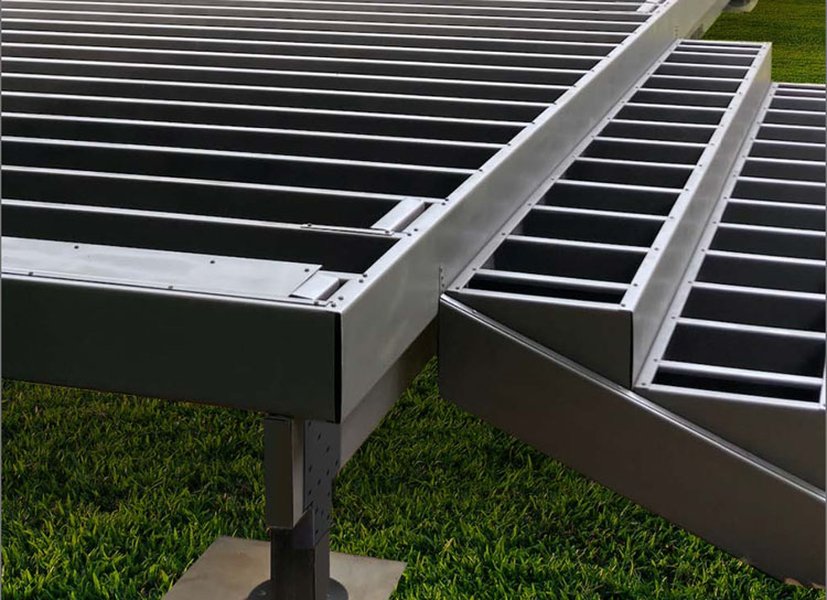
A meticulously constructed deck frame utilizing New Castle steel components, highlighting the precision and strength achievable with steel framing.
Structural Components and Their Sizing Considerations
The primary structural components for your deck will include:
Beams
Beams are the main horizontal supports that carry the load from the joists to the posts. For a 5-meter length, a single continuous beam might be possible, or multiple beams with intermediate support posts. Galvanized steel beams are available in various profiles and gauges. Given the 5-meter span, a robust beam is necessary. Common options include square or rectangular tubing, or built-up sections from lighter gauge steel. Some manufacturers offer standard 10-inch galvanized steel beams that can span up to 10 feet (approximately 3 meters). For a 5-meter span, you might need a heavier gauge or a larger cross-section. For example, a W8x21 (wide flange I-beam) could be considered for greater spans, though lighter-gauge steel can be fabricated into larger cross-sections by combining studs and tracks.
Joists
Joists are the horizontal framing members that support the decking material directly. They run perpendicular to the beams. For a 1.2-meter width, joists will span this distance. Standard galvanized steel joists, often in familiar shapes similar to wood joists (e.g., 2 inches x 6 inches x 16 feet, 16-gauge steel), are available from manufacturers like Fortress Evolution. The spacing of these joists is critical for supporting the decking material and preventing deflection. Typical joist spacing for decking is often 16 inches (approximately 40 cm) or 24 inches (approximately 60 cm) on center, depending on the decking material's span rating.
Posts
Posts provide vertical support for the beams and transfer the deck's load to the footings. For a floating deck, these posts would typically rest on concrete footings, even if the deck is low to the ground. Galvanized steel tubular posts (e.g., 2-inch x 5-inch frames) or square/rectangular tubing are excellent choices for their strength and corrosion resistance. Adjustable steel posts are also available to accommodate variations in ground level and for easier leveling during installation. The number and spacing of posts will depend on the beam spans and the overall load requirements.
Galvanized steel tubular posts featuring adjustable screw top heads, ideal for providing stable and adjustable support for elevated decks.
Decking Material and Considerations
While the framing is steel, the visible decking material can be wood (like ipe or cedar), composite, or PVC. Composite and PVC decking are popular choices with steel frames due to their durability and low maintenance, complementing the long lifespan of the steel. When using wood decking with steel, it is important to incorporate spacers to prevent direct contact between the wood and steel, which can trap moisture and lead to galvanic corrosion.
Galvanization Types
Galvanized steel is available in different grades based on the thickness of the zinc coating, typically measured in ounces per square foot:
- G60: Contains about 0.6 ounces of zinc per square foot. Suitable for most general applications and offers good corrosion protection.
- G90: Contains 0.9 ounces of zinc per square foot. Provides enhanced corrosion resistance and is often recommended for more severe environmental conditions, such as high humidity or marine environments.
For a floating deck, especially one in a potentially moist environment, G90 galvanized steel or even heavier galvanized finishes should be considered for maximum longevity.
Estimating Materials and Design Considerations
Accurately estimating materials for a steel-framed deck requires a detailed plan. Professional deck designers and suppliers can help create a custom plan and materials list, ensuring all components are correctly sized and compatible. For a 1.2 x 5-meter deck, a rough calculation would involve:
- Beams: At least two 5-meter galvanized steel beams running along the length, or shorter sections connected appropriately, with intermediate support posts depending on span ratings and load.
- Joists: Given the 1.2-meter width, joists typically span this distance. If spaced at 40 cm on center, you would need approximately 12-13 joists across the 5-meter length (500 cm / 40 cm = 12.5). Each joist would be 1.2 meters long.
- Posts: The number of posts will depend on the span of the beams and the overall design. For a 5-meter beam, you might need posts at regular intervals, potentially at each end and one or two in the middle, depending on the beam's load capacity.
- Ledger Board (if applicable): While a floating deck is detached, if any part of it abuts a structure, a galvanized steel ledger could be used for attachment.
- Fasteners and Hardware: All fasteners, connectors, and brackets must also be galvanized or stainless steel to prevent galvanic corrosion between dissimilar metals.
It is always recommended to consult with a structural engineer or a knowledgeable deck professional to finalize the design and material specifications, especially for larger or elevated decks, to ensure compliance with local building codes and safety standards.
Comparative Analysis: Steel vs. Wood Deck Framing
To better understand the advantages of galvanized steel, let's compare its performance across key attributes with traditional pressure-treated wood framing.
This radar chart illustrates the comparative performance of galvanized steel and pressure-treated wood across several critical deck framing attributes. The chart visually demonstrates how galvanized steel generally outperforms wood in areas like durability, fire resistance, and dimensional stability, while wood might have an edge in initial material cost and ease of cutting on-site. This comparison helps in understanding the long-term value and practical benefits of choosing steel for your deck frame.
As the chart illustrates, galvanized steel generally provides superior performance in critical areas such as durability, fire resistance, dimensional stability, longevity, and resistance to pests and rot. While the initial material cost for wood might be lower, and its on-site cutting might be simpler for some, the overall benefits and reduced maintenance requirements of steel often lead to a greater long-term value.
Essential Materials for Your Galvanized Steel Floating Deck
Beyond the structural steel components, building a 1.2 x 5-meter floating deck requires a variety of other materials to ensure a complete and successful project. Here's a comprehensive list:
| Component Category | Specific Materials | Purpose & Considerations |
|---|---|---|
| Foundation & Support | Concrete mix, gravel/crushed stone, concrete forms (if needed), galvanized steel footings/piers, adjustable galvanized steel post bases. | Provides a stable base for the posts, preventing settling and ensuring proper drainage. Galvanized components ensure longevity in ground contact. |
| Framing (Galvanized Steel) | Galvanized steel beams (square/rectangular tubing, C-channel), galvanized steel joists (pre-fabricated sections), galvanized steel ledger board (if connecting to a structure), galvanized steel posts. | Forms the primary structural support of the deck, ensuring strength, durability, and resistance to environmental factors. Gauge and profile depend on span and load. |
| Decking Surface | Composite decking boards, PVC decking boards, pressure-treated lumber, hardwood (e.g., Ipe, Cedar). | The visible surface of the deck. Choose based on aesthetics, maintenance preference, and budget. Ensure compatibility with steel framing (e.g., using spacers for wood). |
| Fasteners & Connectors | Galvanized or stainless steel screws, bolts, nuts, washers, joist hangers, connection plates, bracing. | Crucial for securely joining all components. Must be corrosion-resistant to match the galvanized steel frame and prevent galvanic corrosion. |
| Drainage & Protection | Deck flashing tape (for ledger), weed barrier fabric, gravel for under-deck drainage. | Protects the deck frame from moisture, prevents weed growth, and ensures proper water runoff away from the foundation. |
| Railing & Stairs (Optional) | Galvanized steel posts/balusters, composite/PVC railing kits, wood railing components, galvanized steel stair stringers. | Enhances safety and aesthetic appeal. Materials should complement the deck surface and meet local building codes for height and spacing. |
| Tools & Equipment | Tape measure, levels, drills, saws (metal-cutting blades for steel), wrenches, safety gear (gloves, eye protection), digging tools, concrete mixer (if applicable). | Necessary for accurate measurement, cutting, assembly, and safe construction. |
Understanding Floating Docks and Steel in Marine Applications
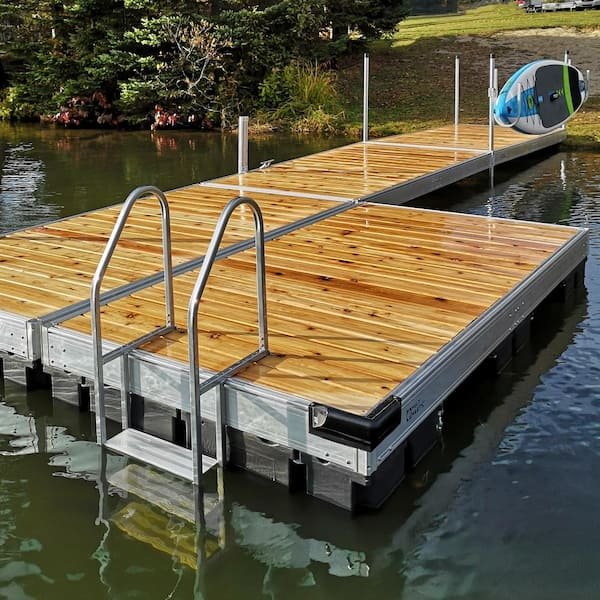
While the user specifically asked about a floating deck, it's worth noting the parallel with floating docks, which extensively use galvanized steel due to their direct exposure to water and harsh marine environments. The principles of strength, corrosion resistance, and longevity are even more critical in these applications.
Galvanized steel is a preferred material for floating docks due to its ability to withstand constant immersion and exposure to corrosive elements like saltwater. Manufacturers utilize hot-dipped galvanized steel truss frames for maximum strength and corrosion resistance, ensuring the docks can support heavy loads and endure decades of use. This highlights the inherent robustness and suitability of galvanized steel for any structure designed to "float" or be in close proximity to moisture, reinforcing its excellent choice for a floating deck.
This video provides a practical look at building a deck with steel framing, offering insights into the installation process and showcasing the final product. It serves as an excellent visual guide to understanding the benefits and techniques involved in using steel for deck construction.
Frequently Asked Questions
What is galvanized steel?
How does galvanized steel compare to wood for deck framing?
Do I need special tools to build a steel-framed deck?
What are the common sizes for galvanized steel deck components?
Is a permit required for building a floating deck?
Conclusion
For a 1.2 x 5-meter floating deck, galvanized steel framing offers an exceptional solution that prioritizes longevity, strength, and minimal maintenance. By choosing appropriately sized galvanized steel beams, joists, and posts, coupled with proper installation techniques and compatible decking materials, you can create a resilient and beautiful outdoor space that will endure for decades. While the initial investment may be higher than traditional wood, the long-term benefits in terms of durability, safety, and reduced upkeep make galvanized steel a smart and sustainable choice for your floating deck project.
Recommended Further Exploration
- Explore the comprehensive advantages of steel deck framing compared to traditional wood construction.
- Delve deeper into different grades of galvanized steel and their suitability for various outdoor environments.
- Conduct a detailed cost-benefit analysis comparing the upfront and long-term expenses of steel versus wood decks.
- Discover available DIY steel deck framing kits and how they can simplify your construction process.