
Unveiling the Tale of Two Distributions: Gamma vs. Generalized Asymmetric Laplace
Exploring the statistical nuances that set apart the Variance/Mean Gamma and Generalized Asymmetric Laplace distributions.
Key Highlights
- Variance/Mean Gamma distribution: A continuous probability distribution derived from a normal variance-mean mixture, useful for modeling data with heavier tails than a normal distribution.
- Generalized Asymmetric Laplace (GAL) distribution: An extension of the Laplace distribution allowing for asymmetry and heavier tails, offering flexibility in modeling various data types.
- Primary Difference: VG distributions are defined by a mixing density that is a gamma distribution, while GAL distributions directly incorporate parameters to control skewness and kurtosis, making them more flexible for modeling asymmetry.
Understanding the Variance/Mean Gamma Distribution
The Variance/Mean Gamma (VG) distribution, also referred to as the Generalized Laplace distribution or Bessel function distribution, is a continuous probability distribution. It is defined as a normal variance-mean mixture where the mixing density is a gamma distribution. This characteristic makes it particularly suitable for modeling phenomena where numerically large values are more probable compared to the normal distribution.
Core Characteristics of the Variance/Mean Gamma Distribution
The VG distribution arises from the normal variance-mean mixture, where the mixing density is a gamma distribution. This results in heavier tails compared to the normal distribution. Here are the key aspects:
- Normal Variance-Mean Mixture: The VG distribution is constructed by mixing a normal distribution with a gamma distribution.
- Heavy Tails: Its tails decrease more slowly than those of the normal distribution, making it suitable for modeling data with extreme values.
- Applications: Commonly used for modeling returns from financial assets and turbulent wind speeds.
Mathematical Representation
The probability density function (PDF) of the Gamma distribution is given by: \[ f(x; \alpha, \beta) = \frac{\beta^\alpha}{\Gamma(\alpha)} x^{\alpha - 1} e^{-\beta x} \] where \( \alpha \) is the shape parameter and \( \beta \) is the rate parameter. The VG distribution inherits properties from this gamma mixing process, leading to its unique characteristics.
Applications and Use-Cases
The Variance/Mean Gamma distribution finds extensive use in various domains due to its ability to model data with heavier tails and capture skewness. Key applications include:
- Finance: Modeling financial asset returns, where extreme values are more frequent than predicted by a normal distribution.
- Meteorology: Analyzing turbulent wind speeds, which often exhibit non-normal characteristics.
Exploring the Generalized Asymmetric Laplace Distribution
The Generalized Asymmetric Laplace (GAL) distribution is an extension of the standard Laplace distribution, providing increased flexibility through the introduction of parameters that control asymmetry and kurtosis. This makes it a versatile tool for modeling various types of data that deviate from normality.
Key Properties of the Generalized Asymmetric Laplace Distribution
The GAL distribution is characterized by its ability to model asymmetry and heavier tails, making it suitable for a wide range of applications.
- Flexibility: The GAL distribution extends the Laplace distribution by adding parameters for skewness and kurtosis.
- Asymmetry: It can model data that is not symmetrical around the mean.
- Heavy Tails: Similar to the VG distribution, it accommodates extreme values more effectively than the normal distribution.
Mathematical Structure
The PDF of the Generalized Asymmetric Laplace distribution is more complex, involving parameters that directly control the skewness and kurtosis of the distribution. A general form can be expressed as: \[ f(x) = \frac{\alpha \beta}{\alpha + \beta} \exp\left(-\frac{|x-\mu|}{\sigma} \left( \alpha I(x \geq \mu) + \beta I(x < \mu) \right) \right) \] where \( \mu \) is the location parameter, \( \sigma \) is the scale parameter, and \( \alpha \) and \( \beta \) control the asymmetry.
Applications in Diverse Fields
The Generalized Asymmetric Laplace distribution is employed in scenarios where data exhibits asymmetry and heavy tails. Common applications include:
- Finance: Modeling non-normal financial data, such as stock returns and option prices.
- Economics: Analyzing income distributions and other economic variables.
Comparative Analysis: VG Distribution vs. GAL Distribution
While both the Variance/Mean Gamma (VG) distribution and the Generalized Asymmetric Laplace (GAL) distribution are used to model data that deviates from normality, they differ in their construction and specific characteristics.
Key Differences Summarized
Here are the main distinctions between the two distributions:
-
Construction: The VG distribution is constructed as a normal variance-mean mixture with a gamma mixing density, whereas the GAL distribution is an extension of the Laplace distribution with added parameters for skewness and kurtosis.
-
Parameters: VG distributions are primarily influenced by the parameters of the underlying gamma distribution, while GAL distributions have explicit parameters to control asymmetry.
-
Flexibility: GAL distributions often offer more direct control over the shape of the distribution due to their explicit skewness and kurtosis parameters.
Detailed Comparison Table
To further clarify the differences, the following table provides a side-by-side comparison of the key attributes of the VG and GAL distributions.
| Feature | Variance/Mean Gamma (VG) Distribution | Generalized Asymmetric Laplace (GAL) Distribution |
|---|---|---|
| Construction | Normal variance-mean mixture with gamma mixing density | Extension of the Laplace distribution |
| Primary Use | Modeling data with heavier tails | Modeling data with asymmetry and heavier tails |
| Parameters | Shape and scale parameters from the gamma distribution | Location, scale, and asymmetry parameters |
| Flexibility in Modeling Asymmetry | Indirect, through the gamma mixing process | Direct, through explicit asymmetry parameters |
| Common Applications | Finance, meteorology | Finance, economics |
Practical Implications
The choice between the VG and GAL distributions depends on the specific characteristics of the data being modeled. If the primary concern is capturing heavy tails, the VG distribution may be suitable. However, if both asymmetry and heavy tails are present and need to be explicitly controlled, the GAL distribution offers a more flexible approach.
Visualizing the Gamma Distribution
Below are examples of Gamma distribution graphs demonstrating different shapes based on varying parameters. These distributions arise naturally in processes where waiting times between Poisson distributed events are relevant.
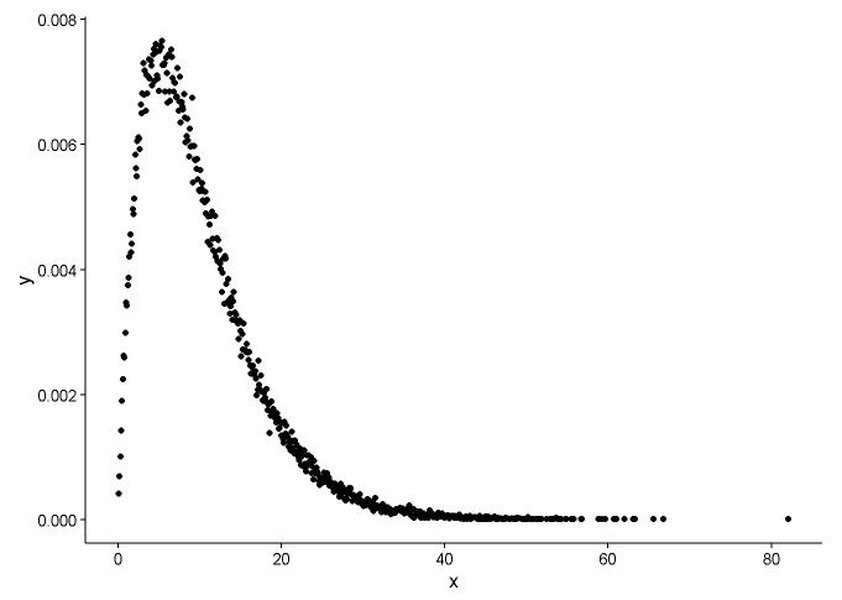
The Gamma distribution's versatility makes it applicable in diverse fields such as modeling rainfall, mechanical tool reliability, and other applications yielding positive results. Understanding its graphical representation is crucial for selecting the appropriate distribution for specific data analysis needs.
Video Explanation: Deep Dive into Gamma Distribution
To further enhance your understanding, the following video provides an in-depth explanation of the gamma distribution, including its mathematical properties and practical applications.
This video, titled "Gamma Distribution - Derivation of Mean, Variance & Moment Generating Function (MGF) (English)" by user Anish Turlapaty, provides a detailed explanation of the Gamma Distribution. The video covers the derivation of the mean, variance, and moment generating function (MGF) for the Gamma Distribution. This is particularly relevant for understanding the mathematical underpinnings of the Gamma Distribution and how its parameters influence its shape and behavior. It's a great resource for those looking to deepen their knowledge of this important statistical distribution.
FAQ Section
References
Last updated April 10, 2025