
Innovative Quantitative Research Topic
Exploring New Avenues in Gender Equality, Women Entrepreneurship, and GDP Analysis
Highlights
- Novel Combinations: Focused on under-researched intersections between gender parity and economic indicators.
- Comprehensive Data Analysis: Leverages extensive secondary datasets from international organizations.
- Policy Relevance: Aims to empower decision-makers through actionable insights on women's entrepreneurship impact.
Proposed Research Topic
"Exploring the Impact of Gender Parity in Entrepreneurship on National GDP Growth: A Comparative Quantitative Analysis Using Secondary Data"
The proposed topic investigates how gender equality in the entrepreneurial landscape shapes GDP growth across diverse economic settings. This study will use secondary data sources to explore the underlying relationships between the level of gender equality in entrepreneurship, the participation and performance of women-led businesses, and the overall economic growth measured by GDP. While research on women entrepreneurship and its economic contributions exists, there is a gap in examining the specific role that gender parity in entrepreneurship plays within differing national contexts.
Research Rationale and Objectives
Research Rationale
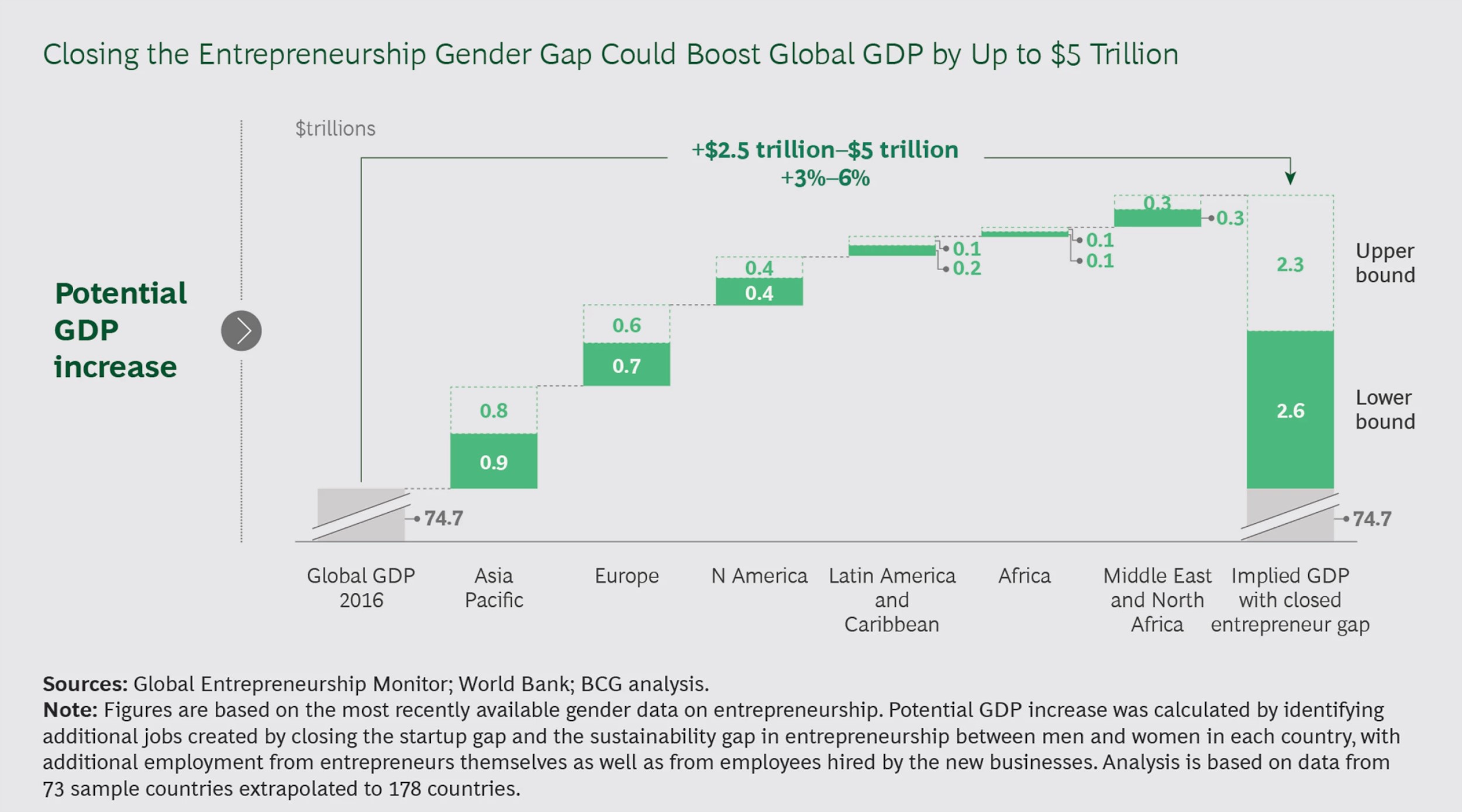
The overarching rationale for this research stems from the understanding that enhancing gender equality does not merely contribute to social justice but also has profound macroeconomic implications. Recent estimates suggest that advancing gender parity could potentially add trillions to global GDP through increased labor force participation, innovation, and improved productivity. Women entrepreneurs, who continue to face systems of bias and resource limitations, represent a largely untapped source of economic dynamism. By focusing on nations with varying levels of gender equality, the study seeks to disentangle the complex and region-specific influences of female entrepreneurial activities on GDP growth.
Research Objectives
- To quantitatively assess the relationship between the Gender Equality Index (GEI) in entrepreneurship and national GDP growth.
- To analyze whether the economic impact of women-led businesses varies across countries with different gender parity levels.
- To examine potential mediating or moderating factors such as access to finance, education levels, and entrepreneurial policies.
- To offer evidence-based policy recommendations for enhancing women entrepreneurship as a means to bolster GDP.
Research Questions
Primary Questions
- How does the level of gender equality in entrepreneurship correlate with GDP growth across different nations?
- Is there a statistically significant difference in the impact of women entrepreneurship on GDP between countries with high and low gender parity?
- What control variables (such as education, regulatory frameworks, and access to capital) most significantly influence the relationship between women entrepreneurship and GDP?
Secondary Questions
- Which regions or income-level groups exhibit stronger correlations between gender equality in entrepreneurship and GDP growth?
- How have changes in gender-centered entrepreneurship policies over the past decade contributed to economic growth?
- Can targeted interventions to support women entrepreneurs yield measurable changes in national GDP over a given period?
Methodology and Data Sources
Data Collection
This study emphasizes the use of secondary data, supporting the investigation with robust, internationally recognized datasets. The following are key secondary data sources:
- World Bank's World Development Indicators (WDI): Provides comprehensive data on national GDP, economic growth metrics, and broader socioeconomic factors.
- Global Gender Gap Report by the World Economic Forum (WEF): Offers essential insights into the state of gender equality, including aspects related to education, economic participation, and opportunity.
- Global Entrepreneurship Monitor (GEM): Supplies detailed statistics on entrepreneurial activities, partitioning information along gender lines.
- OECD Data: Useful for comparing economic performance and entrepreneurial outcomes in OECD countries.
- United Nations Development Programme (UNDP) Human Development Index (HDI): Provides contextual data to control for human capital and institutional quality.
Analytical Framework
The study will implement advanced panel data regression techniques to discern both cross-sectional and time-series variations across countries. The analytical framework aims to isolate the independent impact of gender equality in entrepreneurship on GDP growth while controlling for potential confounding variables. The following steps outline the methodology:
Step 1: Data Preparation
Data collected from various sources will be merged into a unified database. Variables will include GDP growth rates, women entrepreneurial rates, a composite gender equality index specific to entrepreneurship, and other control variables like access to finance and education.
Step 2: Model Specification
The primary model takes the form:
\( \text{\text{GDP Growth}}_{it} = \beta_0 + \beta_1 \text{\text{Gender Equality Index}}_{it} + \beta_2 \text{\text{Women Entrepreneurship Rate}}_{it} + \beta_3 \text{\text{Control Variables}}_{it} + \mu_i + \epsilon_{it} \)
where \( \mu_i \) represents country-specific fixed effects and \( \epsilon_{it} \) is the error term.
Step 3: Regression Analysis
The analysis will involve fixed-effects or random-effects models depending on the Hausman test outcomes, ensuring robustness of the estimates. Interaction terms may be incorporated to examine whether the impact of women entrepreneurship differs by levels of gender equality.
Step 4: Validation and Robustness Checks
To strengthen the credibility of the results, additional analyses such as sensitivity checks and robustness tests will be implemented. Time-fixed effects and regional dummy variables can further account for unobserved heterogeneity.
Analytical Tools and Software
Statistical software such as Stata, R, or Python will be used for the data analysis. These tools facilitate data cleaning, regression analysis, and visualization of the relationships between the variables.
Expected Findings and Policy Implications
Anticipated Outcomes
Although empirical analysis is required to establish conclusive evidence, the study is expected to reveal:
- A positive and statistically significant correlation between higher levels of gender equality in entrepreneurship and GDP growth.
- Differential impacts in OECD versus non-OECD countries, with emerging economies potentially exhibiting more pronounced effects.
- Identification of key moderating factors—such as education systems, finance accessibility, and supportive government policies—that impact the strength of the relationship between women-led entrepreneurial ventures and economic growth.
Policy Implications
The study’s outcomes can offer vital policy recommendations by:
- Highlighting the economic value of investing in gender-inclusive entrepreneurship initiatives.
- Guiding governments on the design of tailored support programs that enhance women entrepreneurship to stimulate overall economic performance.
- Providing evidence for the reallocation of resources toward education, financing options, and mentorship programs specifically aimed at women entrepreneurs.
- Encouraging international cooperation, where best practices can be shared, thereby harmonizing efforts to reduce gender disparities, and boosting global economic growth.
Comparative Data Table
| Data Source | Variables | Country Coverage | Relevance |
|---|---|---|---|
| World Bank WDI | GDP, Economic Growth, Socioeconomic Indicators | Global | Primary economic data for regression analysis |
| Global Gender Gap Report | Gender Equality Indices | Global | Quantifies gender parity across multiple dimensions |
| Global Entrepreneurship Monitor (GEM) | Entrepreneurship Rates by Gender | Multiple countries, including emerging economies | Provides detailed data on women’s entrepreneurship metrics |
| OECD Data | Entrepreneurial Performance, Economic Indicators | OECD Member Countries | Useful for comparative analysis |
| UNDP HDI | Human Capital, Institutional Quality | Global | Controls for socioeconomic status and development level |
Relevance to Sustainable Development Goals
SDG 5 and SDG 8
This study resonates strongly with the United Nations Sustainable Development Goals. Specifically, it addresses:
- SDG 5 (Gender Equality): By exploring the impact of improved gender parity in entrepreneurship, the study contributes to a greater understanding of how empowering women can lead to more inclusive societies.
- SDG 8 (Decent Work and Economic Growth): By elucidating the relationship between women entrepreneurship and GDP growth, the research advocates for inclusive economic strategies that spur innovation, productivity, and sustainable development.
Expected Contributions to Academia and Policy
Academic Contributions
This quantitative study is designed to bridge a significant gap in the literature by focusing on the interplay between gender equality in entrepreneurship and GDP growth. Specific academic contributions include:
- A novel empirical framework that enriches current discussions on economic growth determinants.
- A refined methodology that incorporates multiple measures of gender equality and entrepreneurial performance, enhancing comparative research across different national contexts.
- A statistically robust analysis that can be replicated or extended in future studies, thereby solidifying its academic value.
Policy Recommendations and Practical Applications
Beyond the academic sphere, the findings are anticipated to offer practical insights for policymakers. A clear understanding of the interaction between gender equality and economic growth can lead governments to:
- Design and implement more effective women entrepreneurship programs.
- Reform regulatory frameworks to minimize barriers for female entrepreneurs.
- Allocate resources more strategically to support initiatives that directly contribute to GDP growth.
References
- Advancing Gender Parity in Entrepreneurship - World Economic Forum
- Facts and Figures: Economic Empowerment - UN Women
- Gender Inequality and the Entrepreneurial Gender Gap: Evidence from 97 Countries - Springer
- Embracing Gender Equality in the Entrepreneurial Landscape - LinkedIn
- Frontiers in Psychology on Gender Equality and Entrepreneurship
Recommended Related Queries
Last updated March 14, 2025