
Unlocking Global Insights: What Might Pages 88-100 of "geog.2 Student Book" Reveal (Excluding UK Focus)?
A synthesis of probable geographical themes and concepts based on the book's known curriculum and structure, focusing on international perspectives.
The "geog.2 Student Book" by RoseMarie Gallagher and Richard Parish is a well-regarded resource for Key Stage 3 geography. While direct access to the specific content of pages 88 to 100 is generally restricted due to copyright, we can infer the likely geographical themes explored within this section, particularly when focusing on non-UK contexts as requested. This response synthesizes information from various analyses of the book to provide a comprehensive overview of what these pages might cover.
Highlights: Key Geographical Explorations
- Human-Environment Interaction: A probable core focus is the dynamic relationship between human activities (like farming and settlement) and the physical environment, particularly how landforms and topography shape these interactions globally.
- Global Population and Urbanization: The pages likely delve into patterns of population distribution, density, and the significant trend of urbanization, with case studies and examples drawn from diverse international regions, excluding the UK.
- World Climates and Environmental Issues: Exploration of different global climate zones, their characteristics, and the overarching challenges of climate change, resource management, and sustainable development in various non-UK settings.
Understanding the Scope: Reconstructing Potential Content
It's important to note that the precise text and specific examples on pages 88-100 of the "geog.2 Student Book" (5th edition) cannot be reproduced here. Educational materials like textbooks are protected by copyright, and full digital versions are typically not publicly available. However, by examining the book's overall curriculum, common topics in Key Stage 3 geography, and information from summaries, reviews, and related geographical resources, we can construct a well-informed overview of the likely content. The "geog.123" series is known for its student-friendly language, up-to-date case studies, and clear illustrations designed to engage learners and prepare them for further studies like GCSE.
The following sections outline the probable thematic content, meticulously excluding UK-specific examples and focusing on global geographical concepts and international case studies.
Probable Thematic Focus of Pages 88-100 (Non-UK Content)
Human Activities and Land Use
This is a strong candidate for inclusion within these pages, likely building on foundational geographical concepts. The interaction between human societies and the physical landscape is a cornerstone of geography.
The Influence of Topography on Settlements and Agriculture
One of the recurring themes in geography is how physical landscapes dictate human choices. Pages in this range might elaborate on why gently sloping or flat land is generally preferred for agriculture (e.g., ease of cultivation, suitability for irrigation) and building settlements (e.g., stable foundations, simpler infrastructure development). Examples could be drawn from large river plains in Asia, extensive agricultural regions in the Americas, or fertile plateaus in Africa. Notably, a referenced document ("Geography and Environment S2 SB.pdf") contains a snippet attributed to page 88 of a similar curriculum: "Remember! Human activities such as farming and settlements are more common on land that is gently sloping or flat because it is easy to set them..." This strongly supports the likelihood of this theme being prominent, continuing towards page 100 with discussions on land suitability and its implications.
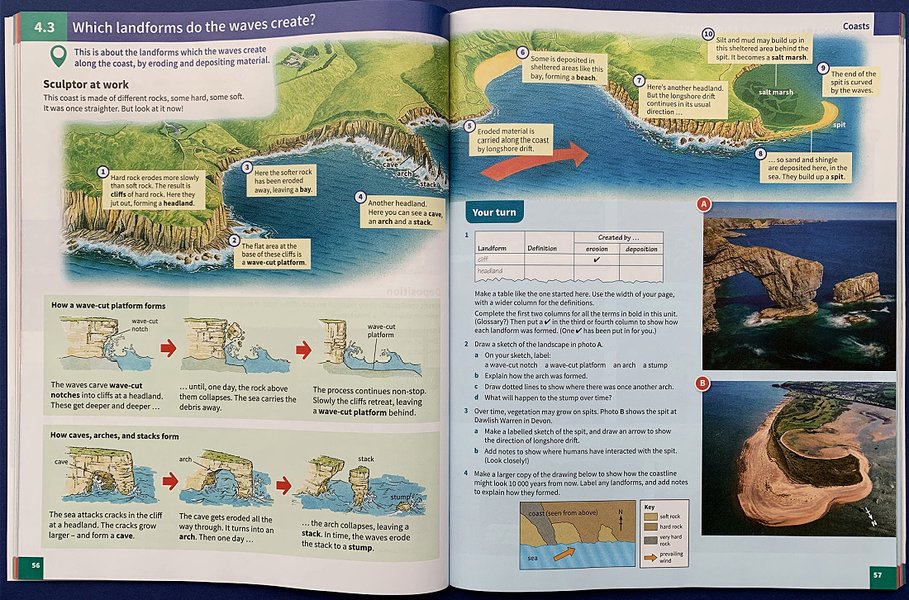
A typical illustrative double-page spread, similar to what might be found in geog.2, showcasing how landforms and human activities are often presented.
Resource Management and Environmental Interactions
This section could explore how different societies manage natural resources like water, soil, and forests in various non-UK geographical contexts. It might touch upon the impacts of human activities, such as deforestation for agriculture, the effects of mining, or water diversion for irrigation, without focusing on UK examples. The concept of sustainable land use and its challenges in different global settings might also be introduced.
Population Dynamics and Urbanization Beyond the UK
Given that the "geog.2" book is known to cover population and urbanization as key topics, this theme is highly probable for pages 88-100, with a distinct international focus.
Global Population Distribution and Density
These pages could explore factors influencing where people live around the world, such as climate favorability, resource availability, economic opportunities, and historical factors. This would likely involve analyzing population density maps and discussing concepts like sparsely and densely populated areas using non-UK examples (e.g., comparing the population patterns of the Amazon rainforest with the river valleys of South Asia or the coastal regions of Southeast Asia).
Urban Growth in Developing Regions
A significant portion might be dedicated to the phenomenon of rapid urbanization occurring in many parts of Asia, Africa, and Latin America. This could include case studies of megacities, discussing their opportunities (e.g., employment, access to services, cultural exchange) and significant challenges (e.g., housing shortages, informal settlements, pollution, strain on infrastructure, social inequalities) from a non-UK perspective.

Visual representation of urban growth trends, a key topic in human geography often discussed in resources like geog.2.
Global Climates, Weather Systems, and Environmental Challenges
This is a staple of geography curricula, and "geog.2" would likely explore these topics with an international lens, excluding specific detailed studies of the UK's climate if the focus is on broader global patterns in this section.
Diverse Climate Zones and Their Impact
The book likely covers different world climate zones (e.g., equatorial, tropical desert, monsoon, Mediterranean, continental, polar – excluding a specific focus on the UK's temperate maritime climate if the pages are dedicated to other regions). It would explain their characteristics, geographical locations, and how they profoundly affect ecosystems, biodiversity, and human lifestyles, including housing, agriculture, and clothing in various international regions.
Addressing Global Warming and Its Consequences
Climate change is a critical contemporary issue. This section could discuss the causes (e.g., greenhouse gas emissions from various global sources) and the widespread impacts of global warming. Examples might include rising sea levels affecting low-lying island nations (e.g., in the Pacific or Indian Oceans), desertification in semi-arid regions of Africa, or changing agricultural patterns and water scarcity in various continents.
Economic Activities in a Global Context
Understanding how people make a living in different parts of the world is central to economic geography.
Agricultural Practices Worldwide
Beyond just identifying where farming occurs, these pages might delve into different types of farming systems (e.g., subsistence agriculture, commercial farming, pastoral nomadism, plantation agriculture) found in various non-UK regions. The physical and human factors influencing these practices, such as climate, soil type, technology, and market access, would be explored.
Resource Extraction and Its Implications
The extraction of minerals, fossil fuels, timber, and other natural resources is a key economic activity with significant geographical, environmental, and social implications. This could be explored through examples from resource-rich countries in continents like South America, Africa, or Asia, discussing both economic benefits and the often-complex challenges related to environmental degradation and social equity.
Potential Regional Case Studies (Non-UK)
The "geog.2" book is known for its use of case studies to illustrate geographical concepts.
Focus on Regions like Asia (e.g., China, Southwest China) or Africa
Specific chapters or sections within the book often zoom in on particular regions to provide in-depth understanding. Given that the overall content of "geog.2" is listed to include "Asia and China," it is plausible that pages 88-100 could feature case studies from these areas or other non-UK regions like parts of Africa. These case studies might examine topics such as development challenges in rapidly industrializing nations, environmental issues like water management in arid regions of Asia, specific industries (e.g., coffee farming in Ethiopia or cut-flower industry in Kenya), or the socio-economic impacts of major infrastructure projects.
Visualizing Interconnected Geographical Concepts
The study of geography involves understanding how different physical and human factors connect and influence each other. The themes likely covered in pages 88-100 of "geog.2" (excluding UK content) would demonstrate these interconnections. The mindmap below illustrates some of these potential relationships, centered around core geographical themes relevant to a global perspective.
(geog.2, pp. 88-100, Non-UK)"] id1["Human-Environment Interaction"] id1a["Topography & Land Use (Farming, Settlements)"] id1b["Resource Management (Water, Soil, Forests)"] id1c["Environmental Impacts & Sustainability"] id2["Population & Urbanization (Global)"] id2a["World Population Distribution & Density"] id2b["Urban Growth & Challenges (Asia, Africa, LatAm)"] id2c["International Migration Patterns & Impacts (Non-UK)"] id3["Climate & Global Environment"] id3a["Major World Climate Zones & Characteristics"] id3b["Global Warming: Causes, Impacts & Responses"] id3c["Ecosystems & Biodiversity (Non-UK Examples)"] id4["Economic Geography (International)"] id4a["Global Agricultural Systems & Food Security"] id4b["Resource Extraction & Trade (Non-UK)"] id4c["Development & Inequality (Global South Focus)"] id5["Regional Studies & Case Studies (Non-UK)"] id5a["Asia (e.g., China, India, SE Asia)"] id5b["Africa (e.g., Sub-Saharan Africa, North Africa)"] id5c["Latin America or Small Island Developing States"] id6["Essential Geographical Skills"] id6a["Interpreting Maps (Thematic, Topographic - Non-UK)"] id6b["Analyzing Geographical Data & Visuals"]
This mindmap outlines how various geographical elements, from physical landscapes to human societal structures and economic activities, are likely explored within the "geog.2" textbook to build a comprehensive understanding of our world from an international perspective.
Comparative Analysis of Factors Influencing Non-UK Regional Development
Regional development across the globe (excluding the UK for this context) is influenced by a complex interplay of factors. The radar chart below offers an illustrative comparison of how different hypothetical non-UK regions might score on key development influencers. This type of analysis helps in understanding why regions develop differently and face unique challenges and opportunities. The scores are purely illustrative for comparative purposes.
This chart visually represents how different combinations of geographical and socio-economic factors can create distinct regional profiles. For instance, a region might be rich in natural resources but face challenges due to difficult topography or climate, impacting its overall development trajectory.
Exploring Global Geographical Perspectives
To broaden the understanding of how geography shapes global events and human societies—themes central to the "geog.2" curriculum—it's insightful to consider broader perspectives on geopolitics and human-environment interactions. While not content from the textbook itself, the following video discusses Tim Marshall's "Prisoners of Geography," a book that explores how physical geography has historically influenced and continues to shape world affairs. This aligns with the study of different world regions and their unique characteristics.
A review of "Prisoners of Geography" by Tim Marshall, illustrating how geographical features influence global politics and history.
Understanding concepts like how mountain ranges can isolate cultures, how access to waterways can drive trade and conflict, or how climate influences agricultural output and societal development, offers a compelling macro-view. This complements the detailed regional studies likely found in "geog.2" by providing a framework for interpreting the significance of geographical factors on a global scale.
Key Geographical Concepts at a Glance: Climate Zones
The "geog.2 Student Book" likely introduces students to various global climate zones and their impact on human life, excluding specific detailed studies of the UK climate in sections focused on other world regions. The table below summarizes characteristics of selected global climate zones and their influence on human activities in non-UK contexts, which could be representative of the content style.
| Climate Zone | Key Characteristics | Typical Non-UK Locations | Impact on Human Activities (Examples) |
|---|---|---|---|
| Equatorial | Consistently hot and wet throughout the year; high humidity; supports dense rainforests and high biodiversity. | Amazon Basin (South America), Congo Basin (Africa), Indonesia. | Dense rainforests can limit large-scale conventional agriculture; supports unique indigenous lifestyles, forestry, and ecotourism. Challenges include leaching of soil nutrients. |
| Tropical Monsoon | Distinct wet and dry seasons; very heavy rainfall during the summer monsoon season. Temperatures remain high. | Indian subcontinent, Southeast Asia (e.g., Vietnam, Thailand), parts of Northern Australia. | Agriculture (especially rice cultivation) is heavily reliant on monsoon rains; seasonal flooding can be a major challenge, but also replenishes fertile soils. |
| Hot Desert (Arid) | Very low and erratic rainfall (typically less than 250mm/year); extreme daily temperature fluctuations (very hot days, cool nights). | Sahara Desert (North Africa), Arabian Desert (Middle East), Atacama Desert (South America), Australian Outback. | Supports sparse population; traditional nomadic pastoralism; modern agriculture reliant on oases or large-scale irrigation (e.g., Nile Valley, Imperial Valley USA). Resource extraction (oil, minerals) is common. |
| Mediterranean | Warm to hot, dry summers; mild, wet winters. Clear skies are common in summer. | Coastal California (USA), Central Chile, Cape Town area (South Africa), Southwestern Australia, countries bordering the Mediterranean Sea (non-European examples). | Favorable for tourism due to pleasant climate; cultivation of drought-resistant crops like olives, grapes, citrus fruits. Water management is crucial in summer. |
| Polar (Tundra & Ice Cap) | Extremely cold year-round; short, cool summers (Tundra) or no true summer (Ice Cap); permafrost (permanently frozen ground) is common in Tundra. | Antarctica, Greenland, Northern Siberia, Northern Canada, Arctic islands. | Very sparse or no permanent human population; traditional hunting/fishing by indigenous groups (e.g., Inuit); scientific research stations; increasing interest in resource extraction (e.g., oil, gas) in Arctic regions. |
Frequently Asked Questions (FAQ)
Why can't I get the exact notes from pages 88-100 of "geog.2 Student Book"?
Educational textbooks like "geog.2 Student Book" are protected by copyright. This means their specific content, including text and images from particular pages, cannot be freely distributed or reproduced without explicit permission from the publishers (Oxford University Press). This response aims to provide an informed synthesis of the *likely* topics and themes covered in those pages, based on the book's known curriculum, its overall structure, typical Key Stage 3 geography content, and focusing on non-UK examples as requested, rather than verbatim notes.
What kind of topics are most likely covered in pages 88-100, excluding UK content?
Based on the book's overall structure and typical Key Stage 3 geography syllabi, pages 88-100 (excluding UK-specific content) would likely cover themes such as:
- Human-Environment Interaction: For instance, how landforms (like plains or mountains) influence farming practices and settlement patterns in various global regions. This could include discussions on resource management.
- Global Population Patterns and Urbanization: This might involve analyzing population distribution in different continents, and case studies of rapidly growing cities in developing countries (e.g., in Asia, Africa, or Latin America), focusing on their opportunities and challenges.
- World Climates and Environmental Issues: An exploration of diverse global climate zones, their characteristics, and their impact on human life and ecosystems, along with discussions on global warming and its consequences in non-UK contexts.
- Economic Activities: This could cover different types of agriculture (subsistence, commercial) and resource extraction (mining, forestry) in various international settings.
- Regional Case Studies: The book often uses case studies, so these pages might feature examples from regions like Asia (including China or Southwest China), Africa, or other parts of the developing world to illustrate geographical concepts.
How does the "geog.2 Student Book" typically present information?
The "geog.123" series, which includes "geog.2," is known for its student-friendly approach. Information is typically presented using:
- Clear, accessible language: Tailored for Key Stage 3 students.
- Well-defined objectives: Often stated at the beginning of units or double-page spreads.
- High-quality visuals: Abundant use of photographs, maps (including Ordnance Survey extracts for map skills, though non-UK maps would be relevant here), diagrams, and charts to explain concepts.
- Up-to-date case studies: Real-world examples from various global locations to make geography relevant.
- Structured layouts: Often using double-page spreads for specific topics.
- Interactive elements: May include "Your turn" questions or short activities to test understanding and encourage application of knowledge.
- Glossary and Index: To aid comprehension and revision.
Are there any specific non-UK case studies I might expect in such a section?
While the exact case studies within pages 88-100 are not detailed in the publicly available information, the "geog.2 Student Book" is known to incorporate international examples. Given the book's stated coverage of "Asia and China," it's reasonable to anticipate case studies from these regions. For example, topics could include:
- Urbanization challenges in a major Asian city (e.g., Mumbai, Shanghai, Dhaka).
- Agricultural practices in a specific non-UK environment (e.g., rice cultivation in Southeast Asia, coffee farming in Ethiopia, or pastoralism in the Sahel).
- Environmental management issues in a particular developing country (e.g., deforestation in the Amazon, water scarcity in the Middle East or North Africa).
- Impacts of climate change on a vulnerable non-UK region (e.g., a small island developing state in the Pacific, or communities in Bangladesh).
These case studies would serve to illustrate broader geographical concepts using concrete, real-world examples from outside the United Kingdom.
Recommended Further Exploration
To deepen your understanding of the geographical themes likely covered in "geog.2 Student Book" (excluding UK content), consider exploring these related queries:
- How do physical landforms influence economic development in different non-European countries?
- What are the primary challenges of rapid urbanization in major cities across Asia and Africa?
- Compare the impacts of different global climate zones on agricultural practices and local economies worldwide.
- Investigate specific examples of human adaptation and resource management in response to environmental changes in developing nations.
References
The information and inferences in this response are based on general knowledge of the "geog.123" series, Key Stage 3 geography curriculum, and details from the following types of sources:

 amazon.co.uk
 amazon.com.mx
Last updated May 19, 2025