
Navigating the Labyrinth: How Early Educational Choices Impact STEM Success in German Universities
Unpacking the complex interplay of mis-selection, evolving assessment methods, and their influence on STEM dropout rates in Germany.
Key Insights into German STEM Dropout Dynamics
- Persistent STEM Dropout Rates: German universities face significant dropout rates in STEM fields, with some programs like mathematics seeing nearly 50% attrition and physics bachelor's programs reaching 60%.
- Early Mis-selection as a Contributing Factor: The stratified German education system, particularly early tracking decisions, can lead to students being placed on paths that do not align with their potential or readiness for demanding STEM studies, indirectly fueling university dropout.
- Shifting Assessment Paradigms: Germany has gradually moved away from standardized tests in early education towards more holistic, teacher-based assessments, driven by pedagogical theories focusing on inclusivity and student well-being, though this shift might have unintended consequences for academic preparedness in STEM.
The Intertwined Realities of Mis-selection and STEM Dropout in Germany
The challenge of high dropout rates in German universities, particularly within Science, Technology, Engineering, and Mathematics (STEM) fields, is a multi-faceted issue. A significant contributing factor identified in various studies is "mis-selection" during the primary and secondary education phases. This refers to instances where students are not adequately matched to educational pathways that align with their aptitudes, interests, and readiness for the rigorous demands of higher education, especially in STEM disciplines.
Early Tracking and its Long-Term Repercussions
Germany's education system is characterized by its early tracking, typically occurring around age 10-12 (Grade 4-6). At this juncture, students are channeled into different secondary school types, such as Hauptschule, Realschule, or Gymnasium. The Gymnasium path culminates in the Abitur, the qualification necessary for university entrance. While intended to provide tailored education, this early stratification can inadvertently lead to mis-selection. Students with strong potential for STEM careers might be directed away from academic tracks or receive instruction that does not sufficiently prepare them for university-level rigor.
The "open-door policy" of German universities, where admission often primarily requires the Abitur, means that many students gain entry without necessarily possessing the foundational preparation or intrinsic motivation required for STEM. This creates a scenario where the admission process is relatively easy, but course completion proves difficult. This mismatch between expectation and reality, coupled with a lack of individualized guidance at the university level, significantly contributes to dissatisfaction and dropout.
Alarming STEM Dropout Statistics
The statistics underscore the severity of the issue. Approximately 30% of all STEM students in Germany do not complete their degrees. This figure escalates significantly in specific fields, with mathematics programs witnessing nearly 50% dropout rates and physics bachelor's programs experiencing an exceptionally high attrition rate of 60%. These numbers highlight a growing skills shortage in STEM areas across Germany, making the issue even more pressing.
Common factors contributing to these high dropout rates include performance problems—students finding the requirements too high and failing intermediate or final exams—and a significant lack of motivation, often stemming from the study program not meeting their expectations. Inadequate study conditions and poor study organization also play a role. Research indicates that prior academic achievements in secondary school are strong predictors of success in higher education STEM programs, implying that if students with insufficient prior achievement are admitted, their risk of dropping out increases.
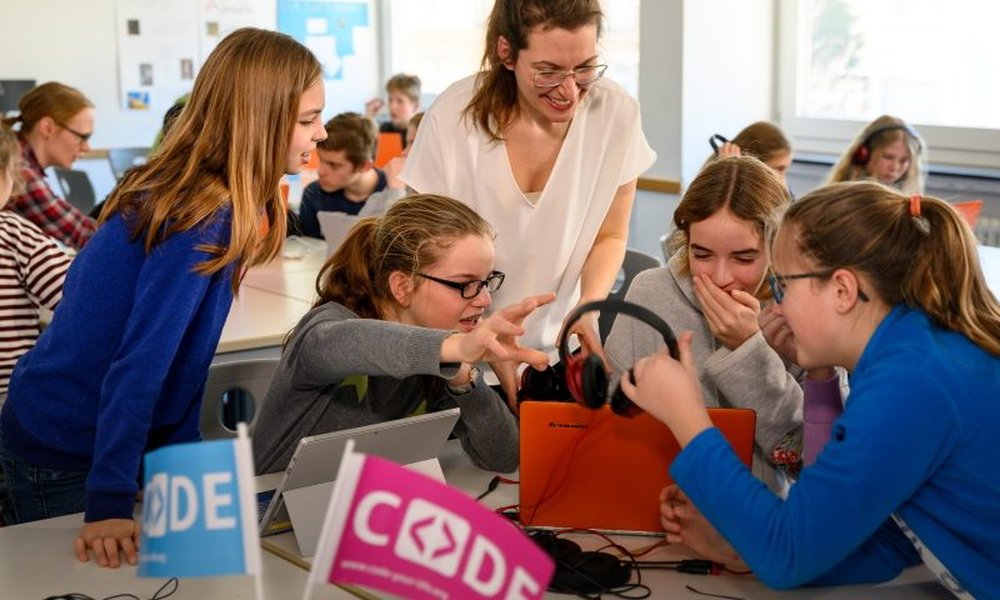
A classroom setting with students engaged in a STEM activity, symbolizing the importance of STEM education in Germany.
The Challenge of International Students in STEM
Germany has seen a rise in international students, with the majority enrolling in STEM programs. However, this demographic also exhibits higher dropout rates in STEM courses compared to non-STEM courses and German students. This could reflect cumulative effects of earlier selection, potential language barriers, and support deficits that may not have been adequately addressed during their primary or secondary education in their home countries or within the German system if they attended earlier schooling in Germany.
Evolution of Assessment Practices: From Traditional Tests to Holistic Evaluations
Germany's education system has undergone significant shifts in assessment practices, particularly in primary and early secondary education. The move has been away from a heavy reliance on traditional, standardized tests and exams towards more continuous, teacher-based assessments that incorporate qualitative factors such as oral classroom participation, project work, and formative feedback. This evolution is rooted in broader educational reforms and pedagogical theories.
A Gradual Shift: Timeline and Rationale
The impetus for these changes began in the 1990s and intensified through the 2000s and 2010s, with ongoing reforms into the 2020s. A pivotal moment was Germany's performance in the Programme for International Student Assessment (PISA) tests in 2000, which highlighted perceived low international rankings and spurred a less ideological, more practical discussion on school development. This led to reforms aimed at establishing federal standards for teaching quality and a more practical orientation in teacher training.
The primary rationale behind this shift is pedagogical: to foster a more holistic, student-centered, inclusive, and adaptive education system. This approach aims to reduce the stress associated with high-stakes testing, better capture students' diverse skills and abilities beyond rote memorization, and accommodate individual learning trajectories and diverse student needs and backgrounds. Teacher assessments, being more context-aware and continuous, were viewed as fairer and more supportive instruments, particularly for disadvantaged students or those with migration backgrounds.
Key Features of Modern German Assessment
- Early Grades (1-2) Primary School: Assessment primarily takes the form of detailed reports describing a pupil's progress, strengths, and weaknesses. Formal examinations are generally absent.
- Later Grades (Grade 3 onwards): Students are gradually introduced to written tests in core subjects like German, Sachunterricht (social studies), and mathematics. Half-yearly reports with marks become common, allowing for comparative assessment.
- Lower Secondary Education: Performance is assessed using a six-mark system. Written exercises, oral contributions, and practical achievements are evaluated throughout the year. Promotion to the next grade depends on achieving an "adequate" mark in promotion-bearing subjects.
- Emphasis on Oral and Practical Assessments: Oral exams, classroom participation, learning portfolios, and project work are increasingly integrated into assessment frameworks, especially in early years.
Research and Policy Driving the Transformation
The move away from early standardized tests is supported by pedagogical research suggesting that excessive reliance on such tests can negatively impact student motivation and disproportionately affect vulnerable student populations. Studies documented how standardized tests at young ages could reinforce existing social inequalities, advocating for more continuous and formative evaluation.
Recent reforms, such as the "A Strong Start in Primary School" project initiated around 2024, focus on expanding educational monitoring and developing diagnostic tools for assessing learning at the beginning of primary school and second grade. Additionally, recommendations for the use of artificial intelligence (AI) in school education processes (October 2024) aim to enable schools to use AI constructively for learning and teaching, potentially enhancing interactive and participatory assessments.
While these reforms promote student well-being and equity, there is an implicit critique that without standardized benchmarks, students may enter university underprepared, particularly for demanding STEM fields. The declining PISA scores in 2023, where German students performed poorly in math and science, further fuel this concern, suggesting a need for balancing holistic assessments with objective measures to ensure foundational skill development.
Understanding the Impact: A Radar Chart Analysis of Educational Factors
To visually represent the nuanced interplay of various educational factors affecting STEM dropout rates in German universities, a radar chart can offer valuable insights. This chart illustrates how different elements, from early academic preparation to assessment methodologies, contribute to the overall challenge. Each axis represents a crucial aspect, and the plotted values reflect the perceived impact or presence of that factor based on the discussed research.
A Visual Journey Through the German Education System's Challenges
This mindmap provides a structured overview of the key components and challenges within the German education system that contribute to STEM dropout rates at the university level. It highlights the interconnectedness of early selection, assessment methods, and their eventual impact on higher education outcomes.
A Deeper Dive: Understanding German University Dropout Rates
To further contextualize the challenges discussed, the following video from YouTube provides a compelling overview of why many students choose to drop out of German universities. It delves into various factors that contribute to this phenomenon, offering a broader perspective beyond just STEM fields but relevant to the overall educational landscape.
This video explains the high dropout rates at German universities, offering insights into the broader context that affects STEM students as well.
Comparing Old and New Assessment Approaches
The table below summarizes the key differences between traditional assessment methods and the more modern, holistic approaches adopted in German primary and secondary education. Understanding these distinctions is crucial for grasping their potential indirect impact on university preparedness, particularly for STEM fields.
| Aspect | Traditional Assessment (Prior to Shift) | Modern/Holistic Assessment (Post-Shift) |
|---|---|---|
| Primary Focus | Summative evaluation, ranking, standardized testing. | Formative feedback, continuous progress, individual learning trajectories. |
| Key Instruments | Written exams, formal tests, standardized benchmarks. | Teacher observations, oral classroom participation, project work, portfolios. |
| Timing | Often high-stakes, end-of-unit or end-of-year exams. | Continuous, integrated throughout the learning process. |
| Goals | Measure knowledge retention, compare student performance. | Promote student well-being, foster engagement, address individual needs, reduce social inequalities. |
| Impact on Student | Potential for high stress, early academic labeling. | More supportive environment, encourages active learning, aims for inclusivity. |
| Potential Drawback (in STEM context) | May not capture holistic skills. | Potential for less objective early identification of foundational skill gaps crucial for STEM. |
Frequently Asked Questions
Are German universities typically difficult to get into?
What are the main reasons for high dropout rates in German STEM fields?
When did Germany begin shifting away from traditional tests in schools?
Does the shift to teacher assessment affect STEM preparedness?
Conclusion
The high dropout rates in German university STEM fields are a complex issue deeply intertwined with early educational experiences. Mis-selection, often a consequence of Germany's stratified early tracking system, plays a significant role in channeling students into pathways that may not align with their eventual academic capabilities or interests in demanding STEM disciplines. Concurrently, the gradual but profound shift in primary and secondary education from traditional, standardized tests towards more holistic, teacher-based assessments, while driven by commendable goals of inclusivity and student-centered learning, presents an intricate challenge. While these changes foster a more supportive learning environment, they may inadvertently reduce early objective benchmarks for foundational skill development, potentially leading to a delayed recognition of academic deficiencies that only become apparent at the university level. Addressing this multifaceted problem requires continued efforts to refine early guidance and selection processes, ensuring students are well-prepared for the rigor of higher education, particularly in critical areas like STEM.
Recommended Further Exploration
- How did the PISA test results influence German education reforms and assessment strategies?
- What proactive strategies are German universities implementing to reduce STEM dropout rates?
- How do different early tracking systems worldwide compare in their impact on university success?
- What is the role of vocational guidance in preventing mis-selection and improving educational outcomes in Germany?
