
Graph Neural Networks in Vision and NLP Applications
Exploring the evolution and innovation in GNN architecture for image recognition, text generation, and sentiment analysis
Key Highlights
- Graph-Based Message Passing: GNNs update node representations by aggregating neighborhood information, breaking traditional spatial and sequential limitations.
- Architectural Innovation in Non-Euclidean Data: New architectures model images as graphs and text as dependency graphs, enhancing contextual understanding and global feature extraction.
- Reviving Early Techniques Through Modern Computation: Historical approaches, such as the seminal paper on the Graph Neural Network Model, have inspired contemporary architectures with improved aggregation and attention mechanisms.
Introduction
Over recent years, Graph Neural Networks (GNNs) have emerged as a powerful tool for tackling tasks that involve non-Euclidean data such as images represented by pixel or patch graphs, natural language texts, and social networks. Their core strength stems from a message passing mechanism where nodes in a graph iteratively update their features by aggregating information from their neighbors. This process of aggregation and updating enables GNNs to capture not only local patterns but also global structures present in the data.
In practical applications, GNNs have been applied to image recognition by modeling images as structured graphs, to text generation by considering words or phrases as nodes in a syntactic or semantic graph, and to sentiment analysis by emphasizing the interrelations between emotional cues in text. While earlier techniques struggled with handling global dependencies and complex non-Euclidean structures, recent advances have led to the hybrid architectures that combine the strengths of graph-based learning with traditional convolutional or transformer-based approaches.
Historical Foundation and Evolution in GNN Research
The foundational principles of GNNs date back to early works that attempted to model graph-structured data with neural networks. One particularly significant paper, which initially did not receive widespread attention, laid the groundwork for current innovations. This paper introduced a recursive message passing framework for graphs, where each node iteratively updated its state by gathering information from connected nodes. Despite its early introduction, the limitations of computational power and small-scale datasets at the time meant that this approach was not aggressively pursued.
The seminal work, published in 2009, proposed a rigorous framework for the Graph Neural Network Model. Its core idea was to solve a fixed-point iteration problem so that all node representations reach a steady state after infinite iterations of message passing. This paper provided an essential theoretical underpinning for later methods that later combined graph convolutional techniques, attention mechanisms, and various pooling strategies to better capture hierarchical and complex patterns.
The evolution of GNNs can broadly be divided into two streams:
Early Approaches
Early GNN models primarily focused on recursive neural architectures that operated on tree structures or simple graphs. These methods, while innovative for their time, faced challenges in scalability and were typically limited by the absence of efficient back-propagation through the graph's structure. The primary drawback was that, without high computational resources, these models could not fully exploit the intricate dependencies in larger datasets.
Modern Enhancements
With the advent of robust computational resources and the emergence of extensive open datasets, research efforts pivoted toward enhancing the underlying algorithms with powerful mechanisms such as graph convolution and attention layers. These improvements include but are not limited to:
- Utilizing hierarchical node pooling to capture global features.
- Integrating attention mechanisms to weigh neighbor contributions differently.
- Combining GNNs with convolutional neural networks (CNN) to improve image-based tasks.
- Blending graph-based information with transformer models for richer text generation and sentiment analysis.
These modern architectures not only address the computational challenges of early GNN models but also extend their applicability to a broader range of tasks including multi-modal sentiment detection and contextual text generation.
Architectural Innovations in GNN for Specific Applications
New architectural designs embrace the unique characteristics of each application domain by redefining the way data is structured as graphs:
Image Recognition
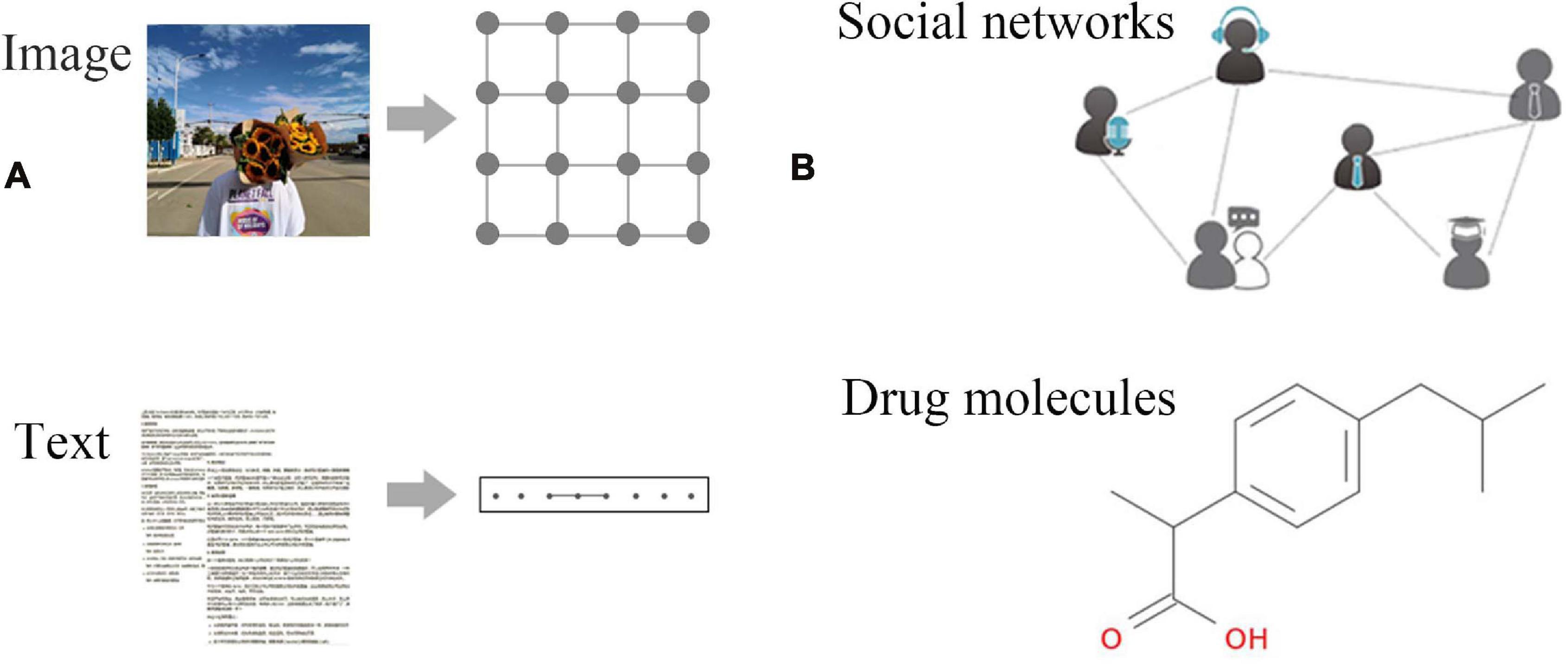
In the realm of image recognition, typical approaches involve transforming an image into a graph structure where either pixels, regions, or super-pixels serve as nodes. The edges in such graphs represent spatial or semantic relationships. This reimagining of an image from a grid-like structure (as used in conventional CNNs) to a graph allows the model to consider non-local context and spatial variability more directly.
Key Components in Image Recognition GNNs
The architecture for applying GNNs to image data generally comprises:
- An initial segmentation or patch extraction process that breaks the image into discrete nodes.
- Graph-building algorithms to establish connections based on proximity or similarity.
- Graph convolutional layers that aggregate information by considering each node's neighborhood.
- Optional integration with CNN layers where features extracted from CNNs serve as node features for further graph-based processing.
This multi-pronged approach ensures that both local features (captured by CNNs) and relational data (captured by GNNs) are effectively exploited, leading to more robust image classifications and object detection paradigms.
Text Generation and Natural Language Processing
Text generation tasks have traditionally relied on sequential models such as Recurrent Neural Networks (RNNs) or the now widely popular transformer model, which, however, assume a linear sequence of words. GNNs, on the other hand, can represent text as graphs by incorporating syntactic dependencies and semantic relationships among words. This representation is key in capturing long-range dependencies and allowing for more coherent and context-aware text generation.
Specific Strategies in Text-based GNN Architectures
The following strategies have been adopted to optimize GNN performance in the NLP domain:
- Constructing heterogeneous graphs where nodes represent words, phrases, or entire sentences and edges represent syntactic dependency or semantic similarity.
- Utilizing multi-relational graphs that incorporate additional relationships such as co-reference or entity associations.
- Incorporating position-aware attention mechanisms that help the model understand the relative importance of different connections.
- Combining GNN outputs with transformer encoders to reinforce context modeling in language generation tasks.
These innovations have been particularly effective in generating text that is not only syntactically fluent but also captures the underlying semantic nuances of the input text.
Sentiment Analysis
Sentiment analysis leverages GNN architectures by mapping textual or social network data into graphs that reveal deep interdependencies among words, phrases, or even individual sentiments. The relationships among nodes can help decode subtle cues that influence the overall emotional tone.
Core Elements of GNN in Sentiment Analysis
In this context, GNNs function by:
- Transforming text into graphs where sentiment-laden words and phrases become nodes.
- Defining connections based on lexical similarity, sentiment polarity, or co-occurrence statistics.
- Utilizing graph convolution layers to integrate neighborhood sentiment signals and capture the cascading effect of emotional cues.
- Augmenting traditional NLP pipelines by embedding graph-based features into classification algorithms to improve accuracy and understand complex sentiment dynamics.
This methodology has proven beneficial in settings like social media analysis and review aggregation, where the subtle interplay between multiple text components is crucial for accurate sentiment detection.
Innovative Architectural Proposition Based on Historical and Modern Insights
Based on decades of research, an emerging innovative architecture seeks to bridge early concepts with modern advancements. This new design retains the original message passing principles fundamentally derived from early GNN models while integrating contemporary elements of attention, hierarchical pooling, and multi-modal data fusion.
The proposed new architecture is inspired by the early theoretical work that was introduced in 2009, which focused on a fixed-point iteration method for node representation. In this new approach, each node begins with an initial feature set derived from either CNN-based image features or transformer-extracted language embeddings. These nodes then engage in a bi-directional message passing process where they iteratively refine their representations using state-of-the-art aggregation functions, including position-based attention and multi-relational pooling.
The core innovation lies in how the architecture integrates global relational context with local feature refinement. In the image domain, this means that after a preliminary CNN processing stage, regions of an image are dynamically connected based on feature similarity, enabling the model to capture both local texture and global object relationships. In the text domain, the model constructs an enriched dependency graph where syntactic and semantic relationships are seamlessly embedded into a transformer-based pipeline augmented by graph convolutions.
This new architecture not only improves performance in each individual task but also offers a flexible framework that can be adapted to multi-modal settings—where text, visual, and even social signal data can be fused into a single graph representation. Consequently, it addresses one of the primary limitations of early techniques: the inefficient handling of complex relationships in heterogeneous data.
Application Domains and Recommended Datasets
The versatility of GNNs allows them to be effectively applied across various domains. Below are some of the primary application fields along with recommended datasets and their associated source codes:
1. Image Recognition and Object Detection
For tasks in computer vision, especially in recognizing complex object relationships and scene understanding, GNNs can be utilized to model images where nodes represent segments or patches and edges represent proximity or feature similarity. This approach has been useful in tasks such as image classification, segmentation, and even object detection when combined with CNNs.
Recommended Datasets:
| Dataset Name | Description | Link |
|---|---|---|
| CIFAR-10 | Small images for classification tasks | CIFAR-10 |
| ImageNet | Large-scale image database for diverse vision tasks | ImageNet |
| COCO | Dataset for object detection and segmentation | COCO |
2. Text Generation and Natural Language Processing
In NLP, the ability to model complex syntactic and semantic relationships using graph representations is a game changer. GNNs can process dependency trees, semantic relations, and even incorporate multi-hop reasoning into text generation pipelines. By integrating these graph features with transformer-based architectures, both coherence and creativity in generated text are significantly enhanced.
Recommended Datasets:
| Dataset Name | Description | Link |
|---|---|---|
| WikiText-103 | Large language modeling dataset sourced from Wikipedia | WikiText-103 |
| BookCorpus | A diverse collection of books for language modeling | BookCorpus |
| Penn TreeBank | Dataset for syntactic parsing and text generation tasks | Penn TreeBank |
3. Sentiment Analysis and Text Classification
Sentiment analysis benefits greatly from graph-based modeling where sentiment cues and relational dependencies are represented in graph form. This approach captures contextual cues that traditional bag-of-words or sequential analysis methods might miss. A graph representation of text or social interactions can yield a more nuanced view of sentiment polarity and intensity.
Recommended Datasets:
| Dataset Name | Description | Link |
|---|---|---|
| IMDB Reviews | Movie reviews labeled for sentiment polarity | IMDB Reviews |
| Stanford Sentiment Treebank | Fine-grained sentiment annotations on a treebank structure | SST |
| Amazon Reviews | Large-scale review dataset covering multiple product categories | Amazon Reviews |
Legacy Techniques and Their Source Code
Many groundbreaking techniques laid the foundation for the modern applications of GNNs. One seminal work, highly influential in its time yet under-recognized in its infancy, was the publication proposing the Graph Neural Network Model. This paper introduced a methodology in which nodes iteratively update their representations via a message passing mechanism, solving a fixed-point iteration problem. Although not widely celebrated upon its release, its concepts have fueled subsequent research and development of more refined GNN architectures.
Additionally, earlier techniques using Recursive Neural Networks (RNNs) for tree-structured data have been crucial in understanding how structured information can be effectively processed. While modern models have largely supplanted these older methods, the original source code implementations, available on widely used platforms, serve as educational tools for understanding how graph-based message passing was originally conceptualized and implemented.
For instance, early implementations that focused on processing tree-structured data laid important groundwork, which many modern libraries have built upon. Several open-source libraries now provide implementations that cover both the classic models and modern adaptations, including those based on spectrum-based approaches and more recently, graph convolutional networks which are found in popular frameworks.
Innovative Architectural Proposal
The proposed new architecture integrates historical and modern insights in a unified framework. It begins by incorporating a CNN or transformer to extract robust initial features from raw input, whether images or text. These features initialize nodes in a graph where the edges denote similarity or semantic relevance. The model then engages in multiple rounds of graph message passing using enhanced aggregation functions:
- Attention-Based Aggregation: Incorporates a context-aware weighting scheme where node contributions are dynamically adjusted according to their relevance determined by an attention mechanism.
- Hierarchical Pooling: Aggregates information across different scales, ensuring that both local details and global dependencies are captured comprehensively.
- Multi-Relational Graph Constructs: Utilizes heterogenous graphs where distinct types of edges capture various aspects of the interactions among nodes (e.g., syntactic relation vs. semantic similarity).
In image recognition applications, this approach allows the model to dynamically form connections between patches based on their visual similarity and contextual relevance, resulting in improved performance on tasks like segmentation and object detection. Meanwhile, for text generation, by framing sentences as graphs that incorporate both syntactic tree structures and semantic co-occurrence networks, the model is able to produce textual outputs that are both contextually coherent and rich in semantic content. Similarly, in sentiment analysis, the combined use of graph-based relationships and traditional NLP embeddings ensures that subtle emotional cues are not lost, thereby improving classification accuracy.
Conclusion and Final Thoughts
Graph Neural Networks have significantly expanded the possibilities across various technology domains by redefining how relational and structured data is handled. The evolution from early recursive models to today’s sophisticated architectures incorporating attention, hierarchical pooling, and multi-relational embedding strategies represents a key transition in machine learning. Despite initial setbacks and limited early adoption due to resource constraints, the pioneering work on fixed-point iteration and message passing laid a robust foundation that modern platforms continue to build upon.
By seamlessly merging the strengths of CNNs and transformer models with innovative graph-based aggregation, the new architecture elaborated above serves as a compelling model for tackling complex tasks in image recognition, text generation, and sentiment analysis. Its adaptability across multi-modal contexts demonstrates the transformative potential of GNNs in capturing both local details and global structure simultaneously. The recommendation of targeted datasets, along with reference to enduring yet foundational literature and source code, provides practitioners with a practical roadmap for experimentation and further research.
The continual refinement of these models promises not only performance improvements in traditional tasks but also opens avenues for entirely new applications that converge multiple data modalities. Leveraging historically underappreciated insights in conjunction with cutting-edge computational techniques ensures that the future of GNNs remains vibrant and full of potential for interdisciplinary breakthroughs.
References
-
Graph Neural Network Model - foundational paper by Scarselli et al.
- Semi-Supervised Classification with Graph Convolutional Networks - Kipf & Welling
- Google Scholar search on Graph Neural Network Model
Recommended Further Queries
Last updated February 20, 2025