
Go vs. Bun: A Deep Dive into Performance and Use Cases
Comparing two powerful technologies for modern development
Key Insights
- Performance Varies by Task: While Go often excels in raw speed due to its compiled nature, Bun can be surprisingly competitive and even faster in specific scenarios, particularly for "hello world" or certain async/synchronous tasks.
- Go's Memory Efficiency: Go consistently demonstrates superior memory management compared to Bun, making it a strong choice for memory-sensitive applications.
- Bun as a JavaScript Runtime Alternative: Bun is emerging as a fast and promising JavaScript runtime, offering significant performance improvements over Node.js and providing a potential migration path for existing Node.js projects.
Introduction
In the rapidly evolving landscape of backend development, choosing the right technology is crucial for building performant and scalable applications. Two notable contenders that often come into discussion are Go (or Golang) and Bun. Go, a statically typed, compiled language developed by Google, has gained popularity for its concurrency features and efficiency. Bun, a relatively new JavaScript runtime built with Zig, aims to revolutionize JavaScript development with a focus on speed and an all-in-one toolkit.
This comprehensive comparison explores the strengths and weaknesses of Go and Bun across various aspects, including performance benchmarks, memory usage, and their respective use cases. By examining their characteristics and observed behaviors in different scenarios, we aim to provide a clearer understanding of when to choose one over the other.
Performance Benchmarks: A Closer Look
Performance is a critical factor when selecting a backend technology. While it's important to note that real-world performance can be influenced by numerous factors beyond the language or runtime itself, benchmarks provide valuable insights into their underlying capabilities. Comparisons between Go and Bun reveal interesting results that are often dependent on the specific workload.
Raw Speed and Throughput
Go, being a compiled language, generally holds an advantage in raw execution speed for CPU-bound tasks. For instance, in benchmarks involving JWT signing and verification, Go has demonstrated significantly higher operations per second compared to Bun.
However, Bun has shown impressive performance in other areas. In some "hello world" HTTP server benchmarks, Bun's native server has been observed to be faster than Go's standard net/http server, particularly under certain concurrent connection loads. This highlights Bun's optimization for specific I/O intensive tasks.
Another area where Bun has shown competitive speed is in handling a large number of async/synchronous tasks. While Go is highly efficient in concurrency with its goroutines, Bun can compete effectively, especially within a sweet spot of task numbers.
Memory Efficiency
When it comes to memory usage, Go consistently outperforms Bun. Go's garbage collection and compiled nature contribute to its lower memory footprint, making it a more memory-efficient choice for applications where minimizing memory consumption is a priority. Bun, on the other hand, has sometimes shown higher memory usage, although this is an area that is expected to improve as the runtime matures.
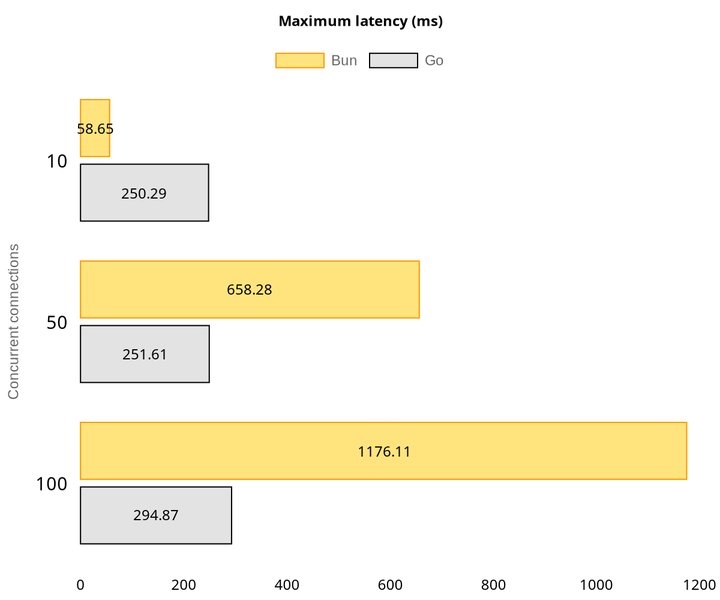
A visual comparison of Bun and Go performance in specific tasks.
Impact of Benchmarking Methodology
It's crucial to consider the methodology used in performance benchmarks. Simple "hello world" tests, while illustrative of basic server performance, may not fully represent real-world application behavior, which often involves database interactions, complex routing, and data transformations. Benchmarks that include routing and higher abstraction frameworks can introduce overhead that affects the results.
For tasks involving significant data transformations or CPU-bound computations rather than just I/O, Go's efficiency in processing instructions quickly tends to give it an edge.
Go's Strengths and Use Cases
Go has established itself as a robust and reliable language for building a wide range of applications. Its design principles, focusing on simplicity, efficiency, and concurrency, make it well-suited for specific use cases.
Concurrency and Scalability
Go's built-in support for concurrency through goroutines and channels is one of its major strengths. This makes it highly effective for building scalable network services, APIs, and distributed systems that need to handle a large number of concurrent connections efficiently.

Highlighting Go's performance in a comparison.
Systems Programming and CLI Tools
Go's compiled nature and ability to produce single static binaries make it an excellent choice for systems programming tasks, building command-line interface (CLI) tools, and developing infrastructure software.
Memory Management and Reliability
Go's efficient memory management and garbage collection contribute to the reliability and stability of applications. This is particularly important for long-running services and systems where predictable performance is essential.
The Go Ecosystem and ORMs
The Go ecosystem offers a rich set of libraries and frameworks. For database interactions, ORMs (Object-Relational Mappers) like Bun (the Go ORM, distinct from the JavaScript runtime) provide a structured way to interact with databases. Go's Bun ORM is a SQL-first ORM that supports various databases like PostgreSQL, MySQL, MSSQL, and SQLite. It aims to provide a simple and idiomatic way to write SQL queries in Go.
The Go Bun ORM supports features like:
- ORM-like experience using SQL
- Structs, maps, scalars, and slices support
- Bulk inserts, updates, and deletes
- Migrations
- Soft deletes

The logo for the Bun Golang ORM.
Using an ORM like Go Bun can simplify database operations and improve developer productivity in Go projects.
Bun's Strengths and Use Cases
Bun, as a modern JavaScript runtime, is making significant strides in challenging the established players like Node.js. Its focus on speed and developer tooling presents compelling advantages for JavaScript developers.
Performance for JavaScript Workloads
Bun is designed for performance, aiming to be significantly faster than Node.js and Deno for various tasks, including script execution, package installation, and running tests. Its speed can make a noticeable difference in development workflows and the performance of JavaScript-based applications.

The logo for the Bun JavaScript runtime.
All-in-One Toolkit
One of Bun's key features is its integration of multiple tools into a single runtime. It includes a native bundler, transpiler, task runner, and npm client. This all-in-one approach simplifies the development environment and can lead to faster build times and development cycles.
Compatibility with Node.js Ecosystem
Bun aims for high compatibility with the existing Node.js ecosystem, allowing developers to leverage a vast number of existing npm packages. This compatibility makes it easier for developers to migrate existing Node.js projects to Bun and benefit from its performance improvements.
Promising for Web Development
With its speed and focus on JavaScript/TypeScript, Bun is a promising option for building web servers, APIs, and other backend services using familiar web frameworks.
Comparing Performance in Specific Scenarios
To further illustrate the performance differences, let's consider some specific scenarios discussed in the sources.
HTTP Server Performance
In basic "hello world" HTTP benchmarks, Bun has shown competitive or even superior performance compared to Go's standard library. However, when considering benchmarks that involve more complex routing or framework overhead, the comparison can shift. The choice of framework within each ecosystem also significantly impacts performance.
A video comparing the performance of Go and Bun.
This video provides a visual comparison of Go and Bun's performance characteristics, focusing on metrics like latency, throughput, saturation, and availability. While synthetic benchmarks can offer initial insights, real-world scenarios, especially those involving database interactions, can reveal different performance profiles, as highlighted in the video's description where Go is suggested to be better for scenarios involving databases.
CPU-Bound Tasks
For tasks that are primarily CPU-bound, such as complex calculations or data processing, Go's compiled nature and efficient instruction execution generally give it a performance advantage over interpreted or just-in-time compiled languages like JavaScript runtimes.
I/O-Bound Tasks
Bun's architecture is optimized for I/O-bound tasks, which is why it performs well in web server benchmarks and tasks involving file system operations or network requests. Its built-in features and performance-oriented design contribute to its efficiency in these areas.
Go vs. Bun: A Comparative Summary
Here's a table summarizing some key aspects of Go and Bun:
| Feature | Go | Bun |
|---|---|---|
| Type | Compiled, Statically Typed Language | JavaScript Runtime (built with Zig), Dynamically Typed (JavaScript/TypeScript) |
| Primary Use Cases | Backend services, network programming, CLI tools, systems programming | Web development (backend and frontend tooling), scripting, package management |
| Performance (General) | High performance, particularly for CPU-bound tasks and concurrency | High performance for JavaScript/TypeScript workloads, competitive in I/O |
| Memory Usage | Generally lower and more efficient | Can be higher, though improving |
| Concurrency Model | Goroutines and Channels (built-in) | Event loop, optimized I/O |
| Ecosystem | Mature, strong for backend and infrastructure | Growing, leverages Node.js ecosystem, includes integrated tooling |
| Learning Curve | Relatively easy to learn due to simplicity | Familiar to JavaScript developers, new tooling to learn |
Choosing Between Go and Bun
The choice between Go and Bun depends heavily on the specific requirements of your project, your team's expertise, and the performance characteristics that are most critical.
When to Choose Go
Go is an excellent choice for:
- Building high-performance backend services and APIs where raw speed and efficient concurrency are paramount.
- Developing systems-level software, CLI tools, and infrastructure components.
- Applications that require low memory consumption and high reliability.
- Teams with experience in statically typed languages or a need for strong typing.
When to Choose Bun
Bun is a compelling option for:
-
JavaScript and TypeScript projects where performance is a key concern, offering a significant upgrade over Node.js.
-
Developers looking for an all-in-one toolkit that simplifies the development workflow with integrated bundler, transpiler, and package manager.
-
Migrating existing Node.js applications to potentially gain performance benefits with minimal code changes.
-
Building fast web servers and I/O-bound applications using the JavaScript ecosystem.
Conclusion
Both Go and Bun are powerful technologies that offer distinct advantages. Go, with its mature ecosystem, strong typing, and inherent performance in CPU-bound tasks and concurrency, remains a top contender for a wide range of backend and systems programming challenges. Bun, on the other hand, is rapidly establishing itself as a high-performance JavaScript runtime that streamlines the development process and offers significant speed improvements for JavaScript-based projects. As Bun continues to evolve, the performance gap in various scenarios may shift, making ongoing evaluation important for developers making technology choices.
FAQ
Is Bun faster than Go?
Performance varies depending on the task. Go is generally faster for CPU-bound operations and has better memory efficiency. Bun can be faster in specific I/O-bound scenarios and for certain async tasks.
What is the Bun ORM for Go?
The Bun ORM for Go is a separate project from the Bun JavaScript runtime. It's a SQL-first Object-Relational Mapper for Go that provides a way to interact with databases using Go code and SQL queries.
Can I use Bun to run Go code?
No, Bun is a JavaScript runtime and executes JavaScript and TypeScript code. Go code is compiled and executed by the Go runtime.
Is Bun a replacement for Node.js?
Bun is designed as a faster alternative to Node.js and aims for high compatibility with the Node.js ecosystem, making it a potential replacement for many Node.js use cases.
References
Last updated May 4, 2025