
Unlocking Your Perfect Swing: The Rise of Immersive Golf Training Facilities in Southern California
Discover how VR, simulators, and laser-guided technology are revolutionizing golf practice and entertainment in the US.
The landscape of athletic training and entertainment is undergoing a significant transformation, largely driven by advancements in virtual reality (VR), sophisticated simulators, and immersive experiences. This trend is particularly pronounced in the United States, where facilities leveraging these technologies are gaining immense popularity. For your client interested in establishing a state-of-the-art golf swing training facility in Southern California, featuring innovative laser-guided corrective technology, the market is ripe with opportunity. This report delves into the rise of such facilities, examines competing products and solutions, provides examples of existing establishments, and outlines typical costs associated with golf simulator usage for game improvement.
Key Insights: The Future of Golf Training
- Immersive Tech is Mainstream: VR and simulators are no longer niche, with a burgeoning market in sports training, particularly golf, offering year-round, data-rich practice.
- Southern California as a Hub: Recognized as a "golf industry mecca," Southern California presents a high-demand environment for innovative golf technologies and training solutions.
- Laser Guidance as a Differentiator: Your client's technology, featuring laser tracking and corrective paths for swing planes, offers a unique selling proposition in a market dominated by camera and radar-based systems.
The Immersive Revolution: Training and Entertainment Reimagined
Across the United States, facilities offering VR and simulator-based experiences are rapidly expanding. Initially popularized in entertainment sectors like gaming and virtual escape rooms, this technology has demonstrated profound efficacy in professional training, including medical, vocational, and, significantly, sports development.
Why Immersive Technology is Gaining Traction
The appeal of VR and simulators lies in their ability to create controlled, repeatable, and highly engaging environments. Users can practice complex skills without real-world consequences, receive immediate feedback, and access diverse scenarios on demand. This is particularly valuable in sports where environmental factors (like weather) or access to specific facilities can be limiting.
The U.S. golf simulators market alone was valued at approximately $694 million in 2021 and is projected to reach $1.416 billion by 2030, growing at a CAGR of 8.6%. This indicates a robust and expanding market that your client is well-positioned to enter, especially with a unique technological offering.
Golf's Embrace of Simulation
In the realm of golf, simulators have become indispensable tools for both amateurs seeking entertainment and serious players focused on game improvement. These systems allow golfers to play virtual rounds on famous courses, analyze their swing mechanics in minute detail, and practice specific shots under consistent conditions. Southern California, with its dense population of golfers and tech-savvy consumers, is a prime location for advanced golf training facilities.
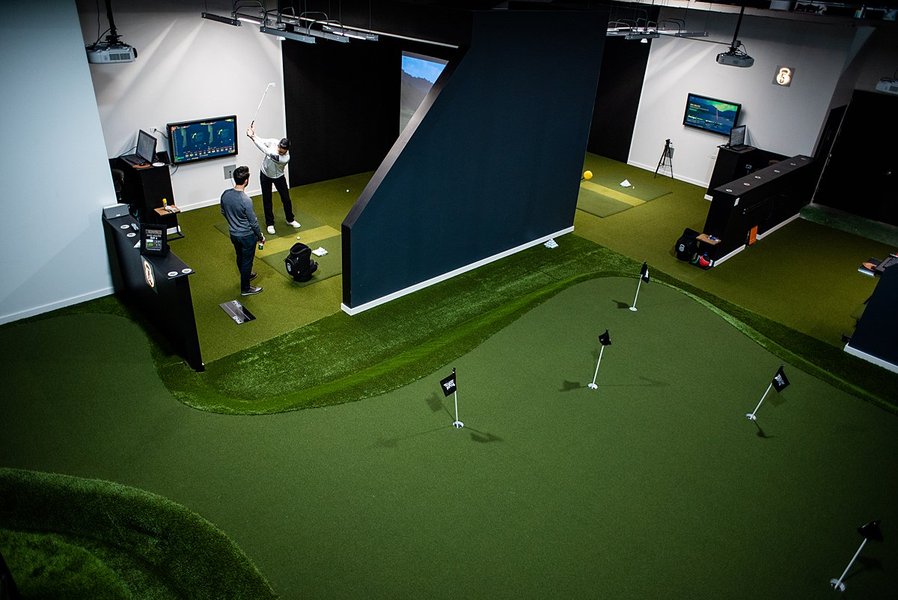
A modern indoor golf facility showcasing multiple simulator bays for practice and play.
Decoding Golf Swing Technology: From Simulators to Laser Precision
Modern golf training technology extends far beyond simple driving ranges. Today's solutions offer sophisticated data capture and analysis, providing golfers with unprecedented insights into their performance.
The Science Behind Modern Golf Simulators
Most high-end golf simulators utilize a combination of technologies, including high-speed cameras, infrared sensors, and radar systems (like Doppler radar), to track club movement and ball flight. These systems capture a wealth of data points, such as:
- Club head speed and path
- Angle of attack and clubface angle
- Ball speed, launch angle, and spin rate
- Carry distance and total distance
- Shot dispersion and trajectory
This data is then processed by powerful software to provide instant feedback, often displayed visually on a large screen, allowing golfers to understand the cause and effect of their swing mechanics.
Your Client's Edge: Laser-Guided Swing Correction
Your client's proposed technology, which uses lasers to track the golfer's swing plane and provide a laser-guided corrective path, introduces a potentially more intuitive and direct feedback mechanism. While many simulators offer swing path visualization post-shot, the real-time, active guidance of a laser could significantly accelerate the learning process by helping golfers feel the correct motion. This active correction offers a distinct advantage over passive analysis, potentially setting a new standard for swing training.
The Competitive Arena: Leading Golf Simulator Brands and Solutions
The golf simulator market is robust, with several key players offering advanced technologies. Understanding these competitors is crucial for positioning your client's unique offering.
TrackMan: The Analyst's Choice
TrackMan technology is widely regarded as an industry leader, particularly favored by PGA Tour professionals and coaches. It utilizes dual radar technology combined with high-definition cameras to deliver precise data on the club and ball. TrackMan provides extensive metrics on swing path, clubface angle, ball spin, and more. Many facilities equipped with TrackMan offer virtual coaching and corrective feedback, though typically based on data analysis rather than real-time laser guidance. Some facilities offer rentals for $30-$50 per hour.
Full Swing Golf: The Immersive Experience
Full Swing Golf simulators are known for their immersive realism, often featuring high-definition visuals of renowned golf courses and responsive tracking. They employ a combination of infrared lightwave technology and high-speed cameras to track the ball's flight immediately after impact, providing real-time feedback. Endorsed by top golfers like Tiger Woods, Full Swing caters to both serious training and entertainment. Home units can start around $5,000+, with commercial setups being significantly more expensive.
GOLFZON: Global Presence, User-Friendly Design
GOLFZON is a globally recognized brand with a significant number of installations worldwide. Their simulators use a combination of infrared and camera technology for accurate tracking. GOLFZON is noted for its user-friendly interfaces, realistic course simulations, and engaging game modes, making it popular for both training and social golf experiences.
Foresight Sports & TruGolf: Precision and Realism
Foresight Sports, with products like the GCQuad and GC2+HMT launch monitors, is another key player known for its camera-based tracking systems that provide highly accurate ball and club data. These are often found in premium indoor golf facilities. TruGolf simulators emphasize realistic ball physics and offer a wide range of virtual courses and practice environments, catering to both commercial and residential markets.
GOLFTEC OptiMotion: Coaching-Centric Approach
GOLFTEC centers utilize their proprietary OptiMotion technology, a motion-capture system that analyzes a golfer's swing in 3D. While not strictly a standalone simulator product for rental, GOLFTEC integrates simulator elements into their coaching sessions. Pricing for sessions often starts around $95-$125, focusing on structured improvement plans with certified coaches. This highlights a competitor focusing on guided improvement through technology.
Visualizing the Golf Tech Landscape
The following mindmap illustrates the key components of the VR and simulator-based golf training ecosystem, particularly relevant for a new facility in Southern California. It connects market opportunities, technological considerations, competitive factors, and business model elements.
Southern California"] id1["Market Opportunity"] id1a["High Golfer Density"] id1b["Tech-Savvy Population"] id1c["'Golf Mecca' Reputation"] id1d["Year-Round Demand"] id2["Core Technology"] id2a["Client's Laser-Guided System"] id2aa["Swing Plane Tracking"] id2ab["Real-Time Corrective Path"] id2b["VR/AR Integration"] id2c["Data Analytics & Progress Tracking"] id3["Competitive Landscape"] id3a["Simulator Brands"] id3aa["TrackMan"] id3ab["Full Swing"] id3ac["GOLFZON"] id3ad["Foresight Sports"] id3b["Existing Facilities"] id3ba["Indoor Golf Centers"] id3bb["Coaching Academies"] id3bc["Entertainment Venues"] id4["Business Model"] id4a["Hourly Rentals"] id4b["Membership Packages"] id4c["Coaching Services"] id4d["Corporate & Group Events"] id4e["Food & Beverage Options"] id5["Facility Features"] id5a["Multiple Bays"] id5b["Lounge/Social Area"] id5c["Pro Shop (Optional)"]
This mindmap highlights how your client's unique laser technology can be positioned within a multifaceted business catering to diverse golfer needs in a competitive yet promising market.
A Look at Existing Facilities: Models for Success
Numerous facilities across the U.S. successfully integrate simulator technology for training and entertainment. These serve as valuable case studies:
High-Tech Havens: Premier Indoor Golf & X-GOLF
Facilities like Premier Indoor Golf (Manhattan) utilize Foresight Sports GC2+HMT launch monitors, offering a blend of serious practice and social lounge environments. X-GOLF, with multiple U.S. locations including California, provides sophisticated simulators along with bar and food services, often hosting corporate events and parties. They emphasize both game improvement and entertainment.
24/7 Access & Community Hubs: GolfCave & The Back Nine Golf
GolfCave (New Jersey, with potential for expansion) offers private "Caves" with TrackMan simulators, accessible 24/7 to members. This model caters to dedicated golfers seeking flexible practice schedules. Similarly, The Back Nine Golf (Carlsbad, CA) provides 24/7 access to top simulators, emphasizing industry-leading analytics and course-like simulations without requiring membership for all booking types, though memberships offer benefits.
Niche and Mobile Solutions: Dryvebox & Smash Factor Lounge
Dryvebox offers mobile golf simulator rentals for events, providing a turnkey solution. Smash Factor Lounge (Chino, CA) is designed for social and immersive golfing sessions, accommodating groups and focusing on enhanced practice opportunities. These illustrate specialized market segments.
Beyond Golf: VR in Broader Training (USC SMART-VR)
The University of Southern California's (USC) SensoriMotor Assessment and Rehabilitation Training in Virtual Reality Center (SMART-VR Center) and its Medical Virtual Reality (MedVR) group demonstrate the broader applications of VR for neurorehabilitation and clinical skills training. This underscores the established credibility and acceptance of VR simulation for serious skill development, a positive indicator for sophisticated golf training applications.
Understanding the Investment: Pricing Structures for Golf Simulators
Pricing for golf simulator usage varies based on location, technology, facility amenities, and session duration. Here's a general overview:
Hourly Rates: What to Expect
Standard hourly rental rates for high-quality golf simulators typically range from $30 to $60 per hour. For example, Golf Galaxy facilities often charge around $50/hour for TrackMan-equipped bays, with discounts for bulk sessions (e.g., $30/hour for 10 prepaid sessions). Some facilities may charge per player for virtual rounds, often around $15-$25 per player for 9 or 18 holes.
Packages and Memberships: Building Loyalty
Many facilities offer package deals (e.g., 10-session packs) or monthly/annual memberships for discounted rates and/or unlimited access. For instance, Purefect Golf Club offers a 12-month membership for $165, including significant simulator hours. Memberships can create a loyal customer base and recurring revenue.
Event and Corporate Rentals
Corporate events and private party rentals can be lucrative. Rates for these can range from $200 to over $550 per hour, depending on the number of simulators, duration, and additional services like catering or coaching.
Comparative Overview of Golf Simulator Options
The table below provides a simplified comparison of different golf simulator technologies and facility models, highlighting key features and typical pricing considerations. This can help in understanding the market positioning for your client's unique laser-guided system.
| Simulator Type/Brand | Key Technology | Primary Focus | Typical User | Common Pricing Model | Average Hourly Rate (Estimate) |
|---|---|---|---|---|---|
| TrackMan | Dual Radar, Camera | Data Accuracy, Swing Analysis | Serious Golfers, Pros, Coaches | Hourly Rental, Lessons | $40 - $70 |
| Full Swing Golf | Infrared, High-Speed Cameras | Immersion, Realistic Simulation | Serious Golfers, Entertainment Seekers | Hourly Rental, Memberships | $35 - $65 |
| GOLFZON | Infrared, Camera | User Experience, Entertainment | Social Golfers, Casual Players | Per Game/Round, Hourly | $30 - $50 |
| Foresight Sports (e.g., GCQuad) | High-Speed Cameras | Precision Data, Portability (Launch Monitors) | Club Fitters, Coaches, Dedicated Players | Hourly Rental, Facility Membership | $35 - $60 |
| General Indoor Golf Center | Various (TrackMan, Full Swing, etc.) | Practice, Entertainment, Social | All Golfer Types | Hourly, Packages, Memberships | $30 - $55 |
| Client's Laser-Guided Tech (Proposed) | Laser Tracking, Corrective Path Guidance | Real-Time Swing Correction, Skill Development | Golfers Seeking Intensive Improvement | Hourly Rental, Coaching Packages | (To be determined, potentially premium) |
Note: Prices are estimates and can vary significantly by location, facility, and specific services offered.
Golf Simulator Technology Feature Comparison
To better understand the positioning of various golf simulator technologies, the following radar chart provides a visual comparison across several key attributes. These are qualitative assessments based on general market perception and typical feature sets. Your client's laser-guided system could aim to excel in areas like "Corrective Feedback" and "Training Efficacy."
This chart suggests that while established brands have strengths in accuracy and immersion, a new technology focusing on superior real-time corrective feedback could carve out a significant niche.
Launching in the Golden State: Considerations for Southern California
Southern California is an attractive but competitive market. Success will depend on strategic positioning and clear differentiation.
The "Golf Industry Mecca" Advantage
The region's high concentration of golfers, numerous prestigious courses, and a culture that embraces innovation make it an ideal testbed and launchpad for new golf technologies. Proximity to industry events and a large pool of potential early adopters are significant advantages.
Differentiating in a Competitive Landscape
While the market is large, it's also home to many established golf facilities and coaching centers. Your client's primary differentiator is the laser-guided corrective path technology. This should be the cornerstone of marketing efforts, emphasizing its unique ability to provide intuitive, real-time swing adjustments.
Marketing Your Unique Proposition
Marketing strategies should target serious golfers looking for tangible game improvement, as well as tech-savvy individuals interested in cutting-edge experiences. Highlighting the precision and immediate feedback of the laser system will be key. Partnerships with local golf pros, clubs, and influencers could also drive adoption.
A Glimpse into High-Tech Golf Simulation
The world of high-end golf simulators is constantly evolving, offering incredibly realistic and data-rich experiences. The following video provides a look into the capabilities of modern simulator technology, exemplified by Full Swing, one of the leading brands in the market. This gives context to the type of immersive environment your client might consider creating, enhanced by their unique laser-guidance system.
This video showcases the level of detail and immersion that top-tier simulators offer, providing a benchmark for the quality of experience that users in a sophisticated market like Southern California might expect. Your client's laser technology could be presented as the next evolution in this high-tech training landscape, focusing on active correction rather than just passive simulation.
Frequently Asked Questions (FAQ)
What makes Southern California a good market for this type of facility?
Southern California is often called a "golf industry mecca" due to its high density of golfers, numerous golf courses, favorable weather for year-round play, and a tech-savvy population receptive to innovative solutions. The strong golf culture and disposable income levels make it a prime market for advanced training facilities.
How does laser-guided swing correction differ from existing simulator technologies?
Most existing simulators use cameras, radar, or infrared sensors to track the swing and ball flight, providing data and visual replays. Laser-guided correction, as proposed, actively projects a corrective path in real-time, offering immediate, tangible guidance for the golfer to adjust their swing plane during the motion. This is a more direct and potentially intuitive form of feedback compared to post-shot analysis.
What are typical hourly rates for golf simulators?
Hourly rates generally range from $30 to $60 for standard simulator bays. Premium facilities or those with top-tier technology like TrackMan might be at the higher end of this range or slightly above. Package deals, memberships, and off-peak hour discounts can reduce the per-hour cost. Mobile or event rentals can be significantly higher, from $199 to $550+ per hour.
What are some key features of leading golf simulator brands?
Leading brands like TrackMan, Full Swing, and GOLFZON offer features such as: precise ball and club data tracking (speed, path, angle, spin), realistic virtual course play on famous courses, detailed swing analysis tools, instant visual feedback, and often, integration with coaching platforms or entertainment-focused game modes.
Are there VR training facilities beyond golf that show market interest?
Yes, VR and simulation are increasingly used in diverse training fields. For example, the University of Southern California (USC) has centers like SMART-VR for neurorehabilitation and MedVR for clinical skills training. The California Department of Rehabilitation also uses assistive technology in its vocational programs. This broader adoption indicates strong market acceptance and trust in simulation-based training.
Recommended Further Exploration
- What are the detailed business models for successful indoor golf centers in major US cities?
- What marketing strategies are most effective for launching a high-tech sports training facility in a competitive market like Southern California?
- What are the latest technological advancements in real-time biofeedback systems for sports performance enhancement?
- How do customer acquisition costs and lifetime value compare for membership-based versus pay-per-use recreational facilities?
References
Last updated May 9, 2025