
Google's AI Mode: Navigating the Seismic Shift in Search and Its Impact on Your Digital Strategy
Unpacking AI Mode's features, its profound effects on organic traffic, and the evolving landscape of SEO for professionals like you.
The digital landscape is once again being reshaped with Google's introduction of "AI Mode," a significant leap in its search technology. This development promises a more conversational, intelligent, and multimodal search experience, but it also brings forth critical questions about the future of traditional search, organic traffic, and the strategies businesses, particularly those reliant on technical documentation, must adopt. As an Information Architect, understanding these changes is paramount for navigating the path ahead.
Key Highlights: The AI Mode Transformation
- Conversational & Comprehensive Answers: AI Mode, powered by advanced Gemini models, aims to provide direct, summarized answers to complex queries, reducing the need for users to sift through multiple links.
- Significant Organic Traffic Shifts: Expect a potential decline in traditional organic traffic as users find solutions within Google's AI interface, coupled with challenges in tracking referral sources from AI Mode.
- Evolution of SEO: The focus of Search Engine Optimization will pivot from keyword ranking to establishing content authority, quality, and structure suitable for AI interpretation and citation.
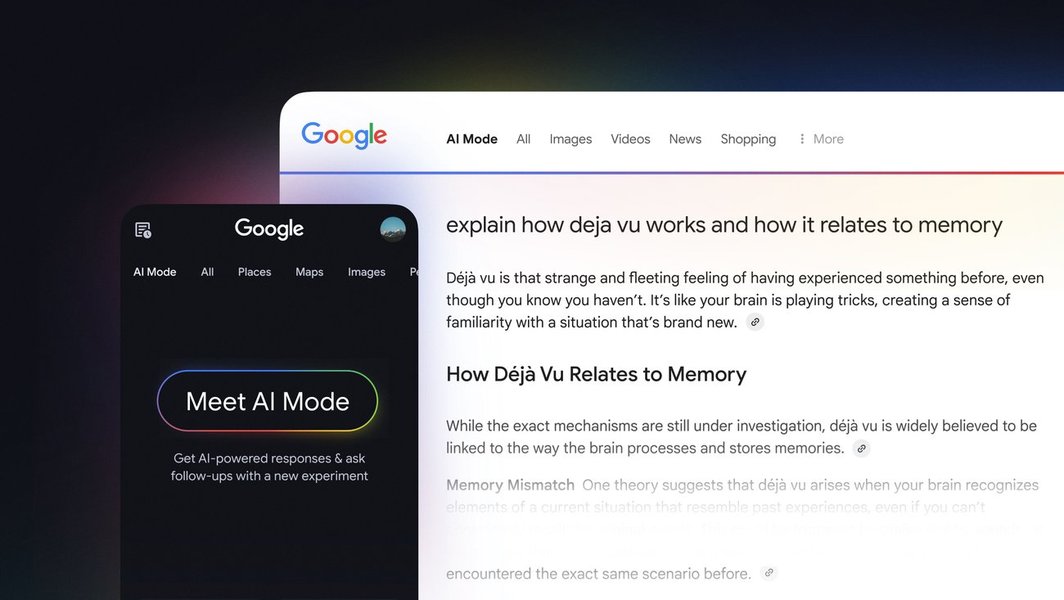
An illustrative example of Google's AI-driven search interface, showcasing a summarized overview.
Decoding Google's AI Mode
Google's AI Mode, announced around March 2025 and progressively rolling out, represents a fundamental change in the search experience. It's not merely an add-on but an evolution towards a more intuitive and intelligent information discovery process. This mode is integrated directly into Google Search and the Google app, appearing as a distinct option for users.
Core Capabilities and Features
At its heart, AI Mode leverages a custom iteration of Google's powerful Gemini models (initially Gemini 2.0, with upgrades to Gemini 2.5) to deliver sophisticated and conversational responses.
- Advanced AI Reasoning: It can understand complex, multi-part, and nuanced questions that might have previously required several separate searches. It employs techniques like "query fan-out" to break down complex queries into subtopics for comprehensive analysis.
- Multimodality: AI Mode accepts various input types, including typed text, voice commands, and even images. This allows users to, for example, take a photo of an object and ask questions about it.
- AI Overviews: Instead of just a list of blue links, AI Mode often provides AI-generated summaries or "AI Overviews" at the top of the results. These overviews synthesize information from multiple web sources to provide a direct answer.
- Conversational Interaction: Users can engage in a dialogue with AI Mode, asking follow-up questions to refine results or delve deeper into a topic, much like conversing with an expert.
- Deep Search: A feature within AI Mode designed for extensive exploration, "Deep Search" can break down a broad question into various subtopics and generate detailed, cited reports, potentially saving significant research time.
- Integration with Google's Ecosystem: AI Mode combines Gemini's capabilities with Google's vast information systems, including the Knowledge Graph, real-time data, and shopping information.
- Personalization (Optional): Users can opt-in to allow AI Mode to access past search history and, eventually, data from other Google apps (like Gmail or Calendar) to provide more tailored and context-aware suggestions.
- Shopping Enhancements: Includes innovative shopping tools like virtual "try-on" for apparel and is testing features for automated purchasing based on user-defined price points.
AI Mode is currently broadly available to U.S. users for English searches and is being integrated into both desktop and mobile search experiences, indicating Google's commitment to this new paradigm.
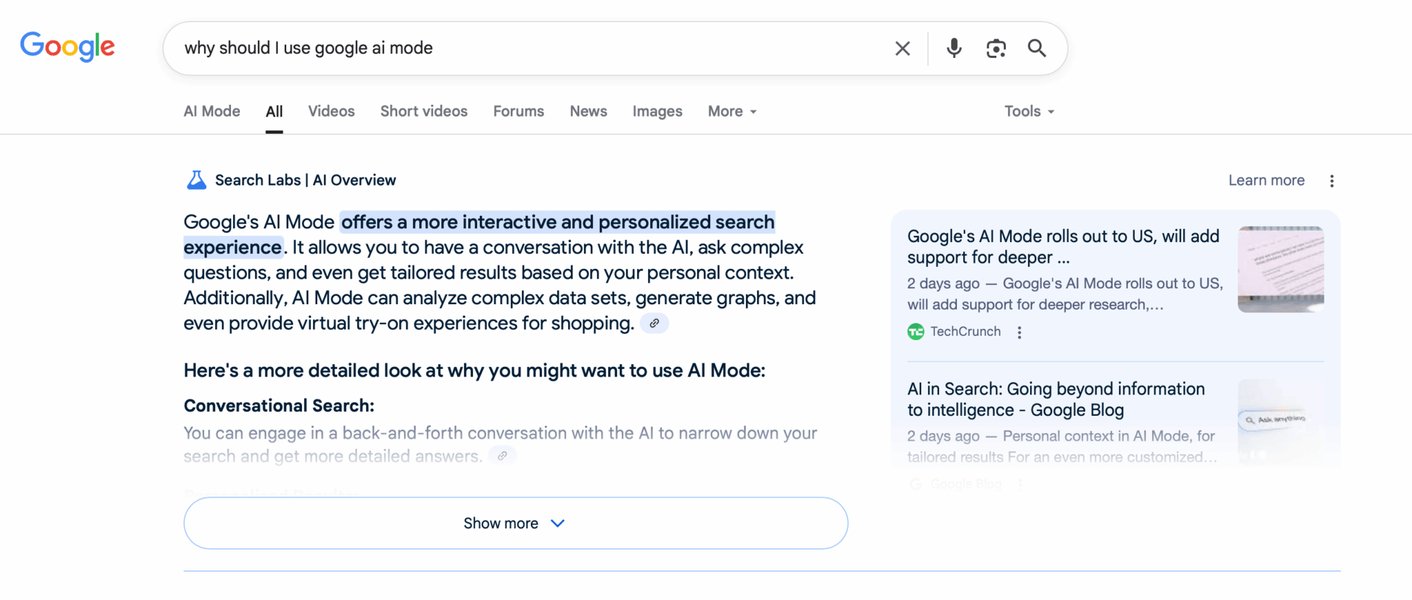
The AI Mode tab is consistently placed on the left in the Google Search interface for easy access.
The Shifting Sands: AI Mode vs. Traditional Search
The advent of AI Mode signifies a departure from the long-standing model of search. Traditional Google Search primarily served as a navigational tool, presenting users with a list of links to external websites where they could find the information they sought. AI Mode, however, aims to be an informational destination in itself.
Key Differences and Impacts
The table below highlights the contrasting approaches of traditional search and the new AI Mode:
| Feature | Traditional Google Search | Google AI Mode |
|---|---|---|
| Primary Output | List of links (SERP) | AI-generated summaries (AI Overviews), conversational responses |
| User Interaction | Clicking links to visit multiple sites | Direct answers, follow-up questions within Google's interface |
| Query Handling | Often requires multiple, refined queries | Handles complex, multi-part, nuanced queries in a single interaction |
| Information Source | Directs to external web pages | Synthesizes information from web content, Knowledge Graph, real-time data; provides citations |
| Goal | Navigate users to relevant web pages | Fulfill information need directly, often without leaving Google |
| Multimodality | Limited (e.g., image search as separate tab) | Integrated text, voice, and image input for queries |
This fundamental shift means users may increasingly find their answers directly within Google's AI-powered interface, reducing the immediate necessity to click through to external websites for many types of queries.
The Ripple Effect: Organic Traffic in the Age of AI
One of the most significant concerns for website owners, content creators, and businesses is the impact of AI Mode on organic traffic. The data and expert analyses suggest a notable transformation is underway.
Will Anyone Visit Your Sites? The Organic Traffic Conundrum
The direct-answer nature of AI Mode and AI Overviews is leading to a phenomenon known as "zero-click searches," where users get their information directly on the search results page without clicking on any organic links. Studies and observations have indicated potential organic traffic declines ranging from 15% to as high as 64% or even 75% for some sites and industries, depending on the query type and content focus. Some projections even suggest a 140% decrease in organic visibility for certain niches.
While AI Mode does include links to sources within its overviews, the primary goal is to satisfy user intent on the spot. This means that for straightforward informational queries—often the bread and butter of technical documentation—users might get their answers from the AI summary, leading to fewer direct visits to your documentation sites.
The Challenge of Untrackable Traffic
A critical issue for measuring impact is that traffic originating from AI Mode interactions can be difficult to track using traditional analytics. Referrer data from AI Mode is often hidden or not clearly distinguished, making it challenging to segregate traffic coming from traditional organic clicks versus interactions within AI Mode. This has been likened to a "Not Provided 2.0" scenario, complicating efforts to accurately assess the source and value of incoming users.
So, while it's not that no one will visit your sites, the volume and nature of organic traffic are set to change. Clicks may become more qualified, as users clicking through from an AI Overview might be seeking deeper, more authoritative information beyond the summary.
The Future of Organic Traffic and SEO Strategy
Organic traffic isn't becoming obsolete, but its role and the strategies to attract it are evolving significantly. Search Engine Optimization (SEO) must adapt to this new AI-driven landscape.
Pivoting SEO: From Keywords to Authority and AI-Readiness
The emphasis in SEO is shifting from traditional tactics like keyword density and sheer backlink volume towards a more holistic approach centered on quality, authority, and AI interpretability.
- Content as the Cornerstone: High-quality, original, accurate, and comprehensive content is more critical than ever. Google's AI aims to surface information from authoritative and trustworthy sources.
- E-E-A-T (Experience, Expertise, Authoritativeness, Trustworthiness): These principles become even more vital. Your content and brand need to be recognized as reliable.
- Structured for AI Consumption: Content needs to be well-structured with clear headings, summaries, lists, and potentially structured data (schema markup) to be easily understood, processed, and cited by AI models.
- Semantic Relevance: Focusing on understanding and comprehensively addressing user intent and related subtopics will be more effective than targeting isolated keywords.
- Brand Building: A strong brand reputation can lead to direct searches and increase the likelihood of being cited in AI summaries.
- Generative Engine Optimization (GEO) / Language Model Optimization (LMO): New terms and techniques are emerging to describe optimizing content specifically for AI models and generative search experiences.
- Multimodal Content: Incorporating relevant images, diagrams, videos, and interactive elements can enhance content value for both users and AI.
- Diversification: Relying solely on organic search will be riskier. Exploring other channels like social media, video platforms (e.g., YouTube), email marketing, and direct traffic initiatives is crucial.
Visualizing the SEO Shift: Traditional vs. AI-Era Focus
The following chart illustrates a conceptual shift in the importance of various SEO factors in the context of AI Mode. While traditional factors remain relevant, their emphasis and interplay are changing, with AI-centric considerations gaining prominence.
This chart suggests that while core UX and content quality remain vital, aspects like deep semantic understanding, robust E-E-A-T signals, structured data, and multimodal content will become increasingly crucial for visibility in an AI-driven search ecosystem.
Mindmap: Understanding Google's AI Mode Ecosystem
To better visualize the components and impacts of Google's AI Mode, the following mindmap outlines its key features, effects on search and traffic, and the resulting shifts in SEO strategy.
This mindmap provides a snapshot of how AI Mode functions as a system and the interconnectedness of its effects across the search landscape.
Implications for Your Role: Technical Documentation in the AI Era
As an Information Architect for a software firm developing Calling and Contact Center software, AI Mode presents specific challenges and opportunities for your technical documentation sites.
Measuring Documentation Traffic: A New Game
The untrackable nature of some AI Mode referrals means traditional methods of measuring organic traffic to your documentation will become less reliable. If users find answers to basic "how-to" questions about your software (e.g., "how to set up call routing in [Your Product]") directly in an AI Overview, they might not visit your site. This complicates evaluating the reach and effectiveness of your documentation based solely on page views from organic search.
You'll need to:
- Focus on Deeper Engagement Metrics: For users who do click through (perhaps for more complex issues or to verify information), metrics like time on page, task completion rates (if trackable), and navigation paths within your documentation site become more important.
- Explore Alternative Attribution Clues: While direct attribution is hard, you might look for correlations between increases in direct traffic or branded searches and periods of high AI Mode usage if your content is frequently cited.
- Consider User Feedback: Direct feedback mechanisms (surveys, in-doc feedback) can provide insights into how users are finding and using your documentation.
Adapting Documentation Strategy
Your technical documentation remains crucial, but its strategy needs to adapt:
- Optimize for AI Citations: Structure your content with extreme clarity. Use summaries, FAQs, precise technical terms, and well-defined sections. Ensure accuracy and keep content up-to-date. This increases the likelihood of your documentation being used as a reliable source for AI Overviews.
- Highlight Complex and Nuanced Information: While AI can summarize common issues, your documentation is vital for in-depth troubleshooting, advanced configurations, API references, and comprehensive guides that go beyond surface-level answers.
- Strengthen In-Product Help and Direct Access: Make it easier for users to access documentation directly from within your Calling and Contact Center software. Promote direct links through customer support channels and community forums.
- Multimodal Documentation: Consider incorporating more diagrams, annotated screenshots, short video tutorials, and interactive elements. AI Mode's multimodal capabilities might favor content that is rich and varied.
- Brand Authority is Key: Ensure your firm is recognized as the definitive source of truth for its products. This involves more than just the documentation site; it's about overall brand presence and authority.
The goal is for your documentation to be so good that it's the preferred source for Google's AI to draw from, and the go-to resource for users needing more than a quick summary.
This video discusses Google's AI Mode and its potential to redefine the future of Google Search, offering further perspectives on the changes.
FAQ: Understanding Google's AI Mode
What exactly is Google's AI Mode?
How will AI Mode affect organic traffic to my website?
Can I track traffic coming specifically from AI Mode?
Is SEO dead because of AI Mode?
How should I adapt my technical documentation for AI Mode?
Conclusion
Google's AI Mode is undeniably a pivotal moment in the evolution of search. It heralds an era where direct, AI-generated answers take center stage, compelling a re-evaluation of how we approach content creation, SEO, and traffic measurement. For Information Architects, especially in specialized fields like Calling and Contact Center software, this means embracing a strategy that prioritizes content quality, authority, and AI-friendliness. While the landscape of organic traffic will change, the value of comprehensive, accurate, and easily accessible technical documentation remains, albeit with new pathways for discovery and impact assessment. Adapting proactively will be key to navigating this new frontier successfully.
Recommended Searches
- What are effective strategies for optimizing technical documentation for AI search engines like Google's AI Mode?
- How can businesses measure the effectiveness and ROI of their content in an environment with increasing zero-click searches?
- What is the impact of multimodal AI search capabilities on visual and video content strategies for businesses?
- How will E-E-A-T (Experience, Expertise, Authoritativeness, Trustworthiness) signals evolve in importance with Google's AI-driven ranking algorithms?