

Gothic architecture, a revolutionary style that swept across Europe from the mid-12th to the 16th centuries, transformed the landscape of medieval construction, particularly in its ecclesiastical forms. Emerging from the Romanesque period, it introduced groundbreaking structural innovations that allowed for unprecedented height, expansive luminous interiors, and a profound sense of verticality, reflecting the era's deep spiritual aspirations. The term "Gothic" itself, originally used by Renaissance critics to disparage the style as "barbarous," ironically now defines one of history's most sophisticated and visually stunning architectural movements.
Key Highlights of Gothic Architectural Mastery
- Structural Ingenuity: The development of pointed arches, rib vaults, and flying buttresses revolutionized building capabilities, enabling taller and lighter structures.
- Luminous Interiors: Large stained-glass windows, including iconic rose windows, became possible due to structural advancements, flooding interiors with colored light and creating a spiritual atmosphere.
- Vertical Emphasis and Ornate Detail: Gothic cathedrals are characterized by their aspiring heights, slender forms, and intricate ornamentation, from delicate tracery to expressive gargoyles and sculptures.
The Genesis of a Revolution: From Romanesque Roots to Gothic Flight
Gothic architecture did not appear in a vacuum but evolved directly from the earlier Romanesque style. Romanesque buildings, characterized by thick walls, rounded arches, and relatively dark interiors, provided the foundational understanding of monumental construction. However, the ambition to build higher and brighter structures pushed medieval architects to seek new solutions. This quest culminated in northern France, specifically the Île-de-France region, around 1140.
The pivotal moment is often attributed to Abbot Suger's rebuilding of the choir at the Abbey of Saint-Denis. Here, a combination of pointed arches, rib vaults, and large stained-glass windows was employed, creating an interior bathed in "divine light" and setting a new paradigm for church design. This innovative approach quickly spread, influencing iconic structures like Sens Cathedral (c. 1140), Senlis (1160), and Notre-Dame de Paris (1163), which further introduced the crucial flying buttresses to support ever-taller walls.
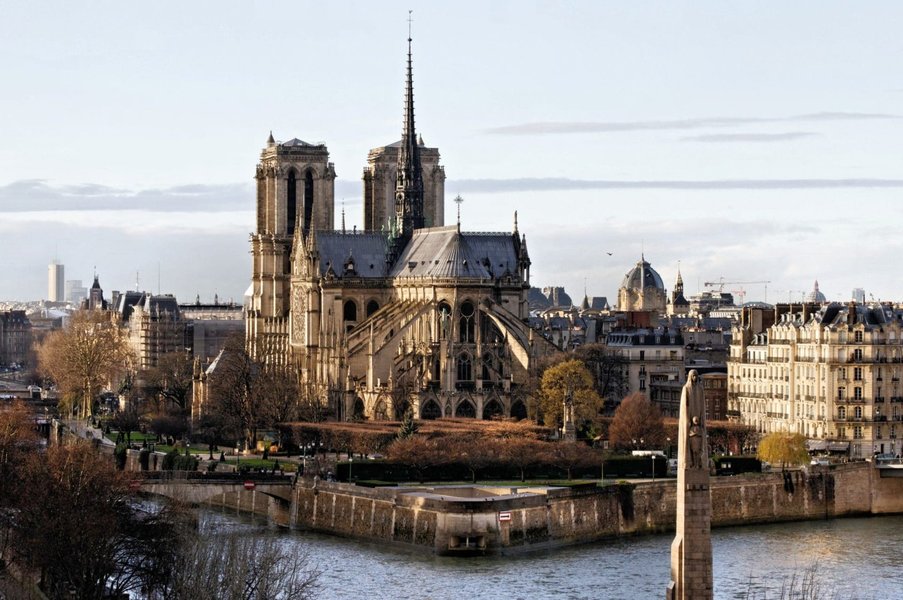
The iconic Notre-Dame de Paris, a masterpiece of Gothic architecture, showcasing its elaborate rose window and flying buttresses.
Architectural Marvels: Defining Characteristics of Gothic Style
The defining features of Gothic architecture are not merely decorative but represent ingenious structural solutions that allowed for its distinctive aesthetic. These elements collectively enabled the construction of awe-inspiring cathedrals that seemed to defy gravity.
The Power of the Pointed Arch
Unlike the semicircular arches of Romanesque architecture, pointed arches are a hallmark of Gothic design. This innovation, possibly influenced by Islamic architecture, allowed for a more efficient distribution of weight. By directing thrusts primarily downwards, pointed arches reduced lateral stress on walls, making it possible to construct taller and thinner supports.
The Elegance of Rib Vaults
Rib vaults are a system of arched ribs that form the skeletal framework of the ceiling. These intersecting diagonal ribs provided superior structural support for high roofs, distributing their weight more effectively and allowing for thinner, non-load-bearing walls between the ribs. This freed up wall space for larger windows.
The Ingenuity of Flying Buttresses
Perhaps the most visually striking and structurally critical innovation, flying buttresses are external arched supports. They transfer the outward thrust from the high walls and heavy roofs across open spaces to solid piers outside the main structure. This allowed architects to greatly reduce the thickness of interior walls, thus accommodating the vast stained-glass windows that are synonymous with Gothic cathedrals.

An illustrative example of flying buttresses, crucial for supporting tall walls and enabling large windows in Gothic structures.
The Artistry of Stained Glass Windows
With the structural limitations overcome by pointed arches and flying buttresses, Gothic cathedrals could feature immense stained-glass windows. These colossal panes, often incorporating intricate tracery (stone frameworks) and circular rose windows, were not just decorative. They served as "picture Bibles" for an largely illiterate populace, depicting biblical narratives and saintly figures, while also suffusing the interior with a vibrant, ethereal light that was believed to symbolize divine presence.
Ornate Decoration and Sculptural Grandeur
Gothic architecture is characterized by its rich and elaborate ornamentation. Facades and interiors were adorned with intricate sculptures of saints, kings, and biblical scenes. Pinnacles, spires, and gargoyles (often serving as decorative water spouts) added to the vertical emphasis and mythical charm of the buildings. This detailed artistry served both didactic and aesthetic purposes, reinforcing religious teachings and enhancing the overall grandeur.
Evolution Across Eras and Regions
Gothic architecture was not a static style; it evolved considerably over its nearly four-century lifespan, leading to distinct phases and regional variations.
Early Gothic (c. 1130–1200)
This initial phase focused on structural experimentation, seen in early French cathedrals like the Abbey of Saint-Denis. Architects were still refining the integration of pointed arches, rib vaults, and early forms of buttressing.
High Gothic (c. 1200–1300)
This period saw the refinement and culmination of Gothic ideals. Structures became grander, taller, and more luminous. Examples like Chartres Cathedral and Reims Cathedral showcase monumental scale, intricate facades, and vast expanses of stained glass.
Late Gothic (c. 1300–1500)
Characterized by increasingly elaborate ornamentation and complexity, the Late Gothic period saw styles like Rayonnant and Flamboyant in France, known for their intricate window tracery. In England, the Perpendicular style emerged, emphasizing strong vertical lines and vast, panel-like windows, as seen in King's College Chapel, Cambridge.
This video delves into the design and construction methods of Gothic cathedrals, offering insights into the engineering prowess of medieval builders.
This video provides a fascinating look into the practicalities of how these colossal structures were designed and built without modern machinery. It highlights the problem-solving and architectural genius required to achieve such ambitious scales and intricate details, shedding light on the historical context of their creation.
Regional Adaptations
While originating in France, Gothic architecture quickly spread across Europe, adapting to local materials, traditions, and cultural preferences.
- English Gothic: Developed distinct styles such as Early English, Decorated, and Perpendicular. Features include long naves, prominent central crossing towers (like Salisbury Cathedral), and elaborate window designs.
- German Gothic: Often characterized by its imposing scale and the use of brick (Brick Gothic in Northern Europe). Ulm Minster and Cologne Cathedral are prime examples of German ambition and craftsmanship.
- Italian Gothic: Tended to retain some Romanesque characteristics, often employing brick and marble. Milan Cathedral, while undeniably Gothic in its overall form, incorporates elements that differentiate it from its French counterparts.
- Spanish Gothic: Merged French influences with local traditions, sometimes featuring elaborate altar screens and chapels, as seen in Barcelona Cathedral.
- Portuguese Manueline Gothic: A unique late-Gothic style that incorporated maritime and discovery-themed motifs, exemplified by the Belém Tower.
Mindmap of Gothic Architectural Influences and Characteristics
To summarize the core aspects and influences of Gothic architecture, the following mindmap visually organizes its key elements, development, and impact.
This mindmap provides a structured overview of Gothic architecture, linking its origins, defining features, evolutionary stages, regional manifestations, and lasting impact. It highlights the interconnectedness of its various aspects, from structural innovations to its symbolic significance.
Notable Examples and Their Unique Contributions
Across Europe, numerous Gothic masterpieces stand as testaments to the style's enduring power and adaptability. Each offers a unique perspective on the characteristics and regional interpretations of Gothic architecture.
| Example | Location | Key Gothic Features Highlighted | Notable Aspect/Contribution |
|---|---|---|---|
| Abbey of Saint-Denis | France | Pioneering pointed arches, rib vaults, stained glass | Considered the birthplace of Gothic architecture under Abbot Suger. |
| Notre-Dame de Paris | France | Iconic rose windows, early flying buttresses, intricate gargoyles | Classic example of Early and High Gothic, a symbol of Paris. |
| Chartres Cathedral | France | Vast nave, remarkably preserved original stained glass, sophisticated flying buttresses | Exemplifies High Gothic perfection and unity of design. |
| Salisbury Cathedral | England | Tallest church spire in the UK, classic English Gothic (Early English style) | Known for its coherent design and rapid construction for its scale. |
| Cologne Cathedral | Germany | Immense scale, intricate spires, grand twin towers | A prime example of German High Gothic, one of the largest cathedrals in Europe. |
| Milan Cathedral | Italy | Countless spires and statues, blend of Gothic and Renaissance elements | A monumental example of Italian Gothic, reflecting regional stylistic differences. |
| King's College Chapel | Cambridge, England | Fan vaulting, immense Perpendicular style windows | A pinnacle of English Perpendicular Gothic, known for its intricate vaulting. |
This table showcases a selection of prominent Gothic structures, detailing their location, characteristic features, and their specific contributions to the architectural lexicon. These examples underline the diversity and ingenuity inherent in the Gothic style.
The Enduring Appeal and Influence of Gothic Style
Gothic architecture was not merely a structural advancement; it was a profound cultural and spiritual expression. The soaring heights and light-filled spaces were intended to evoke a sense of the divine, literally reaching towards the heavens. This deeply religious context was central to its development and widespread adoption across medieval Europe.
Beyond its ecclesiastical dominance, Gothic influences permeated secular architecture, appearing in castles, town halls, palaces, and universities. Even after its decline with the advent of the Renaissance, the style experienced a significant revival in the 19th century, known as Gothic Revival. This period saw architects reinterpreting Gothic motifs and forms, demonstrating the timeless appeal and versatility of its aesthetic principles.
Frequently Asked Questions About Gothic Architecture
What does the term "Gothic" mean in architecture?
Where did Gothic architecture originate?
What are the three main structural innovations of Gothic architecture?
What is the purpose of stained-glass windows in Gothic cathedrals?
Did Gothic architecture only apply to religious buildings?
Conclusion: A Legacy Cast in Stone and Light
Gothic architecture stands as a monumental achievement in human history, an enduring testament to medieval ingenuity, artistic vision, and spiritual devotion. From its humble beginnings in northern France, it blossomed into a style that transcended geographical and temporal boundaries, leaving an indelible mark on the European landscape. The characteristic pointed arches, rib vaults, and flying buttresses were not mere structural novelties; they were the means to an end – to create spaces that aspired heavenward, filled with the ethereal glow of stained glass, inspiring awe and reverence. The evolution of Gothic, with its distinct phases and regional adaptations, showcases a continuous dialogue between structural innovation and aesthetic expression. Its legacy continues to fascinate and inspire, a powerful reminder of an era that dared to build its faith and aspirations into stone and light.
Recommended Further Exploration
- Detailed history of Gothic architecture phases and regional styles
- Engineering principles behind Gothic cathedral construction
- Iconic Gothic cathedrals and their unique architectural features
- Comparison of Romanesque and Gothic architectural styles