

Key Insights from Corpus-Based Error Analysis
- Determiners and Prepositions Dominate: Errors related to determiners and prepositions consistently emerge as the most frequent grammatical challenges for EFL learners, accounting for a significant portion of all mistakes.
- L1 Interference is a Major Driver: A learner's native language (L1) profoundly influences the types of errors made, with specific L1 grammatical structures often leading to predictable errors in English, particularly in areas like article usage and word order.
- Targeted Instruction and AI Tools Offer Solutions: Corpus-based research not only identifies common errors but also informs pedagogical strategies and the development of AI-powered tools that can effectively assist learners in self-correction and improve writing quality.
Understanding the most prevalent grammatical errors in writing produced by English as a Foreign Language (EFL) learners is crucial for educators, language developers, and learners themselves. Corpus-based analysis, which involves scrutinizing large collections of written texts (corpora), offers an empirical and data-driven approach to pinpointing these common pitfalls. This method moves beyond anecdotal observations, providing quantitative and qualitative insights into the linguistic challenges faced by non-native English speakers.
How large datasets reveal granular error patterns.
Corpus linguistics has revolutionized the study of language, particularly in the realm of second language acquisition. By analyzing vast quantities of authentic learner writing, researchers can identify recurring patterns of errors that might otherwise go unnoticed. This methodology is particularly powerful because it allows for:
- Quantitative Assessment: Researchers can count the frequency of different error types, providing a clear statistical picture of the most problematic areas.
- Contextual Understanding: Errors are not examined in isolation but within their original linguistic context, shedding light on the underlying reasons for their occurrence.
- Identification of Learner-Specific Patterns: Different learner groups (e.g., those with specific native languages or proficiency levels) often exhibit distinct error profiles, which corpus analysis can effectively differentiate.
The process typically involves collecting hundreds or even thousands of writing samples from EFL learners. These samples are then often tagged and annotated with error categories, allowing for systematic querying and analysis. Frameworks like Dulay et al.'s surface strategy taxonomy (omission, addition, misformation, misordering) are commonly employed to classify errors, enabling researchers to gain a granular understanding of error types and their distribution.
Unpacking the frequent culprits in EFL writing.
Numerous corpus-based studies consistently highlight a few key areas where EFL learners struggle significantly. These errors often stem from a combination of factors, including the complexity of English grammar, incomplete rule acquisition, overgeneralization of rules, and crucially, interference from their native language (L1).
Determiner Errors: The Elusive "A," "An," and "The"
Determiners, including articles (a, an, the), possessive adjectives (my, your), and demonstratives (this, that), are a frequent source of difficulty. Errors in determiner usage can manifest as either the omission of a necessary determiner or the incorrect insertion of one where it's not required. Some studies indicate that determiner errors alone can constitute a substantial portion of noun phrase errors, impacting clarity and naturalness in writing.
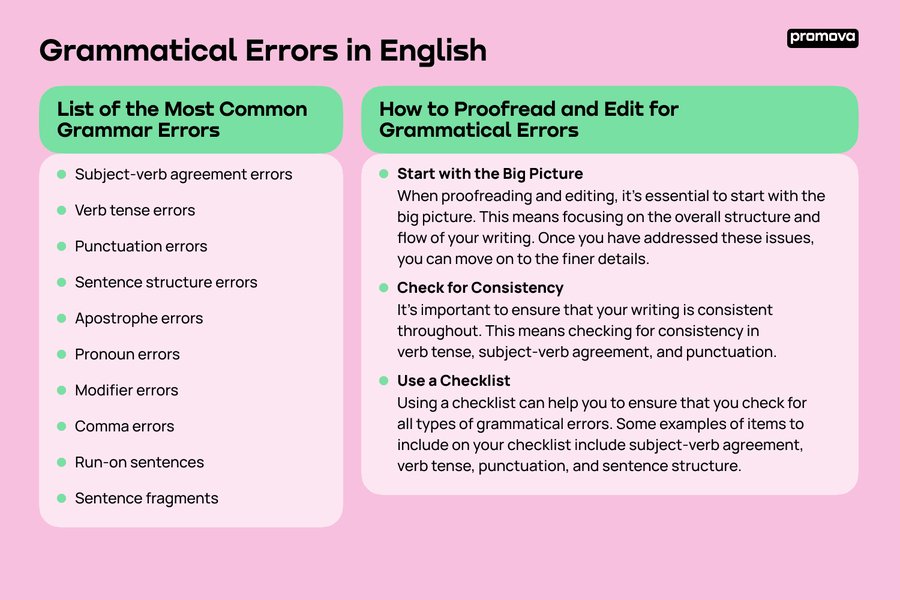
An illustration highlighting various grammatical errors, including those related to articles.
For example, learners whose native languages lack articles often struggle to master their use in English. An Arabic speaker, for instance, might write "I saw man" instead of "I saw a man" or "I saw the man," as Arabic does not have definite or indefinite articles in the same way English does.
Preposition Errors: Navigating "In," "On," and "At"
Prepositions are another notorious challenge. The nuances of English prepositions are often idiomatic and can be particularly hard for learners to acquire, leading to incorrect choices like "depend in" instead of "depend on." These errors are pervasive and contribute significantly to the overall grammatical error count in EFL writing.
Subject-Verb Agreement: The Harmony of Singular and Plural
Mismatches between subjects and verbs in terms of number (singular/plural) are common. Learners might write "The students is studying" instead of "The students are studying." This error often arises when the subject and verb are separated by other words, making the agreement less obvious, or due to L1 influences where subject-verb agreement rules differ.
Tense and Aspect Errors: Mastering the Flow of Time
Distinguishing between different tenses (e.g., simple past vs. present perfect) and aspects can be perplexing for EFL writers. Errors such as "I have visited yesterday" instead of "I visited yesterday" are frequently observed, particularly among learners whose native languages express time in different ways.
Word Order and Sentence Structure: Building Coherent Sentences
While often less frequent than determiner or preposition errors, issues with word order and sentence structure can severely impact readability and comprehension. Misordering in questions (e.g., "Where you live?" instead of "Where do you live?") or in complex sentences is common, especially among beginners. These errors can also be a direct result of L1 syntactic structures being transferred into English.
Other Notable Errors
- Lexical Errors (Spelling and Word Choice): Beyond grammar, spelling mistakes and incorrect word choice (collocations) are also highly frequent. Learners might choose phrases that are grammatically correct but semantically awkward, such as "do a mistake" instead of "make a mistake," often due to direct translation from their L1.
- Punctuation and Mechanical Errors: Run-on sentences, comma splices, and other punctuation issues also contribute to the overall error landscape, affecting the perceived quality and professionalism of the writing.
How linguistic backgrounds shape error patterns.
A critical finding from corpus-based research is the significant role of L1 interference in shaping the error profiles of EFL learners. The grammatical structures and conventions of a learner's native language often transfer into their English writing, leading to predictable errors. This is particularly evident in:
- Article Usage: Learners whose L1s lack articles (e.g., Arabic, Russian, some East Asian languages) frequently struggle with English articles.
- Tense and Aspect: Differences in how L1s express temporal relationships can lead to errors in English verb tense and aspect. For instance, Chinese and Korean students often face difficulties differentiating between past simple and present perfect due to their L1s' distinct aspectual systems.
- Word Order: L1s with different typical sentence structures can cause learners to misorder words in English sentences.
- Prepositions and Collocations: Direct translation of idiomatic expressions or prepositional phrases from the L1 often results in unconventional or incorrect English usage.
Corpus analysis allows researchers to perform contrastive analyses between the learner's L1 and English, pinpointing specific areas where transfer errors are most likely to occur. This insight is invaluable for developing targeted teaching materials and strategies.
From data collection to actionable insights.
The process of conducting a corpus-based error analysis is systematic and rigorous. It typically involves several key stages:
Data Collection
This stage involves gathering a large and representative collection of written texts from EFL learners. These can range from essays and narratives to academic papers, often categorized by proficiency level, educational context (e.g., high school, university, medical students), and native language. A sufficient sample size, often 100-500 writing samples, is crucial for statistical validity.
Error Identification and Annotation
Once collected, the texts are meticulously reviewed to identify errors. Researchers often employ established error taxonomies to categorize these mistakes (e.g., omission, addition, misformation, misordering). Advanced tools like AntConc or Sketch Engine can assist in tagging errors, creating a searchable and analyzable corpus.
Quantitative and Qualitative Analysis
With errors identified and tagged, researchers proceed to quantify them. This involves calculating error rates (e.g., errors per 1,000 words) and their frequencies. Statistical tests (like chi-square) may be used to compare error patterns across different learner groups or proficiency levels. Qualitative analysis then delves deeper into the context of specific errors, examining their linguistic environment and potential causes, such as L1 interference.
Mapping the landscape of EFL writing challenges.
The following mindmap categorizes the common grammar errors discussed, illustrating their interconnectedness and broad impact on EFL writing. It emphasizes the various facets of grammatical and lexical challenges encountered by learners.
This mindmap provides a hierarchical overview of common error categories found in EFL writing, illustrating how different types of errors contribute to overall writing challenges.
Leveraging corpus insights for effective pedagogy.
The findings from corpus-based error analyses have significant implications for both language teaching and the development of learning resources:
- Targeted Instruction: Educators can use error frequency data to prioritize teaching efforts, focusing on the most persistent problems like determiners and prepositions.
- Contrastive Analysis: Understanding how L1 influences errors allows teachers to address specific transfer issues more effectively.
- Self-Correction Strategies: Learners can be trained to recognize and correct their own common errors, using resources informed by corpus data.
- AI-Powered Tools: The vast datasets generated by corpus analysis are instrumental in training AI grammar checkers and writing assistants (e.g., Grammarly), making these tools more accurate and helpful for non-native speakers.
Synthesizing the primary challenges for EFL writers.
The following table summarizes the most common grammatical errors identified through corpus-based analyses, alongside examples and typical causes. This comprehensive overview helps to consolidate the key findings and highlights areas that require particular attention for EFL learners.
| Error Type | Description | Example of Error | Corrected Example | Typical Causes |
|---|---|---|---|---|
| Determiner Errors | Misuse, omission, or unnecessary inclusion of articles (a, an, the) and other determiners. | I saw man walking. | I saw a man walking. | L1 lacks articles, overgeneralization, incomplete rule acquisition. |
| Preposition Errors | Incorrect choice of preposition, leading to awkward or incorrect phrases. | She depends in her parents. | She depends on her parents. | Idiomatic differences, direct L1 translation, complex usage rules. |
| Subject-Verb Agreement | Mismatch between the number of the subject and the verb. | The students is studying hard. | The students are studying hard. | Difficulty with complex subjects, L1 influence, misapplication of rules. |
| Tense and Aspect Errors | Incorrect use of verb tenses or aspects, leading to unclear temporal references. | I have visited my grandma yesterday. | I visited my grandma yesterday. | L1 temporal system differences, confusion between similar tenses. |
| Word Order | Incorrect arrangement of words or phrases in a sentence. | Where you live? | Where do you live? | L1 syntactic transfer, difficulty with inversions in questions. |
| Collocation/Word Choice | Using words together that do not naturally co-occur in English. | He did a mistake. | He made a mistake. | Direct L1 translation, limited exposure to idiomatic English. |
| Punctuation Errors | Misuse of commas, periods, or other punctuation marks. | It was raining he stayed inside. | It was raining, so he stayed inside. | Lack of explicit instruction, L1 punctuation differences. |
Practical tips for avoiding common writing pitfalls.
Understanding these common errors is the first step towards improving writing. For practical advice and demonstrations on how to fix these mistakes, the following video offers valuable insights for English learners. It covers general writing mistakes, which often overlap with grammatical errors identified in corpus analysis, providing actionable strategies for improvement.
This video, titled "ENGLISH FOR BEGINNERS: The Top 5 Writing Mistakes," directly addresses common issues faced by learners. It offers practical guidance on identifying and correcting prevalent errors, complementing the theoretical understanding gained from corpus-based analyses.
Frequently Asked Questions (FAQ)
What is a corpus-based analysis of grammar errors?
Why are determiner errors so common in EFL writing?
How does native language (L1) affect grammar errors in English?
Can AI tools help with correcting grammar errors?
What are the most impactful grammar errors for overall writing quality?
Conclusion
Corpus-based analysis provides an invaluable lens through which to understand the intricate landscape of grammatical errors in EFL writing. It consistently highlights determiners and prepositions as perennial challenges, with L1 interference being a major contributing factor to many error types. By leveraging these data-driven insights, educators can tailor their instruction, learners can focus their efforts on high-impact areas, and technological tools can become more sophisticated in providing effective support. Ultimately, a deeper understanding of these common errors paves the way for more efficient and effective language acquisition strategies, empowering EFL writers to communicate with greater clarity and confidence.
Recommended Further Reading
- How does a learner's native language influence common English grammar errors?
- What are effective pedagogical approaches to address persistent determiner and preposition errors in EFL?
- How are AI-powered tools evolving to better assist non-native English speakers with grammar correction?
- What are the detailed methodologies involved in conducting a comprehensive corpus-based analysis of learner errors?