
Visualizing Solutions: How to Graph the Linear Inequality \(x + y \leq 200\)
Unlock the simple steps to map out the infinite solutions to this common mathematical constraint.
Highlights of Graphing \(x + y \leq 200\)
- Identify the Boundary: Start by graphing the line \(x + y = 200\), which divides the coordinate plane into two regions.
- Determine the Line Type: Since the inequality includes "equal to" (\(\leq\)), the boundary line is solid, indicating points on the line are part of the solution.
- Shade the Solution Area: Use a test point (like the origin) to determine which side of the line satisfies the inequality; shade this region (below the line) to represent all valid \( (x, y) \) pairs.
Understanding the Linear Inequality
What Does \(x + y \leq 200\) Represent?
The inequality \(x + y \leq 200\) is a linear inequality in two variables, \(x\) and \(y\). It doesn't represent a single line but rather a vast region on the coordinate plane. Every point \( (x, y) \) within this region (including its boundary) satisfies the condition that the sum of its x-coordinate and y-coordinate is less than or equal to 200. Graphing this inequality allows us to visualize all possible solutions simultaneously.
This type of inequality is fundamental in various fields, including algebra, economics (budget constraints), and operations research (resource limitations in linear programming).
Step-by-Step Guide to Graphing \(x + y \leq 200\)
Step 1: Graph the Boundary Line
Turning Inequality into Equality
The first step is to treat the inequality as an equation to find the boundary line that separates the coordinate plane. Replace the \(\leq\) sign with an \(=\) sign:
\[ x + y = 200 \]This is the equation of a straight line.
Finding Key Points: Intercepts
The easiest way to graph a line is often by finding its intercepts (where the line crosses the axes):
- Y-intercept (where \(x = 0\)): Substitute \(x = 0\) into the equation: \(0 + y = 200 \implies y = 200\). The y-intercept is at the point \((0, 200)\).
- X-intercept (where \(y = 0\)): Substitute \(y = 0\) into the equation: \(x + 0 = 200 \implies x = 200\). The x-intercept is at the point \((200, 0)\).
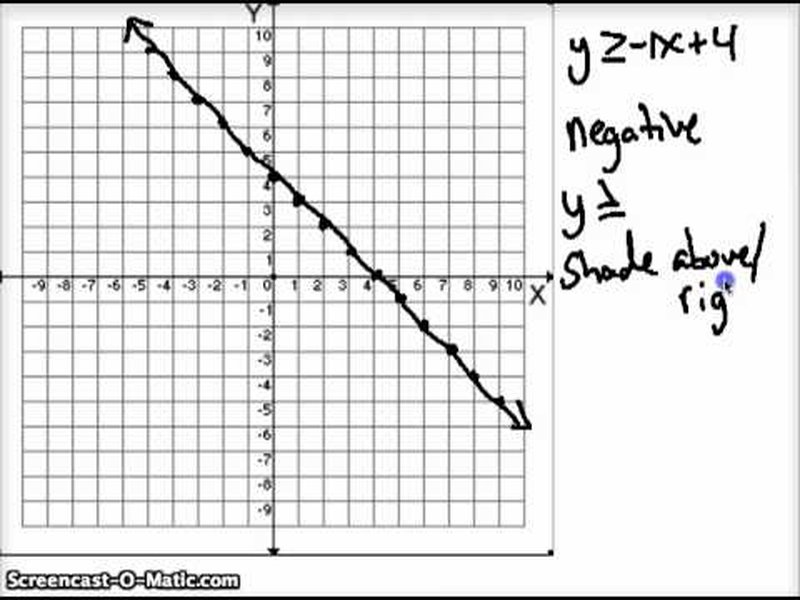
Visual representation of finding intercepts to plot a line. While this image shows a different inequality, the concept of using intercepts applies directly to \(x + y = 200\).
Drawing the Line
Plot the two intercepts, \((0, 200)\) and \((200, 0)\), on the coordinate plane. Then, draw a straight line passing through both points. This line represents all pairs \( (x, y) \) for which \(x + y\) is exactly equal to 200.
Alternatively, you can rewrite the equation in slope-intercept form (\(y = mx + b\)):
\[ y = -x + 200 \]This tells us the slope (\(m\)) is -1 (meaning the line goes down 1 unit for every 1 unit it moves to the right) and the y-intercept (\(b\)) is 200, confirming our point \((0, 200)\).
Step 2: Determine the Line Type (Solid or Dashed)
The type of line depends on the inequality symbol:
- For \(\leq\) (less than or equal to) or \(\geq\) (greater than or equal to), the line is solid. This indicates that points *on* the line are included in the solution set.
- For \(<\) (less than) or \(>\) (greater than), the line is dashed. This indicates that points *on* the line are *not* part of the solution.
Since our inequality is \(x + y \leq 200\), we use a solid line for \(x + y = 200\).
Step 3: Select the Correct Region (Shading)
Using a Test Point
The line \(x + y = 200\) divides the coordinate plane into two half-planes. We need to determine which half-plane contains the points that satisfy \(x + y \leq 200\). To do this, we select a test point that is *not* on the line. The origin, \((0, 0)\), is usually the easiest choice, provided the line doesn't pass through it.
Substitute the coordinates of the test point \((0, 0)\) into the original inequality:
\[ x + y \leq 200 \] \[ 0 + 0 \leq 200 \] \[ 0 \leq 200 \]Interpreting the Result
The statement \(0 \leq 200\) is true. This means that the test point \((0, 0)\) *is* part of the solution set. Therefore, we must shade the entire region (half-plane) that contains the origin \((0, 0)\). This is the region below and to the left of the solid line \(x + y = 200\).
If the test point had resulted in a false statement, we would shade the region on the *opposite* side of the line.

Example graph illustrating the concept of shading the solution region for a linear inequality. The shaded area represents all points satisfying the inequality.
The Final Graph
The final graph consists of the solid line \(x + y = 200\) and the entire shaded region below and to the left of it. This shaded area represents the infinite set of points \( (x, y) \) for which the sum of the coordinates is less than or equal to 200.
Mindmap Summary: Graphing \(x + y \leq 200\)
Visualizing the Process
This mindmap outlines the key steps and concepts involved in graphing the linear inequality \(x + y \leq 200\). It provides a quick visual summary of the entire process, from identifying the boundary line to determining the final shaded solution region.
This visualization helps reinforce the logical flow required to accurately represent the inequality on the coordinate plane.
Key Considerations in Graphing Linear Inequalities
Relative Importance of Steps
When graphing linear inequalities like \(x + y \leq 200\), several steps are crucial. The radar chart below offers an opinionated view on the relative importance or potential difficulty associated with each core aspect of the process. Understanding these nuances helps in avoiding common errors.
This chart highlights that understanding the inequality symbol's meaning (determining line type and shaded region) is often considered the most crucial step, while finding intercepts or slope are fundamental but perhaps less prone to conceptual errors once the method is known.
Verifying Points in the Solution Set
Testing Example Coordinates
To confirm our understanding, let's test a few points to see if they fall within the solution region defined by \(x + y \leq 200\).
| Point (x, y) | Calculation (x + y) | Is \(x + y \leq 200\)? | Location Relative to Line | In Solution Set? |
|---|---|---|---|---|
| (50, 100) | 50 + 100 = 150 | 150 ≤ 200 (True) | Below | Yes |
| (0, 0) | 0 + 0 = 0 | 0 ≤ 200 (True) | Below | Yes |
| (100, 100) | 100 + 100 = 200 | 200 ≤ 200 (True) | On the line | Yes |
| (200, 0) | 200 + 0 = 200 | 200 ≤ 200 (True) | On the line | Yes |
| (-50, 100) | -50 + 100 = 50 | 50 ≤ 200 (True) | Below | Yes |
| (150, 100) | 150 + 100 = 250 | 250 ≤ 200 (False) | Above | No |
| (200, 50) | 200 + 50 = 250 | 250 ≤ 200 (False) | Above | No |
This table clearly shows that points on the line or in the region below/left of the line satisfy the inequality, while points above/right do not.
Visual Demonstration: Graphing Constraints
Graphing Inequalities in Linear Programming
Inequalities like \(x + y \leq 200\) are often used as constraints in linear programming problems, where we aim to optimize an objective function subject to certain limitations. Understanding how to graph these constraints is a crucial first step. The video below provides a tutorial on drawing constraints on a graph, which is directly applicable to our inequality.
This video demonstrates the process for various constraints, reinforcing the techniques discussed: finding intercepts, drawing the boundary line (solid or dashed), and identifying the feasible region (the area satisfying all constraints, analogous to our single shaded region).
Frequently Asked Questions (FAQ)
Why do we use a test point like (0, 0)? +
A test point helps determine which side of the boundary line satisfies the inequality. The line divides the plane into two regions. By testing *one* point not on the line, we can definitively know whether the region containing that point is the solution set or if the opposite region is. The origin (0, 0) is often chosen because it simplifies the calculation (substituting zero for x and y is easy), but any point not on the line will work.
What if the inequality was \(x + y < 200\)? +
If the inequality was strict (< or >), the process is nearly identical, but the boundary line \(x + y = 200\) would be drawn as a dashed line instead of a solid line. This indicates that the points exactly on the line are *not* included in the solution set. The shading process using a test point remains the same; you would still shade below the line for \(x + y < 200\).
What if the test point (0, 0) is on the line? +
If the boundary line passes through the origin (e.g., for an inequality like \(y \leq 2x\)), you cannot use (0, 0) as a test point because it doesn't fall clearly into one region or the other. In this situation, simply choose any other point that is obviously not on the line, such as (1, 0), (0, 1), or (1, 1), and substitute its coordinates into the inequality to determine the correct region to shade.
What if \(x\) and \(y\) must be non-negative? +
In many real-world applications (like resource allocation or production quantities), \(x\) and \(y\) must be greater than or equal to zero (\(x \geq 0, y \geq 0\)). These additional constraints restrict the solution to the first quadrant of the coordinate plane. When graphing \(x + y \leq 200\) under these conditions, the shaded region would be a triangle bounded by the line \(x + y = 200\), the x-axis (\(y=0\)), and the y-axis (\(x=0\)). The vertices of this triangular region would be (0, 0), (200, 0), and (0, 200).
References
- Graphing Linear Inequalities - Math is Fun
- Graphing inequalities (x-y plane) review | Khan Academy
- Desmos Graphing Calculator - Desmos
- Graph inequalities with Step-by-Step Math Problem Solver - QuickMath
- Inequalities Calculator - Symbolab
- How do you graph the inequality y > x? | Socratic
Recommended
Last updated April 17, 2025