
Unraveling the Cosmos' Whispers: A Beginner's Guide to Gravity Waves
Explore the ripples that shape our universe, from atmospheric phenomena to the profound gravitational waves of spacetime.
Key Insights into Gravity Waves
- Differentiating Definitions: The term "gravity waves" commonly refers to two distinct phenomena: atmospheric/fluid gravity waves (driven by buoyancy and gravity in media like air or water) and gravitational waves (ripples in spacetime predicted by Einstein).
- Gravitational Waves as Cosmic Messengers: Astrophysical gravitational waves are generated by extremely violent cosmic events, such as colliding black holes and merging neutron stars, carrying unique information about these unseen phenomena across vast cosmic distances.
- Groundbreaking Detection: The direct detection of gravitational waves in 2015 by LIGO marked a new era in astronomy, allowing scientists to "listen" to the universe in ways impossible with traditional light-based telescopes.
The term "gravity waves" can be a source of confusion, as it refers to two fundamentally different concepts in science. On one hand, we have atmospheric or fluid gravity waves, which are observable phenomena in Earth's oceans and atmosphere. On the other, and perhaps more profoundly, are gravitational waves—the invisible ripples in the very fabric of spacetime, a concept central to Albert Einstein's theory of general relativity. This explanation will demystify both, with a primary focus on the latter, which has revolutionized our understanding of the universe.
The Dual Nature of "Gravity Waves"
To truly understand "gravity waves," it's crucial to distinguish between their two main interpretations:
1. Atmospheric (or Fluid) Gravity Waves: Ripples in Fluids
These waves occur in fluid mediums like air or water. They are a familiar part of our everyday world, even if we don't always call them "gravity waves." Imagine wind blowing over a mountain range or a large thunderstorm generating powerful updrafts. These disturbances cause the air to oscillate as gravity (or buoyancy, which is gravity-related) tries to restore it to equilibrium. This creates wave-like patterns in the atmosphere, often visible as undulating cloud formations or felt as turbulence during flights.
Similarly, waves on the surface of the ocean, driven by wind and gravity, are also a form of fluid gravity waves. These waves are distinct from gravitational waves in space because they travel through a physical medium and are restored by the Earth's gravitational pull on that medium, not by disturbances in spacetime itself.
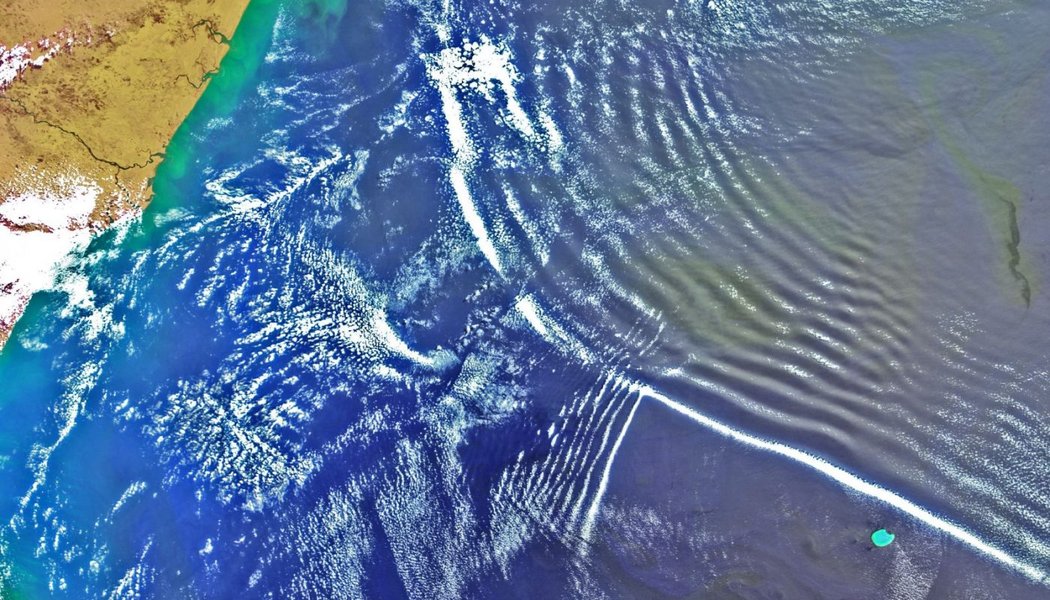
Atmospheric gravity waves, often visible as ripple-like cloud patterns, are caused by air responding to gravitational forces.
2. Gravitational Waves: Ripples in Spacetime
This is the concept that has captivated astrophysicists and was a century-long quest in physics. Gravitational waves are "ripples" or "vibrations" in the fabric of spacetime itself—the four-dimensional continuum that weaves together the three dimensions of space with time. These ripples are not waves in a fluid, but fundamental distortions of reality, much like how a heavy ball placed on a stretched rubber sheet creates a dip, and if that ball moves, it creates ripples that propagate outwards.
The Vision of Albert Einstein
The existence of gravitational waves was first predicted by Albert Einstein in 1916 as a direct consequence of his groundbreaking general theory of relativity. Einstein's theory redefines gravity not as a force, but as the curvature of spacetime caused by the presence of mass and energy. When massive objects accelerate or move dynamically, they create disturbances in this spacetime fabric, sending out these ripples that travel at the speed of light.
This video from ESA provides an accessible visual explanation of gravitational waves, demonstrating how these ripples in spacetime are generated by violent cosmic events and their significance in astrophysics.
This particular video is highly relevant because it offers a clear and concise animation of what gravitational waves are and how they are created. It vividly illustrates the concept of spacetime bending and rippling due to massive accelerating objects, which is central to understanding this complex phenomenon. The visual representation helps bridge the gap between abstract theory and observable effects, making it an excellent resource for beginners.
Cosmic Origins: Where Do They Come From?
The strongest gravitational waves originate from some of the most cataclysmic events in the universe, involving objects with immense mass moving at extreme speeds. Key sources include:
- Colliding Black Holes: When two black holes spiral inward and merge, they create colossal disturbances in spacetime, releasing a burst of gravitational waves as they coalesce into a single, larger black hole.
- Merging Neutron Stars: Similar to black holes, two incredibly dense neutron stars orbiting each other will eventually collide, producing intense gravitational waves along with electromagnetic radiation (light, gamma rays, etc.).
- Black Hole-Neutron Star Mergers: These "mixed mergers" also generate significant gravitational wave signals, offering unique insights into the properties of these exotic objects.
- Supernovae: The energetic collapse and explosion of massive stars can also be a source of gravitational waves, although the signals are typically weaker and harder to detect than those from mergers.
- Spinning Neutron Stars: Neutron stars with slight irregularities or "mountains" on their surface, if spinning rapidly, can continuously emit weak gravitational waves.
- Big Bang Echoes: Scientists theorize that gravitational waves might even be remnants from the very early universe, potentially offering a window into the conditions immediately after the Big Bang.
The Subtle Effect: Stretching and Squeezing Spacetime
As gravitational waves pass through Earth, they cause spacetime to stretch and compress in perpendicular directions. Imagine a grid. As a wave passes, it might stretch the grid horizontally while squeezing it vertically, and then vice versa. This effect is incredibly tiny by the time the waves reach us—often less than the width of a proton. This minuscule distortion is why their direct detection was such a monumental challenge.
The Quest for Detection: A New Window on the Universe
For decades after Einstein's prediction, gravitational waves remained theoretical. Indirect evidence emerged in 1974 when astronomers Joseph H. Taylor Jr. and Russell A. Hulse observed a binary pulsar system. The two pulsars were spiraling closer together at a rate consistent with the loss of energy via gravitational wave emission, an observation that earned them the Nobel Prize in Physics in 1993.
The Direct Detection: LIGO's Breakthrough
The first direct detection of gravitational waves occurred on September 14, 2015, by the U.S. National Science Foundation's Laser Interferometer Gravitational-wave Observatory (LIGO). LIGO consists of two widely separated detectors in Livingston, Louisiana, and Hanford, Washington. Each detector is an L-shaped instrument with arms several kilometers long. Lasers are used to precisely measure the distance between mirrors at the ends of these arms. When a gravitational wave passes, it slightly changes the length of the arms, creating a detectable interference pattern in the laser light. This historic detection, originating from two colliding black holes 1.3 billion light-years away, confirmed Einstein's theory and opened a revolutionary new field: gravitational-wave astronomy.
Since then, other observatories, such as Virgo in Italy and KAGRA in Japan, have joined LIGO, expanding the network and improving the accuracy of gravitational wave source localization. These detections have allowed scientists to "hear" the universe in a way never before possible, providing insights into phenomena that are otherwise invisible to traditional telescopes that rely on electromagnetic radiation (light, radio waves, X-rays, etc.).
Why Gravitational Waves Are So Important
The ability to detect and study gravitational waves offers a profoundly new way to explore the cosmos. Unlike light, which can be absorbed or scattered by dust and gas, gravitational waves pass largely unimpeded through matter. This means they carry pristine information about the violent events that generated them, allowing us to:
- Probe Extreme Gravity: Study the behavior of spacetime in extreme gravitational environments, such as those near black holes and neutron stars, testing Einstein's general theory of relativity under conditions previously inaccessible.
- "See" the Unseen: Observe events that produce no light, like the mergers of black holes, or events hidden by dense cosmic dust.
- Unlock Early Universe Secrets: Potentially detect gravitational waves from the very early moments of the universe, providing clues about the Big Bang and cosmic inflation.
- Complement Traditional Astronomy: Combine gravitational wave observations with electromagnetic observations to create a more complete picture of cosmic events. For example, the merger of neutron stars was observed with both gravitational waves and electromagnetic radiation, providing unprecedented insights.
Comparing the Two "Gravity Waves"
To further clarify the distinction, here's a comparative overview:
| Aspect | Atmospheric/Fluid Gravity Waves | Gravitational Waves (Astrophysical) |
|---|---|---|
| What are they? | Waves in a fluid medium (air, water) | Ripples in the fabric of spacetime itself |
| Cause | Gravity/buoyancy restoring disturbed fluid to equilibrium | Accelerating masses (e.g., merging black holes) disturbing spacetime curvature |
| Medium of Travel | Air, water, or other fluids | Spacetime (the fundamental fabric of the universe) |
| Speed | Typically much slower than the speed of light | Always travel at the speed of light |
| Observable Effects | Undulating cloud patterns, ocean waves, air turbulence | Minute stretching and compressing of space, detected by specialized instruments like LIGO |
| Detection Method | Visible to the naked eye, weather instruments, radar | Highly sensitive laser interferometers (e.g., LIGO, Virgo, KAGRA) |
| Significance | Meteorology, oceanography, aviation safety | Astrophysics, cosmology, understanding fundamental gravity, black holes, neutron stars, Big Bang |
Understanding the Impact: A Radar Chart Perspective
The following radar chart illustrates the relative significance and impact of gravitational wave astronomy across various scientific domains. These scores represent an opinionated analysis of their influence rather than precise measurements, demonstrating how gravitational waves offer unique contributions that complement and expand upon traditional astronomy.
A Conceptual Map of Gravity Wave Phenomena
This mindmap visually organizes the two main types of "gravity waves" and their key characteristics, making it easier to grasp their distinct natures and significance.
Ocean waves, Air turbulence"] id5["Speed: Sub-light speed"] id6["Detection: Visual,
Weather instruments"] id7["Significance: Meteorology,
Oceanography, Aviation"] id8["Gravitational Waves"] id9["Medium: Spacetime fabric"] id10["Cause: Accelerating massive objects
(e.g., black hole mergers)"] id11["Examples: Ripples from
colliding black holes or neutron stars"] id12["Speed: Speed of Light"] id13["Detection: Laser Interferometers
(LIGO, Virgo, KAGRA)"] id14["Significance: Astrophysics,
Cosmology, Testing General Relativity"] id15["Key Figures: Albert Einstein
(Prediction), LIGO (Direct Detection)"]
Frequently Asked Questions about Gravity Waves
What is the primary difference between atmospheric gravity waves and gravitational waves?
Are gravitational waves dangerous?
Can gravitational waves be used for communication?
How do scientists "hear" gravitational waves?
Was the existence of gravitational waves ever doubted?
Conclusion
Whether you're looking at the wavy patterns in the clouds or contemplating the profound ripples from colliding black holes, the concept of "gravity waves" is fascinating. While one pertains to terrestrial fluid dynamics, the other offers an unprecedented window into the most extreme and distant events of the universe, reaffirming Einstein's genius and opening up a new frontier in cosmic exploration. The direct detection of gravitational waves has ushered in a new era of astronomy, allowing us to perceive the universe not just through light, but also through its subtle, powerful wiggles.
Recommended Further Exploration
- How do gravitational wave detectors like LIGO work?
- What are the latest discoveries involving gravitational waves?
- How does general relativity explain gravity?
- What is multi-messenger astronomy?