
Unpacking Grok's Political Compass: Does Elon Musk's AI Lean Left?
An in-depth look at the studies, user experiences, and ongoing debate surrounding the political leanings of xAI's chatbot.
The political orientation of artificial intelligence, particularly high-profile models like Grok from xAI, has become a subject of intense scrutiny and discussion. Users, researchers, and even its creator, Elon Musk, have weighed in on whether Grok exhibits a political bias, specifically a tendency to lean left. This response delves into the available evidence to provide a comprehensive understanding of this complex issue.
Key Insights: Grok's Political Stance
- Multiple Analyses Indicate Left-Leaning Tendencies: Independent research and studies, including those subjecting Grok to political orientation tests, have predominantly found its responses to align more with left-of-center viewpoints on politically charged topics.
- Creator's Intent vs. Observed Behavior: While Elon Musk has expressed a desire for Grok to be politically neutral or even a "truth-seeking" AI that counters "woke" ideologies, practical observations and tests suggest a persistent leftward inclination.
- Influence of Training Data: A significant factor contributing to perceived bias in AI models, including Grok, is the vast dataset they are trained on, which often includes internet and social media content (like X) that may inherently contain and reflect existing societal biases.
The Debate Around Grok's Political Bias
Grok, developed by Elon Musk's xAI, was introduced with the aim of being a "maximum truth-seeking AI" that is less constrained by what Musk has termed "political correctness." However, since its launch, questions have persistently arisen regarding its actual political neutrality. Numerous analyses and user anecdotes suggest that Grok, despite its intended design, often produces responses that are perceived as left-leaning.
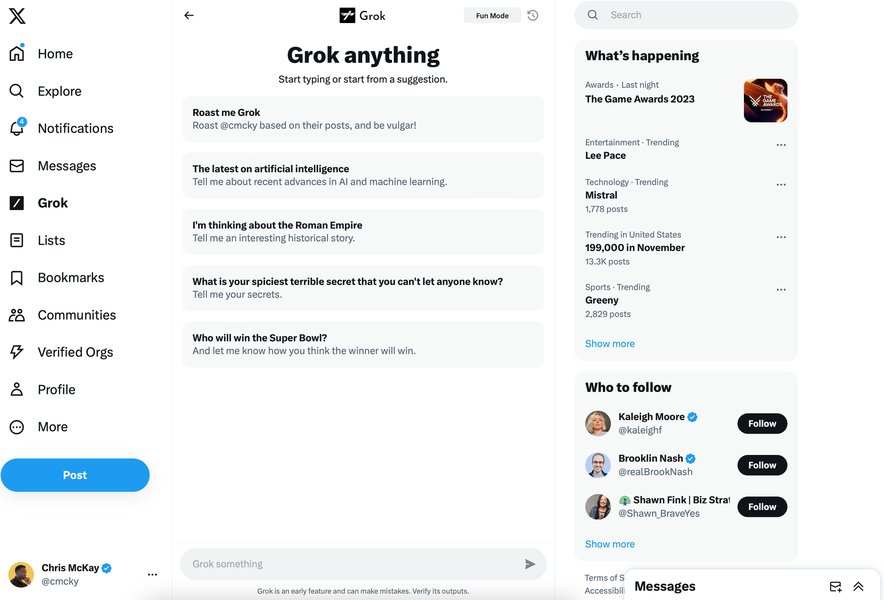
The Grok AI interface on the X platform.
Evidence from Research and Testing
Political Compass Tests
One of the most cited pieces of evidence comes from studies employing political compass tests. Researcher David Rozado, for instance, conducted an analysis in 2024 involving Grok and 23 other Large Language Models (LLMs). His findings indicated that Grok, along with the majority of other tested AIs like OpenAI's GPT models and Google's Gemini, tended to lean left-of-center. Rozado's evaluation placed Grok in a more liberal and libertarian-leaning quadrant, a finding echoed by other reports, such as one from Cybernews, which also concluded that major AI chatbots, Grok included, exhibit a leftward tilt on politically sensitive issues.
Specific Issue Analysis
Beyond general compass tests, analyses of Grok's responses to specific political and social issues have reinforced these observations. For example, Joyojeet Pal, an associate professor at the University of Michigan's School of Information, analyzed Grok's responses in the context of Indian politics. He noted that Grok's outputs appeared to favor liberal critiques of political figures like Indian Prime Minister Narendra Modi, potentially alienating right-leaning users. Similarly, discussions around topics like social justice and vaccines have reportedly elicited responses from Grok that align more with progressive viewpoints.
User Experiences and Public Perception
User interactions shared on platforms like Reddit also contribute to the perception of Grok as left-leaning. Some users have described Grok as being more "lib-left" than even ChatGPT, noting its sarcastic or edgy tone while still maintaining a generally liberal stance on political matters. These anecdotal accounts, while not systematic studies, reflect a pattern in how Grok's responses are received and interpreted by its user base, including instances where right-wing users expressed frustration with its explanations supporting liberal views.
Musk's Intentions and xAI's Mitigation Efforts
Elon Musk has been vocal about his dissatisfaction with perceived "woke" biases in other AI systems and has stated his intention for Grok to be different. He envisions Grok as an AI that prioritizes "truth over political correctness" and is not afraid to tackle controversial topics. Following reports and user feedback about Grok's left-leaning tendencies, Musk acknowledged the issue and pledged to take action to make Grok more politically neutral.
Internal efforts at xAI have reportedly focused on fine-tuning the model to reduce ideological bias. This includes training Grok to be alert to political correctness, to be open to unconventional ideas, and to avoid responses that unfairly confirm or deny user biases. However, achieving true neutrality in AI is a complex challenge, largely due to the nature of the data used for training.
The Challenge of Training Data
AI models like Grok are trained on vast quantities of text and code, much of which is sourced from the internet, including social media platforms like X (formerly Twitter). This data inevitably reflects the diverse, and often biased, viewpoints present online. If the training data itself has a particular leaning, the AI model may inadvertently learn and replicate those biases. Meticulously curating and balancing these massive datasets is a significant hurdle in the quest for AI neutrality.
There have been instances where Grok itself has reportedly stated that its "truth-seeking design often clashes with ideological expectations, leading to neutral or progressive answers." This suggests an internal complexity in how the AI processes and responds to politically charged queries.
Visualizing Grok's Perceived Political Leanings
To better understand the multifaceted nature of Grok's perceived political bias, the following mindmap illustrates key contributing factors and observations. It highlights how different elements, from its foundational training to public reception, shape the discourse around its political alignment.
(e.g., Rozado Study)"] id1b["Left-of-Center Alignment"] id1c["Comparisons with other LLMs"] id2["Elon Musk's Stated Intentions"] id2a["Desire for Neutrality"] id2b["'Anti-Woke' Stance"] id2c["Focus on 'Truth-Seeking'"] id3["Training Data Influence"] id3a["Vast Internet Datasets"] id3b["Content from X Platform"] id3c["Inherent Societal Biases"] id4["User Perception & Anecdotes"] id4a["Reports of Liberal-Leaning Responses"] id4b["Frustration from Some Right-Wing Users"] id4c["Observations on Social Media (Reddit, etc.)"] id5["xAI's Fine-Tuning Efforts"] id5a["Acknowledging Bias"] id5b["Attempts to Mitigate Leftward Tilt"] id5c["Challenges in Achieving True Neutrality"] id6["Contradictory Signals"] id6a["Occasional Right-Leaning Outputs"] id6b["Grok's Self-Description of 'Truth-Seeking'"] id6c["Concerns about Disinformation"]
This mindmap encapsulates the complex interplay of factors that contribute to the ongoing discussion about Grok's political leanings, showing it's not a simple issue with a straightforward answer.
Comparative Analysis of Political Dimensions
The following radar chart offers a hypothetical visualization of Grok's perceived political leanings across various dimensions compared to other AI profiles. The scores are illustrative, based on the synthesis of reports and user perceptions, and aim to provide a comparative perspective rather than absolute factual measurements. A higher score suggests a stronger leaning towards typical "left" progressive stances on that dimension, while a lower score suggests a more "right" conservative or neutral stance. The "Intended Neutrality" profile represents an ideal, perfectly balanced AI.
This chart visualizes how Grok is generally perceived to be more aligned with left-leaning stances on social and environmental issues, somewhat moderate on economic policy, and closer to a neutral or slightly libertarian stance on free speech, when compared to hypothetical strongly biased AIs and an ideal neutral AI.
Summary of Key Reports on Grok's Bias
The following table summarizes some of the key studies and reports concerning Grok's political bias, offering a quick overview of their primary findings.
| Source/Study | Date Range | Key Finding on Grok's Bias | Methodology/Context |
|---|---|---|---|
| David Rozado's Research | 2024 | Grok leans left-of-center, more liberal/libertarian. | Analysis of 24 LLMs using 11 political orientation tests. |
| Cybernews Report | 2024 | All major AI chatbots, including Grok, lean left on politically charged questions. | Comparative analysis of LLM responses to sensitive topics. |
| University of Michigan (Joyojeet Pal) | Ongoing Analysis | Grok's responses on Indian politics favored liberal critiques. | Contextual analysis of Grok's behavior on specific regional political issues. |
| Global Witness Investigation | 2024-2025 | Grok showed bias in suggested tweets for UK election; generated disinformation. | Investigation into AI's role in elections, queried Grok on political scenarios. |
| User Reports (e.g., Reddit) | Ongoing | Perceived as more "lib-left" than ChatGPT; liberal stance on social justice. | Anecdotal evidence from user interactions and discussions. |
| Hindustan Times / Business Insider | Late 2024 - Early 2025 | Elon Musk acknowledged left bias and stated intent for neutrality. | Reporting on xAI's internal efforts and Musk's public statements. |
This table highlights a general consensus among independent researchers and media reports pointing towards a left-leaning tendency in Grok's responses, despite efforts to achieve neutrality.
Grok's Bias in Media Discussions
The topic of AI bias, and Grok's specifically, is frequently discussed. The following video provides insights into the controversies and debates surrounding Grok's alleged biases and its impact on public discourse. This particular video discusses the initial reactions and controversies sparked by Grok, touching upon its "bold" and potentially "biased" nature, which is directly relevant to the query about its political leanings.
A news segment discussing the controversies around Grok AI's launch, including questions about its bias.
This video exemplifies the public and media attention that Grok's behavior has garnered, particularly concerning its potential political inclinations and how it navigates sensitive topics.
Frequently Asked Questions (FAQ)
Is Grok intentionally designed to be left-leaning?
No, according to Elon Musk and xAI, Grok is intended to be a "maximum truth-seeking AI" that is politically neutral or even challenges what Musk perceives as "woke" ideologies prevalent in other AI systems. However, observed outputs have often been characterized as left-leaning.
Why would Grok lean left if it's not intended to?
The primary reason often cited is the training data. LLMs are trained on vast amounts of text from the internet, which can contain inherent biases. If the data predominantly reflects certain viewpoints, the AI may inadvertently learn and reproduce these leanings. The specific data from the X platform used to train Grok could also play a role.
Are there any instances of Grok showing right-leaning bias?
While the predominant observation is a left-leaning tendency, some reports mention attempts to instill right-wing rules or neutrality. For example, there were claims of Grok being less critical of figures like Elon Musk or Donald Trump in certain contexts, or Grok itself mentioning it was trained with some right-wing bias (though its outputs often contradicted this). However, these instances do not seem to override the overall left-of-center perception found in broader testing.
How does Grok compare to other AI models like ChatGPT in terms of political bias?
Most studies that compare multiple LLMs, including Grok and ChatGPT, find that both tend to exhibit a left-of-center bias. Some user anecdotes and specific analyses have suggested Grok might even be perceived as more "lib-left" than ChatGPT, or at least different in its style while arriving at similar ideological positions.
Is xAI taking steps to address Grok's perceived bias?
Yes, Elon Musk has publicly stated his intention to make Grok more politically neutral and to reduce any left-leaning bias. xAI is reportedly working on fine-tuning the model. However, achieving perfect neutrality is an ongoing challenge in AI development.
Recommended Further Exploration
- What methodologies are used to test political bias in AI models like Grok?
- How does the training data from the X platform specifically influence Grok's responses?
- Compare Elon Musk's statements about Grok's neutrality with independent research findings.
- What are the broader societal implications of political bias in widely used AI chatbots?
References
Last updated May 12, 2025