
Unlocking the Details of US Patent 6214804B1: Your Guide to Patent Discovery
Navigate the world of patent databases to access comprehensive information on specific inventions and intellectual property.
Understanding a specific US Patent, such as US Patent 6214804B1, involves knowing where and how to search for its official documentation. While the precise contents of this particular patent require consulting dedicated databases, this guide will equip you with the knowledge and tools to effectively retrieve and interpret such information.
Key Insights at a Glance
- Patent Identification: The number "US 6214804B1" signifies a granted United States patent, with "US" denoting the country, "6214804" being the unique serial number, and "B1" indicating it's an issued patent (first publication of a granted patent).
- Primary Search Resources: The most reliable sources for accessing patent documents are the United States Patent and Trademark Office (USPTO) through its Patent Public Search tool, Google Patents, Espacenet, and WIPO's PATENTSCOPE.
- Information Within a Patent: A full patent document typically includes a title, abstract, inventor details, assignee information, issue date, detailed description of the invention, drawings (if applicable), and, most importantly, the claims which define the legal scope of protection.
Decoding Your Patent Number: US 6214804B1
Understanding the components of a patent number is the first step in your search. For "US 6214804B1":
- US: This prefix clearly indicates that the patent was granted by the United States Patent and Trademark Office.
- 6214804: This is the unique serial number assigned to the patent. Patent numbers in the 6 million range were generally issued in the early 2000s (around 2000-2001).
- B1: This is a kind code. "B1" typically signifies that this is the first publication of a granted patent that was not previously published as a pre-grant application. If it had been published as an application first, the granted patent might have a "B2" kind code.
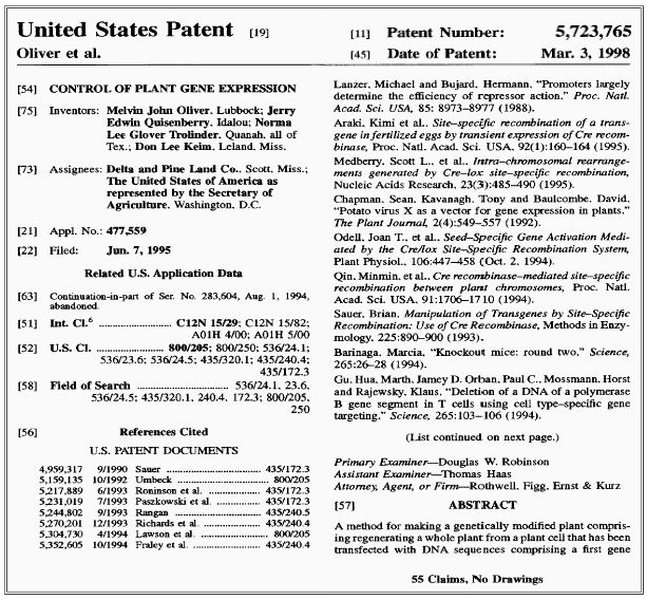
An illustrative guide on dissecting the sections of a patent document.
Premier Platforms for Patent Exploration
Several powerful online databases provide free access to patent documents. To find information on US Patent 6214804B1, these are your primary resources:
United States Patent and Trademark Office (USPTO)
Patent Public Search
The USPTO's official Patent Public Search tool is the definitive source for US patents. It has replaced older systems (like PatFT and AppFT) and offers a robust platform for searching and viewing patent documents.
- Features: Provides access to full-text patents and published applications. It offers both a Basic Search interface for simple queries (e.g., by patent number) and an Advanced Search for more complex queries using various fields and Boolean operators.
- How to Use: Navigate to the USPTO website's patent search section and enter "6214804B1" into the search bar.
Public Search Facility
For those who can visit in person, the USPTO Public Search Facility in Alexandria, Virginia, offers direct access to patent information in various formats.
Google Patents
Google Patents is a widely used search engine that indexes patents and patent applications from the USPTO and many other international patent offices.
- Features: Allows searching by keyword, inventor, assignee, patent number, and Cooperative Patent Classifications (CPCs). It provides access to full patent documents, often including PDFs and links to related documents and prior art.
- How to Use: Simply enter "US6214804B1" into the Google Patents search bar.
Espacenet
Offered by the European Patent Office (EPO), Espacenet provides access to over 150 million patent documents from around the world, including US patents.
- Features: Advanced search capabilities, bibliographic data, and often links to the full-text documents. It's an excellent resource for international patent searches.
WIPO PATENTSCOPE
The World Intellectual Property Organization (WIPO) offers PATENTSCOPE, a database that allows searching of international Patent Cooperation Treaty (PCT) applications and national and regional patent collections.
- Features: Flexible search syntax, automatic word stemming, relevance ranking, and translation tools for abstracts and titles.
PAT2PDF.org
This website provides a straightforward way to download PDF copies of U.S. patents and published applications simply by entering the patent number.
- Features: Useful for quickly obtaining a clean PDF copy of a known U.S. patent. You can request multiple patents by separating numbers with a semicolon.
Comparative Overview of Patent Search Platforms
The table below offers a side-by-side comparison of the key features of the major patent search databases, helping you choose the best tool for your needs when looking up US Patent 6214804B1 or any other patent.
| Feature | USPTO Patent Public Search | Google Patents | Espacenet | WIPO PATENTSCOPE | PAT2PDF.org |
|---|---|---|---|---|---|
| Primary Focus | US Patents & Applications | Global Patents & Applications | Global Patents & Applications (EPO-centric) | PCT Applications & Global Collections | US Patent PDFs |
| Full-Text Search | Yes | Yes | Yes (coverage varies) | Yes (coverage varies) | N/A (direct download by number) |
| PDF Download | Yes | Yes | Yes | Yes | Yes (primary function) |
| Advanced Search Capabilities | Yes (dedicated advanced interface) | Yes (fielded search, CPCs) | Yes (SmartSearch, classification search) | Yes (flexible syntax, cross-lingual) | No (number input only) |
| Ease of Use (Basic Search) | Good | Excellent | Good | Good | Excellent (for its purpose) |
| Coverage | US only | Extensive international | Extensive international | Extensive international (strong on PCT) | US only |
Visualizing Patent Search Platform Strengths
To further illustrate the capabilities of these patent search platforms, the radar chart below provides a visual comparison across several key metrics. This can help you quickly identify which platform might best suit specific research needs when investigating patents like US Patent 6214804B1. The scores (out of 10) are based on general capabilities and user experience.
The Anatomy of a Patent Document
Once you locate US Patent 6214804B1 (or any other patent), you will find it contains several standard sections, each providing specific information:
- Cover Page: Includes the patent number, title of the invention, inventor(s) name(s) and city/state, assignee (if any), filing date, issue date, U.S. and international classification codes, references cited, and an abstract.
- Abstract: A brief summary (typically under 150 words) of the invention's nature and gist.
- Drawings (if applicable): Visual representations of the invention. Most patents include drawings.
- Background of the Invention: Discusses the field of the invention and the problems the invention aims to solve, often referencing prior art.
- Summary of the Invention: A concise overview of the invention's objects and advantages.
- Detailed Description: A thorough explanation of the invention, including how to make and use it, and the best mode contemplated by the inventor. This section must be enabling, meaning someone skilled in the art could reproduce the invention based on this description.
- Claims: This is the most crucial part legally. The claims define the precise scope of the exclusive rights granted by the patent. They are numbered and set out what the patent actually protects.
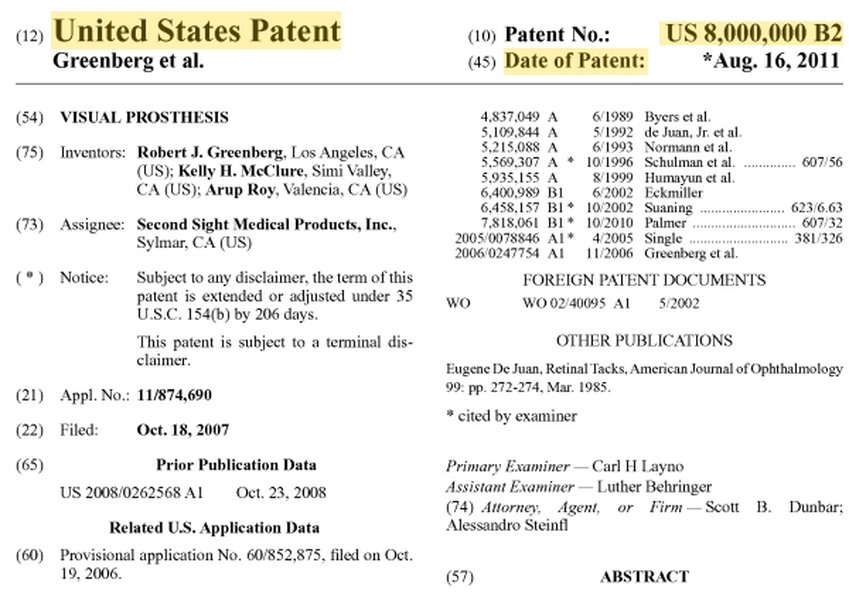
Example of the cover page of a granted U.S. Patent.
Navigating the Patent Discovery Process: A Mindmap
The mindmap below outlines the typical journey involved in finding and understanding a specific patent like US Patent 6214804B1. It starts with identifying the patent number and moves through selecting appropriate search tools, retrieving the document, and finally, analyzing its content.
The Role of the USPTO
The United States Patent and Trademark Office (USPTO) is the federal agency responsible for granting U.S. patents and registering trademarks. It plays a crucial role in promoting innovation and technological advancement by providing inventors with exclusive rights for their discoveries for a limited time. Notably, the USPTO operates solely on fees collected from users, such as patent application fees and trademark registration fees, rather than taxpayer dollars. The agency also collaborates with international bodies like the European Patent Office (EPO) and the Japan Patent Office (JPO) as part of the Trilateral Patent Offices to harmonize patent practices globally. The legal foundation for the U.S. patent system is derived from the Copyright Clause of the U.S. Constitution.
Frequently Asked Questions (FAQ)
What does the "B1" at the end of a US patent number mean?
The "B1" is a USPTO kind code. It generally indicates that the patent is a utility patent that was granted and published without having a prior publication of its application (a pre-grant publication, which would typically be an "A" document). So, US Patent XXXXXXXB1 is the first publication of that granted patent.
Are all US patents available online for free?
Yes, issued U.S. patents and published patent applications are generally available for free public inspection through online databases like the USPTO's Patent Public Search, Google Patents, and Espacenet. Some services might charge for advanced analytics or bulk downloads, but basic access to the documents is free.
How can I get a PDF copy of US Patent 6214804B1?
Once you locate the patent on platforms like USPTO Patent Public Search or Google Patents, there's usually an option to download a PDF version. Alternatively, websites like PAT2PDF.org specialize in providing direct PDF downloads of U.S. patents by simply entering the patent number.
What if I can't find US Patent 6214804B1 in the databases?
Ensure the patent number is entered correctly, including the "US" prefix and "B1" suffix (though some search engines are flexible). If it's still not found, it could be an error in the number, or, rarely, a patent that is not yet indexed or has an unusual status. Double-checking across multiple databases (USPTO, Google Patents) is advisable. It is highly likely a patent with this number exists and is searchable.
Recommended Further Exploration
To deepen your understanding of patents and intellectual property, consider exploring these related queries:
- How to read and interpret patent claims for legal understanding.
- What is the difference between a patent application and a granted patent?
- How to conduct a prior art search for an invention.
- Understanding patent classification systems like CPC and IPC.
References
The information and resources mentioned in this response are based on publicly available data from the following authoritative sources:
Last updated May 12, 2025