
Unveiling the Marine Marvel: Organ Development and Size Dynamics in Halobates hayanus
A Comprehensive Look at the Adaptations of the Ocean Skater
Key Insights into Halobates hayanus
- Unique Marine Adaptation: Halobates hayanus is one of the rare insect species that has successfully colonized marine habitats, particularly coastal and sheltered environments. This adaptation is largely attributed to its specialized superhydrophobic body surface.
- Size-Dependent Organ Development: The total length (TL) of Halobates hayanus is a crucial indicator of its developmental stage, influencing the maturation and structure of key internal organs such as the integument, muscular, nervous, digestive, excretory, and reproductive systems.
- Bio-Inspired Design Potential: The remarkable adaptations of Halobates hayanus, including its superhydrophobicity and efficient surface locomotion, offer significant inspiration for advancements in material science, such as liquid-repellent surfaces and drag reduction technologies.
The marine water-strider Halobates hayanus (White, 1883), a fascinating member of the order Heteroptera and family Gerridae, represents a remarkable evolutionary achievement: the successful colonization of marine environments by an insect. While the vast majority of water striders inhabit freshwater bodies, Halobates stands out as one of the few genera, and specifically five species within it, that have truly conquered the open ocean. This paper delves into the intricate relationship between the total length distribution and the developmental progression of selected internal organs in Halobates hayanus, providing a comprehensive overview of its unique biology, adaptations, and ecological significance.
Understanding Halobates hayanus: A Marine Pioneer
Halobates hayanus is predominantly found in tropical and subtropical marine habitats, particularly in sheltered coastal areas and mangrove ecosystems. This species, along with other coastal Halobates, plays a vital role in its environment, often preying on terrestrial insects that fall onto the water surface. The ability of Halobates to thrive in saltwater is a testament to unique morphological and physiological adaptations that distinguish it from its freshwater relatives.
Classification and Habitat
As a member of the family Gerridae, Halobates hayanus belongs to a group of insects commonly known as water striders, water skeeters, or pond skaters. While approximately 750 species of water striders exist, most are freshwater dwellers. However, the genus Halobates, with over 40 species, is almost exclusively marine. Among these, five species are truly oceanic, meaning they live on the surface of the open ocean, only venturing near the coast during storms. H. hayanus, being a coastal species, is often associated with mangrove habitats and other marine vegetation in the Indo-Pacific region, including areas like Libong Island, Thailand, where samples for histological studies have been collected.
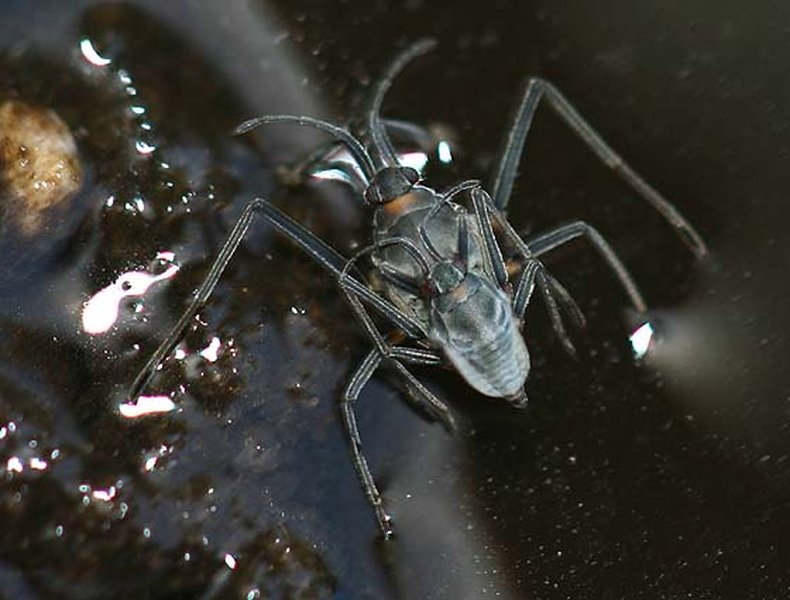
Marine Water Strider (Rhagovelia plumbea) gracefully resting on the water surface.
Phenomenal Adaptations for Aquatic Life
The success of Halobates hayanus in marine environments is attributed to several key adaptations. A primary adaptation is its remarkable superhydrophobicity, achieved through a dense layer of microscopic hairs covering its entire body. These hairs trap a layer of air, preventing the insect from getting wet and sinking. This "plastron" not only provides buoyancy but also offers resistance to splashes and aids in rapid resurfacing from accidental submersion.
Furthermore, Halobates species are significantly smaller and lighter than their freshwater counterparts, despite having similar leg lengths. For instance, oceanic H. germanus and coastal H. hayanus are up to four times smaller and two to three times lighter than freshwater relatives. This size reduction, coupled with their superhydrophobicity, allows them to fully harness the surface tension of seawater, enabling impressive locomotion and agility. They can reach speeds of "a hundred body lengths per second" and launch themselves with vertical accelerations of approximately 400 \( \text{m/s}^2 \), far exceeding freshwater species.
Total Length as a Developmental Indicator
The total length (TL) of Halobates hayanus serves as a critical parameter for understanding its growth stages and the corresponding development of its internal organs. Research indicates that the TL of this insect can be categorized into distinct size groups, reflecting different life stages and physiological maturity.
Size Distribution and Molting Stages
Observations on Halobates hayanus suggest that its total length can be broadly divided into three groups: small (0.1-0.2 cm), medium (0.3-0.4 cm), and large (0.5-0.6 cm). Adult specimens of H. hayanus collected from areas like Libong Island, Thailand, have been found to range from 0.6-0.8 cm in total length. Water striders undergo five molts before reaching the adult stage, with first-instar nymphs measuring only about 1 mm (0.1 cm) in body length. This progressive increase in total length directly correlates with the development and differentiation of their internal systems.
Histological Development Across Life Stages
The total length distribution is intricately linked to the histological development of various organs in Halobates hayanus. Histological studies examine the microscopic structure of tissues and organs, providing insights into their development and function. For H. hayanus, this includes detailed analyses of the integumentary, muscular, nervous, digestive, excretory, and reproductive systems.
The Integumentary System
The integumentary system, the outer covering of the insect, is vital for protection and interaction with the environment. In Halobates hayanus, it comprises three layers: the epicuticle, exocuticle, and endocuticle. The integrity and specialized structure of these layers, particularly the epicuticle with its hydrophobic micro-hairs, are crucial for its ability to remain on the water surface without getting wet. The development of this system is directly tied to the insect's molting process and increasing total length.
Muscular and Nervous Systems
The muscular system of H. hayanus primarily consists of skeletal muscle, essential for its rapid and agile movements across the water surface. The nervous system, including the frontal ganglia and subesophageal ganglion, coordinates these complex movements and sensory perceptions. As the insect grows in total length, these systems undergo maturation, enhancing its locomotive capabilities and predatory efficiency.
This radar chart illustrates the developmental progression of key biological traits and capabilities across different total length (TL) groups of Halobates hayanus. It visually demonstrates how characteristics such as superhydrophobicity, locomotive speed, prey capture efficiency, the maturity of various organ systems, environmental resilience, and reproductive capacity evolve from early nymph stages (small TL) through mid-development to the fully mature adult stages (large TL). The increasing scores for each trait across the size groups highlight the enhancements in functionality and adaptation as the insect grows and its internal organs develop. For instance, while basic superhydrophobicity is present early on, its effectiveness and the overall resilience of the insect are maximized in larger, adult specimens, correlating with the full development of its integumentary and muscular systems.
Digestive, Excretory, and Reproductive Systems
The midgut and hindgut, components of the digestive system, are crucial for nutrient absorption from their diet, which includes zooplankton, floating insects, fish eggs, and larvae. The excretory system in Halobates hayanus features fully formed Malpighian tubules, responsible for waste removal. The reproductive system, comprising ovarian structures, reproductive tracts, and accessory organs in females, is also a key area of study. The development of these systems is directly linked to the total length, with larger individuals typically exhibiting fully mature and functional organs necessary for reproduction and sustained metabolic activity.
This video provides quick facts about sea skaters (Halobates), highlighting their unique surface-skating abilities and adaptations for marine life. It visually complements the discussion on the specialized morphology and behavior that allow these insects to thrive in open ocean environments.
Ecological Role and Broader Implications
Halobates hayanus, like other water striders, plays a role in its ecosystem as a predator, often feeding on insects that fall onto the water surface. Oceanic species are known to consume zooplankton, floating insects, fish eggs, and even dead jellyfish. Their ability to effectively process these varied diets underscores the functional maturity of their digestive system in larger specimens.
Environmental Interactions
The presence of Halobates in marine habitats also highlights broader environmental considerations. In recent decades, oceanic Halobates species have been observed laying eggs on floating plastic waste. While this provides more breeding surfaces, it raises concerns about potential disruptions to marine food chains if Halobates populations become unusually common due to increased oviposition sites. This interaction underscores the need for further research into the long-term ecological impacts of plastic pollution on marine insects.
Bio-Inspired Technological Advancements
The exceptional adaptations of Halobates, particularly its superhydrophobicity and efficient surface locomotion, offer valuable insights for bio-inspired engineering. The micro-hair structure on their legs, which traps air and repels water, has potential applications in developing novel liquid-repellent surfaces, anti-dew materials, and technologies for drag reduction in marine vessels. Understanding the intricate mechanics behind their ability to walk on water can also inform the design of advanced robotics capable of traversing liquid surfaces.
Summary of Developmental Characteristics
To summarize the key developmental aspects of Halobates hayanus in relation to its total length, the following table provides a concise overview:
| Characteristic | Early Nymph (Small TL) | Mid-Development (Medium TL) | Adult (Large TL) |
|---|---|---|---|
| Total Length (cm) | 0.1 - 0.2 | 0.3 - 0.4 | 0.5 - 0.8 |
| Integumentary System | Basic layers present, superhydrophobic hairs developing. | Layers more defined, dense hydrophobic hair distribution. | Fully developed epicuticle, exocuticle, and endocuticle; optimal superhydrophobicity. |
| Muscular System | Developing skeletal muscles; limited power. | Muscles more developed; increased strength for propulsion. | Fully formed skeletal muscles; capable of rapid and powerful locomotion. |
| Nervous System | Ganglia forming; basic sensory and motor functions. | Nervous system more complex; enhanced coordination. | Fully developed frontal and subesophageal ganglia; advanced sensory and motor control. |
| Digestive System | Simple midgut and hindgut; limited feeding capacity. | Digestive organs maturing; broader dietary intake. | Fully functional midgut and hindgut; efficient digestion of diverse prey. |
| Excretory System | Malpighian tubules present but less active. | Malpighian tubules more active; increased waste processing. | Fully formed and highly active Malpighian tubules; efficient waste excretion. |
| Reproductive System | Rudimentary gonads; immature. | Developing ovarian/testicular structures. | Fully developed ovaries/testes, reproductive tract, and accessory organs; reproductively active. |
Frequently Asked Questions about Halobates hayanus
Recommended Further Exploration
- Explore the specific adaptations that allow oceanic Halobates species to thrive in the open ocean.
- Investigate how the unique surface locomotion of water striders inspires the development of new materials and technologies.
- Delve into the ecological implications of marine insects, like Halobates, utilizing plastic waste for egg-laying.
- Understand the complete life cycle and predatory feeding behaviors of coastal water striders.
References
Last updated May 21, 2025