
Unlocking the Unified Story: Exploring Harmonized Gospels
Discover resources, tools, and insights for reading Matthew, Mark, Luke, and John as a single, cohesive narrative of Jesus' life.
The four Gospels offer unique perspectives on the life, teachings, death, and resurrection of Jesus Christ. While each provides invaluable insights, many readers seek a way to experience these accounts as a single, flowing story. This is where "Gospel Harmonization" comes in – the practice of weaving together the narratives of Matthew, Mark, Luke, and John into a unified whole or presenting them side-by-side for easy comparison. This approach aims to provide a comprehensive, chronological understanding of Jesus' ministry.
Key Insights
- Diverse Resources Available: Numerous harmonized Gospels exist in various formats, including books, online tools, and downloadable PDFs, catering to different study preferences (e.g., merged narratives, parallel columns, chronological focus).
- Balancing Unity and Distinctiveness: Harmonization offers a unified view but can sometimes obscure the unique theological emphases, literary styles, and intended audiences of the individual Gospel writers.
- Digital Possibilities: Modern technology allows for interactive digital harmonies with features like source tracking, parallel views, timelines, and annotation tools, enhancing the study experience beyond static text.
Discovering Harmonized Gospel Resources
Whether you prefer a physical book, an online interactive tool, or a downloadable PDF, numerous resources are available that present the Gospels in a harmonized format. These resources vary in their approach, methodology, and the Bible translation used.
Books Offering Merged Narratives
Several authors have undertaken the task of blending the four Gospels into a single, continuous story:
- "The Gospels Combined" by Chad Mabey: Compiles the four accounts into one continuous reading, intended as a study aid rather than a replacement for the individual Gospels.
- "The Gospel of Jesus: The Four Gospels in a Single Complete Narrative" by Loraine Boettner: Uses the Christian Standard Bible (CSB) to create a unified story, incorporating relevant passages from Acts and 1 Corinthians.
- "The ONE: A Blending of the Four Gospels": Merges the distinct voices into a singular, fluid narrative suitable for devotional reading or study.
- "The Common Gospel": Aims for conciseness by removing redundancies, claiming to be significantly shorter while preserving the core message.
- "The Merged Gospels" by Gary Crossland: A detailed, word-for-word harmony based on original Greek texts, offering depth but requiring careful study.
- "A Harmony of the Gospels for Students of the Life of Christ" by A.T. Robertson: A classic, scholarly work often used in academic settings, focusing on chronological arrangement.
Online Tools and Websites
Interactive online platforms provide dynamic ways to explore the Gospels in harmony:
- Blue Letter Bible - Harmony of the Gospels: Offers comparative study charts showing parallel passages side-by-side, categorized by subject. Also provides downloadable PDFs.
- ParallelGospels.NET: Features an online interface displaying the four Gospels in parallel columns using a modern translation (World English Bible).
- Bible Hub Parallel Gospels: Allows users to view the Gospels side-by-side with verse alignment and navigation by events.
- The Chosen Presents: A Blended Harmony of the Gospels: Offers a chronological narrative blending all four accounts, associated with the popular TV series.
- NET Bible Synthetic Harmony: Presents a harmony designed for chronological reading that avoids excessive repetition while respecting the uniqueness of each Gospel.
Downloadable PDF Resources
For offline study, several harmonies are available as free PDF downloads:
- A.T. Robertson's Harmony: The classic scholarly harmony is widely available for download (e.g., via Enduring Word).
- Blue Letter Bible Harmony PDF: A downloadable version of their comparative charts.
- Chronological Harmonies: Various websites (like GodsBreath.net or Austin Bible Church) offer free PDF harmonies focusing on arranging events according to a timeline.
- Other PDF Harmonies: Search results often link to various PDF compilations based on different translations (like KJV) or specific arrangements (e.g., focusing on 250 events).
Understanding Different Harmonization Approaches
Gospel harmonies aren't monolithic; they employ different methods to integrate the four accounts:
- Complete Harmony / Merged Narrative: Attempts to weave every verse from all four Gospels into one continuous, chronological story. This provides a seamless reading experience but requires significant editorial decisions.
- Parallel Harmony: Presents the text of the Gospels side-by-side in columns, allowing readers to easily compare accounts of the same event or teaching. This preserves the original texts entirely but doesn't create a single narrative.
- Chronological Harmony: Focuses primarily on arranging the events and teachings of Jesus' life in sequential order, often using one Gospel as a base and integrating material from others. The exact chronology can sometimes be debated among scholars.
- Synthetic Harmony: Aims to create a smooth narrative by blending accounts but often avoids repeating similar phrasing or details unless deemed necessary, seeking a balance between completeness and readability.
- Condensed or Short Harmony: Focuses on key events and teachings, omitting some details or parallel accounts to create a shorter, more accessible overview.
Visualizing Harmonization Trade-offs
Different harmonization approaches offer distinct advantages and disadvantages. The radar chart below provides a subjective comparison of common methods based on key study criteria. A higher score indicates a stronger emphasis on that particular aspect.
This chart illustrates that merged narratives excel in flow but may sacrifice unique perspectives, while parallel views maximize comparison and source preservation but lack a single story. Chronological and synthetic approaches attempt different balances between these factors.
Designing an Ideal User Interface for a Combined Gospel Tool
A dedicated website or app for reading a combined, single-text Gospel could offer powerful features for both casual reading and in-depth study. Here’s a potential UI concept:
Core Layout and Navigation
The primary view would be a clean, continuous scrolling pane displaying the harmonized text. Navigation could be facilitated by:
- An interactive, collapsible timeline showing major periods and events in Jesus' life. Clicking an event jumps to the relevant text section.
- A searchable table of contents or chapter/section menu.
- A robust search function for keywords, phrases, or specific pericopes (story units).
Key UI Functions
To enhance understanding and study, the UI should incorporate several key functions:
Source Tracking and Comparison
- Source Indicators: Subtle visual cues (e.g., small icons, color-coded text background, or bracketed references like [Mk 1:1]) indicating which Gospel(s) contribute to each sentence or paragraph.
- Parallel Passage Pop-up/Panel: Hovering over or clicking a section reveals the original verse(s) from the source Gospels in a pop-up window or a dedicated side panel.
- Comparison Mode Toggle: A button to switch the entire view to a parallel column layout, showing the harmonized text alongside the corresponding passages from Matthew, Mark, Luke, and John.
Study and Customization Tools
- Annotations and Notes: Ability for users to highlight text, add personal notes, and bookmark sections.
- Cross-References: Integrated links to related passages within the Gospels or other parts of the Bible.
- Commentary Integration: Optional display of scholarly or devotional commentary relevant to the selected passage.
- Customization: Options for adjusting font size, theme (light/dark mode), and the visibility level of source indicators.
- Audio Mode: A read-aloud feature, potentially using different voices or tones to represent material from different Gospels.
- Thematic Filters: Ability to filter the text to show only miracles, parables, Passion Week events, etc.
UI Feature Summary Table
The following table summarizes the core features suggested for an enhanced digital Gospel harmony experience:
| Feature | Description | Benefit |
|---|---|---|
| Continuous Scroll View | Presents the harmonized text as one seamless narrative. | Provides an uninterrupted reading experience. |
| Source Indicators | Visually marks the origin (Matthew, Mark, Luke, John) of text segments. | Maintains transparency about how the harmony was constructed. |
| Parallel Passage Viewer | Displays original Gospel text(s) corresponding to a harmonized section on demand. | Allows quick comparison and checking of original wording. |
| Comparison Mode | Switches view to show harmonized text alongside all four Gospels in columns. | Facilitates detailed side-by-side analysis. |
| Interactive Timeline | Visual navigation tool based on the chronology of Jesus' life. | Helps users understand the sequence of events. |
| Search & Filters | Enables searching for specific content and filtering by theme/type. | Supports targeted study and research. |
| Annotations & Notes | Allows users to add personal highlights, bookmarks, and notes. | Personalizes the study experience. |
| Cross-References | Links to related biblical passages. | Provides broader scriptural context. |
Visualizing Gospel Harmonization Concepts
The mindmap below outlines the core concepts related to Gospel Harmonization, including its purpose, methods, available resources, benefits, potential drawbacks, and the steps involved in creating a custom digital harmony.
This mindmap provides a high-level overview of the key elements involved in understanding and utilizing harmonized Gospels.
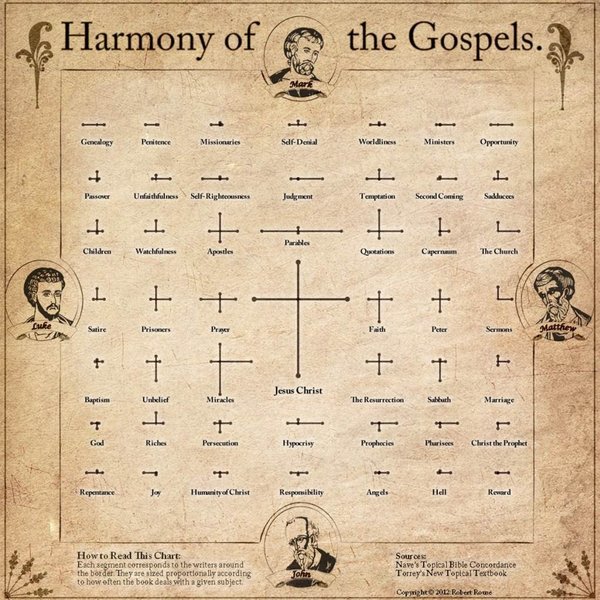
An infographic illustrating the concept of a Gospel harmony.
Visual aids like the one above can help conceptualize how the events from the four Gospels align chronologically.
Doctrinal Considerations: Potential Cons of Harmonization
While harmonized Gospels are valuable study tools, it's important to consider potential drawbacks from a Christian doctrinal and interpretive standpoint:
- Loss of Individual Gospel Emphasis: Each Gospel writer had a unique perspective, audience, and theological purpose. Matthew presents Jesus as the Messianic King fulfilling prophecy, Mark emphasizes Jesus' actions and servanthood, Luke highlights Jesus' universal compassion and ministry to the marginalized, and John focuses on Jesus' divinity and relationship with the Father. Merging these accounts can flatten these distinct theological contours and literary styles, potentially diminishing the specific message God intended through each author.
- Interpretational Bias of the Harmonizer: Creating a harmony requires making decisions about the order of events, which details to include from parallel accounts, and how to reconcile apparent discrepancies. These choices inevitably reflect the harmonizer's own interpretation and theological assumptions, which may subtly influence the reader's understanding.
- Obscuring Literary and Theological Nuances: The Gospels employ different narrative techniques, structures, and thematic developments. A harmonized text, focused primarily on chronological or narrative cohesion, might obscure these subtleties, making it harder to appreciate the unique literary artistry and theological depth of each original book.
- Oversimplification of Discrepancies: Minor variations exist between the Gospels regarding the sequence of events, specific wording of sayings, or inclusion/omission of details. While many can be reasonably reconciled, a harmonized version often presents one specific resolution, potentially glossing over complex textual issues or interpretive questions that arise from studying the variations directly.
- Risk of Replacing Individual Study: While intended as aids, there's a risk that readers might rely solely on a harmonized version, neglecting the essential practice of reading and studying each of the four Gospels individually in their canonical form. Christian tradition generally upholds the integrity and sufficiency of each Gospel as inspired Scripture.
Therefore, harmonies are best used as supplementary resources alongside, rather than replacements for, the study of the individual Gospels.
DIY: Steps to Create Your Own Harmonized Gospel Website/App
If existing resources don't meet your specific needs, creating your own digital harmonized Gospel is a significant but feasible project. Here’s a potential action plan:
- Define Your Harmonization Approach:
- Decide on the type: Merged narrative, parallel view, chronological focus, synthetic blend, etc.
- Establish clear principles for handling parallel passages, unique material, and discrepancies.
- Select the base Bible translation(s) – consider using public domain or openly licensed versions (e.g., WEB, KJV) to avoid copyright issues.
- Acquire and Structure Source Texts:
- Obtain the digital text of the four Gospels in your chosen translation(s).
- Parse the text into a structured format (e.g., database or JSON files) by book, chapter, verse, and potentially smaller pericope units.
- Perform the Harmonization:
- Meticulously compare the Gospels, identifying parallel passages and unique sections. Use existing scholarly harmonies (like Robertson's) as references.
- Arrange the material according to your defined approach. This is the most labor-intensive and requires careful theological and historical consideration.
- Write or assemble the harmonized text, deciding how to integrate accounts and indicate sources.
- Design and Develop the User Interface (UI):
- Choose your platform: Website (using HTML, CSS, JavaScript frameworks like React or Vue) or mobile app (iOS/Android).
- Design the layout and user experience based on the desired features (timeline, parallel view toggle, search, etc.). Focus on readability and intuitive navigation.
- Implement Core Functionality (Coding):
- Develop the front-end to display the harmonized text and implement UI features.
- Build a back-end (if needed) to manage the text data, user accounts, notes, etc. (e.g., using Node.js, Python/Django, PHP).
- Code the logic for displaying source indicators, switching views, searching, and other interactive elements.
- Integrate Additional Features:
- Add functionalities like the interactive timeline, annotation tools, cross-referencing, commentary integration, etc.
- Ensure accessibility features (e.g., adjustable text size, screen reader compatibility).
- Testing and Refinement:
- Thoroughly test the accuracy of the harmonization and the functionality of the website/app.
- Check for usability issues across different devices and browsers.
- Seek feedback from potential users, including those with biblical studies knowledge, and iterate on the design and content.
- Deployment and Maintenance:
- Deploy the website to a hosting service or publish the app to app stores.
- Plan for ongoing maintenance, bug fixes, potential content updates, and user support. Consider open-sourcing the project to allow community contributions.
This process requires a combination of biblical knowledge, careful research, technical skills, and attention to detail.
Frequently Asked Questions (FAQ)
What exactly is Gospel Harmonization?
Gospel harmonization is the process of arranging the four canonical Gospels (Matthew, Mark, Luke, and John) into a single, chronological or thematic narrative, or presenting them side-by-side (in parallel columns) to highlight similarities and differences in their accounts of Jesus Christ's life and teachings. The goal is often to provide a comprehensive overview or facilitate comparative study.
Why would someone read a harmonized Gospel?
People read harmonized Gospels to gain a clearer understanding of the overall timeline of Jesus' life and ministry, to see how different Gospels recount the same events, to get a comprehensive picture by combining details from all four accounts, or simply for a smoother, continuous reading experience, especially if they are new to the Gospels.
Are Gospel harmonies doctrinally problematic?
While generally considered useful study tools, harmonies can have drawbacks. The primary concern is that they might obscure the unique theological emphases, literary styles, and intended audiences of each individual Gospel. The process also involves interpretive choices by the harmonizer. Most scholars and theologians recommend using harmonies as supplements to, not replacements for, studying the four Gospels in their original forms to fully appreciate their distinct contributions to Scripture.
What's the main difference between a parallel Gospel and a merged Gospel harmony?
A parallel Gospel presents the texts of Matthew, Mark, Luke, and John side-by-side in columns, allowing readers to directly compare how each writer recounts specific events or teachings. It preserves the original texts intact. A merged Gospel harmony blends the content from the four Gospels into a single, continuous narrative, often arranging events chronologically and combining details from multiple accounts to create one unified story.
Recommended Further Exploration
- How do different Gospel harmony methodologies compare in their treatment of discrepancies?
- What are the specific theological implications of each Gospel's unique perspective that might be lost in harmonization?
- Explore the history of Gospel harmonization, including early attempts like Tatian's Diatessaron.
- What are the main technical challenges involved in building an interactive digital Gospel harmony tool?
References
 effectualfaith.files.wordpress.com

Last updated May 4, 2025