

- Foundation of Quantum Chemistry: The Hartree-Fock approximation is a cornerstone for understanding and predicting the behavior of multi-electron systems, providing a crucial starting point for more advanced computational methods.
- Self-Consistent Field Approach: It iteratively refines electron orbitals until a stable, average field is achieved, effectively solving the complex many-body problem.
- Balancing Accuracy and Efficiency: While it cleverly accounts for exchange interactions, its mean-field nature means it neglects dynamic electron correlation, offering a good balance between computational cost and predictive power.
The Hartree-Fock (HF) approximation stands as a monumental achievement in quantum chemistry, offering a practical and foundational method to approximate the wave function and energy of systems containing multiple electrons, such as atoms and molecules. At its core, the HF method simplifies the intricate dance of many electrons by treating each electron as moving independently within an average field created by all other electrons. This ingenious simplification transforms a prohibitively complex many-body problem into a manageable set of single-electron equations, providing invaluable insights into electronic structure and properties.
The Essence of the Hartree-Fock Approximation
The fundamental premise of the Hartree-Fock approximation lies in its ability to convert a multi-electron problem into a series of one-electron problems. This is achieved by making a crucial assumption about the nature of the many-electron wave function and then employing an iterative computational process to find a self-consistent solution.
Approximating the Wave Function: The Slater Determinant
One of the key innovations of the Hartree-Fock method is the approximation of the true many-electron wave function as a single Slater determinant. This choice is not arbitrary; it is specifically designed to satisfy the Pauli exclusion principle, which dictates that no two identical fermions (like electrons) can occupy the same quantum state simultaneously. The Slater determinant ensures that the overall wave function is antisymmetric with respect to the exchange of any two electrons, a fundamental requirement for fermionic systems.
Each component of this Slater determinant is a spin orbital, which is a product of a spatial orbital (describing the electron's position in space) and a spin function (describing its spin state). By constructing the wave function in this manner, the method inherently incorporates the exchange interaction, a quantum mechanical effect that arises from the indistinguishability of electrons and their antisymmetric wave function.
The Self-Consistent Field (SCF) Procedure
The Hartree-Fock method is inherently iterative, employing what is known as the Self-Consistent Field (SCF) procedure. This iterative process is necessary because the effective field experienced by each electron depends on the wave functions of all other electrons, which are initially unknown. The steps typically involve:
- Initial Guess: An initial set of approximate molecular orbitals is generated. This can be done using simpler, non-iterative methods.
- Fock Matrix Construction: Based on these initial orbitals, a Fock operator (and its matrix representation) is constructed. The Fock operator accounts for the kinetic energy of an electron, its attraction to the nuclei, and its average repulsion and exchange interactions with all other electrons.
- Solving for New Orbitals: The Hartree-Fock equations, which are eigenvalue equations involving the Fock operator, are then solved to obtain a new set of improved molecular orbitals and their corresponding orbital energies.
- Convergence Check: The new orbitals are compared to the orbitals from the previous iteration. If the differences are smaller than a predefined threshold, the calculation has converged to a self-consistent solution.
- Iteration: If convergence has not been reached, the newly calculated orbitals are used to construct a refined Fock operator, and the process repeats until self-consistency is achieved.
This iterative nature ensures that the calculated orbitals are consistent with the average field they generate, providing a stable and physically meaningful solution.
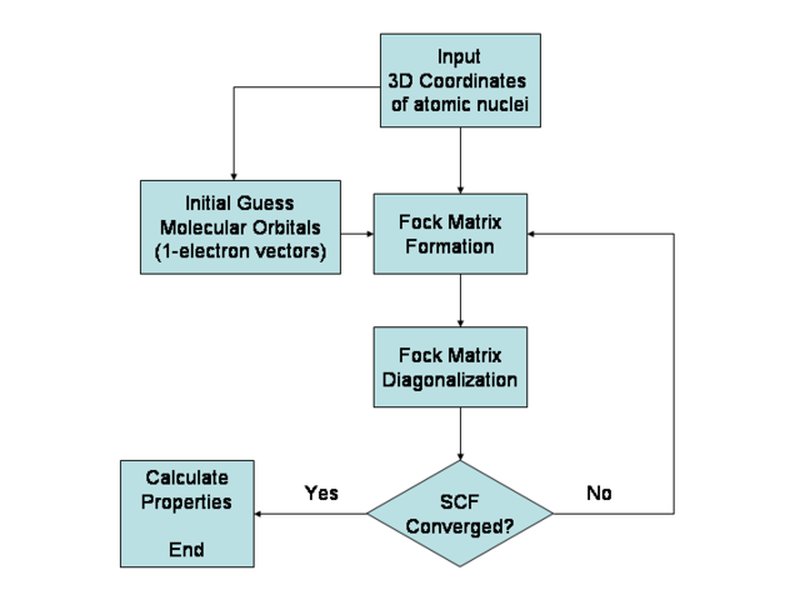
Visual representation of the iterative Hartree-Fock self-consistent field (SCF) process.
Components of the Fock Operator
The Fock operator (F̂) is central to the Hartree-Fock equations. It is a one-electron operator that effectively captures the interactions an electron experiences within the mean field of all other electrons and the nuclei. The Fock operator comprises several key terms:
Kinetic Energy Operator (T̂)
This term describes the kinetic energy of the electron. Mathematically, it is given by \( \frac{-\hbar^2}{2m_e} \nabla^2 \).
Nuclear Attraction Operator (V̂_ne)
This term accounts for the attractive electrostatic interaction between the electron and all the atomic nuclei in the system. For a single electron \( i \) and nuclei \( \alpha \), it's \( -\sum_{\alpha} \frac{Z_{\alpha}e^2}{r_{i\alpha}} \), where \( Z_{\alpha} \) is the nuclear charge and \( r_{i\alpha} \) is the distance between the electron and the nucleus.
Coulomb Operator (Ĵ)
Also known as the Hartree operator, this term describes the average repulsive interaction between a specific electron and the charge distribution of all other electrons. It represents the classical electrostatic repulsion. For an electron \( i \) interacting with another electron \( j \), this is \( \langle \phi_j | \frac{1}{r_{ij}} | \phi_j \rangle \), where \( \phi_j \) is the orbital of electron \( j \) and \( r_{ij} \) is the distance between the two electrons.
Exchange Operator (K̂)
This is a purely quantum mechanical term with no classical analogue. It arises from the antisymmetry requirement of the wave function for identical fermions and effectively accounts for the "exchange" of electrons. The exchange operator reduces the electron-electron repulsion energy for electrons with the same spin, leading to a phenomenon known as the "Fermi hole." For electrons \( i \) and \( j \), this term involves permuting the electrons in the integral: \( \langle \phi_j | \frac{1}{r_{ij}} | \phi_i \rangle \).
The Basis Set Expansion
In practical Hartree-Fock calculations, the molecular orbitals are not determined analytically. Instead, they are expanded as a linear combination of atomic orbitals (LCAO) or other basis functions. This transforms the complex integro-differential Hartree-Fock equations into a set of algebraic equations, which can be solved using matrix methods. The choice of basis set significantly impacts the accuracy and computational cost of the calculation. Larger and more flexible basis sets generally lead to more accurate results but require greater computational resources.
Here's a simplified representation of how basis functions contribute to the Fock matrix and subsequent solution:
Mindmap illustrating the computational workflow of the Hartree-Fock method, emphasizing the role of basis sets and the iterative SCF procedure.
Variants of Hartree-Fock
The Hartree-Fock method has several variants adapted for different types of electronic systems:
Restricted Hartree-Fock (RHF)
This variant is used for closed-shell systems, where all electrons are paired in molecular orbitals. It assumes that electrons with opposite spins occupy the same spatial orbital.
Unrestricted Hartree-Fock (UHF)
For open-shell systems (e.g., radicals or molecules with unpaired electrons), UHF allows electrons of alpha spin and beta spin to occupy different spatial orbitals. This provides more flexibility and can better describe spin polarization, but it can also lead to "spin contamination" where the calculated spin state is not a pure spin eigenstate.
Restricted Open-Shell Hartree-Fock (ROHF)
ROHF is a compromise for open-shell systems where core and paired valence electrons are restricted to shared spatial orbitals, while unpaired electrons are allowed to occupy distinct spatial orbitals. It maintains spin purity, addressing some limitations of UHF.
Applications and Significance
The Hartree-Fock method finds extensive applications across various scientific disciplines:
- Molecular Geometry Optimization: Predicting stable molecular structures.
- Vibrational Frequencies: Calculating IR and Raman spectra.
- Ionization Energies and Electron Affinities: Estimating these properties through Koopmans' theorem, which relates orbital energies to experimental ionization potentials.
- Dipole Moments and Other Properties: Calculating various electrical and magnetic properties.
- Drug Discovery and Materials Science: Providing initial insights into molecular interactions and material properties, guiding further experimental or computational studies.
The table below summarizes some key characteristics and comparative aspects of Hartree-Fock:
| Characteristic | Description | Implication for HF |
|---|---|---|
| Wave Function Approximation | Single Slater Determinant | Ensures antisymmetry and incorporates exchange effects. |
| Electron Treatment | Independent electrons in average field | Simplifies calculation but neglects dynamic correlation. |
| Computational Cost | Scales roughly as N4 (N = number of basis functions) | Feasible for medium-sized systems; more efficient than correlated methods. |
| Accuracy (Ground State) | Qualitatively correct, quantitatively often good but not exact | Useful for predicting trends, but for high accuracy, post-HF methods are needed. |
| Inclusion of Exchange | Fully incorporated | Crucial for understanding spin-dependent phenomena. |
| Basis for Post-HF Methods | Provides the reference wave function | Serves as the starting point for nearly all high-accuracy quantum chemistry calculations. |
Visualizing the Hartree-Fock Method
To further contextualize the Hartree-Fock method, the following video provides an excellent overview of how the algorithm works and its core principles in computational chemistry.
This video, titled "The Hartree-Fock Algorithm," delves into the iterative process and underlying equations of the Hartree-Fock method. It explains how initial guesses for orbitals are refined through successive calculations involving the Fock operator until a self-consistent solution is obtained, offering a clear visual and conceptual understanding of this fundamental quantum chemistry technique.
Frequently Asked Questions
What is the main purpose of the Hartree-Fock approximation?
How does the Hartree-Fock method account for electron interactions?
What is the significance of the Slater determinant in Hartree-Fock theory?
What are the main limitations of the Hartree-Fock method?
Why is Hartree-Fock still important if it has limitations?
Conclusion
The Hartree-Fock approximation, a foundational pillar in computational quantum chemistry, offers a powerful yet pragmatic approach to understanding the electronic structure of multi-electron systems. By elegantly simplifying the intractable many-body Schrödinger equation into a solvable set of self-consistent field equations, it has enabled countless breakthroughs in our comprehension of chemical bonding, molecular properties, and reaction mechanisms. While its mean-field nature means it neglects the intricate dance of dynamic electron correlation, its computational tractability and its role as an indispensable stepping stone for more sophisticated correlated methods firmly cement its status as a vital tool in the quantum chemist's arsenal. From predicting molecular geometries to serving as the basis for advanced quantum computing algorithms in chemistry, the Hartree-Fock method continues to shape our exploration of the quantum world.
Recommended Further Exploration
- How is electron correlation addressed in quantum chemistry?
- What are post-Hartree-Fock methods and their applications?
- Explain the self-consistent field (SCF) procedure in detail.
- Comparison of Density Functional Theory (DFT) and Hartree-Fock methods.