
HEART vs. JTBD: Unpacking Two Powerful Product Frameworks
Measuring user experience or uncovering core needs? Understand the key differences between Google's HEART and Jobs To Be Done.
In the world of product development and user experience (UX) design, understanding your users is paramount. Two prominent frameworks often discussed are Google's HEART framework and the Jobs To Be Done (JTBD) theory. While both aim to improve products by focusing on the user, they tackle this goal from fundamentally different perspectives and serve distinct purposes. Understanding their differences is crucial for knowing when and how to apply each effectively.
Highlights: HEART vs. JTBD
- Focus Difference: HEART measures how well users interact with an existing product (UX quality), while JTBD seeks to understand why users choose a product in the first place (underlying needs and motivations).
- Nature of Framework: HEART is a quantitative, metrics-driven framework for UX measurement and optimization. JTBD is a qualitative, theory-based framework geared towards innovation and understanding customer behavior.
- Application Stage: JTBD is often applied early in the product lifecycle for discovery and strategy, while HEART is typically used later for evaluating and improving existing products or features.
Understanding the Google HEART Framework
Measuring the Pulse of User Experience
Developed by Google's research team (Kerry Rodden, Hilary Hutchinson, Xin Fu) in 2010, the HEART framework provides a structured methodology for measuring the quality of user experience, particularly for large-scale applications. Its primary goal is to move beyond subjective assessments and provide objective, quantifiable data on how users are interacting with and feeling about a product. HEART is an acronym representing five key dimensions of user experience:
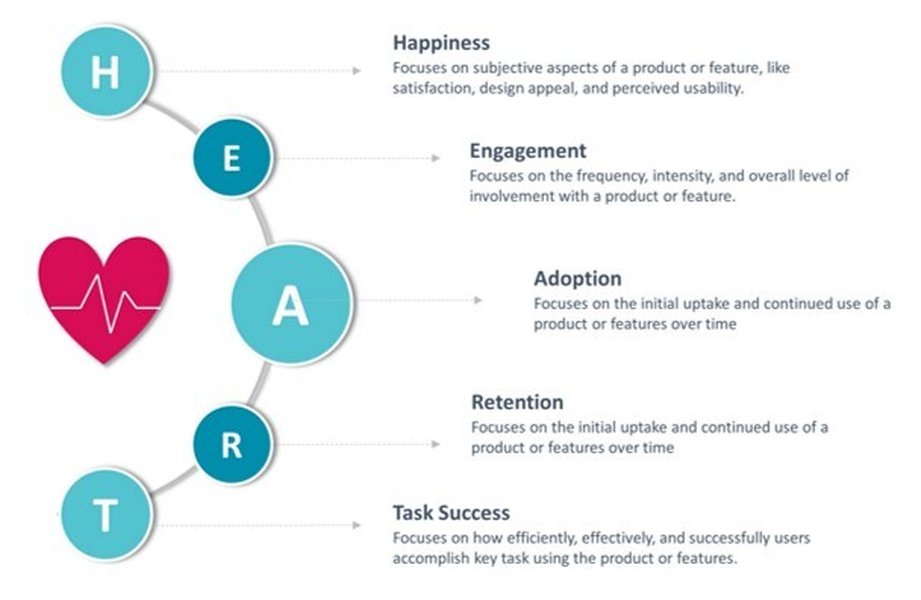
A visual representation of the HEART framework's five dimensions.
The Five Pillars of HEART
- Happiness: This measures users' attitudes and satisfaction towards the product. It's often captured through surveys (like Net Promoter Score - NPS or CSAT), user ratings, or sentiment analysis of feedback. The goal is to understand how users feel about their experience.
- Engagement: This tracks the level of user involvement and interaction with the product. Metrics might include frequency of use, session duration, depth of interaction (e.g., number of features used), or intensity (e.g., key actions performed per user per day). It gauges how actively users are using the product.
- Adoption: This measures the rate at which new users start using the product or a specific feature within a defined timeframe. It focuses on acquisition and initial uptake, often tracked through metrics like new user sign-ups or feature activation rates.
- Retention: This tracks the rate at which existing users continue to use the product over time. It's crucial for understanding long-term value and loyalty. Metrics include churn rate, repeat usage rates (e.g., daily/monthly active users), or cohort retention analysis.
- Task Success: This evaluates users' ability to complete specific, goal-oriented tasks within the product efficiently and effectively. Metrics can include task completion rates, time-on-task, error rates, or navigation efficiency. It focuses on the product's usability and effectiveness.
The Goals-Signals-Metrics (GSM) Process
HEART is often implemented using the Goals-Signals-Metrics (GSM) process. This helps teams translate broad UX goals into specific, actionable metrics:
- Goals: Define the high-level objectives for each HEART category (e.g., "Increase user satisfaction for feature X").
- Signals: Identify lower-level indicators that suggest success or failure related to the goal (e.g., "Users spend less time completing the task" could signal improved Task Success).
- Metrics: Choose specific, quantifiable metrics to track these signals over time (e.g., "Average task completion time in seconds").
By using GSM, teams can ensure their chosen metrics directly relate to their UX goals and avoid getting lost in vanity metrics. HEART provides a holistic view, helping product teams prioritize improvements that genuinely enhance the user experience and align with business objectives.
Visualizing HEART with Google
This video provides a concise overview of the HEART framework and how it helps measure user experience effectively.
Learn about the Google HEART framework for measuring user experience.
Exploring the Jobs To Be Done (JTBD) Framework
Uncovering the 'Why' Behind Customer Choices
The Jobs To Be Done (JTBD) framework, popularized by theorists like Clayton Christensen and Anthony Ulwick, offers a different lens for understanding customer behavior and driving innovation. Instead of focusing on user demographics or product features, JTBD posits that customers "hire" products or services to get specific "jobs" done in their lives. The core idea is to understand the underlying goal, task, or problem a customer is trying to solve when they seek out a solution.
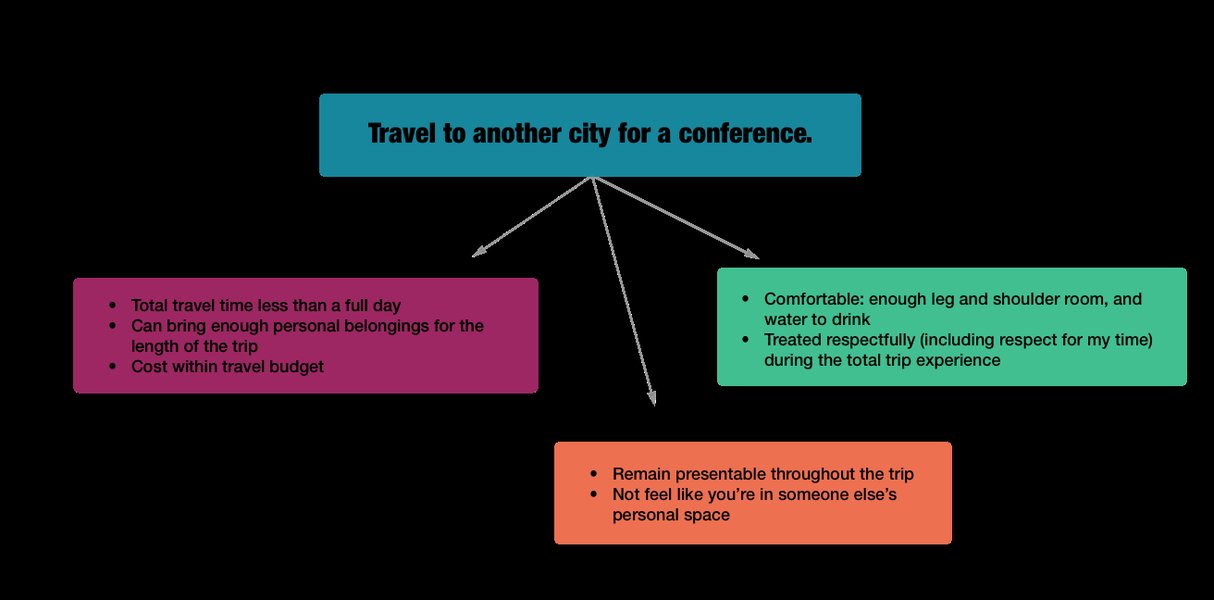
Conceptual illustration of the Jobs To Be Done framework.
Core Concepts of JTBD
- The "Job": This is the fundamental problem the customer is trying to solve or the progress they are trying to make in a given circumstance. Jobs can be functional (e.g., "listen to music while commuting"), social (e.g., "impress my colleagues with my presentation"), or emotional (e.g., "feel relaxed after a long day").
- Hiring and Firing: Customers "hire" a product when they believe it will help them accomplish their job better than alternatives. They "fire" a product when it no longer serves the job well or a better solution emerges.
- Circumstances Matter: JTBD emphasizes understanding the context in which the job arises. The situation often dictates the constraints and desired outcomes.
- Desired Outcomes: Customers have specific criteria (often unspoken) for what constitutes successful completion of the job. Understanding these outcomes is key to designing effective solutions.
Methodology and Application
Applying JTBD typically involves qualitative research methods, such as in-depth customer interviews (often called "switch interviews" focusing on why a customer switched from one solution to another) and job mapping. The goal is to uncover:
- The core functional, social, and emotional dimensions of the job.
- The context and circumstances triggering the need.
- The struggles or obstacles customers face with current solutions.
- The desired outcomes and metrics customers use (implicitly or explicitly) to judge success.
JTBD is primarily a strategic tool used for:
- Innovation: Identifying unmet needs and opportunities for new products or services.
- Product Strategy: Defining the value proposition based on the job the product performs.
- Marketing: Crafting messages that resonate with the customer's underlying motivations.
- Design: Focusing feature development on helping customers achieve their job outcomes more effectively.
By focusing on the stable, long-term "job" rather than fleeting customer preferences or demographics, JTBD aims to provide a more reliable foundation for innovation and product development.
HEART vs. JTBD: A Comparative Analysis
Putting the Frameworks Side-by-Side
While both frameworks are user-centric, their focus, methodology, and application differ significantly. HEART is about measuring and improving the experience of using a product, whereas JTBD is about understanding the fundamental need that leads someone to use a product.
Focus and Purpose
- HEART: Focuses on UX performance and quality metrics of an existing product. Its purpose is measurement and optimization.
- JTBD: Focuses on understanding the underlying customer motivations, needs, and the context of use. Its purpose is insight generation for innovation and strategy.
Methodology
- HEART: Primarily quantitative, relying on data collection, analytics, and predefined metrics (Happiness, Engagement, Adoption, Retention, Task Success) through the GSM process.
- JTBD: Primarily qualitative, using methods like customer interviews, observation, and job mapping to uncover deep insights into customer goals and struggles.
Stage of Application
- HEART: Best suited for evaluating and iterating on existing products already in the market or post-launch.
- JTBD: Most valuable during the early stages of product development, ideation, market research, and defining the core value proposition.
Output
- HEART: Produces dashboards, reports, and scores related to UX quality, guiding tactical improvements.
- JTBD: Produces "job stories," detailed descriptions of customer needs, desired outcomes, and insights that inform strategic product decisions.
Summary Table: HEART vs. JTBD
This table provides a concise summary of the core differences between the two frameworks:
| Aspect | HEART Framework | Jobs To Be Done (JTBD) Framework |
|---|---|---|
| Main Focus | Measuring and improving user experience metrics | Understanding user/customer motivations and needs |
| Type of Framework | UX performance measurement and analytics tool | Innovation and customer-centric theory |
| Core Question | How satisfied and effective is the user experience? | Why/how do customers "hire" a product to get a job done? |
| Metrics vs. Insights | Quantitative UX metrics | Qualitative insights into user goals and motivations |
| Application | Track UX success, prioritize improvements | Drive product innovation, define customer needs |
| Output | Data-driven UX scores and metrics | Jobs-to-be-done statements, solution ideas |
Visualizing Framework Focus: A Radar Chart Comparison
Comparing HEART and JTBD Across Key Dimensions
To better illustrate the differing strengths and orientations of the HEART and JTBD frameworks, the following radar chart compares them across several dimensions relevant to product development. This chart reflects a qualitative assessment based on the typical applications and strengths of each framework:
As the chart suggests, JTBD scores higher on strategic focus, qualitative insight, innovation driving, and early-stage relevance. Conversely, HEART excels in tactical application, quantitative measurement, optimization focus, and late-stage relevance. This visualization highlights their complementary nature: JTBD helps define the 'what' and 'why', while HEART helps measure and improve the 'how well'.
Mindmap: Connecting HEART and JTBD Concepts
An Overview of Core Ideas
This mindmap provides a visual summary connecting the core concepts of both the Google HEART framework and the Jobs To Be Done framework, illustrating their distinct focuses within the broader context of product development and user understanding.
The mindmap visually separates the core tenets of each framework. HEART branches into its five metrics and quantitative methodology aimed at optimization, while JTBD branches into its focus on underlying needs, qualitative methods, and strategic application for innovation.
Complementary, Not Competitive
Using HEART and JTBD Together
While distinct, the HEART and JTBD frameworks are not mutually exclusive. In fact, they can be highly complementary:
- JTBD Informs HEART: Insights from JTBD research can help define meaningful goals and metrics for the HEART framework. Understanding the core "job" a user is trying to accomplish can clarify what "Task Success" truly means or which aspects of "Engagement" are most relevant to delivering value.
- HEART Validates JTBD Solutions: Once a product or feature has been developed based on JTBD insights, the HEART framework can be used to measure how effectively the solution is enabling users to get their job done and assess the overall quality of their experience. For example, high Task Success and Happiness scores might validate that the product successfully addresses the identified job.
By leveraging JTBD for strategic direction (understanding the 'why') and HEART for tactical execution and measurement (evaluating the 'how well'), product teams can build solutions that are both deeply rooted in customer needs and demonstrably effective in user experience.
Frequently Asked Questions (FAQ)
What is the main goal of the HEART framework?
The main goal of the HEART framework is to provide a structured, quantitative way to measure the quality of user experience (UX) for a product or feature across five key dimensions: Happiness, Engagement, Adoption, Retention, and Task Success. It helps teams track UX performance objectively and make data-informed decisions for improvement.
What is the main goal of the Jobs To Be Done (JTBD) framework?
The main goal of the JTBD framework is to understand the underlying motivations and needs that drive customers to use ("hire") a product or service. It focuses on identifying the specific "job" – the progress a customer is trying to make or the problem they are trying to solve – to guide innovation and product strategy effectively.
Can HEART and JTBD be used together?
Yes, they can be highly complementary. JTBD can provide the foundational understanding of customer needs ("the job") which helps define relevant goals and metrics for the HEART framework. HEART can then measure how well a product designed around a specific job is performing in terms of user experience (e.g., Task Success, Happiness).
Which framework is better for innovation?
Jobs To Be Done (JTBD) is generally considered more suited for driving innovation. Its focus on uncovering unmet customer needs and understanding the "why" behind their choices helps identify opportunities for creating new solutions or significantly improving existing ones based on the core job customers are trying to accomplish.
Which framework is better for measuring product performance?
The HEART framework is specifically designed for measuring product performance, particularly concerning user experience. Its five dimensions provide a structured way to track quantitative metrics related to how users interact with and feel about an existing product, making it ideal for monitoring UX health and guiding optimization efforts.
Recommended
- Explore practical steps for implementing the Google HEART framework in your product team.
- Discover examples and techniques for conducting effective Jobs To Be Done customer interviews.
- Learn strategies for integrating insights from JTBD with the measurement capabilities of HEART.
- Investigate other popular frameworks used in product development and UX research.
References
Last updated May 5, 2025