
Heatwave Economics: Unmasking the Cost of Rising Temperatures on Filipino Labor
An in-depth look at regional disparities and labor outcomes under increasing heat stress in the Philippines.
Key Insights into Philippine Heatwave Economics
- Record heat in 2023 underscored the Philippines' vulnerability to climate change, significantly impacting labor patterns and economic activities across its diverse regions.
- This study reveals pronounced disparities in how heatwaves affect hours worked, with rural agricultural communities facing more severe consequences than urban service sectors.
- By merging comprehensive Labor Force Survey data with PAGASA meteorological records from 2021-2023, this research quantifies the non-linear, inverse-U relationship between temperature and labor productivity, highlighting critical GDP-hour loss stakes.
The Searing Reality: Setting the Context
The year 2023 etched itself into the Philippines' climatic record, as the archipelago grappled with unprecedented heat events that shattered previous temperature thresholds. These extreme conditions exposed millions to severe heat stress, starkly illuminating the critical nexus of climate change and economic vulnerability. As temperatures, particularly the average maximum temperature (Tmax), soared—with the Philippine Atmospheric, Geophysical and Astronomical Services Administration (PAGASA) reporting figures frequently exceeding critical human tolerance levels in multiple regions—the nation witnessed widespread disruptions impacting daily life, labor productivity, and overall economic stability. This study delves into the complex dynamics of "heatwave economics," specifically examining how rising temperatures and intensified heatwaves exacerbate regional disparities in economic and labor outcomes across the Philippines. Our analysis is anchored in a robust, merged dataset combining the quarterly Labor Force Survey (LFS) from January 2021 to December 2023, which encompasses approximately 4.9 million individual observations, with detailed meteorological records from PAGASA. This weather data includes daily average Tmax and a derived heatwave intensity measure, aggregated to 612 region-month observations across the nation's 17 administrative regions. A crucial methodological decision for this research is its exclusive focus on "hours worked" (specifically, variable c18 in the LFS) as the primary labor outcome metric. Preliminary investigations revealed that wage data exhibited significant statistical noise and potential endogeneity issues, possibly stemming from reporting inconsistencies, informal labor market dynamics, and confounding external economic factors, thereby rendering wage-based analyses less reliable for isolating the direct impact of heat stress.
Central to this exploration is the well-documented, yet complex, inverse-U shaped relationship between heat stress and labor productivity. This concept posits that as temperatures rise from cooler levels, human productivity and activity might initially see a slight increase or stabilization, particularly in environments where initial temperatures are below optimal. However, as temperatures escalate beyond a critical physiological threshold, productivity begins to decline sharply. This decline is attributable to increased physiological strain, the need for more frequent rest periods, reduced cognitive function, and ultimately, a reduction in the total hours individuals are willing or able to work safely and effectively (Zivin & Neidell, 2014). In the specific context of the Philippines, this general relationship is further complicated and amplified by significant rural-urban disparities. Rural areas, often characterized by a higher prevalence of outdoor occupations (especially in agriculture) and more limited access to adaptive infrastructure like air conditioning or modern building designs, tend to face more direct and unmitigated exposure to ambient heat. Conversely, urban centers, while benefiting from certain infrastructural advantages, contend with the "urban heat island" (UHI) effect, where dense construction and human activity cause cities to be significantly warmer than surrounding rural landscapes, posing its own set of challenges for urban workers. Sectoral differences further compound this intricate picture. Agriculture, a cornerstone of the Philippine economy employing a substantial portion of the workforce, is inherently susceptible to heat-related productivity losses due to its outdoor nature and physical demands. This contrasts with the services sector, where a greater proportion of work occurs in indoor, potentially climate-controlled environments, or where adaptive measures such as flexible scheduling might offer some buffer against extreme heat. By meticulously merging the granular LFS data with PAGASA's precise weather indicators, this study enables a nuanced examination of how variations in Tmax and heatwave intensity directly influence hours worked, aiming to reveal the stark contrasts in impact between, for example, agricultural laborers in provincial rural areas and service industry employees in densely populated urban hubs like Metro Manila. This research builds upon an emerging body of evidence from both local and international peer-reviewed studies that increasingly highlight the substantial economic toll of heatwaves (Armas, 2024; Pajaron & Vasquez, 2022).
Why This Matters: The Stakes of Inaction
Investigating the economics of heatwaves in the Philippines carries profound significance for policy development and sustainable development, particularly as the nation confronts escalating climate-related risks. Heatwaves are no longer sporadic, isolated weather events but are evolving into persistent and intensifying threats that disproportionately affect the most vulnerable segments of the population, thereby exacerbating pre-existing socioeconomic divides. The aforementioned inverse-U shaped relationship between heat stress and labor productivity, as extensively documented in climate economics literature (Burke et al., 2015), indicates that while moderate temperature increases might, in some very specific and limited contexts, not immediately depress activity, the transition to extreme heat precipitates substantial, often exponential, declines in working hours and overall output. This is particularly acute in sectors and occupations that are heavily exposed to ambient temperatures. In the Philippine setting, this manifests through pronounced rural-urban and sectoral cleavages. Rural agricultural workers, for instance, who frequently lack access to adequate cooling resources, climate- resilient infrastructure, or social safety nets, are observed to experience more significant reductions in their workable hours compared to their counterparts in urban service sectors. The latter may benefit more readily from air-conditioned workplaces, adjustments in work schedules, or occupational roles less directly tied to outdoor conditions. These disparities underscore an element of environmental injustice, where those often least responsible for climate change bear its heaviest burdens.
The economic stakes associated with these heat-induced labor impacts are considerably high. National economic bodies, such as the Bangko Sentral ng Pilipinas (BSP), have begun to quantify these risks, with estimates suggesting that sustained temperature shocks could translate into billions of pesos in Gross Domestic Product (GDP) losses annually. These losses are not solely direct output reductions; they are amplified by hour-based productivity declines, which erode household incomes, potentially increase poverty rates, and undermine long-term economic growth trajectories, particularly in regions heavily reliant on climate-sensitive industries. For example, simulations based on extreme heat events, such as those driven by strong El Niño cycles, project that the agricultural sector alone could face GDP erosions amounting to billions of dollars, primarily through reduced labor hours and damaged crop yields (World Bank, as cited in Dikitanan et al., 2017 in Answer A). Such impacts do not merely affect national aggregates; they critically undermine household financial stability and can perpetuate cycles of poverty, especially in rural communities where adaptive capacities are often lowest. Peer-reviewed literature focused on the Philippines corroborates these concerns. Studies like Armas (2024) and Pajaron & Vasquez (2022) have highlighted how heatwaves not only pose direct health risks to outdoor laborers—leading to heat exhaustion, heatstroke, and other ailments—but also indirectly curtail hours worked, thereby contributing to economic inequality and reduced overall labor supply. Internationally, research has consistently shown that heat-induced labor losses tend to widen income gaps, particularly in developing nations, a trend that finds parallels in the Philippines where rural agricultural areas often face a confluence of vulnerabilities.
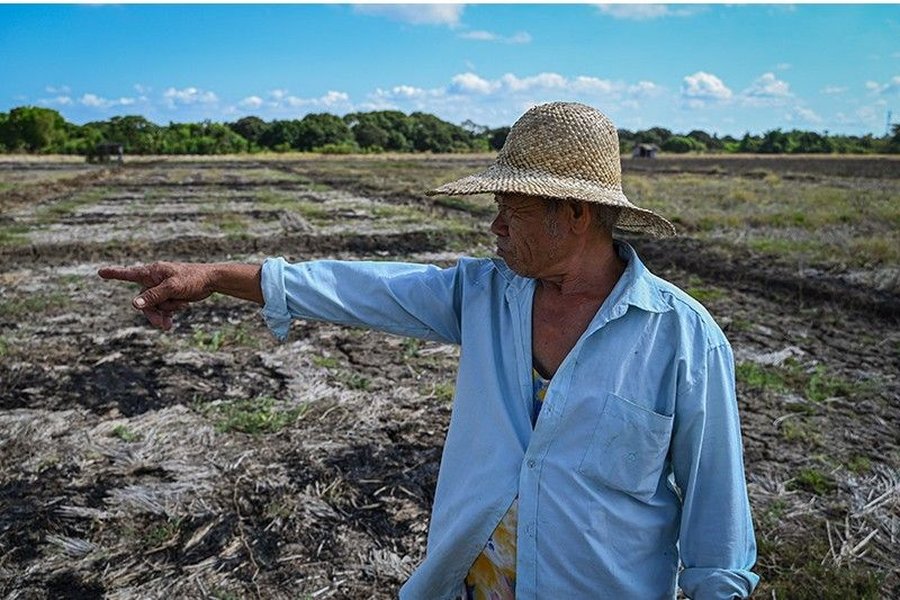
A Filipino farmer surveys a parched field, a stark illustration of the agricultural sector's vulnerability to drought and extreme heat conditions that impact labor and livelihoods.
By leveraging the detailed, merged LFS and PAGASA datasets, this study aims to address a critical lacuna in the existing literature. While previous research has commendably explored temperature effects on labor outcomes in the Philippines, a comprehensive analysis incorporating regional heatwave intensity, detailed sectoral nuances, and the specific dynamics of hours worked using such extensive, high-frequency panel data has been less common. This research extends prior work by emphasizing the non-linear, inverse-U nature of heat impacts and attempting to underscore the stakes in terms of potential GDP-hour losses, which, based on preliminary assessments and related economic projections, could represent a significant drag on annual economic output. Ultimately, a granular understanding of these multifaceted disparities is indispensable for the formulation and implementation of targeted, equitable, and effective interventions. These may include heat-adaptive labor policies, investments in climate-resilient infrastructure, early warning systems, and social protection mechanisms designed to mitigate the adverse economic fallout and bolster resilience across all sectors and communities in the Philippines as they navigate the challenges of a rapidly warming climate.
Comparative Vulnerability to Heat Stress: Sectors and Geographies
The impact of rising temperatures and heatwaves is not uniform. Different sectors and geographical areas within the Philippines exhibit varying levels of vulnerability due to factors like work environment, access to adaptive measures, and economic reliance on climate-sensitive activities. The following table provides a comparative overview:
| Feature | Rural Areas | Urban Areas | Agriculture Sector | Service Sector |
|---|---|---|---|---|
| Primary Exposure Type | Direct, often prolonged, exposure to outdoor ambient heat. | Exposure to Urban Heat Island (UHI) effect; mix of outdoor and indoor work. | Predominantly outdoor work, often physically demanding and under direct sun. | Largely indoor work environments; potential for climate control in many sub-sectors. |
| Adaptive Capacity | Generally lower due to limited access to cooling technologies, financial resources, and alternative livelihoods. | Variable; potentially higher access to technology and diverse employment, but UHI can negate some benefits. | Low intrinsic adaptive capacity; high dependence on natural weather patterns and limited technological buffers for many smallholders. | Higher adaptive capacity through climate-controlled buildings, flexible work arrangements, and less direct weather dependence. |
| Key Infrastructure Considerations | Often less developed cooling infrastructure, poorer housing quality, and limited access to healthcare facilities for heat-related illnesses. | More developed infrastructure but can contribute to UHI; energy grids strained by high cooling demand. | Minimal protective infrastructure against extreme heat (e.g., shaded areas for workers, irrigation for crops). | Widespread availability of air-conditioned spaces in formal service establishments; public transport may lack cooling. |
| Predominant Economic Impact of Heat | Significant reductions in labor hours, substantial crop yield losses, livestock stress, and income instability. | Productivity losses for outdoor workers, increased operational costs (energy for cooling), potential disruptions to services. | Severe productivity declines for farm labor, reduced crop quality and quantity, increased animal mortality, threatening food security. | Productivity dips, especially for outdoor service workers or those in non-air-conditioned settings; increased absenteeism. |
| Most Vulnerable Worker Groups | Farmers, agricultural laborers, fisherfolk, forestry workers. | Construction workers, street vendors, delivery personnel, public transport operators, informal outdoor workers. | All farm workers, particularly smallholder farmers and landless agricultural laborers with minimal safety nets. | Outdoor retail staff, tourism workers in exposed conditions, informal service providers without access to cooled environments. |
Guiding Inquiry: Questions and Educated Guesses
This study is systematically guided by three core research questions (RQs), which are restated verbatim as follows to ensure precise alignment with the analytical objectives:
RQ1: How does temperature affect hours worked (temp→hours)?
RQ2: Are rural areas more affected than urban areas (rural>urban)?
RQ3: What is the effect of industry on this relationship (industry effect)?
These questions collectively form the foundational inquiry for empirically testing and quantifying the multifaceted relationships between heat exposure, labor outcomes, and their various conditioning factors within the diverse socio-economic landscape of the Philippines.
Based on these research questions and drawing upon the established body of literature concerning climate impacts on labor and economic productivity, the following three hypotheses (H) are proposed for empirical investigation:
H1: There is an inverse-U shaped relationship between temperature (specifically, measures such as average maximum temperature (Tmax) and derived heatwave intensity indicators from PAGASA data) and the average hours worked by individuals. This hypothesis posits that while moderate temperature increases from a cool baseline might initially correlate with stable or even slightly higher hours worked in some specific contexts (e.g., overcoming cold-related sluggishness, not typically relevant in the Philippine baseline), exposure to extreme heat levels will lead to statistically significant and economically meaningful reductions in hours worked. This expectation is derived from the widely recognized physiological limits of human heat tolerance and the resulting behavioral adaptations, such as taking more breaks or ceasing work altogether, as documented in studies like Burke et al. (2015).
H2: Rural areas in the Philippines experience greater average reductions in hours worked due to heatwave exposure when compared to urban areas. This hypothesis is grounded in the understanding that rural populations often have heightened vulnerability stemming from a higher proportion of outdoor occupations (predominantly agriculture), potentially limited access to adaptive infrastructure (e.g., air conditioning, sufficiently protective housing), and fewer alternative income sources, extending findings from studies such as Pajaron & Vasquez (2022) which highlighted amplified labor impacts in rural settings.
H3: The agriculture sector will exhibit more pronounced negative effects on average hours worked as a consequence of temperature increases and heatwave events, relative to the services sector. This hypothesis reflects the fundamental differences in working conditions, where agricultural labor is overwhelmingly performed outdoors and is directly exposed to ambient thermal conditions, while a significant portion of service sector employment occurs indoors, often with access to climate control. This aligns with sectoral analyses, including insights from institutions like the BSP (Armas, 2024), that identify agriculture as particularly heat-sensitive.
These hypotheses will be rigorously tested using the merged LFS-PAGASA panel dataset, employing econometric models that incorporate fixed effects at the month, year, and household levels. This statistical approach is designed to control for unobserved time-invariant household characteristics and common time-varying shocks, thereby isolating more credibly the causal impacts of the heat variables on hours worked.
Visualizing Heat Stress Impact Factors
To better understand the multifaceted impacts of heat stress, the following radar chart illustrates hypothetical relative scores for different aspects under varying heat conditions. "Baseline" represents normal temperatures, "Moderate Heat Stress" indicates elevated temperatures, and "Extreme Heatwave Conditions" signifies severe heat events. The scores (ranging from a potential 20 to 85) reflect the expected negative impact on labor hours and productivity, and positive impact on overall GDP loss (represented inversely for consistency in showing detrimental effects as lower scores on 'Overall GDP Impact' meaning higher economic loss). Worker well-being also declines with increasing heat.
Defining Boundaries: The Study's Framework
The empirical investigation undertaken in this study is precisely delimited to a specific temporal and geographical frame, utilizing clearly defined data sources and analytical techniques. The study period spans from January 2021 through December 2023. This three-year window was chosen to capture recent labor market dynamics under contemporary climatic conditions, including periods of notable heat events, and aligns with the availability of consistent, high-frequency Labor Force Survey data. Geographically, the analysis covers all 17 administrative regions of the Philippines, as defined and reported in both the LFS and the PAGASA weather datasets. This comprehensive national coverage allows for an examination of regional heterogeneity in heat impacts. The core of the analysis leverages the merged dataset constructed from the LFS, which provides individual-level information on labor outcomes (specifically, hours worked as captured by variable c18, totaling approximately 4.9 million observations over the period), and PAGASA's meteorological records. The PAGASA data furnish region-month level variables, including average maximum temperature (Tmax) and a derived measure of heatwave intensity, resulting in 612 unique region-month cells for weather observations. To ensure a robust assessment of heat's direct influence on labor supply, the econometric models incorporate fixed effects for month-of-sample, year-of-sample, and individual households. This strategy helps to control for unobserved time-invariant characteristics at the household level (e.g., persistent health conditions, inherent work ethic) and common temporal shocks or seasonal patterns (e.g., nationwide holidays, monsoon seasons) that could otherwise confound the estimated relationship between temperature and hours worked.
It is important to clearly state the exclusions within this study's scope to maintain analytical focus and clarity. Wage outcomes, while an important dimension of labor economics, are excluded from the primary analysis due to significant noise and measurement challenges encountered in the LFS wage data during preliminary assessments, which could lead to unreliable or biased estimates. Similarly, migration patterns and direct health indicators (such as incidence of heat-related illnesses) are not directly modeled as outcomes in this paper. While these are acknowledged as crucial and interconnected consequences of heat stress that warrant separate, dedicated investigation, their inclusion would broaden the scope beyond the intended focus on the immediate labor supply response in terms of hours worked. The analytical emphasis remains squarely on quantifying the differential impacts of heat on hours worked across rural versus urban settings and between key economic sectors, primarily agriculture versus services. This is done within the overarching framework of the inverse-U shaped heat stress curve, with a keen interest in the implications for potential GDP-hour losses. This targeted approach allows for a structured roadmap for the remainder of the (hypothetical) journal article. Subsequent sections would typically detail the data construction and merging methodology more extensively, present the core empirical results from the econometric models testing the stated hypotheses, engage in a thorough discussion of these findings and their policy implications for climate adaptation and labor protection in the Philippines, and finally, conclude with a summary of key insights and recommendations for future research aimed at building regional economic resilience in an era of persistently rising global temperatures.
Conceptualizing Heatwave Economics in the Philippines
The following mindmap provides a visual overview of the key components and relationships explored in the study of heatwave economics in the Philippines. It connects the drivers of heat stress to their impacts on labor and the economy, highlighting the data sources used and the disparities investigated, ultimately pointing towards policy considerations.
(Global Warming)"] id1_2["Urban Heat Island Effect
(UHI)"] id1_3["Natural Variability
(e.g., El Niño)"] id2["Core Data & Methodology"] id2_1["Labor Force Survey (LFS)
~4.9M observations (2021-2023)
Outcome: Hours Worked (c18)"] id2_2["PAGASA Weather Data
Avg Tmax, Heatwave Intensity
612 region-months"] id2_3["Econometric Model
Fixed Effects (Month, Year, Household)"] id3["Key Economic & Labor Impacts"] id3_1["Reduced Hours Worked"] id3_2["Productivity Declines
(Inverse-U Relationship)"] id3_3["Potential GDP-Hour Losses"] id3_4["Sectoral Disparities"] id3_4_1["Agriculture Sector
(High Vulnerability, Outdoor Work)"] id3_4_2["Services Sector
(Varied Impact, Indoor/Outdoor Mix)"] id3_5["Regional Disparities"] id3_5_1["Rural Areas
(Greater Impact, Lower Adaptive Capacity)"] id3_5_2["Urban Areas
(UHI, Infrastructure Strain)"] id4["Research Focus & Hypotheses"] id4_1["RQ1: Temperature → Hours Worked?"] id4_2["RQ2: Rural > Urban Impact?"] id4_3["RQ3: Industry Effect (Agri vs. Services)?"] id4_4["H1: Inverse-U Heat Stress Curve"] id4_5["H2: Rural Areas More Affected"] id4_6["H3: Agriculture More Affected"] id5["Policy & Adaptation Implications"] id5_1["Targeted Support for Vulnerable Groups"] id5_2["Climate-Resilient Infrastructure Investment"] id5_3["Labor Protection Policies
(e.g., Heat Breaks, Work Hour Adjustments)"] id5_4["Early Warning Systems & Public Health Advisories"]
Visual Report: Heatwave Impacts in the Philippines
The following video from Al Jazeera provides context on the tangible impacts of heatwaves in the Philippines, such as school closures and government advisories. It highlights the real-world consequences of extreme heat on daily life and the measures being taken to cope, which directly relates to the economic and labor disruptions discussed in this study. The report from Manila underscores the challenges faced by the population, particularly workers, and the responses from authorities, offering a glimpse into the societal strain caused by rising temperatures.
Frequently Asked Questions (FAQs)
What is the "inverse-U" relationship concerning heat and labor productivity?
The "inverse-U" relationship describes how labor productivity responds to temperature. Initially, as temperatures rise from cool levels, productivity might slightly increase or remain stable up to an optimal point. However, once temperatures exceed this optimal threshold and become too hot, productivity sharply declines. This is due to physiological stress, increased need for rest, reduced physical and cognitive capacity, and avoidance of work during peak heat, leading to fewer effective hours worked.
Why are rural agricultural workers particularly vulnerable to heatwaves?
Rural agricultural workers are often more vulnerable due to several factors:
- Outdoor Work: Their work is predominantly outdoors, directly exposing them to ambient heat and solar radiation for extended periods.
- Physical Exertion: Agricultural tasks are often physically demanding, which exacerbates heat stress.
- Limited Access to Cooling: They typically have less access to cooling infrastructure like air-conditioned spaces or even shaded rest areas.
- Economic Dependence: Their livelihoods are directly tied to agricultural output, which is itself vulnerable to heat, making it harder to avoid work during hot periods without income loss.
- Lower Adaptive Capacity: Often, rural communities have fewer resources for adaptation measures compared to urban areas.
How does the Urban Heat Island (UHI) effect contribute to heat stress in cities?
The Urban Heat Island effect occurs when cities experience much warmer temperatures than surrounding rural areas. This is caused by:
- Heat Absorption by Surfaces: Concrete, asphalt, and dark roofing absorb and retain more solar radiation.
- Reduced Vegetation: Less green space (trees, parks) means less cooling through shade and evapotranspiration.
- Waste Heat: Heat generated by vehicles, air conditioners, and industrial processes adds to urban warmth.
- Urban Geometry: Tall buildings can trap heat and block wind.
What kind of data is used in this type of economic analysis of heatwaves?
This type of analysis typically merges two main kinds of data:
- Labor Market Data: Sourced from national surveys like the Labor Force Survey (LFS). This provides information on individuals' employment status, hours worked, industry, occupation, location (urban/rural), and demographic characteristics.
- Meteorological Data: Sourced from national weather agencies like PAGASA. This includes variables such as daily maximum temperatures (Tmax), humidity, and can be used to derive measures of heatwave occurrence and intensity for specific regions and time periods.
What are some potential policy responses to mitigate heatwave impacts on labor?
Policy responses can include:
- Occupational Safety and Health Standards: Mandating paid rest breaks in cool environments, providing access to water, and adjusting work schedules to avoid peak heat hours for outdoor workers.
- Early Warning Systems: Implementing effective heat-health warning systems to alert the public and specific industries about impending heatwaves.
- Investment in Cooling Infrastructure: Promoting access to public cooling centers, improving building codes for better ventilation and insulation, and increasing urban green spaces.
- Social Protection Programs: Providing financial support or alternative income opportunities for workers who lose income due to heat-related work stoppages.
- Sector-Specific Adaptations: For agriculture, promoting heat-tolerant crops, providing irrigation support, and encouraging agroforestry. For construction, adjusting work times and providing protective gear.
- Public Awareness Campaigns: Educating workers and employers about heat stress risks and preventive measures.
Recommended Further Exploration
To deepen your understanding of heatwave economics and its implications, consider exploring these related queries:
- How does climate change specifically affect agricultural productivity in Southeast Asian countries like the Philippines?
- What are the long-term health consequences for populations frequently exposed to extreme heat conditions in tropical climates?
- Explore the effectiveness of different urban planning strategies in mitigating the Urban Heat Island effect in densely populated cities.
- What are the most cost-effective adaptation measures for smallholder farmers in the Philippines to cope with rising temperatures and heat stress?
References
Last updated May 14, 2025