
Unlock the Secret of Heavy Water: Why Doesn't It Need Special Uranium?
Discover how this unique water helps power nuclear reactors differently!
Imagine the water you drink every day. Now, picture a slightly different version of it, one that's a tiny bit heavier. That's called heavy water! It sounds like something from a science fiction movie, but it's real and plays a super important role in some types of nuclear power plants. Let's dive into what heavy water is and how it connects to uranium fuel, especially the "enriched" kind.
Quick Highlights: What You Need to Know
- Heavy Water vs. Regular Water: Regular water is H₂O, but heavy water uses a heavier type of hydrogen called deuterium (D), making it D₂O. It's about 10% denser than normal water.
- Super Slowdown Power: In nuclear reactors, heavy water is amazing at slowing down super-fast particles called neutrons without absorbing too many of them. This is crucial for keeping the nuclear reaction going.
- No Enrichment Needed!: Because heavy water is so good at managing neutrons, reactors that use it can run on natural uranium (the kind found in nature), unlike many other reactors that need specially processed enriched uranium.
What Exactly IS Heavy Water?
Meet Deuterium: Hydrogen's Heavier Sibling
You know that regular water is made of tiny parts called molecules. Each water molecule has two hydrogen atoms and one oxygen atom – scientists write this as H₂O.
Hydrogen is usually the lightest element, with just one proton in its center. But sometimes, hydrogen atoms have an extra particle called a neutron hanging out with the proton. This makes the hydrogen atom heavier. This heavier version of hydrogen is called deuterium (symbol D).
So, heavy water is simply water where both hydrogen atoms are the heavier deuterium type. Its chemical formula is D₂O instead of H₂O. Because deuterium is heavier than regular hydrogen, D₂O molecules are slightly heavier and denser than H₂O molecules.
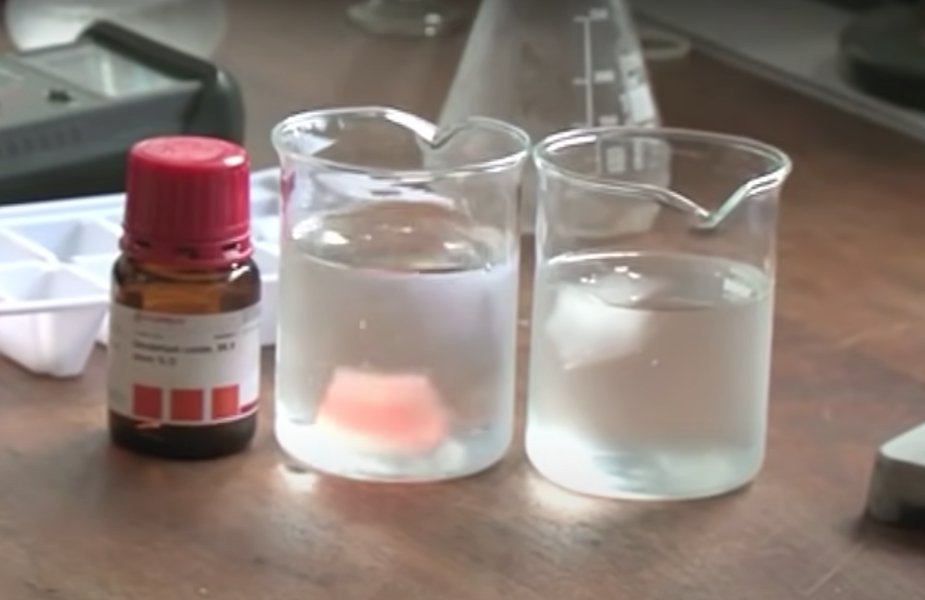
Regular ice (right) floats in regular water, but ice made from heavy water (left) sinks because D₂O is denser than H₂O.
Is it Really Different?
Mostly, heavy water looks and feels like regular water. It's clear and odorless. However, because it's denser, an ice cube made from heavy water will actually sink in regular water, unlike a normal ice cube! It also freezes and boils at slightly different temperatures. While small amounts aren't harmful to drink, large amounts can interfere with processes in living things because it's chemically a bit different.
Heavy Water's Big Job: Taming Neutrons in Nuclear Reactors
The Role of a Moderator
Nuclear reactors create energy by splitting atoms, usually uranium atoms. This splitting process, called nuclear fission, releases a lot of energy (which we can use to make electricity) and also shoots out tiny, super-fast particles called neutrons.
For the reactor to keep working, these fast neutrons need to hit other uranium atoms and cause them to split too, creating a chain reaction. However, neutrons that are moving too fast just zip right past the uranium atoms without splitting them effectively. They need to be slowed down!
This is where a moderator comes in. A moderator is a material inside the reactor that acts like a speed bump for neutrons, slowing them down to the right speed (called "thermal" speeds) so they are more likely to cause fission in other uranium atoms.
Why Heavy Water is a Star Moderator
Both regular water (H₂O, often called "light water" in this context) and heavy water (D₂O) can be used as moderators. However, they behave differently:
- Light Water (H₂O): It's good at slowing down neutrons, but it also tends to absorb (or "capture") some of them. Think of it like a slightly sticky speed bump – it slows the neutrons down, but some get stuck and can't continue the chain reaction.
- Heavy Water (D₂O): It's also very good at slowing down neutrons, but crucially, it absorbs far fewer neutrons than light water. It's like a super-efficient, non-sticky speed bump. It slows the neutrons down effectively without removing many from the process.
This difference in neutron absorption is the key reason heavy water is so valuable in certain reactor designs.
Visualizing Moderator Properties
This chart compares the estimated effectiveness of Light Water and Heavy Water as moderators in nuclear reactors based on key properties. Higher values generally indicate better performance for that specific property (except for Neutron Absorption and Enrichment Need, where lower is better). Note that these are relative comparisons for illustrative purposes.
As the chart suggests, heavy water's low neutron absorption makes it highly efficient for sustaining a nuclear reaction, especially with fuel that isn't boosted or "enriched".
Uranium: Natural vs. Enriched
What's the Difference?
The fuel used in most nuclear reactors is uranium. Uranium dug out of the ground, called natural uranium, is mostly made up of two types, or isotopes:
- Uranium-238 (U-238): Makes up about 99.3% of natural uranium. It doesn't split easily to release energy.
- Uranium-235 (U-235): Makes up only about 0.7% of natural uranium. This is the important one! U-235 splits easily when hit by a slow neutron, releasing energy and more neutrons – this is called being "fissile".
Because there's so little U-235 in natural uranium, it's often difficult to keep a chain reaction going, especially in reactors using light water (which absorbs some of the precious neutrons).
Boosting the Fuel: Uranium Enrichment
To solve this, scientists often use a process called enrichment. This process increases the percentage of U-235 in the uranium fuel, typically from 0.7% up to about 3-5% for most power reactors. Think of it like sorting through a huge bag of mixed candies to pick out more of your favorite kind – it takes a lot of effort and special technology.
Enriched uranium makes it much easier to sustain a nuclear chain reaction, particularly in light water reactors where some neutrons get absorbed by the water.

Facilities like this use complex machinery (like gas centrifuges) to enrich uranium, increasing the concentration of U-235.
The Connection: Why Heavy Water Lets Reactors Skip Enrichment
Using Natural Uranium Directly
Now, let's put it all together! Remember how heavy water is great at slowing down neutrons *without* absorbing many?
This super-efficiency means that reactors designed to use heavy water as a moderator have plenty of neutrons available to split the small amount of U-235 present in natural uranium. They don't waste neutrons like light water reactors do.
Therefore, heavy water reactors can run perfectly well using natural uranium as fuel. They don't need the complicated and expensive process of uranium enrichment!
So, heavy water isn't used *to make* enriched uranium. Instead, its special properties allow certain reactors, like the Pressurized Heavy Water Reactor (PHWR) or the Canadian CANDU reactors, to *avoid the need* for enriched uranium altogether.
Reactor Type Comparison
This table summarizes the key differences between typical Light Water Reactors (LWRs) and Heavy Water Reactors (HWRs) related to fuel and moderation:
| Feature | Light Water Reactor (LWR) | Heavy Water Reactor (HWR / CANDU) |
|---|---|---|
| Moderator | Ordinary "Light" Water (H₂O) | Heavy Water (D₂O) |
| Neutron Absorption by Moderator | Moderate | Very Low |
| Fuel Type Typically Used | Enriched Uranium (3-5% U-235) | Natural Uranium (~0.7% U-235) |
| Requires Uranium Enrichment? | Yes | No |
| Coolant | Often Light Water (H₂O) | Often Heavy Water (D₂O) |
A Side Note: Plutonium Production
While heavy water reactors use natural uranium, something else interesting happens inside them. The abundant U-238 in the natural uranium fuel can absorb some of the extra neutrons (that weren't absorbed by the heavy water). When U-238 absorbs a neutron, it eventually transforms into a different element called Plutonium-239 (Pu-239).
Pu-239 is also fissile, like U-235, and can be used as fuel in other reactors or, importantly, in nuclear weapons. This is why the production and use of heavy water are monitored internationally – because although it allows reactors to avoid uranium enrichment, the reactors themselves can produce plutonium, which is another sensitive nuclear material.
Mapping the Concepts
How It All Fits Together
This mind map shows the key ideas we've discussed and how they connect, starting from heavy water and leading to its impact on uranium fuel use in reactors.
Learn More Visually
Heavy Water Explained
This video gives a simple explanation of what heavy water (Deuterium Oxide) is, touching on its properties and how it differs from regular water. Understanding its basic nature helps grasp why it functions differently in reactors.
Frequently Asked Questions (FAQ)
Is heavy water dangerous to drink?
Drinking a very small amount of heavy water isn't immediately harmful. However, drinking large quantities over time can be dangerous. Because deuterium is heavier than regular hydrogen, it can slow down important chemical reactions in your body (like cell division) if it replaces too much of the normal water in your system. It's definitely not something you should drink regularly!
Is heavy water radioactive?
Pure heavy water (D₂O) itself is not radioactive. Deuterium is a stable isotope of hydrogen. However, heavy water that has been used inside a nuclear reactor might become slightly radioactive. This is usually due to absorbing stray neutrons which can create small amounts of tritium (another hydrogen isotope, which is radioactive) or activating impurities in the water.
Why don't all reactors use heavy water if it allows natural uranium?
That's a great question! There are trade-offs. Producing heavy water is expensive and energy-intensive because it's rare (only about 1 in 6,500 water molecules is D₂O) and hard to separate from regular water. Light water reactors, while needing enriched uranium (which is also expensive to produce), can use cheap and abundant regular water as the moderator and coolant. Different countries and companies weigh the costs and benefits of enrichment versus heavy water production when choosing reactor designs. Heavy water reactors also tend to be larger and more complex in some ways.
So, heavy water helps make nuclear power, not bombs?
Primarily, yes. Heavy water's main role is in specific types of nuclear power reactors (like CANDU) to generate electricity efficiently using natural uranium. However, as mentioned, these reactors produce plutonium-239 as a byproduct from the U-238 in the fuel. Plutonium-239 *can* be separated from the used fuel and used to make nuclear weapons. So, while heavy water itself isn't a weapon material, its use in certain reactors is linked to the potential production of weapons-usable plutonium, which is why its trade is carefully controlled.
Recommended Further Exploration
- How do CANDU reactors work with natural uranium?
- What is the process of uranium enrichment?
- Difference between nuclear fission and nuclear fusion explained simply?
- What is plutonium and why is it important in nuclear technology?
References
Last updated May 5, 2025