
Unveiling the Flow: What Did the Enigmatic Heraclitus Truly Say?
Exploring the profound insights of the pre-Socratic philosopher on change, unity, and the cosmos.
Heraclitus of Ephesus, a pre-Socratic Greek philosopher who flourished around 500 BCE, remains one of antiquity's most intriguing thinkers. Often called the "Obscure" or "Dark One" due to his dense, aphoristic style, his surviving fragments offer profound reflections on the nature of reality, change, and human existence. His ideas, though sometimes cryptic, have echoed through centuries of philosophical thought.
Key Insights from Heraclitus
- Everything Flows (Panta Rhei): Heraclitus famously argued that change is the fundamental nature of reality, comparing the world to an ever-flowing river.
- Unity of Opposites: He believed that harmony arises from the tension and balance of opposing forces (like life/death, day/night), which are interconnected parts of a single whole.
- The Logos and Fire: He introduced the concept of the Logos as the underlying rational principle governing the cosmos, and identified fire as the primordial element symbolizing constant transformation.
The Perpetual Flux: Stepping into the Ever-Changing River
Understanding "Panta Rhei"
Perhaps Heraclitus's most famous contribution is the doctrine of universal flux, often summarized by the Greek phrase "Panta Rhei" (everything flows). While he may not have used these exact words, the concept permeates his thought. It's vividly captured in the analogy of the river:
"You cannot step into the same river twice."
Variations exist, such as, "No man ever steps in the same river twice, for it's not the same river and he's not the same man." This illustrates two key aspects of his philosophy:
- The External World is Constantly Changing: The river's water is continuously replaced, meaning the river itself is never identical from one moment to the next.
- The Internal Self is Also in Flux: The person stepping into the river is also changing, experiencing new thoughts, sensations, and physical states.
For Heraclitus, permanence is an illusion. Reality is not static but a dynamic process of becoming. Change isn't just incidental; it is the very essence of existence. This perspective challenges us to embrace impermanence as the fundamental condition of life.
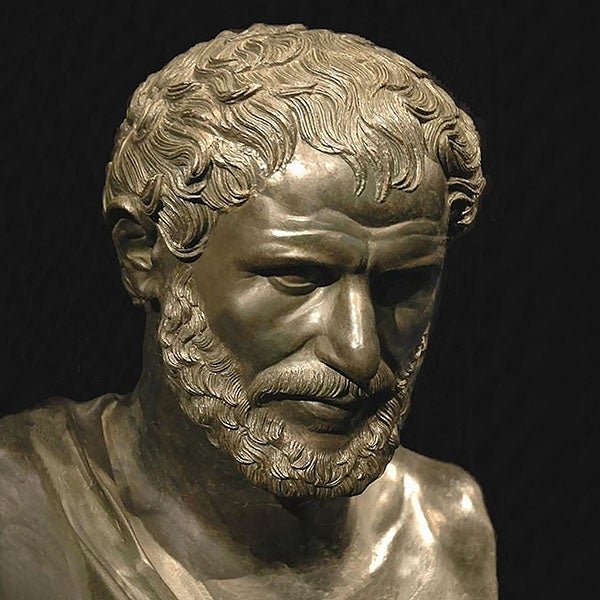
A visual representation of Heraclitus of Ephesus.
Harmony in Tension: The Unity of Opposites
Why Conflict is Essential
Contrary to seeing opposites as purely antagonistic, Heraclitus viewed them as fundamentally interconnected and interdependent aspects of a single, unified reality. He believed that the tension and interplay between contraries are necessary for existence and harmony. Key sayings illustrating this include:
- "The way up and the way down are one and the same."
- "Strife is justice."
- "All things take place by strife."
He argued that concepts like day and night, life and death, war and peace, hot and cold, are not mutually exclusive but define each other. Harmony doesn't arise from the absence of conflict, but from the dynamic balance and constant interaction of these opposing forces. This "unity of opposites" is governed by the underlying cosmic principle, the Logos.
Fire and the Logos: Cosmic Order and Reason
The Element of Transformation
In Heraclitus's cosmology, fire holds a central place. He identified it not merely as a physical substance but as the archetypal element representing the fundamental nature of the universe – constant change, transformation, and energy. He described the world order as:
"An ever-living fire, kindling in measures and being extinguished in measures."
Fire embodies the process of flux, consuming and transforming matter, mirroring the perpetual cycle of creation and destruction in the cosmos. All things are seen as an "exchange for fire," suggesting a continuous transformation process where fire is the underlying medium.
The Governing Principle: Logos
Underpinning the constant change and the unity of opposites is the Logos. Heraclitus was one of the first Greek philosophers to use this term in a metaphysical sense. The Logos represents the universal reason, law, or principle that orders and governs the cosmos. It is the rational structure inherent in reality, ensuring that change, while constant, is not chaotic but follows a coherent pattern. Although the Logos is common to all, Heraclitus lamented that most people fail to grasp it, living as if they had their own private understanding detached from this universal principle.
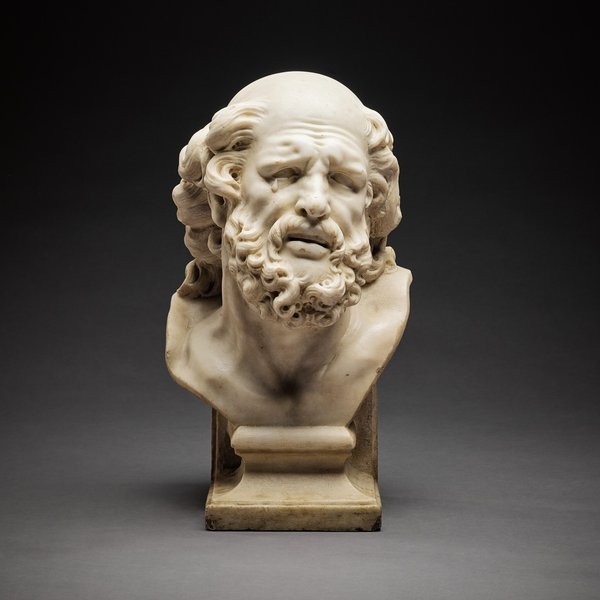
A sculpted bust representing the philosopher Heraclitus.
Mindmap of Heraclitus's Core Concepts
This mindmap visually summarizes the interconnected pillars of Heraclitus's philosophy, showing how concepts like Flux, Opposites, Fire, and Logos relate to each other and form a coherent worldview.
Exploring the Weight of Ideas: Centrality of Concepts
While all of Heraclitus's core ideas are interconnected, we can visualize their perceived centrality or emphasis within his overall philosophical system. This radar chart offers an interpretation of how strongly each concept features in discussions of his work, based on surviving fragments and historical analysis. Concepts like Flux and the Unity of Opposites are often seen as cornerstones, while others like Fire and Logos provide the cosmological and metaphysical framework.
Knowledge, Character, and the Soul
Senses, Insight, and Wisdom
Heraclitus valued sensory experience as a starting point for knowledge. He is quoted as saying, "The things of which there is sight, hearing, experience, I prefer." However, he cautioned against relying solely on the senses without deeper reflection. True understanding, for Heraclitus, required insight into the underlying patterns of change and the Logos governing the cosmos. He criticized those who lived unaware of the rational order surrounding them, comparing them to people asleep.
The Importance of Character
Heraclitus also emphasized introspection and the significance of one's inner life. He famously stated:
"Character is fate" (or "destiny").
This suggests that our inherent nature, choices, and actions shape the course of our lives. He connected our inner state to our experience of the world with sayings like:
"The soul is dyed the color of its thoughts. Think only on those things that are in line with your principles and can bear the light of day."
This highlights the ethical dimension of his philosophy, urging self-awareness and alignment between one's thoughts and principles. Seeking self-knowledge ("I searched myself") was a crucial endeavor.
Heraclitus's Wisdom in His Own Words
The following table summarizes some of the key sayings attributed to Heraclitus and the core philosophical concepts they illustrate:
| Key Quote / Saying | Philosophical Concept Illustrated |
|---|---|
| "You cannot step into the same river twice." | Universal Flux / Constant Change |
| "The way up and the way down are one and the same." | Unity of Opposites / Interdependence |
| "War [Strife] is the father of all and king of all..." / "Strife is Justice." | Harmony through Conflict / Unity of Opposites |
| "The world order... is an ever-living fire, kindling in measures and being extinguished in measures." | Fire as the Primal Element / Cosmic Order & Change |
| "All things are an exchange for fire, and fire for all things..." | Fire as Fundamental Substance / Transformation |
| "Listening not to me but to the Logos it is wise to agree that all things are one." | The Logos / Underlying Unity & Reason |
| "Character is fate (destiny)." | Ethics / Self-Determination / Importance of Inner Qualities |
| "The soul is dyed the color of its thoughts." | Mind-Body Connection / Ethics / Influence of Thought |
| "The things of which there is sight, hearing, experience, I prefer." | Epistemology / Value of Sensory Experience |
| "Nature loves to hide." | Epistemology / Need for Deeper Inquiry Beyond Appearances |
Hear the Echoes: Heraclitus's Enduring Thoughts
The fragmented nature of Heraclitus's work lends itself well to contemplation. This video explores some of his most famous quotes, offering interpretations and reflecting on their timeless relevance to understanding life, change, and the human condition.
As the video highlights, Heraclitus encourages us to look beyond the surface of things, to recognize the constant flux of existence, the interplay of opposites that creates harmony, and the importance of aligning ourselves with the underlying rational order (Logos) of the universe. His insights into character and thought remain powerful guides for self-reflection.
Frequently Asked Questions about Heraclitus
Why is Heraclitus called "The Obscure"?
Heraclitus earned nicknames like "The Obscure" and "The Dark One" primarily because of his writing style. His work survives only in fragments, often presented as aphorisms or riddles that are dense, paradoxical, and open to multiple interpretations. He deliberately employed ambiguity and complex metaphors, challenging readers to think deeply rather than offering straightforward explanations.
Did Heraclitus actually say "Panta Rhei" (everything flows)?
While the phrase "Panta Rhei" perfectly encapsulates Heraclitus's doctrine of universal flux, there is no direct evidence in the surviving fragments that he used these exact words himself. Plato and other later philosophers attributed the idea and sometimes similar phrasing to him, cementing the association. The core concept, however, is undeniably central to his philosophy, exemplified by the river analogy.
How did Heraclitus influence later philosophy?
Heraclitus had a significant impact on subsequent thought. Plato engaged deeply with Heraclitus's ideas on flux, contrasting them with his own theory of eternal Forms. The Stoics adopted and adapted Heraclitus's concepts of the Logos, cosmic fire, and the acceptance of natural order and change. His emphasis on the unity of opposites and the dynamic nature of reality has resonated through figures like Hegel and Nietzsche, and continues to influence metaphysics, epistemology, and ethics.
What is the difference between Heraclitus and Parmenides?
Heraclitus and Parmenides represent opposing views in pre-Socratic philosophy regarding change. Heraclitus argued that reality is fundamentally characterized by constant change and flux ("everything flows"). In contrast, Parmenides argued that change is an illusion and that reality is one, eternal, and unchanging Being. All perceived change and multiplicity, according to Parmenides, belong to the realm of deceptive appearances, not true reality which can only be grasped by reason.
Recommended Reads
Explore further facets of Heraclitus's thought and related philosophical concepts:
- What is the concept of Logos in ancient Greek philosophy?
- Compare the philosophies of Heraclitus and Parmenides on change.
- How did Heraclitus influence Stoicism?
- Explain the unity of opposites in philosophy.
References
Last updated May 4, 2025