
The Power of the People: Unraveling America's Largest Mass Demonstrations
A comprehensive analysis of crowd sizes from the most influential protests in U.S. history, revealing how collective action has shaped the nation
Key Insights on U.S. Protest Movements
- The 2020 George Floyd protests represent the largest mass demonstration in U.S. history, with an estimated 15-26 million participants nationwide.
- Women's rights demonstrations consistently draw massive crowds, with the 2017 Women's March mobilizing 3.3-5.6 million people across the country.
- Social media and technology have dramatically increased protest participation, with 8 of the 10 largest U.S. protests occurring since 2016.
Comprehensive Table of Major U.S. Protest Crowd Sizes
The following table presents the most significant protests in U.S. history, arranged by estimated crowd size. These figures represent the best available estimates from multiple sources, though exact counting methodologies vary and remain controversial.
| Protest/Movement | Year(s) | Primary Location(s) | Estimated Attendance | Cause/Focus |
|---|---|---|---|---|
| George Floyd/Black Lives Matter Protests | 2020 | Nationwide (2,000+ cities) | 15,000,000 - 26,000,000 | Racial justice, police reform |
| Women's March | 2017 | Washington D.C. + 650+ cities | 3,300,000 - 5,600,000 | Women's rights, anti-Trump |
| March for Our Lives | 2018 | Washington D.C. + 800+ cities | 1,200,000 - 2,000,000 | Gun control legislation |
| March for Women's Lives | 2004 | Washington D.C. | 500,000 - 1,150,000 | Reproductive rights |
| Million Man March | 1995 | Washington D.C. | 400,000 - 1,000,000 | African American unity |
| Nuclear Disarmament Protest | 1982 | New York City | 1,000,000 | Anti-nuclear weapons |
| "Hands Off!" Protests | 2025 | Nationwide (all 50 states) | 600,000 - 1,000,000+ | Against Trump administration policies |
| March for Science | 2017 | Washington D.C. + 600+ cities | 1,000,000+ | Science funding, climate action |
| March on Washington for Jobs and Freedom | 1963 | Washington D.C. | 250,000 | Civil rights, economic equality |
| Solidarity Day | 1981 | Washington D.C. | 260,000 | Labor rights, union support |
| Anti-Vietnam War Moratorium | 1969 | Washington D.C. + multiple cities | 250,000 - 500,000 | Opposition to Vietnam War |
| Climate Strike | 2019 | Nationwide (multiple cities) | Hundreds of thousands | Climate action |
| Poor People's Campaign | 1968 | Washington D.C. | 50,000 - 150,000 | Economic justice |
| Bonus Army March | 1932 | Washington D.C. | 43,000 | Veterans' benefits |
Historical Evolution of U.S. Protest Movements
The landscape of American protest has evolved dramatically over time, with recent years showing a remarkable increase in both the frequency and scale of mass demonstrations. Several factors have contributed to this trend:
The Digital Revolution in Protest Mobilization
Social media and digital communication tools have transformed how protests are organized, allowing for rapid, large-scale mobilization that was previously impossible. The ability to instantly share information, coordinate logistics, and document events in real-time has dramatically increased participation rates and geographic spread.
From Word-of-Mouth to Viral Hashtags
Earlier protests relied on physical flyers, phone trees, and community organizations to spread the word. Modern movements like Black Lives Matter and the Women's March leveraged hashtags, Facebook events, and dedicated apps to coordinate millions of participants across multiple cities simultaneously.
Demographic and Generational Shifts
Younger generations show higher willingness to participate in direct action, with Millennials and Gen Z demonstrating unprecedented levels of protest engagement. This generational shift has coincided with increased diversity in protest leadership and more intersectional approaches to movement building.
Youth-Led Movements
The March for Our Lives following the Parkland shooting demonstrated how youth activists could rapidly organize national demonstrations. Similarly, youth leadership has been central to climate activism and progressive political movements in recent years.
Measuring the Crowds: Challenges and Controversies
Crowd size estimation remains contentious and methodologically challenging. Different counting techniques—from aerial photography to cell phone data analysis—can produce widely varying figures, often influenced by political motivations. The Crowd Counting Consortium and similar academic initiatives have worked to standardize these measurements.
Comparative Impact Analysis of Major U.S. Protests
Understanding protest movements requires looking beyond raw numbers to examine their broader impact across multiple dimensions. The following radar chart compares six of America's most significant protest movements across key metrics of influence and reach.
The radar chart above visualizes how different protest movements compare across six critical dimensions, with higher scores indicating greater impact in that category. The Civil Rights Movement shows exceptional policy impact and longevity, while the Women's March and Black Lives Matter demonstrations achieved unprecedented scale and geographic spread.
Visual Documentation of America's Largest Protests
Historical images provide powerful context for understanding the scale and impact of major demonstrations throughout U.S. history.

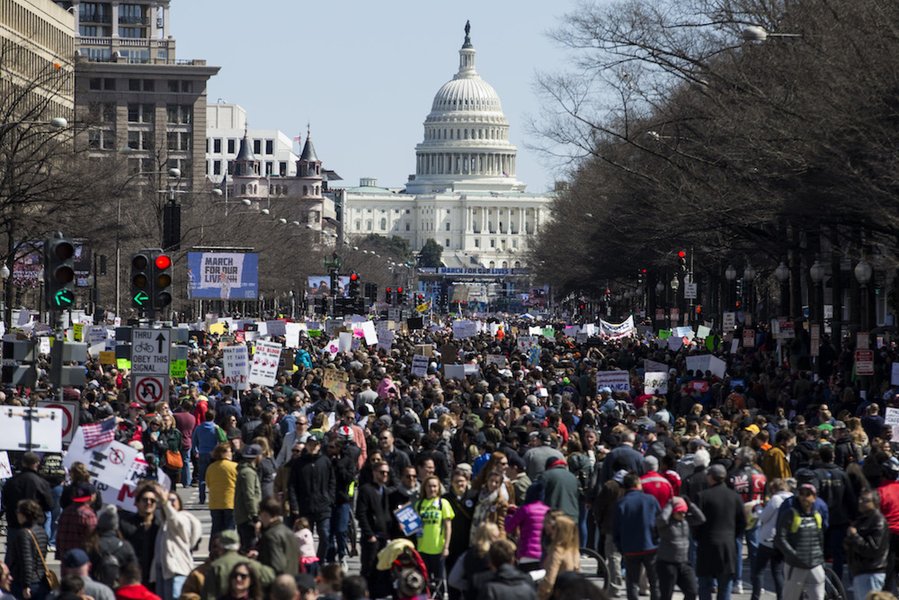
Massive crowds gather in Washington D.C. during the 2020 Black Lives Matter protests following George Floyd's murder
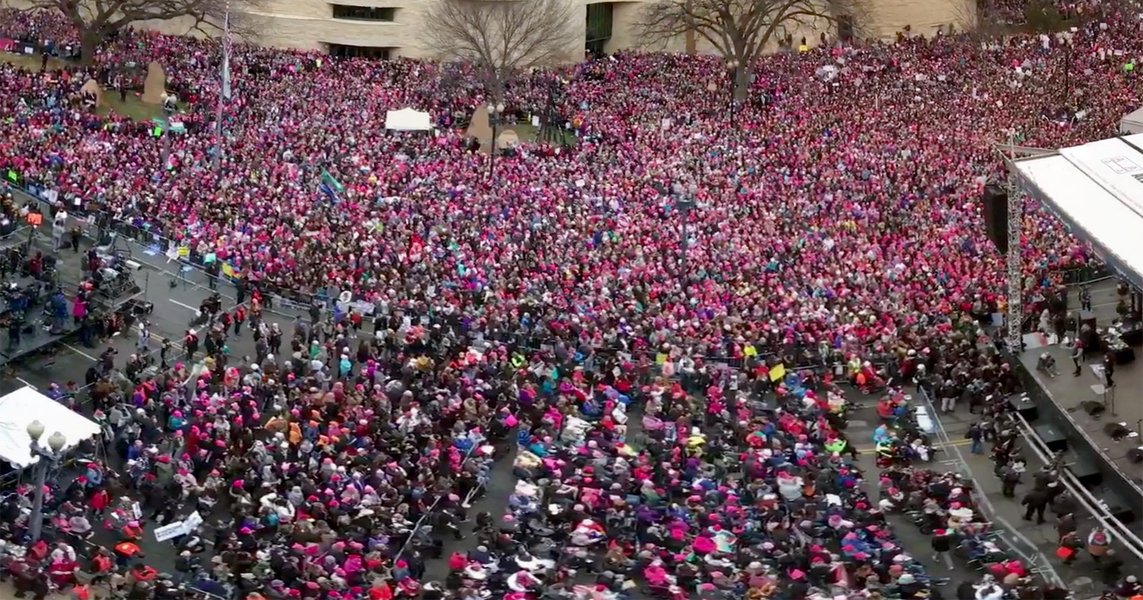
Aerial view of the Women's March in Washington D.C., January 21, 2017, which drew 470,000-500,000 participants in the capital alone
Side-by-side comparison showing crowd sizes at the 2017 Presidential Inauguration (left) versus the Women's March (right)
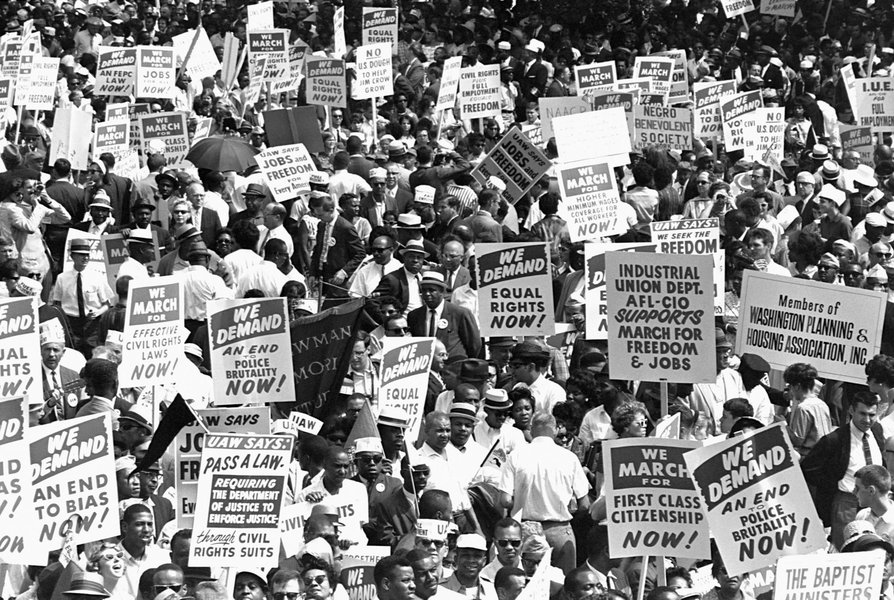
The historic March on Washington for Jobs and Freedom in 1963, where Martin Luther King Jr. delivered his "I Have a Dream" speech before 250,000 people
Major Categories of American Protest Movements
American protests have addressed a wide range of social, political, and economic issues throughout history. The following mindmap categorizes major protest movements by their primary focus areas, revealing patterns in how collective action has evolved.
The mindmap illustrates how U.S. protest movements span diverse causes while often sharing tactics, leadership networks, and overlapping participants. Many modern movements draw inspiration from earlier protests, adapting strategies for contemporary contexts.
Inside the 2025 "Hands Off!" Protests: A New Era of Demonstration
The "Hands Off!" protests of 2025 represent one of the most recent large-scale demonstrations in the United States, with coordinated events held in all 50 states. The video above shows footage from the National Mall in Washington D.C., where tens of thousands gathered in opposition to various policies of the Trump administration.
These protests are particularly notable for their rapid organization across multiple locations simultaneously, demonstrating the continued evolution of protest coordination in the digital age. Organizers leveraged social media platforms and encrypted messaging apps to mobilize participants, while specialized apps helped track attendance numbers more accurately than in previous mass demonstrations.
The "Hands Off!" movement exemplifies how contemporary protests increasingly employ sophisticated digital infrastructure alongside traditional gathering tactics, creating hybrid online-offline mobilization strategies that can rapidly respond to political developments.
Methodologies for Measuring Protest Attendance
Accurately counting protesters has long challenged researchers, journalists, and authorities. The methods below represent the evolution of crowd-size estimation techniques, each with their own advantages and limitations.
| Methodology | Description | Accuracy | Notable Examples |
|---|---|---|---|
| Aerial Photography | Using overhead images to count people or estimate density per unit area | Moderate to High | Women's March (2017), March on Washington (1963) |
| Grid Sampling | Counting people in sample areas and extrapolating to the total space | Moderate | Million Man March (1995), Anti-Vietnam War protests |
| Turnstile/Entry Counts | Counting participants as they enter a defined space | High (for controlled access events) | Washington Mall events, stadium-based rallies |
| Mobile Phone Data | Analyzing cellular network usage in protest areas | Moderate to High | George Floyd Protests (2020), "Hands Off!" Protests (2025) |
| Public Transit Ridership | Measuring increases in public transportation usage | Low to Moderate | Women's March (2017), March for Our Lives (2018) |
| Crowd Density Analysis | Using computer vision to analyze crowd density in images | High | Black Lives Matter (2020), Climate Strikes (2019) |
| Participant Surveys | Polling attendees about group size and geographic origin | Low | Various smaller protests and rallies |
Modern protest size estimation increasingly combines multiple methodologies, with academic institutions like the Crowd Counting Consortium developing standardized approaches to increase accuracy and reduce political bias in reporting.
Frequently Asked Questions About U.S. Protests
What was the largest single protest in U.S. history?
How are protest crowd sizes measured?
Why have protest sizes increased in recent years?
Which protest had the greatest policy impact?
What was the first major protest in U.S. history?
References
- List of protests and demonstrations in the United States by size - Wikipedia
- The largest marches and protests in American history - Business Insider
- The largest protests in American history are happening right now - Mashable
- 10 Largest Protests In The History Of America - World Atlas
- Crowd Counting Consortium - Ash Center at Harvard Kennedy School
- Crowd Scientists Say Women's March in Washington Had 3 Times as Many People as Trump's Inauguration - New York Times
- Famous protests in US history and their impacts - WNCT
- 2023 Trends in U.S. Protest Activity - Counting Crowds
Recommended Topics
Last updated April 6, 2025