
Navigating the New Era: A Comprehensive Policy on Hong Kong's MPF Offset Abolition
Your definitive guide to understanding and implementing the MPF offsetting changes effective May 1, 2025.
The landscape of employee benefits and employer obligations in Hong Kong has undergone a significant transformation with the abolition of the Mandatory Provident Fund (MPF) offsetting mechanism. This policy and procedure document provides a comprehensive framework for [Company Name] to navigate these changes, ensuring full compliance with the Employment and Retirement Schemes Legislation (Offsetting Arrangement) (Amendment) Ordinance 2022, effective May 1, 2025. Understanding these changes is crucial for both employers and employees to manage expectations and responsibilities accurately.
Key Highlights of the MPF Offset Abolition
- No More Offset with Mandatory Contributions: For employment periods on or after May 1, 2025, employers cannot use their mandatory MPF contributions to offset statutory Severance Payments (SP) or Long Service Payments (LSP).
- Transitional Rules for Existing Employees: Employees hired before May 1, 2025, will have their SP/LSP calculated in two parts, with different offsetting rules applying to service before and after the transition date.
- Government Support Available: A 25-year government subsidy scheme is in place to assist employers in managing the financial impact of these changes.
[Company Name] Policy & Procedure: MPF Offsetting Abolition
Effective Date: May 1, 2025
1. Purpose
This Policy and Procedure (P&P) document aims to:
- Inform all employees and management of [Company Name] about the abolition of the MPF offsetting mechanism in Hong Kong, effective May 1, 2025.
- Outline the implications for Severance Payments (SP) and Long Service Payments (LSP).
- Detail employer obligations concerning MPF contributions and the calculation of statutory payments.
- Establish clear administrative procedures to ensure [Company Name]'s full compliance with the Employment and Retirement Schemes Legislation (Offsetting Arrangement) (Amendment) Ordinance 2022 ("Amendment Ordinance").
- Guide Human Resources, Payroll, and Finance departments in implementing these changes.
2. Background
Historically, employers in Hong Kong were permitted to use the accrued benefits derived from their mandatory contributions to an employee's MPF scheme to offset statutory SP and LSP. Recognizing the need to enhance employees' retirement protection, the Hong Kong Government enacted the Amendment Ordinance to abolish this offsetting arrangement.
Effective May 1, 2025 (the "Transition Date"), employers are no longer allowed to use the employer's mandatory MPF contributions to reduce SP or LSP entitlements accrued for employment periods on or after this date. This policy reflects [Company Name]'s commitment to adhering to these new legal requirements.

Preparing for the abolition of the MPF offsetting mechanism in Hong Kong.
3. Scope
This policy applies to:
- All employees of [Company Name] in Hong Kong who are covered under the Mandatory Provident Fund (MPF) System or other statutory retirement schemes subject to these offsetting rules.
- All employment contracts, payroll processes, and Human Resources procedures involving SP and LSP calculations and payments.
- Terminations of employment occurring on or after May 1, 2025.
- The Human Resources, Payroll, and Finance departments of [Company Name].
4. Key Definitions
- MPF Offsetting Mechanism: The previous arrangement allowing employers to use accrued benefits from their MPF contributions (mandatory and voluntary) to cover SP or LSP liabilities.
- Abolition Date / Transition Date: May 1, 2025, the date from which the new rules apply.
- Severance Payment (SP): A statutory payment due to an eligible employee whose employment contract is terminated due to redundancy or layoff after not less than 24 months of continuous employment.
- Long Service Payment (LSP): A statutory payment due to an eligible employee who has been continuously employed for not less than 5 years and whose employment is terminated for reasons other than serious misconduct or redundancy (e.g., retirement, death, ill health, or employer insolvency).
- Employer's Mandatory Contributions (ERMC): The 5% of relevant income that employers are legally required to contribute to an employee's MPF scheme, subject to statutory caps.
- Employer's Voluntary Contributions (ERVC): Any MPF contributions made by the employer over and above the mandatory requirement.
- Gratuities: Payments based on years of service, typically contractual, which can also be used for offsetting.
- Pre-transition Portion: The SP/LSP attributable to an employee's years of service before May 1, 2025.
- Post-transition Portion: The SP/LSP attributable to an employee's years of service on or after May 1, 2025.
Understanding the Core Changes
The central pillar of the MPF offsetting abolition is the protection of retirement savings derived from employer mandatory contributions. This section delves into the specifics of the new rules and how they apply to different scenarios.
(Effective May 1, 2025)"] id1["Core Change"] id1a["No offsetting SP/LSP with
Employer's Mandatory Contributions
(for service post-transition)"] id1b["Voluntary contributions & gratuities
can still be used for offset"] id2["Impacted Payments"] id2a["Severance Payment (SP)"] id2b["Long Service Payment (LSP)"] id3["Transitional Arrangements
(Employees hired pre-May 1, 2025)"] id3a["Pre-transition portion (up to Apr 30, 2025)
- Offset with mandatory & voluntary contributions"] id3b["Post-transition portion (from May 1, 2025)
- Offset with voluntary contributions ONLY"] id4["Employer Responsibilities"] id4a["Update HR/Payroll Systems"] id4b["Accurate Record Keeping"] id4c["Employee Communication"] id4d["Financial Planning"] id5["Government Support"] id5a["25-Year Subsidy Scheme"] id5b["TransitionEase Portal for applications"] id6["Key Legislation"] id6a["Employment & Retirement Schemes Legislation
(Offsetting Arrangement) (Amendment) Ordinance 2022"]
A mindmap illustrating the key components and implications of the MPF offset abolition.
5. Policy Details
5.1 The Abolition of MPF Offsetting
From May 1, 2025:
- [Company Name] will not use accrued benefits from its mandatory MPF contributions (ERMC) to offset any SP or LSP amount related to an employee's years of service on or after May 1, 2025 (the post-transition portion).
- [Company Name] may continue to use accrued benefits from its voluntary MPF contributions (ERVC) and any contractual gratuities based on years of service to offset SP/LSP, for both pre-transition and post-transition portions of service.
5.2 Transitional Arrangements for Employees Hired Before May 1, 2025
For employees whose continuous employment with [Company Name] commenced before May 1, 2025, and whose employment terminates on or after this date, their SP/LSP entitlement will be calculated in two parts:
- Pre-transition Portion: Calculated based on years of service up to April 30, 2025. For this portion, [Company Name] can continue to offset the SP/LSP amount using accrued benefits from both its mandatory (ERMC) and voluntary (ERVC) MPF contributions.
- Post-transition Portion: Calculated based on years of service from May 1, 2025, onwards. For this portion, [Company Name] can only offset the SP/LSP amount using accrued benefits from its voluntary (ERVC) MPF contributions and gratuities. ERMC cannot be used for this portion.
The "last month's wages" (or average wages over the preceding 12 months) used for calculating the pre-transition portion will be based on the wages for the month/period immediately preceding the Transition Date (i.e., April 2025 or the 12 months prior). For the post-transition portion, it will be based on the wages for the month/period immediately preceding the termination date.
5.3 Calculation of Severance Payment (SP) and Long Service Payment (LSP)
The fundamental formula for calculating SP/LSP remains unchanged under the Employment Ordinance: \[ \text{SP/LSP} = (\text{Last full month's wages} \times \frac{2}{3}) \times \text{Years of service} \] Alternatively, an employee can opt for their average daily wages in the 12 months immediately preceding termination.
- The monthly wage for calculation is capped at HK$22,500.
- The maximum total SP/LSP payable to an employee under the Employment Ordinance is HK$390,000.
- If an employee's total calculated SP/LSP (sum of pre- and post-transition portions, if applicable) exceeds HK$390,000, the amount in excess of the cap will be deducted first from the post-transition portion of the SP/LSP.
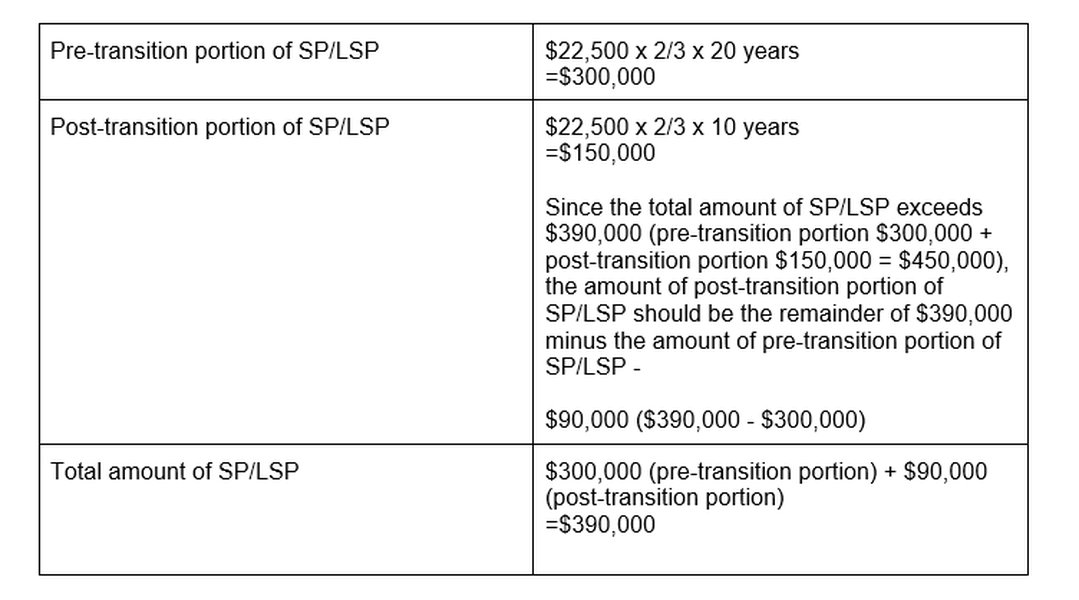
Visualizing the SP/LSP calculation components under the new regime.
5.4 Summary of Offsetting Rules
The following table summarizes the offsetting rules:
| Feature | SP/LSP for Service *Before* May 1, 2025 (Pre-transition Portion) | SP/LSP for Service *On or After* May 1, 2025 (Post-transition Portion) |
|---|---|---|
| Offset with Employer's Mandatory Contributions (ERMC) | Permitted | Not Permitted |
| Offset with Employer's Voluntary Contributions (ERVC) | Permitted | Permitted |
| Offset with Gratuities (based on years of service) | Permitted | Permitted |
5.5 Government Subsidy Scheme
[Company Name] will explore and, where eligible, apply for the Government's 25-year Subsidy Scheme. This scheme is designed to help employers, particularly small and medium-sized enterprises, share the financial burden of SP/LSP during the initial years following the abolition.
- The subsidy amount varies depending on the specific year and the employer's total SP/LSP expenses for the post-transition portion.
- Applications will be managed through the government's "TransitionEase Portal."
- The Finance Department will be responsible for understanding the eligibility criteria and application process.
An informational video explaining the abolition of the MPF offsetting arrangement.
5.6 Record Keeping
[Company Name] will adhere to the following record-keeping requirements:
- Maintain wage records for each employee covering at least the 12 months preceding their termination of employment. These records must be kept for at least six months after the employee ceases to be employed.
- For employees hired before May 1, 2025, [Company Name] must specifically keep wage records covering the 12 months immediately preceding May 1, 2025. These records must also be retained for at least six months after the employee leaves employment to facilitate accurate calculation of the pre-transition portion of SP/LSP.
- All documentation related to MPF contributions (mandatory and voluntary), SP/LSP calculations, and payments must be meticulously maintained and readily accessible for audit and compliance purposes.
5.7 Employee Communication
Transparency with employees is paramount. [Company Name] will:
- Inform all current and new employees about these changes to the MPF offsetting arrangement and their implications.
- Update employment contracts, employee handbooks, and internal HR portals to reflect the new legal framework.
- Provide channels for employees to ask questions and seek clarification on how these changes affect them personally.
Critical Focus Areas for Employer Preparedness
Adapting to the MPF offset abolition requires proactive measures across various operational areas. The following chart highlights key dimensions of employer preparedness, rated by the general level of effort or complexity involved for a typical organization.
Radar chart depicting critical focus areas for employers in adapting to the MPF offset abolition. Data points are illustrative of general effort/complexity.
6. Procedures for Implementation
6.1 Pre-Transition Preparations (Actions completed or ongoing prior to May 1, 2025)
- System Updates: The Human Resources and Payroll departments will ensure that all relevant systems are updated to accurately calculate SP/LSP according to the new two-tier system and offsetting rules. This includes distinguishing between pre- and post-transition service periods and applying the correct offsetting logic.
- Record Auditing: Conduct an audit of employee records, particularly wage data for the 12 months leading up to May 1, 2025, for all employees hired before this date.
- Staff Training: Relevant HR, Payroll, and Management staff will be trained on the new legislation, this policy, and associated procedures.
- Financial Planning: The Finance department will assess the potential financial impact of the abolition and incorporate this into budgeting and financial planning.
- Subsidy Scheme Familiarization: Proactively gather information about the Government Subsidy Scheme and prepare for potential applications.
6.2 Post-Transition Operations (Actions from May 1, 2025, onwards)
- SP/LSP Calculation: Upon an eligible employee's termination, the HR department will calculate SP/LSP in strict accordance with this policy, the Amendment Ordinance, and the Employment Ordinance. This includes applying the two-tier calculation for employees with pre-transition service.
- Offset Application: Offsets will be applied correctly, distinguishing between mandatory and voluntary contributions for the appropriate service periods.
- Payment Processing: The Finance/Payroll department will process SP/LSP payments within the statutory timelines. Applications for government subsidies will be made as applicable.
- Documentation: All calculations, decisions, and payments related to SP/LSP and MPF offsetting will be thoroughly documented and records maintained as per section 5.6.
7. Roles and Responsibilities
- Human Resources Department:
- Overall responsibility for implementing and maintaining this policy.
- Ensuring accurate calculation of SP/LSP.
- Communicating policy changes to employees and updating relevant documentation (contracts, handbooks).
- Training management and staff on the policy.
- Maintaining employee records related to service, wages, and MPF.
- Finance/Payroll Department:
- Ensuring payroll systems are compliant with the new rules.
- Processing SP/LSP payments accurately and on time.
- Managing applications for and accounting of the Government Subsidy Scheme.
- Budgeting for potential increases in SP/LSP costs.
- Managers and Supervisors:
- Understanding the policy and its implications for their teams.
- Consulting with HR on termination processes to ensure compliance.
- Employees:
- Familiarizing themselves with this policy.
- Providing accurate information as required for SP/LSP calculations.
- Directing queries to the HR department.
8. Compliance and Monitoring
[Company Name] is committed to full compliance with the Amendment Ordinance and all related employment legislation. Non-compliance can lead to legal penalties, financial liabilities, and reputational damage.
- This policy will be reviewed periodically (at least annually) and updated as necessary to reflect any further legislative changes or official guidance from the Labour Department.
- Internal audits may be conducted to ensure adherence to this policy.
- Any disputes arising from the application of this policy will be handled in accordance with [Company Name]'s grievance procedures and, where necessary, with reference to the Labour Department for conciliation.
9. Related Policies and Legislation
- Employment Ordinance (Cap. 57)
- Mandatory Provident Fund Schemes Ordinance (Cap. 485)
- Employment and Retirement Schemes Legislation (Offsetting Arrangement) (Amendment) Ordinance 2022
- [Company Name] Employee Handbook
- [Company Name] Grievance Procedure Policy
10. Revision History
| Version | Date | Description of Changes | Prepared By | Approved By |
|---|---|---|---|---|
| 1.0 | May 18, 2025 | Initial issue of the policy regarding the abolition of MPF offsetting. | HR Department | [CEO/Managing Director Name] |
For further inquiries regarding this policy, please contact the Human Resources Department.
Frequently Asked Questions (FAQ)
Recommended Further Insights
To deepen your understanding of related employment and financial matters in Hong Kong, consider exploring these topics:
- What are the precise steps and current wage caps for calculating Severance Payments and Long Service Payments in Hong Kong?
- What is the detailed application process and eligibility criteria for the Hong Kong government's subsidy scheme related to the MPF offset abolition?
- How does the abolition of MPF offsetting specifically impact the financial planning and HR practices of small and medium enterprises in Hong Kong?
- What are the best practices for communicating significant changes in employee benefits, like the MPF offset abolition, to maintain transparency and trust?
References
Last updated May 18, 2025