
Solving the Classic Horse Theft Pursuit Problem
Unraveling the Dynamics of a Historical Chase
Key Insights into the Pursuit
- Understanding Relative Speed: The core of this problem lies in the concept of relative speed. The owner gains on the thief based on the difference in their speeds, not their individual speeds alone.
- Tracking the Shrinking Gap: The problem provides snapshots of the distance between the owner and the thief at different points in the chase, allowing us to determine the rate at which the owner closes the distance.
- Calculating the Remaining Distance: By establishing the owner's rate of closing the distance, we can project how much further the owner needs to travel to cover the remaining gap and apprehend the thief.
Horse theft has a long and often severe history. Historically, it was considered a grave offense, sometimes punishable by death, because a horse represented essential transportation and a significant economic asset. In modern times, while punishments may differ, horse theft remains a serious issue, with cases reported across various regions, sometimes involving complex interstate investigations. This classic mathematical problem, sometimes referred to as a "chase problem" or "pursuit problem," uses the scenario of a horse theft to illustrate principles of relative motion and problem-solving.
Analyzing the Pursuit
To solve this problem, we need to analyze the information provided at two distinct points in the owner's pursuit. We are given the initial head start of the thief and the distance remaining between the owner and the thief after the owner has traveled a certain distance.
Initial Situation
The thief has a head start of 37 ri.
Situation After Owner Travels 145 Ri
After the owner travels 145 ri, the thief is still 23 ri ahead. This means the owner has reduced the initial gap.
Calculating the Distance Covered by the Thief
In the time the owner traveled 145 ri, the initial 37 ri gap was reduced, and the thief is now 23 ri ahead. This implies that the thief has also traveled a certain distance during this time. The distance the owner has gained on the thief is the initial head start minus the remaining distance:
\[ \text{Distance Gained by Owner} = \text{Initial Head Start} - \text{Remaining Distance} \]
\[ \text{Distance Gained by Owner} = 37 \text{ ri} - 23 \text{ ri} = 14 \text{ ri} \]
This 14 ri is the amount by which the owner has closed the gap during the time they traveled 145 ri. Therefore, in the same amount of time the owner traveled 145 ri, the thief must have traveled the distance the owner gained plus the initial head start:
\[ \text{Distance Traveled by Thief} = \text{Distance Gained by Owner} + \text{Remaining Distance} \]
\[ \text{Distance Traveled by Thief} = 14 \text{ ri} + 23 \text{ ri} = 37 \text{ ri} \]
Hold on, let's re-evaluate this. The distance gained by the owner is the amount by which the initial gap is reduced. If the initial gap was 37 ri, and the gap is now 23 ri, the owner has closed 37 - 23 = 14 ri of the distance.
So, when the owner traveled 145 ri, they closed the gap by 14 ri. This means that for every 145 ri the owner travels, they get 14 ri closer to the thief.
Determining the Relative Speed
The owner closes the gap at a rate of 14 ri for every 145 ri they travel. This gives us a ratio of their speeds, or more specifically, the rate at which the owner reduces the distance between them and the thief.
Let \( S_o \) be the owner's speed and \( S_t \) be the thief's speed. In the time it took the owner to travel 145 ri, let's call this time \( t \). The distance the owner traveled is \( D_o = S_o \times t = 145 \) ri.
During the same time \( t \), the thief traveled a distance \( D_t = S_t \times t \). We know that the initial head start was 37 ri, and after time \( t \), the thief is 23 ri ahead. So, the distance the thief traveled during this time \( t \) is their initial head start plus the distance they traveled while the owner was pursuing:
\[ \text{Thief's position after time } t = \text{Initial Head Start} + \text{Distance thief traveled in time } t \]
\[ \text{Owner's position after time } t = \text{Distance owner traveled in time } t \]
The difference in their positions is the remaining distance:
\[ \text{Thief's position} - \text{Owner's position} = 23 \text{ ri} \]
\[ (37 + S_t \times t) - (S_o \times t) = 23 \]
\[ 37 + t(S_t - S_o) = 23 \]
This doesn't seem right, as \( S_t - S_o \) would be negative since the owner is catching up. Let's think about the distance the thief traveled from the point where the owner started the chase.
When the owner started chasing, the thief was 37 ri away. After the owner traveled 145 ri, the thief was 23 ri ahead of the owner's current position. So, the total distance from the owner's starting point to the thief's current position is 145 ri (owner's distance) + 23 ri (remaining gap) = 168 ri.
In the same amount of time the owner traveled 145 ri, the thief traveled from their initial position (37 ri ahead of the owner's starting point) to their current position (168 ri from the owner's starting point).
Therefore, the distance the thief traveled during this time is:
\[ \text{Distance Traveled by Thief} = \text{Thief's current distance from owner's start} - \text{Thief's initial distance from owner's start} \]
\[ \text{Distance Traveled by Thief} = 168 \text{ ri} - 37 \text{ ri} = 131 \text{ ri} \]
So, while the owner traveled 145 ri, the thief traveled 131 ri. This gives us a ratio of their speeds:
\[ \frac{S_t}{S_o} = \frac{\text{Distance Traveled by Thief}}{\text{Distance Traveled by Owner}} = \frac{131}{145} \]
The owner's speed relative to the thief (the rate at which the owner closes the gap) is \( S_o - S_t \).
In the time it took the owner to travel 145 ri, the owner closed the gap by \( 145 - 131 = 14 \) ri. This confirms our earlier calculation of the distance gained. The owner gains 14 ri for every 145 ri they travel.
Calculating the Remaining Distance to be Closed
The owner is 23 ri behind the thief when the owner has traveled 145 ri. The owner needs to close this remaining 23 ri gap.
Using the Rate of Closing the Gap
We know the owner closes the gap at a rate of 14 ri for every 145 ri traveled. We can set up a proportion to find out how many more ri the owner needs to travel to close the remaining 23 ri gap.
Let \( x \) be the additional distance the owner needs to travel to catch up with the thief.
\[ \frac{\text{Distance Closed by Owner}}{\text{Distance Traveled by Owner}} = \frac{\text{Remaining Distance to Close}}{\text{Additional Distance to Travel}} \]
\[ \frac{14 \text{ ri}}{145 \text{ ri}} = \frac{23 \text{ ri}}{x \text{ ri}} \]
Now, we can solve for \( x \):
\[ 14 \times x = 145 \times 23 \]
\[ 14x = 3335 \]
\[ x = \frac{3335}{14} \]
\[ x \approx 238.21 \text{ ri} \]
Alternatively, we can think in terms of the ratio of the distances traveled. In the time the owner travels 145 ri, the thief travels 131 ri. The owner travels \( \frac{145}{131} \) times the distance the thief travels in the same amount of time. The owner closes the gap by the difference in their distances traveled: \( 145 - 131 = 14 \) ri.
The remaining distance to close is 23 ri. The owner needs to travel enough distance to cover this 23 ri gap at the same rate they were closing the gap before. The rate of closing the gap is 14 ri closed per 145 ri traveled by the owner.
So, to close 1 ri of the gap, the owner travels \( \frac{145}{14} \) ri.
To close the remaining 23 ri gap, the owner needs to travel:
\[ \text{Additional Distance} = \text{Remaining Distance to Close} \times \text{Rate of Owner's Travel per Ri Closed} \]
\[ \text{Additional Distance} = 23 \text{ ri} \times \frac{145 \text{ ri}}{14 \text{ ri}} \]
\[ \text{Additional Distance} = \frac{23 \times 145}{14} \text{ ri} \]
\[ \text{Additional Distance} = \frac{3335}{14} \text{ ri} \]
\[ \text{Additional Distance} \approx 238.21 \text{ ri} \]
Let's verify this. If the owner travels an additional 238.21 ri, the total distance the owner has traveled from the start of the chase is \( 145 + 238.21 = 383.21 \) ri.
In the time the owner traveled 238.21 ri, the thief would have traveled a distance proportional to the ratio of their speeds. The thief travels \( \frac{131}{145} \) times the distance the owner travels in the same amount of time.
Distance traveled by thief during the additional pursuit time: \( 238.21 \times \frac{131}{145} \approx 215.21 \) ri.
The thief's total distance from the owner's starting point would be their position when the owner had traveled 145 ri (which was 168 ri from the owner's start) plus the additional distance they traveled:
\[ \text{Thief's total distance} = 168 \text{ ri} + 215.21 \text{ ri} = 383.21 \text{ ri} \]
This matches the total distance the owner traveled, meaning they would meet at this point.
Understanding "Ri" as a Unit of Distance
The term "ri" is a traditional East Asian unit of length. Its exact value has varied over time and across different regions. In the context of this problem, "ri" serves as a consistent unit of distance, and the specific conversion to modern units like kilometers or miles is not necessary to solve the problem, as long as we are consistent in using "ri" throughout the calculations. The problem focuses on the relationships between the distances traveled within this unit.
Connecting to Pursuit Problems
This problem is a classic example of a "pursuit problem" or "chase problem" in mathematics. These problems typically involve two objects moving at different speeds, with one object trying to catch up to the other. The key to solving such problems is often to consider the relative speed between the two objects – the rate at which the distance between them changes.
Visualizing the Chase
Imagine the owner and the thief on a line. Initially, the thief is at a position 37 ri ahead of the owner's starting point. When the owner reaches the 145 ri mark from their start, the thief is at a position that is 23 ri ahead of the owner's 145 ri mark. This means the thief is at \( 145 + 23 = 168 \) ri from the owner's starting point.
During the time the owner traveled 145 ri, the thief moved from 37 ri to 168 ri from the owner's starting point. The distance the thief traveled during this time is \( 168 - 37 = 131 \) ri.
The difference in the distances they covered in the same amount of time is \( 145 - 131 = 14 \) ri. This 14 ri represents the amount by which the owner closed the initial gap.
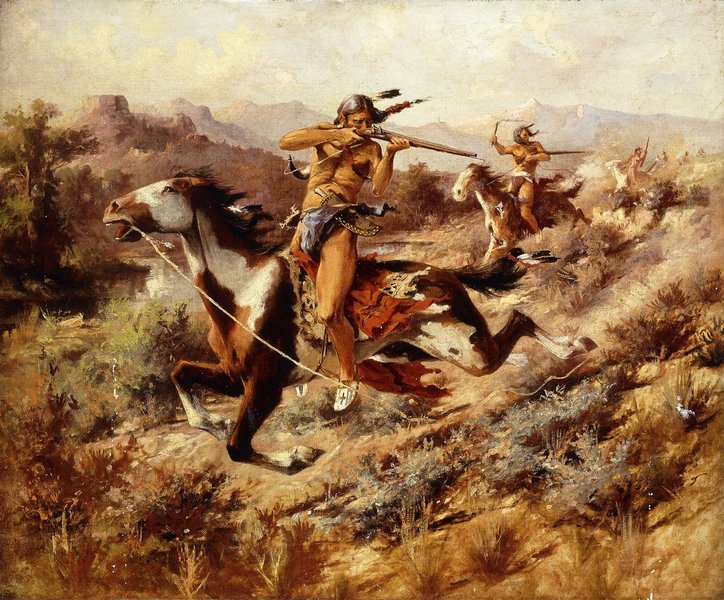
A visual representation of a historical pursuit.
Setting up Equations (Optional)
While we solved this problem using ratios, we could also use algebraic equations. Let \( S_o \) be the owner's speed and \( S_t \) be the thief's speed (in ri per unit of time). Let \( t_1 \) be the time it took the owner to travel 145 ri, and \( t_2 \) be the additional time required for the owner to catch the thief.
From the first part of the chase:
Distance covered by owner: \( D_o = S_o \times t_1 = 145 \)
Distance covered by thief in the same time: The thief started 37 ri ahead and is now 23 ri ahead. So, the thief traveled \( 145 + 23 - 37 = 131 \) ri in time \( t_1 \). Thus, \( D_t = S_t \times t_1 = 131 \).
From these two equations, we can find the ratio of their speeds: \( \frac{S_o}{S_t} = \frac{145}{131} \).
Now, let's consider the point where the owner catches the thief. Let \( x \) be the additional distance the owner travels after the 145 ri mark to catch the thief. The total distance the owner travels is \( 145 + x \).
In the additional time \( t_2 \), the owner travels \( x \) ri, so \( x = S_o \times t_2 \).
During this same additional time \( t_2 \), the thief also travels. The thief was 23 ri ahead when the owner was at the 145 ri mark. For the owner to catch up, the thief must travel an additional distance such that the owner covers the initial 23 ri gap plus the distance the thief travels in time \( t_2 \). The total distance the thief travels from their position when the owner was at 145 ri is \( 23 + \text{distance thief travels in } t_2 \).
The distance the thief travels in time \( t_2 \) is \( S_t \times t_2 \).
When the owner catches the thief, their total distances from the owner's starting point will be equal. The owner's total distance is \( 145 + x \).
The thief's total distance from the owner's starting point at the moment of capture is their position when the owner was at 145 ri (which was 168 ri from the owner's start) plus the distance the thief travels in time \( t_2 \). So, Thief's total distance = \( 168 + S_t \times t_2 \).
At the point of capture:
\[ 145 + x = 168 + S_t \times t_2 \]
We know \( x = S_o \times t_2 \), so \( t_2 = \frac{x}{S_o} \).
Substitute \( t_2 \) into the equation:
\[ 145 + x = 168 + S_t \times \frac{x}{S_o} \]
\[ 145 + x = 168 + x \left(\frac{S_t}{S_o}\right) \]
We know \( \frac{S_t}{S_o} = \frac{131}{145} \).
\[ 145 + x = 168 + x \left(\frac{131}{145}\right) \]
\[ x - x \left(\frac{131}{145}\right) = 168 - 145 \]
\[ x \left(1 - \frac{131}{145}\right) = 23 \]
\[ x \left(\frac{145 - 131}{145}\right) = 23 \]
\[ x \left(\frac{14}{145}\right) = 23 \]
\[ x = \frac{23 \times 145}{14} \]
\[ x = \frac{3335}{14} \]
\[ x \approx 238.21 \text{ ri} \]
Both methods yield the same result, confirming the calculation. The owner traveled approximately 238.21 more ri to catch up with the thief.
Summary of Distances
Here's a table summarizing the key distances in the problem:
| Description | Distance (ri) |
|---|---|
| Initial Head Start of Thief | 37 |
| Distance Traveled by Owner in First Phase | 145 |
| Remaining Distance Ahead of Thief After First Phase | 23 |
| Distance Thief Traveled in First Phase | 131 |
| Distance Owner Gained in First Phase | 14 |
| Additional Distance Owner Traveled to Catch Up | \( \approx 238.21 \) |
| Total Distance Traveled by Owner to Catch Up | \( 145 + 238.21 \approx 383.21 \) |
| Total Distance Traveled by Thief to Catch Up | \( 37 + 131 + (238.21 \times \frac{131}{145}) \approx 37 + 131 + 215.21 \approx 383.21 \) |
As the table shows, when the owner has traveled a total of approximately 383.21 ri, the thief has also traveled a total distance from the owner's starting point that puts them at the same location, resulting in the capture.
Historical Context of Horse Theft
The scenario presented in this problem, while a mathematical exercise, is rooted in the historical reality of horse theft. Horse theft was a prevalent crime for centuries, particularly in societies where horses were vital for transportation, agriculture, and warfare. The severity of the punishment often reflected the value placed on horses. In some historical contexts, horse theft was considered a capital offense.
Historical efforts to combat horse theft.
Organizations like the Anti-Horse Thief Association were formed to combat this crime and apprehend thieves. Even today, while less common than in the past, horse theft still occurs and is treated seriously by law enforcement.
Modern Relevance of Pursuit Problems
While this specific problem involves horses and a historical unit of distance, the underlying mathematical principles are applicable to various modern scenarios involving relative motion, such as calculating the time or distance it takes for one vehicle to overtake another, or the rendezvous of objects in different fields like physics or engineering.
Frequently Asked Questions
What is a "ri"?
A "ri" is a traditional East Asian unit of length. Its length has varied historically and geographically. For this problem, its specific modern equivalent is not needed; it functions as a consistent unit of distance.
Why is this called a "pursuit problem"?
A pursuit problem is a type of mathematical problem where one object is chasing another. These problems often involve calculating the time or distance it takes for the pursuing object to catch the object being pursued, taking into account their speeds and initial separation.
Does the actual speed of the horse and thief matter?
No, the actual speeds are not needed to solve this problem. What matters is the relationship between their speeds, specifically the rate at which the owner closes the distance on the thief. This rate is determined from the information given about the distances covered and the remaining gap.
Are there other ways to solve this problem?
Yes, as demonstrated, this problem can be solved using ratios or by setting up algebraic equations based on the distances and implied speeds. Both methods rely on understanding how the distance between the owner and the thief changes over time.
Is horse theft still a crime today?
Yes, horse theft is still a crime. While perhaps not as widespread as historically, it does occur, and law enforcement agencies investigate such cases.
References
Last updated May 12, 2025