
Humanity's Resurgence: A Decades-Long Struggle Against Martian Domination
Unpacking the intricate timeline for human resistance and eventual triumph in a post-invasion Earth, drawing lessons from iconic alien conquest narratives.
Key Insights into Humanity's Fight for Freedom
- Initial Overwhelm and Devastation: In the immediate aftermath of a successful Martian invasion, humanity would face widespread chaos and catastrophic losses, with conventional military forces quickly decimated by superior alien technology like Heat-Rays and Black Smoke.
- Generational Resistance and Adaptation: A successful human comeback would not be swift but rather a prolonged, generational struggle, likely spanning several decades (20 to 100+ years). This period would be characterized by the formation of clandestine resistance groups, preservation of knowledge, and a slow, arduous process of reverse-engineering Martian technology and exploiting their weaknesses.
- Leveraging Strategic Weaknesses: Ultimate success would hinge on humanity identifying and exploiting unforeseen Martian vulnerabilities—whether biological, technological, or social—that conventional warfare initially failed to address, much like the "Capping" mechanism and gravity-related weaknesses explored in John Christopher's *The Tripods* series.
Imagine a world where H.G. Wells’s Martians not only invaded Earth but also successfully established dominion, untouched by terrestrial pathogens. This chilling hypothetical, akin to the oppressive control depicted in John Christopher’s *The Tripods* series, prompts a profound question: how long would it take for humanity to mount a successful resistance and reclaim its planet? The answer, synthesized from various analyses of these classic narratives, suggests a long, arduous, and multi-generational struggle, emphasizing human resilience, adaptability, and ingenuity in the face of overwhelming odds.
The Onslaught: Initial Martian Domination and Humanity's Collapse
In the original *War of the Worlds*, H.G. Wells vividly portrays a technologically superior Martian force, armed with devastating Heat-Rays, toxic Black Smoke, and towering Tripods. Their invasion is swift and brutal, overwhelming human military defenses and infrastructure with terrifying efficiency. If we remove the Martians' fatal biological vulnerability to Earth's microbes, their initial conquest would be near-total. Communication and transportation networks would be disabled, leading to widespread chaos and disorganization among human populations. The Martians, viewing humanity as mere animals, would focus on control and resource extraction, specifically human blood for sustenance, as their ultimate goal is to terraform Earth to suit their needs, eventually leading to human eradication.
This scenario aligns closely with John Christopher’s *The Tripods* series, where alien "Masters" enforce their rule through massive three-legged machines and, more chillingly, by implanting "Caps" into humans at age 16. These Caps suppress individuality and free will, transforming humans into docile subjects. This "capping" mechanism represents a profound level of control, far beyond mere physical subjugation, actively stifling any immediate large-scale organized resistance. Humanity would be reduced to a largely pastoral existence, with technology regressed to pre-industrial levels, all under the watchful, oppressive gaze of the Tripods and their human enforcers, the Black Guard.
Weaponry and Control Mechanisms
The success of the Martian takeover would lie in their superior weaponry and the sophisticated control mechanisms they employ:
- Heat-Rays: Capable of incinerating anything in their path, these weapons would rapidly neutralize conventional military units and urban centers.
- Black Smoke: A poisonous gas that would suffocate and eliminate resistance, pre-empting direct confrontation and causing widespread panic.
- Tripods: These colossal machines serve as mobile fortresses, providing both offensive power and a physical presence that enforces Martian authority across the landscape.
- The "Cap": As seen in *The Tripods*, this device would directly suppress human free will, preventing coordinated rebellion and ensuring a docile, subservient population.
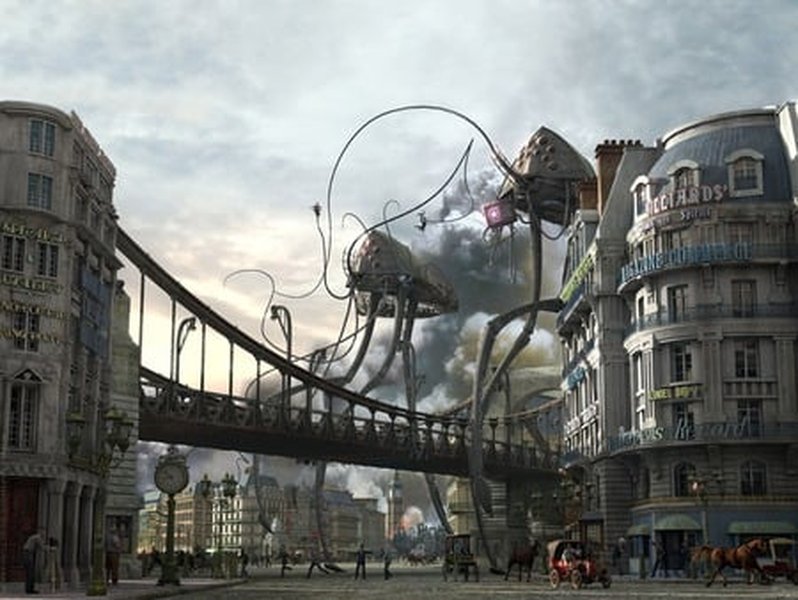
Martian Tripods launch a devastating attack on a city, showcasing their overwhelming technological superiority.
The Seed of Resistance: Pockets of Hope and Clandestine Efforts
Despite the initial overwhelming dominance, human history, both real and fictional, demonstrates an inherent resilience. Pockets of resistance would inevitably form, driven by those who evade immediate capture or who are somehow un-"capped" (as in *The Tripods*). These early resistance efforts would be small, uncoordinated, and largely ineffective against the Martians’ might, focusing primarily on survival and stealth.
Guerrilla Warfare and Knowledge Preservation
Inspired by the artilleryman's vision in Wells's novel, initial human resistance would likely adopt guerrilla tactics. Survivors would hide in remote areas, underground bunkers, or dilapidated urban ruins, conducting hit-and-run attacks and avoiding direct confrontation. A crucial aspect of this phase would be the preservation of knowledge—scientific, historical, and cultural—to prevent total regression to barbarism. This clandestine effort would be vital for any future comeback, as it would form the basis for understanding and eventually countering the Martian threat.
Infiltration and Intelligence Gathering
The strategy employed by the resistance in *The Tripods*—infiltrating the Masters' cities to learn about their biology, technology, and plans—offers a blueprint for effective long-term resistance. This suggests that direct military confrontation may not be the initial path to success. Instead, identifying and exploiting inherent Martian vulnerabilities, such as physiological weaknesses or operational dependencies, would become paramount. The Masters in *The Tripods*, for instance, were eventually revealed to be susceptible to Earth's gravity, artificially increased in their cities—a weakness that could only be discovered through painstaking espionage.
The Long Game: Factors Influencing a Successful Comeback
The timeline for a successful human comeback is highly dependent on several critical factors, each presenting its own set of challenges and opportunities.
The radar chart above illustrates a comparative analysis of humanity's standing during the initial Martian domination versus its potential during a long-term comeback. It highlights the significant shift in key factors that would empower human resistance. For instance, while technological leapfrogging might be minimal initially, it becomes a crucial advantage for humans over time. Similarly, factors like exploiting Martian weaknesses and generational knowledge transfer, which are almost non-existent during the initial subjugation, become highly influential in a sustained resistance movement.
Human Population and Organization
Despite their technological superiority, the Martians in Wells's narrative are suggested to have limited numbers. This numerical disparity becomes a critical long-term advantage for humanity. If humans can effectively organize and coordinate, their sheer numbers could eventually overwhelm the Martians, even if it requires a shift from direct military confrontation to large-scale, coordinated uprisings and sabotage.
Reverse-Engineering and Technological Adaptation
A significant hurdle would be the vast technological gap. However, over decades, if resistance groups could salvage disabled Martian machines or capture alien individuals, reverse-engineering their technology would become a viable, albeit incredibly challenging, long-term goal. This "technological leapfrogging" is a common theme in alien invasion narratives, where humanity eventually turns the invaders' own advancements against them. The ability to understand and replicate Martian weapons, communication, or even their power sources would be a game-changer.
Psychological and Social Dynamics
Human ingenuity, resolve, and the refusal to be subjugated are powerful, intangible forces. Even under the oppressive "Capping" mechanism of *The Tripods*, the human spirit for freedom persists. The gradual psychological erosion of Martian control through whispers of rebellion, the preservation of uncapped communities, and the rediscovery of individuality would be as crucial as any military strategy. This mental and social resistance would be foundational for inspiring and sustaining the long-term struggle.
Timeline for Successful Comeback: A Generational Battle
Considering the overwhelming initial Martian advantage and the profound suppression of human society, a successful human comeback would not be measured in years, but in decades, or even centuries. This is a multi-generational struggle, requiring immense patience, stealth, scientific discovery, and a willingness to operate in the shadows for a prolonged period.
| Phase of Resistance | Estimated Timeframe | Characteristics and Activities |
|---|---|---|
| Initial Disarray & Survival | Months to ~5 Years | Widespread human losses, chaos, disorganization. Focus on individual survival, scattered acts of desperation, avoiding direct confrontation. Formation of isolated survivor groups. |
| Clandestine Organization & Intelligence Gathering | 5 to 20 Years | Formation of small, hidden resistance cells. Preservation of knowledge, covert recruitment, intelligence gathering on Martian biology, technology, and operational patterns. Development of basic communication networks. |
| Technological Adaptation & Strategic Planning | 20 to 50 Years | Beginning of reverse-engineering Martian technology from salvaged parts. Development of new tactics tailored to discovered Martian vulnerabilities. Training of specialized units for espionage and sabotage. Gradual increase in coordinated, but still limited, attacks. |
| Coordinated Counter-Offensive & Reclamation | 50 to 100+ Years | Large-scale, coordinated rebellions. Significant breakthroughs in counter-technology or biological warfare (if applicable). Reclamation of key territories or crippling strikes against Martian strongholds. Potential for a full-scale war to force Martian retreat or defeat. |
This table illustrates the likely progression of human resistance, moving from scattered survival efforts to a cohesive, technologically capable force capable of challenging Martian hegemony. Each phase builds upon the successes and lessons learned from the previous, highlighting the gradual nature of this epic struggle.
The "Tripods" Model: A Blueprint for Prolonged Resistance
The *Tripods* series provides one of the most detailed fictional explorations of such a prolonged resistance. The existence of the "Cap" means that active, widespread rebellion is almost impossible for capped adults. Therefore, the resistance must rely on the "uncapped" youth, training them in hidden enclaves in remote areas like the White Mountains. Their strategy involves a generational effort to understand the Masters' weaknesses and eventually infiltrate their cities to disrupt their control from within. This model strongly suggests that success would only come after multiple generations have contributed to the cause, perhaps a century or more, before humanity could truly reclaim its freedom.
This mindmap visually represents the complex interplay of initial Martian dominance, the various phases of human resistance, and the critical factors that would determine the timeline for a successful comeback. It highlights the multi-faceted nature of the struggle, from technological challenges to psychological warfare, and emphasizes the long-term, generational commitment required.
Visualizing the Struggle: Human vs. Martian Power Dynamics
To further illustrate the challenging path to human victory, let's consider a relevant video that delves into the dynamics of alien invasions. The video, titled "WHAT IF IT COULD COME BACK THE TRIPODS TV SERIES," explores the themes and challenges presented in *The Tripods* TV series, which directly addresses the scenario of human subjugation and eventual resistance against a technologically superior alien force. It delves into the narrative of the Tripods' control and humanity's fight for freedom, making it highly relevant to our hypothetical scenario.
A retrospective look at "The Tripods" TV series, exploring the themes of alien subjugation and human resistance.
This video provides a valuable look into how *The Tripods* series conceptualized the prolonged struggle against alien rule, including the nuances of the "Capping" mechanism and the slow, arduous process of building a resistance movement. It underscores that human defiance isn't merely about direct confrontation but also about psychological and social resilience in the face of overwhelming power. Understanding these dynamics is crucial for comprehending the long-term nature of humanity's potential comeback in such a scenario.
Frequently Asked Questions (FAQ)
How would Martians maintain control without biological weakness?
What would be the primary challenges for human resistance?
Could humans reverse-engineer Martian technology?
Is total victory against the Martians even possible in this scenario?
Conclusion
In a hypothetical scenario where H.G. Wells's Martians successfully conquer Earth without succumbing to disease, and establish a prolonged dominion akin to John Christopher's *The Tripods*, humanity's comeback would be a monumental, generations-long endeavor. The initial phase would be marked by overwhelming defeat and chaos, followed by the formation of scattered, clandestine resistance groups focused on survival and intelligence gathering. The true "comeback"—a coordinated, effective counter-offensive capable of challenging Martian rule—would likely take several decades, potentially a century or more. Success would not stem from conventional warfare but from humanity's unwavering resilience, its capacity for technological adaptation, and its ability to uncover and exploit fundamental weaknesses in the Martian overlords, whether biological, environmental, or internal to their oppressive system. It would be a testament to the enduring human spirit, a battle fought not just with weapons, but with intellect, patience, and the collective will to be free.
Recommended Further Exploration
- How would a post-apocalyptic human society rebuild after alien invasion?
- What are the common weaknesses of alien invaders in science fiction?
- The psychology of long-term resistance movements against overwhelming odds
- Technological reverse-engineering in science fiction alien invasion scenarios
Referenced Search Results

 inhermajestysname.wordpress.com
 chrishallamworldview.wordpress.com