
Unveiling the Marvels of LCST Hydrogels: Temperature-Responsive Smart Materials
Exploring the unique properties and transformative applications of hydrogels with a Lower Critical Solution Temperature.
Key Insights into LCST Hydrogels
- Temperature-Driven Phase Transition: LCST hydrogels undergo a fascinating reversible transition from a swollen, hydrophilic state to a shrunken, hydrophobic, and often solidified, state as temperature increases above their Lower Critical Solution Temperature (LCST).
- Tunable LCST for Diverse Applications: The LCST of these hydrogels can be precisely adjusted by modifying their chemical composition, such as the number of PEG units in poly(PEGMA) or by copolymerization, allowing for tailored responses in various environments, including physiological conditions.
- Pivotal in Biomedical and Smart Material Fields: Due to their temperature-responsive nature, LCST hydrogels are highly promising for applications in drug delivery, tissue engineering, smart windows, and soft robotics, offering advantages like injectability, controlled release, and biocompatibility.
Hydrogels are remarkable intelligent materials characterized by their ability to undergo significant changes in physical properties—such as volume, mechanical strength, and solubility—in response to external stimuli. Among these, thermoresponsive hydrogels, particularly those exhibiting Lower Critical Solution Temperature (LCST) properties, stand out for their profound and reversible reactions to temperature fluctuations. This unique characteristic makes them invaluable in a wide array of advanced technological and biomedical applications.
Understanding the LCST Phenomenon in Hydrogels
The Mechanism Behind Temperature-Induced Transitions
The core of an LCST hydrogel's behavior lies in its critical solution temperature, specifically the Lower Critical Solution Temperature (LCST). For polymers with LCST behavior, their water-solubility diminishes as temperature increases. Below their LCST, these hydrogels are typically in a swollen, hydrophilic state, forming hydrogen bonds with water molecules. However, once the ambient temperature rises above the LCST, a dramatic phase separation occurs. The polymer chains become increasingly hydrophobic, expelling water and leading to a significant volume contraction and solidification, transforming from a liquid-like solution to a solid gel. This inverse temperature-dependence is a key differentiator from Upper Critical Solution Temperature (UCST) hydrogels, which solidify upon cooling.
The transition is driven by a delicate balance of hydrogen bonding and hydrophobic interactions. At lower temperatures, the entropy of the water molecules structured around the hydrophilic polymer segments is relatively low, and hydrogen bonds between the polymer and water dominate. As temperature rises, the kinetic energy of water molecules increases, leading to the disruption of these hydrogen bonds. Concurrently, hydrophobic interactions between polymer segments become more prominent, causing the polymer chains to collapse and aggregate, thereby expelling water from the network. This phenomenon is often accompanied by an increase in the entropy of the system as constrained water molecules are released.
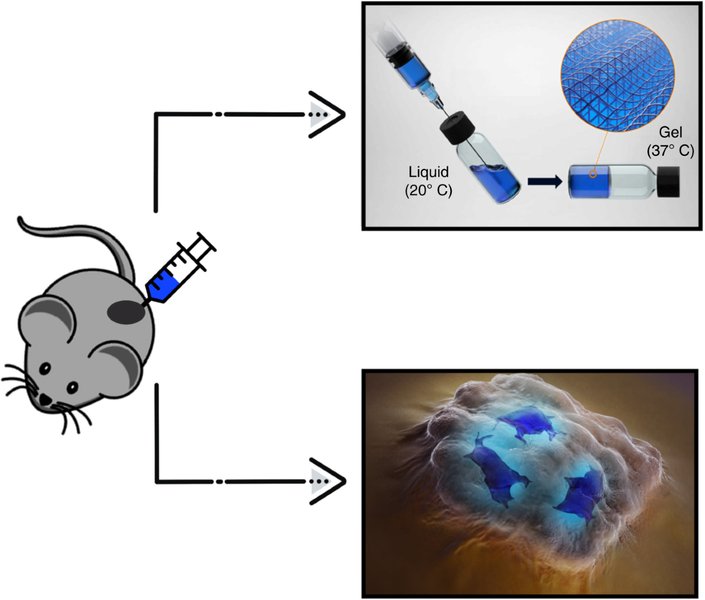
Illustration of a hydrogel undergoing a temperature-induced phase transition, showcasing the change from a swollen to a collapsed state around its LCST.
Key Polymers Exhibiting LCST Behavior
Numerous polymers exhibit LCST behavior, with poly(N-isopropylacrylamide) (PNIPAAm) being one of the most widely studied. PNIPAAm hydrogels typically have an LCST around 32 °C, which is close to physiological body temperature, making them highly attractive for biomedical applications. Other polymers and copolymers, such as poly(PEGMA) (poly(poly(ethylene glycol) methacrylate)) and poly(N-vinylcaprolactam) (PNVCL), also display LCST properties. The LCST of poly(PEGMA) hydrogel films can range from 15 to 60 °C depending on the number of PEG units (from 2 to 5), showcasing the tunability of this critical temperature. Similarly, the LCST of PNVCL is often reported to be between 34–37 °C.
Mechanisms of Phase Transition
The phase transition in LCST hydrogels is a complex interplay of thermodynamic factors. When temperature is below the LCST, the hydrophilic segments of the polymer predominantly interact with water through hydrogen bonding, leading to a hydrated, swollen gel. As temperature increases above the LCST, the balance shifts: hydrophobic interactions become more favorable, causing the polymer chains to self-associate and expel water, resulting in a collapsed, less hydrated state. This process is reversible, allowing the hydrogel to swell again upon cooling below its LCST.
Tailoring LCST Properties for Specific Needs
Strategies for Adjusting the LCST
The ability to precisely control the LCST of hydrogels is crucial for their practical implementation. Researchers employ several strategies to fine-tune this critical temperature:
- Copolymerization: Incorporating hydrophilic or hydrophobic co-monomers into the polymer chain can shift the LCST. For instance, increasing the proportion of hydrophilic co-monomers generally raises the LCST, while adding more hydrophobic units lowers it. This allows for the creation of hydrogels with LCSTs ranging from ambient temperatures to physiological temperatures and beyond.
- Degree of Polymerization and Crosslinking: The length of polymer chains and the density of crosslinks within the hydrogel network can influence the LCST and the sharpness of the phase transition. Higher crosslinking density might lead to more constrained polymer chains, affecting their ability to collapse freely.
- Salt and pH Effects: The presence of salts or changes in pH can significantly modulate hydrophobic and electrostatic interactions within the hydrogel, thereby altering the LCST. For example, sodium chloride can be used to tune the "temperature window" of hydrogels exhibiting both LCST and UCST.
- Number of PEG Units: For poly(PEGMA) hydrogels, the transition temperature is directly related to the number of PEG units, ranging from 15 to 60 °C for 2 to 5 PEG units, respectively.
The Role of Hydrophobicity and Hydrogen Bonding
The LCST behavior is fundamentally dominated by a fine balance between hydrophilic (hydrogen bonding) and hydrophobic interactions. Polymers with LCSTs are typically composed of both hydrophilic and hydrophobic groups. At low temperatures, the enthalpy gain from hydrogen bonding between the polymer and water molecules is sufficient to overcome the entropic penalty of forming a structured water cage around the hydrophobic polymer segments. As temperature increases, the entropy of water molecules becomes the dominant factor, leading to the breaking of these hydrogen bonds and the aggregation of hydrophobic polymer segments, resulting in phase separation and gel collapse.
Diverse Applications of LCST Hydrogels
Transformative Potential Across Industries
The unique thermoresponsive properties of LCST hydrogels make them highly desirable for a broad spectrum of advanced applications, particularly in fields requiring precise control over material behavior in response to temperature.
Biomedical Innovations
In the biomedical sector, LCST hydrogels are revolutionary, especially for applications within the human body:
- Drug Delivery Systems: Many LCST hydrogels are designed to be liquid at room temperature and then solidify into a gel upon injection into the body, which is at a higher temperature (e.g., 37 °C). This allows for minimally invasive delivery and controlled, sustained release of therapeutics at the target site, preventing leaks and ensuring dose accuracy.
- Tissue Engineering and Regenerative Medicine: LCST hydrogels can encapsulate cells and biomolecules, providing a supportive scaffold that changes properties with temperature. This enables the creation of 3D cell sheets, cell culture platforms, and scaffolds for tissue regeneration, facilitating cell growth and viability.
- Biosensors and Actuators: Their volumetric shape deformation in response to temperature changes makes them ideal for artificial muscles and other soft robotics applications, as well as highly sensitive biosensors.
- Wound Healing and Adhesion Prevention: Injectable LCST hydrogels can form protective barriers or deliver active agents directly to wound sites, promoting healing and preventing unwanted tissue adhesion post-surgery.
Beyond Healthcare: Smart Materials and More
LCST hydrogels also find utility in various other cutting-edge fields:
- Smart Windows: Hydrogels combining both LCST and UCST properties can create "temperature windows" that modulate light transmittance, offering potential for energy-efficient smart window technologies.
- Separation and Flocculation: Their ability to undergo phase transition can be leveraged in separation processes, such as flocculation in wastewater treatment or mineral ore processing, by controlling the aggregation and settling of particles.
- 4D Printing: The temperature-sensitive volume change of LCST hydrogels makes them excellent candidates for 4D printing, where materials change shape over time in response to stimuli.
- Moisture Absorption and Water Recovery: Certain thermoresponsive gels can absorb moisture from the air at temperatures below their LCST and then release it as liquid water above their LCST, demonstrating potential for energy-efficient water condensation systems.
Challenges and Future Directions
Despite their promise, challenges remain in the widespread application of LCST hydrogels. Issues such as mechanical strength, long-term stability, and biodegradability need continuous improvement. For instance, while PNIPAAm is widely studied, its non-biodegradability can limit certain biomedical uses, prompting research into biodegradable co-polymers like those derived from dextran. Future research is focused on developing multi-stimuli responsive hydrogels (e.g., pH/temperature dual response) and enhancing their mechanical properties for more robust and versatile applications.
This radar chart illustrates the perceived strengths of LCST hydrogels across various key performance indicators relevant to their application. The data points reflect the current capabilities and future potential of these smart materials.
Comparative Analysis of LCST Hydrogel Properties
Understanding Key Performance Metrics
To fully appreciate the potential of LCST hydrogels, it's essential to understand how different properties contribute to their overall performance and suitability for specific applications. The table below provides a comparative overview of critical characteristics:
| Property | Description | Impact on Applications | Tunability |
|---|---|---|---|
| LCST (Transition Temperature) | The specific temperature at which the hydrogel undergoes a phase transition from hydrophilic (swollen) to hydrophobic (collapsed/gel). | Crucial for targeted drug delivery (e.g., body temperature for *in situ* gelation), smart windows, and actuators. | Highly tunable via copolymerization, monomer ratios (e.g., PEG units), and chemical modification. Ranges from 8°C to 60°C depending on polymer type. |
| Swelling Ratio | The degree to which the hydrogel absorbs water and expands below its LCST, and shrinks above it. | Dictates drug loading capacity, mechanical properties, and response kinetics. Affects cell culture environments. | Influenced by crosslink density, polymer composition (hydrophilicity/hydrophobicity balance), and environmental factors like pH and ionic strength. |
| Mechanical Strength | The hydrogel's ability to withstand external forces (e.g., compression, stretching) without irreversible deformation. | Essential for load-bearing applications in tissue engineering, soft robotics, and injectable formulations. | Can be improved through interpenetrating networks (IPNs), addition of reinforcing agents, and hybrid crosslinking strategies. |
| Biocompatibility | The material's ability to interact with biological systems without eliciting an adverse immune response. | Paramount for all biomedical applications (drug delivery, tissue engineering, implants). | Depends on the chemical nature of the polymer backbone and degradation products. Many LCST polymers like PNIPAAm and PNVCL show low cytotoxicity. |
| Biodegradability | The capacity of the hydrogel to degrade into non-toxic components over time in a biological environment. | Important for temporary implants, drug carriers that need to be eliminated from the body, and reducing long-term risks. | Can be engineered by incorporating biodegradable linkages or using natural polymers like dextran and alginate in copolymers. |
Visualizing Thermoresponsive Hydrogels
Exploring the LCST Behavior in Action
To further illustrate the dynamic behavior of thermoresponsive hydrogels, particularly those exhibiting LCST properties, the following video provides a visual demonstration of how these materials respond to temperature changes. It showcases the practical implications of their unique phase transition. Understanding this visual transformation is key to grasping their versatility in various applications.
This video explains the phenomenon of thermoresponsive polymers, specifically focusing on LCST behavior, and demonstrates how certain polymers, like poly(N-isopropylacrylamide), change their properties with temperature. This visual insight helps in understanding the core concept behind LCST hydrogels.
Frequently Asked Questions about LCST Hydrogels
Recommended Further Exploration
- Explore the full spectrum of biomedical applications for thermoresponsive hydrogels.
- Delve into the synthesis and characterization methods of PNIPAAm hydrogels.
- Understand the fundamental mechanisms driving sol-gel transitions in smart polymers.
- Discover the latest advancements in 4D printing utilizing responsive materials.
References
Last updated May 21, 2025