
Hydroxyapatite-Based Materials for Water Treatment by Fixed-Bed Continuous Flow Column Adsorption: A Scientific Review
Integrating Synthesis, Mechanisms, and Applications for Environmental Remediation
Key Takeaways
- Comprehensive Understanding: A complete review includes synthesis methods, adsorption mechanisms, process modeling, and comparative performance evaluations.
- Operational Parameters: Fixed-bed continuous flow columns allow real-world simulation through breakthrough curve analysis, highlighting the optimization of parameters such as bed height, flow rate, and contaminant concentration.
- Future Directions: Research must focus on improving material modification, regeneration techniques, scale-up strategies, and long-term performance for sustainable water treatment solutions.
1. Introduction
Water treatment remains one of the most critical challenges for ensuring the sustainable supply of clean water, particularly in areas where contamination by heavy metals, fluoride, organic pollutants, and emerging contaminants is prevalent. Recent advances in adsorption technology have focused on the development of novel adsorbents, among which hydroxyapatite-based materials have attracted significant attention. This review examines in detail the potential of hydroxyapatite (HAP) for water treatment via fixed-bed continuous flow column adsorption.
Hydroxyapatite (chemical formula Ca10(PO4)6(OH)2) features unique properties including a high adsorption capacity, excellent ion-exchange abilities, and distinct acid–base characteristics. These attributes render HAP particularly effective for the removal of contaminants from water. The objective of this scientific review is to synthesize available knowledge on hydroxyapatite-based adsorbents applied in fixed-bed column systems, outlining fundamental concepts, critical design parameters, and recent innovations.
2. Fundamentals of Fixed-Bed Continuous Flow Column Adsorption
2.1. Fixed-Bed Column Configuration and Operational Parameters
In fixed-bed continuous flow column adsorption, the adsorbent material is packed into a column, and contaminated water is passed through at a controlled flow rate. Key operational parameters include:
- Inlet Concentration: The initial concentration of the target contaminant affects the adsorption capacity and breakthrough behavior.
- Flow Rate: It determines the contact time between the water and the adsorbent, influencing mass transfer zones and the overall kinetics of the adsorption process.
- Bed Height: A higher bed increases the residence time, providing more binding sites and delaying breakthrough until saturation is reached.
- Empty Bed Contact Time (EBCT): This parameter is critical for designing systems that maximize efficiency while preventing rapid saturation.
The operational performance of fixed-bed adsorption systems is typically represented by breakthrough curves, which plot the ratio of effluent to influent contaminant concentration (Ceff/C0) against time. These curves are essential for evaluating the column’s performance, and they form the basis for modeling adsorption kinetics.
2.2. Adsorption Mechanisms in HAP-Based Systems
The effectiveness of hydroxyapatite arises from its ability to facilitate multiple adsorption mechanisms:
- Physical Adsorption: Contaminants are loosely held on the surface of HAP via van der Waals forces.
- Ion Exchange: HAP can exchange its calcium ions with other metal ions in solution, making it effective in removing heavy metals and radionuclides.
- Chemisorption: In some instances, chemical bonding may occur between the adsorbent surface and contaminants, thereby ensuring a more permanent attachment.
- Electrostatic Interactions: The surface functional groups present on HAP favor the attraction of oppositely charged contaminants, such as fluoride and various organic molecules.
3. Synthesis and Modification of Hydroxyapatite-Based Materials
3.1. Synthesis Methods
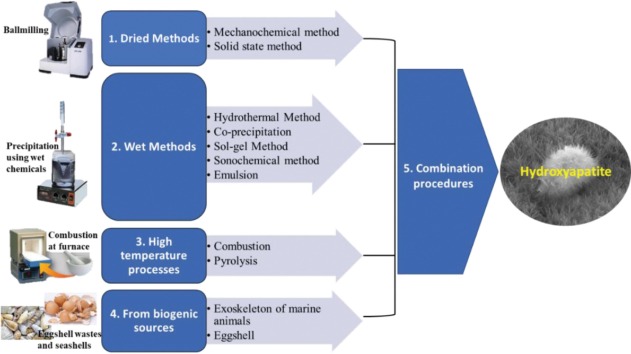
The synthesis of hydroxyapatite is performed using various techniques that can be broadly grouped into conventional and advanced methods. The most commonly used synthesis routes include:
- Precipitation: This is a straightforward and cost-effective method where calcium and phosphate sources react under controlled pH and temperature conditions to yield HAP crystals.
- Sol–Gel Process: This technique offers better control over the microstructure and crystallinity of HAP, allowing the tailoring of textural properties such as surface area and porosity.
- Microwave-Assisted Synthesis: This method reduces synthesis time and energy consumption while enhancing the uniformity of particle size and morphology.
- Hydrothermal Methods: Operating at elevated temperatures and pressures in an aqueous environment allows for the formation of nanostructured hydroxyapatite with superior adsorption capabilities.
3.2. Material Modifications and Composite Formations
To enhance the performance of HAP-based adsorbents, numerous modifications have been explored:
- Metal and Non-metal Doping: Incorporating foreign ions into the HAP lattice can increase selectivity toward specific contaminants through tailored ion exchange properties.
- Surface Functionalization: Grafting organic molecules or polymers onto the surface improves dispersion, mechanical stability, and contaminant affinity.
- Composite Formation: Blending HAP with other materials such as biochars, clays, or synthetic polymers can combine the beneficial properties of each component, thereby increasing the adsorption capacity and overall robustness of the system.
Table 1. Synthesis Methods and Modifications of HAP
| Synthesis/Modification Method | Main Features | Advantages | Applications |
|---|---|---|---|
| Precipitation | Reaction between calcium and phosphate precursors | Low cost, easy to scale | General water treatment, fluoride removal |
| Sol–Gel | Controlled hydrolysis of precursors | High purity, controlled porosity | Targeted adsorption of organics and metals |
| Microwave-Assisted | Rapid synthesis under microwave heating | Reduced synthesis time, uniform particle size | Nanostructured HAP for high surface area applications |
| Hydrothermal | High pressure and high temperature conditions | Improved crystallinity and morphology | Nanoscale adsorbents for advanced contaminant removal |
| Surface Functionalization | Grafting polymers or organic groups | Enhanced selectivity and stability | Removal of complex mixtures of pollutants |
| Composite Formation | Blending HAP with other adsorbents | Increased mechanical strength and multifunctionality | Industrial scale fixed-bed columns |
4. Fixed-Bed Column Studies for Hydroxyapatite Adsorbents
4.1. Experimental Setup and Breakthrough Curves
In fixed-bed column studies, the performance of hydroxyapatite-based adsorbents is extensively evaluated using breakthrough curves. These curves represent the temporal evolution of the effluent concentration (Ceff) as a function of time until breakthrough is reached. They enable the determination of several key parameters:
- Breakthrough Time: The time at which contaminants begin to appear in the effluent, indicating the column has reached a near-saturation state.
- Saturation Capacity: Maximum adsorption capacity before the adsorbent bed becomes exhausted.
- Mass Transfer Zone (MTZ): The region within the column where the gradient of contaminant adsorption exists – a critical factor influencing column efficiency.
Typical experimental setups involve packing the adsorbent into glass or acrylic columns with controlled dimensions, then pumping synthetic or real water samples containing known contaminant concentrations through the system. Adjustments in flow rate and bed height allow detailed investigations into the adsorption kinetics and performance under varying operational conditions.
4.2. Modeling Approaches for Column Performance
Mathematical models are vital for predicting column performance, optimizing design parameters, and scaling up the process. Commonly used models in fixed-bed adsorption studies include:
- Thomas Model: Predicts breakthrough curves based on a second-order reversible reaction kinetics approach, ideal for evaluating capacity and rate constants.
- Yoon–Nelson Model: Simplifies the prediction by estimating the time required for 50% breakthrough of the adsorbate.
- Bed-Depth Service Time (BDST) Model: Provides a direct link between the bed depth and the predicted service time for given operating conditions, enabling column design.
- Clark Model: Combines aspects of mass transfer theory and adsorption isotherms to predict the breakthrough behavior with respect to Freundlich kinetics.
Modeling not only aids in understanding the fundamental behavior but also serves as a tool to anticipate adjustments that can enhance the design and operation of fixed-bed columns on an industrial scale.
5. Water Treatment Applications and Performance Evaluations
5.1. Removal of Targeted Pollutants
Hydroxyapatite-based adsorbents are versatile in handling a wide range of pollutants:
- Heavy Metals: HAP effectively removes lead, cadmium, and copper through ion exchange, leveraging its high affinity for metal ions.
- Fluoride Ions: Due to its high adsorption capacity under neutral or near-neutral pH conditions, hydroxyapatite is well-suited for defluoridation processes.
- Organic Pollutants: Its surface functionalization promotes the adsorption of various organic molecules including pharmaceuticals such as ibuprofen and other endocrine-disrupting chemicals.
- Radionuclides: The unique chemical and structural properties allow the capture and retention of radionuclides from contaminated water streams.
5.2. Comparative Analysis and Case Studies
Comparative studies between batch and column adsorption results illustrate that, while batch tests offer initial insights into adsorption capacity, fixed-bed column experiments are indispensable for evaluating real-world performance. These studies also reveal that modifications to HAP – whether by doping, surface functionalization, or composite fabrication – can significantly enhance adsorption efficiencies.
Several case studies have demonstrated the successful application of hydroxyapatite in treating simulated and real wastewater. For instance, pilot-scale fixed-bed columns have shown excellent removal efficiencies for fluoride and heavy metal ions after tuning parameters such as flow rate and bed height. Such studies further emphasize the reproducibility and stability of the adsorption mechanism under continuous flow conditions.
6. Regeneration, Reusability, and Operational Considerations
6.1. Regeneration Techniques
The economic viability of the process is closely linked with the ability to regenerate and reuse the adsorbents. Various regeneration strategies have been studied to restore the adsorption capacity of HAP-based materials:
- Chemical Regeneration: Involves treatment with acids, bases, or chelating agents to desorb bound contaminants while retaining the structural integrity of hydroxyapatite.
- Thermal Regeneration: Utilizes controlled heating to drive off contaminants; however, care must be taken to avoid degradation of the material.
- Combined Methods: An integrated approach using both chemical and thermal treatments can often yield higher regeneration efficiencies.
6.2. Scaling Up and Economic Aspects
While laboratory and pilot-scale studies have demonstrated promising results, transitioning to full-scale industrial applications necessitates a thorough consideration of several operational challenges:
- Column Clogging and Pressure Drop: The physical stability and particle size distribution of the adsorbent play significant roles in preventing blockages in the fixed-bed system.
- Synthesis Cost-Effectiveness: Selecting cost-effective synthesis methods and utilizing waste-derived calcium sources contribute to lowering overall costs.
- Life Cycle Analysis: Evaluating the environmental impact through comprehensive life cycle assessments ensures that the process is sustainable in the long term.
Addressing these operational issues is critical for scaling up the technology, rendering hydroxyapatite-based adsorbents a realistic and sustainable solution for industrial-scale water treatment.
7. Challenges and Future Perspectives
7.1. Current Limitations
Despite hydroxyapatite's significant promise, there are challenges yet to be fully resolved:
- Long-term Stability: Continuous exposure to various water matrices can lead to gradual degradation or fouling of HAP particles. More research is needed to improve their longevity, especially under varying pH and salinity conditions.
- Adsorbent Regeneration Efficiency: Although several regeneration methods exist, optimizing the process to fully recover the adsorptive capacity without significant performance loss after multiple cycles is a subject of ongoing research.
- Integration into Existing Treatment Systems: Seamless integration of HAP-based materials into existing water treatment infrastructures remains a logistical and technical challenge for many municipalities and industries.
7.2. Emerging Trends and Future Directions
Future research is gravitating towards:
-
Nano-Structured HAP: Advanced synthesis routes aimed at producing nanostructured hydroxyapatite can offer superior surface areas and tailored pore structures, boosting overall adsorption efficiencies.
-
Hybrid and Composite Materials: Combining HAP with other nanomaterials or polymers can lead to multifunctional adsorbents which have improved mechanical stability and regeneration capacities.
-
Smart Process Control: Integration of sensor technologies and advanced process modeling will enable real-time control and optimization of fixed-bed columns in operating environments.
-
Scale-Up Strategies: Continued focus on large-scale pilot studies and further refinement of mathematical models (Thomas, Yoon–Nelson, BDST, Clark) will facilitate design modifications suitable for industrial applications.
-
Economic and Environmental Assessments: Robust cost-benefit analyses and environmental impact studies will be key to establishing hydroxyapatite-based adsorbents as a viable technology for global water treatment challenges.
8. Conclusion and Final Thoughts
Hydroxyapatite-based materials represent a promising frontier in water treatment technology, particularly when employed in fixed-bed continuous flow column adsorption systems. Their intrinsic properties—high adsorption capacity, ion exchange efficiency, and tunable surface chemistry—coupled with various innovative synthesis methods, lend these materials significant advantages for removing a wide range of water contaminants.
This review has presented a comprehensive perspective on hydroxyapatite, from fundamental adsorption mechanisms and material synthesis to fixed-bed column experimental setups and process modeling. Emphasis was placed on understanding the interplay of operational parameters in controlling breakthrough dynamics, as well as on emerging strategies for enhancing adsorbent reusability and integration into practical water treatment scenarios. While a series of technical challenges remain, focused research on material modification, regeneration protocols, and system-scale designs promises to further overcome these limitations. Ultimately, hydroxyapatite-based adsorbents, supported by robust modeling and optimization, offer a path forward toward sustainable, cost-effective, and highly efficient water purification technology, marking a significant development in the domain of environmental remediation.
References
For further reading and detailed experimental methodologies, please consult the following references:
Final Thoughts
In summary, the comprehensive review of hydroxyapatite-based materials for water treatment by fixed-bed continuous flow column adsorption demonstrates extensive progress in understanding the interplay between material properties, synthesis routes, and operational parameters. As research progresses, further integration of advanced material modifications and predictive modeling will likely pave the way for the successful industrial application of HAP-based adsorbents in global water purification efforts.
Last updated February 17, 2025