
Understanding the ICCP Classification of the Vitrinite Maceral Group
A comprehensive look at the International Committee for Coal and Organic Petrology's system for classifying vitrinite
Coal is a complex organic rock formed from the accumulation and diagenesis of plant matter over geological time. Its composition is described in terms of "macerals," which are the organic components analogous to minerals in inorganic rocks. Macerals are identified and classified based on their morphology, structure, and optical properties under a microscope. The International Committee for Coal and Organic Petrology (ICCP) has developed a standardized system for classifying these macerals, providing a common language for petrologists worldwide. A key part of this system is the classification of the vitrinite group, which is often the most abundant maceral group in many coals and provides crucial information about coal rank and properties.
Key Insights into the ICCP Vitrinite Classification
- Hierarchical Structure: The ICCP System 1994 for vitrinite divides the maceral group into subgroups, which are further subdivided into individual macerals based on their origin and physical characteristics.
- Origin from Woody Tissue: Vitrinite macerals are primarily derived from the lignin and cellulose-rich cell walls of woody plant tissues that have undergone coalification.
- Correlation with Coal Rank: Vitrinite reflectance is a fundamental parameter used to determine the thermal maturity or rank of coal, and the ICCP classification provides a framework for understanding the vitrinite components being measured.
The Foundation: Maceral Groups
Before diving into the specifics of the vitrinite group, it's important to understand the broader classification of coal macerals. The ICCP system recognizes three primary maceral groups:
- Vitrinite/Huminite: Derived primarily from woody tissues (lignin and cellulose). Huminite is the term used for this group in low-rank coals (lignites and subbituminous coals), and it transforms into vitrinite as coal rank increases.
- Liptinite (or Exinite): Originates from the lipid-rich parts of plants, such as spores, pollen, cuticles, resins, waxes, and algae. These macerals typically have higher volatile matter content than vitrinite at lower coal ranks.
- Inertinite: Formed from plant material that has undergone oxidation, fungal attack, or charring (fusinite) during the peat-forming stage. Inertinite macerals are generally inert during carbonization processes.
These maceral groups are distinguished based on their appearance under a microscope, including their reflectance of light, morphology, and internal structure.
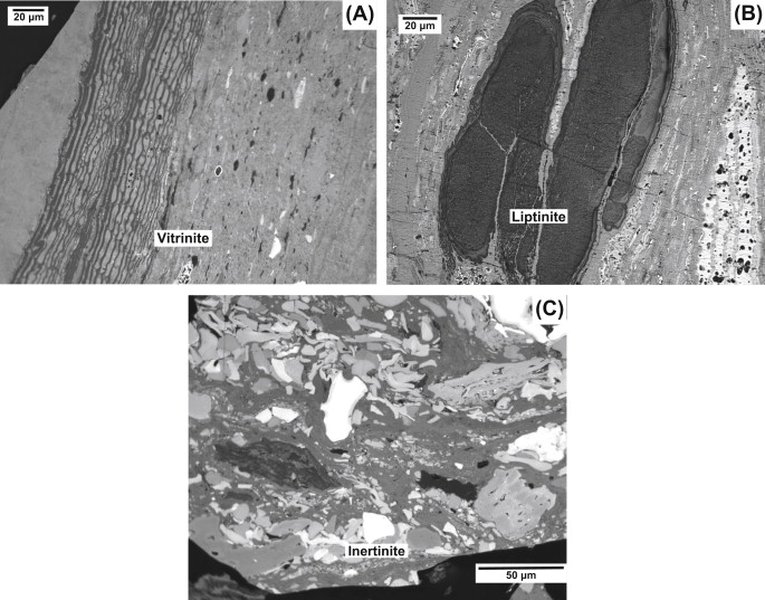
Different maceral groups as seen under a microscope.
The ICCP System 1994: Focus on Vitrinite
The ICCP System 1994 provided a revised and standardized classification specifically for the vitrinite maceral group. This system aimed to provide a more detailed and consistent framework for identifying and quantifying the various forms of vitrinite found in medium to high-rank coals. The classification is hierarchical, moving from the maceral group level to subgroups and then to individual macerals.
Vitrinite Subgroups
Within the ICCP System 1994, the vitrinite maceral group is divided into three principal subgroups. These subgroups are primarily differentiated based on the degree of preservation of the original plant cellular structure and the extent of gelification the organic matter has undergone during coalification.
Telovitrinite
Telovitrinite comprises vitrinite macerals that retain visible evidence of the original plant cell structure. This indicates that the woody tissue underwent coalification with relatively good preservation of its anatomical features. Within telovitrinite, two macerals are recognized:
- Telinite: Shows well-preserved cell structure, often with distinct cell lumens (cavities).
- Collotelinite: Exhibits preserved cell structure, but the cell lumens are filled with a homogeneous gel-like substance (collotelite).
Detrovitrinite
Detrovitrinite is composed of fragmented or detrital vitrinite material where the original plant structure is largely or completely destroyed. It consists of smaller particles of vitrinite that have been broken down and redeposited. The macerals within detrovitrinite are:
- Detrovitrinite (undifferentiated): Fragmented vitrinite without recognizable plant structure.
- Semifusinite (vitrinite-derived): While semifusinite is typically an inertinite maceral, some material with transitional properties between vitrinite and fusinite, derived from woody tissue, may be classified here depending on its optical properties.
Gelovitrinite
Gelovitrinite represents vitrinite macerals that appear as homogeneous, structureless masses. This indicates that the original plant material underwent extensive gelification, a process where the organic matter is converted into a colloidal or gel-like substance during the early stages of coalification. The macerals in this subgroup are:
- Corpogelinite: Occurs as discrete, rounded or oval bodies of gelified material.
- Desmogelininite: Appears as irregular or streaky masses of gelified material, often intimately mixed with other macerals.
The classification at the subgroup and maceral levels allows for a more detailed petrographic analysis, providing insights into the depositional environment and the degree of degradation of the plant material before and during coalification. However, it's noted that agreement in analysis can be better at the maceral group level compared to the subgroup and maceral levels.
Relationship with Huminite
The ICCP System 1994 for vitrinite was developed in conjunction with the classification of huminite for low-rank coals. Huminite is considered the precursor to vitrinite. As the coal rank increases due to increased temperature and pressure, huminite transforms into vitrinite. The ICCP systems for huminite and vitrinite are correlated, allowing for a consistent classification scheme across different coal ranks. Generally, the transition from huminite to vitrinite is considered to occur at a vitrinite reflectance of approximately 0.5%.
Importance of Vitrinite Classification and Analysis
The detailed classification of vitrinite macerals, as provided by the ICCP System 1994, is crucial for several reasons in coal petrology and utilization:
Coal Rank Determination
Vitrinite reflectance is the most widely used parameter for determining the rank of medium to high-rank coals. As coalification progresses, the reflectance of vitrinite increases predictably. By measuring the random reflectance of vitrinite macerals under a microscope, petrologists can assess the thermal maturity of the coal, which is directly related to its properties and potential uses. The ICCP classification helps in identifying the vitrinite particles appropriate for reflectance measurements.
Predicting Coal Behavior
The different vitrinite macerals and subgroups can have varying physical and chemical properties. Understanding the proportions of these different vitrinite components, along with the proportions of other maceral groups, can help predict how a coal will behave during different industrial processes, such as combustion, carbonization (coking), and gasification.
This video provides a visual introduction to the different macerals of coal, including vitrinite, which is relevant to understanding their appearance and context.
Depositional Environment and Paleoecology
The types and proportions of macerals in a coal can provide clues about the type of plant material that contributed to the peat and the environmental conditions under which the peat accumulated. For example, a high proportion of telovitrinite might suggest a depositional environment where woody tissues were well-preserved, while a higher proportion of detrovitrinite could indicate more fragmentation and transport of the organic material.
Comparison with Other Classification Systems
While the ICCP system is widely accepted internationally, other classification systems for coal macerals exist, such as the ASTM (American Society for Testing and Materials) system and historical systems like the Stopes-Heerlen system. The ICCP has worked to correlate its system with others to facilitate communication and comparison of data. The ICCP System 1994 for vitrinite built upon previous ICCP classifications (e.g., ICCP 1971) and aimed for better alignment with the huminite classification for low-rank coals.
Summary of ICCP Vitrinite Classification (System 1994)
The following table summarizes the hierarchical classification of the vitrinite group according to the ICCP System 1994:
| Maceral Group | Subgroup | Maceral | Description |
|---|---|---|---|
| Vitrinite | Telovitrinite | Telinite | Vitrinite with well-preserved cell structure and lumens. |
| Collotelinite | Vitrinite with preserved cell structure, lumens filled with gelified material. | ||
| Detrovitrinite | Detrovitrinite (undifferentiated) | Fragmented vitrinite without recognizable plant structure. | |
| Semifusinite (vitrinite-derived) | Transitional material between vitrinite and fusinite, derived from woody tissue. | ||
| Gelovitrinite | Corpogelinite | Discrete, rounded or oval bodies of gelified vitrinite. | |
| Desmogelininite | Irregular or streaky masses of gelified vitrinite. |
This detailed subdivision allows petrologists to characterize the organic composition of coals with greater precision.
Accreditation and Standardization
The ICCP plays a vital role in standardizing petrographic analysis methods and nomenclature. Through its commissions and working groups, the ICCP develops and refines classification systems like the Vitrinite System 1994. The organization also runs accreditation programs, such as the Single Coal Accreditation Program (SCAP) and Dispersed Organic Matter Vitrinite Reflectance (DOMVR), to ensure the quality and comparability of petrographic data produced by different laboratories and analysts worldwide. These programs test the ability of analysts to correctly identify and quantify macerals and measure vitrinite reflectance according to established standards, including those from ISO (International Organization for Standardization).
Future Directions and Updates
The ICCP's classification systems are not static; they are periodically reviewed and updated to incorporate new scientific understanding and analytical techniques. Following the revision of vitrinite in 1998 (based on the 1994 discussions), the ICCP also published revised classifications for inertinite (2001) and huminite (2005). The ICCP continues to work on updating the classification of the liptinite group, ensuring that the overall maceral classification system remains comprehensive and relevant.
Frequently Asked Questions
What is a maceral?
A maceral is an organic component of coal or other organic-rich sedimentary rocks, analogous to a mineral in inorganic rocks. Macerals are identified and classified based on their microscopic appearance and properties.
What is the ICCP?
The ICCP stands for the International Committee for Coal and Organic Petrology. It is an international organization dedicated to the study of organic matter in rocks, establishing standards for nomenclature, classification, and analytical methods in organic petrology.
Why is the ICCP Vitrinite System 1994 important?
The ICCP Vitrinite System 1994 provides a standardized, hierarchical classification for the vitrinite maceral group, which is essential for consistent and comparable petrographic analysis of medium to high-rank coals. This classification aids in determining coal rank, predicting coal behavior during utilization, and understanding depositional environments.
How does vitrinite relate to coal rank?
Vitrinite reflectance, a measure of how much light vitrinite macerals reflect, increases with increasing thermal maturity (coal rank). This makes vitrinite reflectance a primary parameter for assessing coal rank and the thermal history of sedimentary basins.
Recommended Reading
- Explore the ICCP classification system for huminite macerals in low-rank coals.
- Learn about the ICCP's classification of the inertinite maceral group.
- Understand the relationship between vitrinite reflectance and coal rank.
- Discover the methods used for analyzing coal macerals.
References
Last updated May 18, 2025