
Navigating the Crypto Landscape: Identifying Tokens with Unfavorable Spreads
A Guide for Market Makers to Spot and Understand Wide Bid-Ask Spreads in the Cryptocurrency Market
As a market maker, understanding and identifying crypto tokens with "bad spreads" is crucial for optimizing your strategies and managing risk. In the context of cryptocurrency trading, a "bad spread" primarily refers to a wide bid-ask spread. This signifies a significant difference between the highest price a buyer is willing to pay (the bid price) and the lowest price a seller is willing to accept (the ask price). A wide spread indicates lower liquidity, higher transaction costs, and potentially greater price volatility, which can impact a market maker's profitability and ability to efficiently facilitate trades.
Key Insights into Identifying and Managing Wide Spreads
- Understanding Bid-Ask Spread Fundamentals: The bid-ask spread is the core indicator of liquidity and transaction cost. A wider spread means higher implicit costs for executing trades, directly impacting a market maker's bottom line.
- Liquidity as a Primary Driver: Tokens with low trading volume and shallow order books typically exhibit wider spreads. This is a critical signal for market makers, as it suggests difficulty in matching buy and sell orders without significant price impact.
- Leveraging Tools and Data for Analysis: Utilizing order books, market data platforms, and analytical tools is essential to effectively monitor spreads, identify illiquid tokens, and anticipate market movements.
Understanding the Bid-Ask Spread in Crypto Trading
The bid-ask spread is a fundamental concept in all financial markets, including cryptocurrencies. It represents the immediate cost of executing a trade. For market makers, this spread is their primary source of profit. They aim to buy at the bid price and sell at the ask price, profiting from the difference. However, a wide spread presents challenges. In crypto, where volatility can be high and liquidity can vary wildly between assets, understanding and reacting to spreads is paramount.
The bid price is the highest price a buyer is currently willing to pay for a cryptocurrency, while the ask price (or offer price) is the lowest price a seller is willing to accept. The difference between these two prices is the bid-ask spread. This spread essentially covers the cost for market makers to facilitate trades and absorb the risk of holding volatile assets. For instance, if Bitcoin has a bid price of $25,000 and an ask price of $25,200, the spread is $200. This $200 represents the immediate cost a trader would incur if they simultaneously bought and sold the asset.
The Mechanics of Bid and Ask Prices
Crypto exchanges operate using order books, which display all pending buy (bid) and sell (ask) orders for a given asset. The order book is a real-time reflection of supply and demand. Market makers play a crucial role in these order books by placing both buy and sell orders, thereby providing liquidity to the market. When a market maker places a limit order to buy below the current market price or sell above it, they are acting as a "maker," adding depth to the order book. When a trader places a market order that immediately gets filled against an existing order, they are acting as a "taker," removing liquidity.
Here's a breakdown of how bid and ask prices work within an order book:
- Bid Orders: These are buy orders from traders specifying the maximum price they are willing to pay for a token. The highest bid is the top of the buy side of the order book.
- Ask Orders: These are sell orders from traders specifying the minimum price they are willing to accept for a token. The lowest ask is the top of the sell side of the order book.
- Order Book Depth: The total volume of buy and sell orders at various price levels indicates the market's depth. A deep order book suggests robust liquidity, while a shallow one implies thin liquidity and potentially wider spreads.
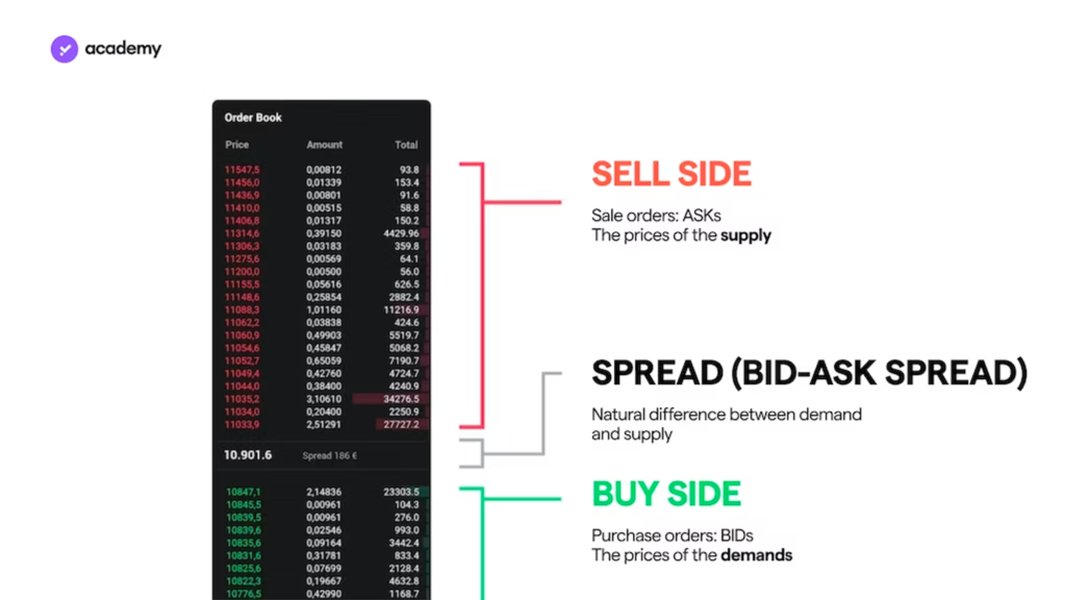
Visualizing an Order Book to Understand Bid and Ask Dynamics.
Factors Influencing Bid-Ask Spreads
Several factors contribute to the width of the bid-ask spread in cryptocurrency markets:
- Liquidity and Trading Volume: This is the most significant factor. Highly liquid assets like Bitcoin and Ethereum, with high trading volumes and many active buyers and sellers, typically have very narrow spreads. Conversely, lesser-known altcoins or newly launched tokens often have low liquidity, resulting in wider spreads. For a market maker, this means it's harder to execute large trades without significantly impacting the price.
- Volatility: Increased market volatility can lead to wider spreads. During periods of rapid price swings or major news events, market makers adjust their prices to account for the increased risk, widening the gap between bids and asks.
- Exchange Type and Fee Structure: Different exchanges have varying liquidity pools and fee structures. Centralized exchanges generally offer better liquidity and tighter spreads for major assets compared to decentralized exchanges (DEXs), especially for smaller tokens. Some exchanges might also charge high trading fees, which can implicitly widen the effective spread for traders.
- Market Maker Activity: The presence and activity of market makers directly influence spreads. In markets with robust market-making activity, spreads tend to be tighter as competition among market makers drives prices closer together.
- Asset Type: Stablecoins (like USDT) typically have the tightest spreads due to their price stability and high liquidity, while highly speculative or newly launched meme coins might exhibit extremely wide spreads.
Identifying Tokens with "Bad Spreads" for Market Making
As a market maker, your goal is often to identify assets with predictable spreads that allow for profitable arbitrage or liquidity provision. "Bad spreads" for you would be those that are consistently wide, volatile, or indicative of illiquidity, making your operations risky or unprofitable. Here's how to identify them:
Analyzing Order Book Depth and Liquidity
The order book is your primary tool. A token with a "bad spread" will show a significant gap between the highest bid and lowest ask, coupled with shallow order book depth. This means there are limited buy and sell orders around the current price, making it difficult to execute large trades without incurring substantial slippage.
Observing the Quantity at Bid and Ask
Look at the volume (quantity) of orders available at the best bid and ask prices. If these quantities are small, even a narrow spread might quickly widen as your orders consume the available liquidity. For instance, a token might show a $0.01 spread, but if there's only 1 unit available at that price, your larger order will "walk" the book, filling against less favorable prices further down, effectively leading to a much wider realized spread.
Monitoring the cumulative volume at different price levels also provides insights into the market's resilience to large orders. Tokens with a deep order book can absorb larger trades with less price impact.
Monitoring Spread Percentage and Volatility
While a raw spread in dollar terms can be misleading for different price points, calculating the spread as a percentage of the ask price offers a standardized metric. A high percentage spread is a clear indicator of a "bad" or costly spread.
\[ \text{Spread Percentage} = \frac{\text{Ask Price} - \text{Bid Price}}{\text{Ask Price}} \times 100\% \]For example, if a token trades at a bid of $1.00 and an ask of $1.05, the spread is $0.05. The percentage spread is \(\frac{0.05}{1.05} \times 100\% \approx 4.76\%\). This is significantly high compared to major cryptocurrencies, which might have spreads of less than 0.1%.
Moreover, observe how quickly the spread fluctuates. If it widens dramatically during periods of normal trading activity, it suggests underlying liquidity issues or potential manipulation. Volatile spreads make it challenging for market makers to consistently profit.
Analyzing Trading Volume and Market Capitalization
Tokens with low trading volume and small market capitalization are often prone to wider spreads. These tokens have fewer active participants, making them less liquid and more susceptible to large price swings from even relatively small trades. Market makers should prioritize tokens with robust daily trading volumes, as this indicates a healthy, active market where liquidity provision can be more reliably profitable.
Tools and Strategies for Market Makers
To effectively identify and capitalize on (or avoid) tokens with bad spreads, market makers employ various tools and strategies:
Utilizing Advanced Trading Platforms and Data Providers
- Real-Time Order Books: Accessing real-time, comprehensive order book data is non-negotiable. Platforms like TradingView, CoinMarketCap, and CoinGecko often provide live data, but market makers might need direct API access to exchanges for higher-frequency data.
- Spread Monitoring Tools: Some platforms and custom-built scripts allow market makers to continuously monitor spreads across multiple tokens and exchanges, alerting them to widening spreads or arbitrage opportunities.
- Liquidity Heatmaps: Visual tools that display order book depth and density can quickly highlight areas of low liquidity, indicating potential wide spreads.
Employing Automated Trading Systems
Automated trading bots are invaluable for market makers. They can react to spread changes and execute trades far faster than humans, enabling them to capitalize on fleeting opportunities or adjust strategies in volatile conditions. Python-based solutions for automated credit spread finding, for example, can be adapted to identify wide bid-ask spreads and execute trades when conditions are favorable.
# Example Python snippet (conceptual) for checking spread
def get_bid_ask_spread(symbol, exchange_api):
    order_book = exchange_api.fetch_order_book(symbol)
    bid = order_book['bids'][0][0] if order_book['bids'] else None
    ask = order_book['asks'][0][0] if order_book['asks'] else None

    if bid and ask:
        spread = ask - bid
        percentage_spread = (spread / ask) * 100
        return spread, percentage_spread
    return None, None

# In a market making bot, you would continuously check this for various tokens
# and adjust your quoting strategy based on the calculated spread.
Understanding Slippage and Its Relation to Spreads
Slippage occurs when the execution price of a market order differs from the expected price due to insufficient liquidity at the desired price point. Wide bid-ask spreads inherently lead to higher slippage, especially for large orders. Market makers must account for potential slippage in their profitability calculations. For instance, if you intend to buy a large quantity of a token, and the order book is shallow, your market order will "eat through" multiple ask levels, resulting in an average purchase price higher than the initial best ask.
The Impact of Wide Spreads on Market Makers
For market makers, wide spreads are a double-edged sword. While they represent a larger potential profit margin on individual trades, they also indicate higher risk and lower turnover. Operating in markets with consistently wide spreads can lead to:
- Increased Capital Requirements: Market makers need more capital to cover potential price movements within a wide spread.
- Lower Profitability: Although the percentage spread might be high, the low trading volume associated with wide spreads means fewer opportunities to execute trades, leading to lower overall profits.
- Higher Risk of Inventory Loss: Holding assets in illiquid markets exposes market makers to greater risk of price depreciation if they cannot offload their inventory quickly.
- Difficulty in Hedging: It becomes harder to effectively hedge positions when spreads are wide, as the cost of entering and exiting positions is high.
Comparative Analysis of Crypto Token Spreads
To illustrate the varying nature of spreads across different crypto tokens, the following radar chart provides a conceptual comparison based on typical market conditions. This chart visually represents how key attributes like liquidity, volatility, and trading volume influence the bid-ask spread of different crypto asset categories.
Conceptual Radar Chart: Comparative Spreads of Crypto Token Categories.
As the chart illustrates, major cryptocurrencies score high on liquidity, trading volume, and spread consistency, making them ideal for market making due to their tight and predictable spreads. Established altcoins offer a balance, while newly launched or low-cap tokens often present the challenge of low liquidity, low trading volume, high volatility, and inconsistent (wide) spreads, making them riskier and more expensive for market making.
Deep Dive: Understanding Order Books and Spreads
The order book is at the heart of price discovery and liquidity in crypto markets. To truly identify "bad spreads," market makers must be proficient in reading and interpreting order books. This involves understanding the cumulative depth of orders, identifying large block orders (iceberg orders), and recognizing how price movements impact the spread.
Learn how to read and use a crypto order book to understand bid-ask spreads.
The video above provides a comprehensive tutorial on how to use the order book in cryptocurrency exchanges, explaining bids, asks, makers, and takers. For market makers, mastering this understanding is fundamental to identifying where liquidity is thin and spreads are wide, which are direct signals of "bad spreads." Understanding the dynamics of an order book helps in assessing the true cost of a trade beyond the quoted price.
Practical Steps for Identifying Bad Spreads
Here’s a structured approach for market makers to identify crypto tokens with bad spreads:
| Step | Action | Why it helps identify "bad spreads" |
|---|---|---|
| 1 | Access Real-Time Order Books | Directly observe the bid and ask prices and the quantity of orders at each level. Wide gaps and thin order depth immediately signal a bad spread. |
| 2 | Calculate Percentage Spread | Convert the raw spread into a percentage relative to the asset's price. Consistently high percentage spreads (e.g., >0.5% for non-stablecoins) indicate high transaction costs and potential illiquidity. |
| 3 | Monitor Trading Volume & Market Cap | Tokens with low 24-hour trading volume and small market caps often correlate with wider, less predictable spreads. These are less desirable for active market making. |
| 4 | Observe Spread Volatility | Track how the spread behaves over time. If it widens significantly during normal market conditions or small trades, it signals instability and poor liquidity. |
| 5 | Check for Slippage Impact | Simulate or execute small trades to see the actual price impact. High slippage for relatively small orders confirms illiquidity and a "bad spread" environment. |
| 6 | Compare Across Exchanges | Some tokens may have better liquidity and tighter spreads on one exchange versus another. Compare spreads for the same token across multiple platforms. |
| 7 | Analyze Fundamental Factors | Research the token's utility, development team, community, and recent news. Lack of real use case, inactive development, or negative news can lead to reduced demand and wider spreads. |
By systematically applying these steps, market makers can gain a clearer understanding of which crypto tokens exhibit unfavorable bid-ask spreads and make informed decisions on where to deploy their capital and market-making strategies.
Frequently Asked Questions (FAQ)
What is a bid-ask spread in crypto?
Why are some crypto spreads wider than others?
How does a wide spread affect market makers?
Can I profit from wide spreads as a market maker?
What are the best tools to monitor crypto spreads?
Conclusion
For market makers, identifying crypto tokens with "bad spreads" is an essential skill that directly impacts profitability and risk management. These bad spreads are primarily characterized by wide bid-ask differences, shallow order book depth, low trading volumes, and high volatility. By diligently analyzing order book dynamics, calculating percentage spreads, and leveraging advanced monitoring tools and automated systems, market makers can strategically avoid or cautiously engage with these challenging assets. Focusing on high-liquidity assets with tighter, more consistent spreads generally provides a more reliable and profitable environment for market-making operations, while understanding the underlying reasons for wide spreads allows for informed decision-making in the volatile crypto market.
Recommended Further Exploration
- How to analyze crypto token liquidity for market making strategies?
- What is the impact of market volatility on crypto spreads and how to manage it?
- What are the best automated market making strategies for crypto in low-liquidity environments?
- How does understanding slippage improve crypto trading decisions for large orders?