

Implicit differentiation is a powerful technique in calculus that allows us to find the derivative of a function even when it's not explicitly defined as \( y = f(x) \). This method is particularly useful for complex equations where \( x \) and \( y \) are intertwined. The process involves differentiating both sides of an equation with respect to \( x \), treating \( y \) as a function of \( x \), and then using the chain rule for terms involving \( y \). This approach enables us to determine both the first derivative, \( \frac{dy}{dx} \), which represents the slope of the tangent line at a given point, and the second derivative, \( \frac{d^2y}{dx^2} \), which provides insights into the curvature of the function's graph.
Key Insights into Implicit Differentiation
- The Chain Rule is Paramount: When differentiating terms involving \( y \), remember to apply the chain rule, multiplying by \( \frac{dy}{dx} \). This is the cornerstone of implicit differentiation.
- Systematic Isolation of \( \frac{dy}{dx} \): After differentiating, the algebraic challenge lies in isolating \( \frac{dy}{dx} \) to express the first derivative.
- Second Derivative Complexity: Calculating the second derivative requires differentiating the first derivative expression, often necessitating the quotient rule and substitution of the previously found \( \frac{dy}{dx} \) value.
Let's delve into the specific problem of finding the first and second derivatives for the implicit function \( x^3 - 3x^2 - 4x = y^3 - 3y^2 - 10y \) at the point \( (4, 5) \). This exercise not only demonstrates the mechanics of implicit differentiation but also highlights its importance in analyzing the behavior of implicitly defined curves.
Ensuring Point-Curve Membership
Before proceeding with differentiation, it's good practice to verify that the given point \( (4, 5) \) actually lies on the curve defined by the implicit function. This step helps confirm the validity of the problem's premise.
Substitution into the Equation
Substitute \( x = 4 \) and \( y = 5 \) into the original equation:
\[ \text{Left side: } 4^3 - 3(4)^2 - 4(4) = 64 - 3(16) - 16 = 64 - 48 - 16 = 0 \] \[ \text{Right side: } 5^3 - 3(5)^2 - 10(5) = 125 - 3(25) - 50 = 125 - 75 - 50 = 0 \]Since both sides equate to 0, the point \( (4, 5) \) indeed lies on the curve.
Differentiating Both Sides Implicitly
To find the first derivative \( \frac{dy}{dx} \), we differentiate every term in the equation \( x^3 - 3x^2 - 4x = y^3 - 3y^2 - 10y \) with respect to \( x \). Remember to apply the chain rule when differentiating terms involving \( y \).
\[ \frac{d}{dx}(x^3) - \frac{d}{dx}(3x^2) - \frac{d}{dx}(4x) = \frac{d}{dx}(y^3) - \frac{d}{dx}(3y^2) - \frac{d}{dx}(10y) \]Applying Differentiation Rules
Performing the differentiation yields:
\[ 3x^2 - 6x - 4 = 3y^2 \frac{dy}{dx} - 6y \frac{dy}{dx} - 10 \frac{dy}{dx} \]Isolating \( \frac{dy}{dx} \)
Next, we group the terms containing \( \frac{dy}{dx} \) and factor it out:
\[ 3x^2 - 6x - 4 = (3y^2 - 6y - 10) \frac{dy}{dx} \]Finally, solve for \( \frac{dy}{dx} \):
\[ \frac{dy}{dx} = \frac{3x^2 - 6x - 4}{3y^2 - 6y - 10} \]Evaluating \( \frac{dy}{dx} \) at \( (4, 5) \)
Substitute \( x = 4 \) and \( y = 5 \) into the expression for \( \frac{dy}{dx} \):
\[ \frac{dy}{dx}\Big|_{(4,5)} = \frac{3(4)^2 - 6(4) - 4}{3(5)^2 - 6(5) - 10} \] \[ \frac{dy}{dx}\Big|_{(4,5)} = \frac{3(16) - 24 - 4}{3(25) - 30 - 10} \] \[ \frac{dy}{dx}\Big|_{(4,5)} = \frac{48 - 24 - 4}{75 - 30 - 10} \] \[ \frac{dy}{dx}\Big|_{(4,5)} = \frac{20}{35} = \frac{4}{7} \]So, the first derivative at \( (4, 5) \) is \( \frac{4}{7} \).
Differentiating \( \frac{dy}{dx} \) Again
To find the second derivative \( \frac{d^2y}{dx^2} \), we must differentiate the expression for \( \frac{dy}{dx} \) with respect to \( x \). This typically involves the quotient rule, as \( \frac{dy}{dx} \) is a fraction.
\[ \frac{d^2y}{dx^2} = \frac{d}{dx}\left(\frac{3x^2 - 6x - 4}{3y^2 - 6y - 10}\right) \]Let \( u = 3x^2 - 6x - 4 \) and \( v = 3y^2 - 6y - 10 \). The quotient rule states \( \frac{d}{dx}\left(\frac{u}{v}\right) = \frac{v \frac{du}{dx} - u \frac{dv}{dx}}{v^2} \).
Calculating Derivatives of \( u \) and \( v \)
First, find \( \frac{du}{dx} \) and \( \frac{dv}{dx} \):
\[ \frac{du}{dx} = 6x - 6 \] \[ \frac{dv}{dx} = \frac{d}{dx}(3y^2 - 6y - 10) = (6y - 6)\frac{dy}{dx} \]Applying the Quotient Rule
Substitute these into the quotient rule formula:
\[ \frac{d^2y}{dx^2} = \frac{(3y^2 - 6y - 10)(6x - 6) - (3x^2 - 6x - 4)((6y - 6)\frac{dy}{dx})}{(3y^2 - 6y - 10)^2} \]Evaluating \( \frac{d^2y}{dx^2} \) at \( (4, 5) \)
Now, substitute \( x = 4 \), \( y = 5 \), and \( \frac{dy}{dx} = \frac{4}{7} \) into this lengthy expression.
Let's break down the terms:
- \( (3y^2 - 6y - 10) = 3(5)^2 - 6(5) - 10 = 75 - 30 - 10 = 35 \)
- \( (6x - 6) = 6(4) - 6 = 24 - 6 = 18 \)
- \( (3x^2 - 6x - 4) = 3(4)^2 - 6(4) - 4 = 48 - 24 - 4 = 20 \)
- \( (6y - 6)\frac{dy}{dx} = (6(5) - 6)\left(\frac{4}{7}\right) = (30 - 6)\left(\frac{4}{7}\right) = 24\left(\frac{4}{7}\right) = \frac{96}{7} \)
- \( (3y^2 - 6y - 10)^2 = (35)^2 = 1225 \)
Substitute these values back into the \( \frac{d^2y}{dx^2} \) formula:
\[ \frac{d^2y}{dx^2}\Big|_{(4,5)} = \frac{(35)(18) - (20)\left(\frac{96}{7}\right)}{ (35)^2 } \] \[ \frac{d^2y}{dx^2}\Big|_{(4,5)} = \frac{630 - \frac{1920}{7}}{1225} \]To simplify the numerator, find a common denominator:
\[ 630 - \frac{1920}{7} = \frac{630 \times 7}{7} - \frac{1920}{7} = \frac{4410 - 1920}{7} = \frac{2490}{7} \]Now substitute this back into the overall expression:
\[ \frac{d^2y}{dx^2}\Big|_{(4,5)} = \frac{\frac{2490}{7}}{1225} \] \[ \frac{d^2y}{dx^2}\Big|_{(4,5)} = \frac{2490}{7 \times 1225} = \frac{2490}{8575} \]Finally, simplify the fraction by dividing both the numerator and denominator by their greatest common divisor, which is 5:
\[ \frac{d^2y}{dx^2}\Big|_{(4,5)} = \frac{2490 \div 5}{8575 \div 5} = \frac{498}{1715} \]Thus, the second derivative at \( (4, 5) \) is \( \frac{498}{1715} \).
Figure 2: Mindmap illustrating the structured approach to implicit differentiation for both first and second derivatives.
This mindmap outlines the systematic steps required to tackle implicit differentiation problems. It emphasizes the iterative nature, where the result of the first derivative calculation feeds into the second derivative calculation.
The Geometric Interpretation of Derivatives
The derivatives we calculated have clear geometric meanings. The first derivative, \( \frac{dy}{dx} = \frac{4}{7} \), represents the slope of the tangent line to the curve at the point \( (4, 5) \). A positive slope indicates that the curve is increasing at that point. The second derivative, \( \frac{d^2y}{dx^2} = \frac{498}{1715} \), provides information about the concavity of the curve. Since \( \frac{498}{1715} \) is positive, the curve is concave up at \( (4, 5) \).
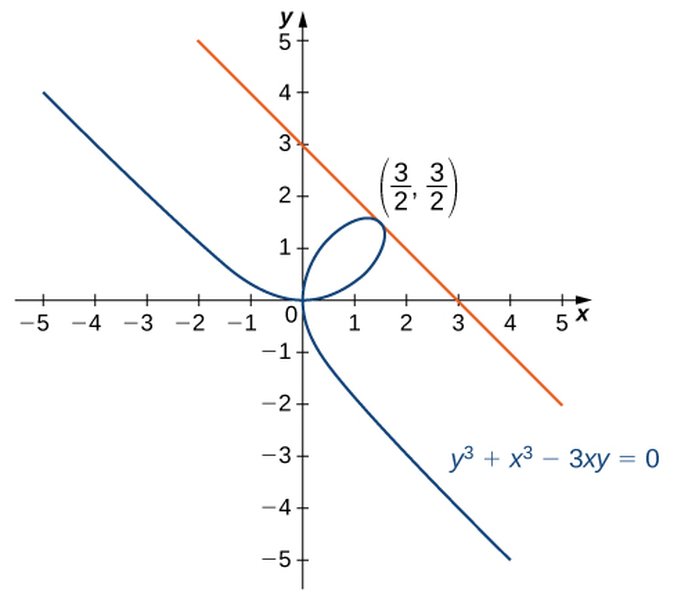
Figure 3: An illustration showing a tangent line at a point on an implicitly defined curve. The slope of this tangent is given by the first derivative at that point.
This image depicts a tangent line on an implicit curve, visually representing what the first derivative calculates. The tangent line's slope at a specific point indicates the instantaneous rate of change of \( y \) with respect to \( x \) at that exact location on the curve.
Figure 4: This video provides a comprehensive guide on finding both first and second derivatives using implicit differentiation, aligning directly with the methods used in this analysis.
The embedded video offers a detailed, step-by-step walkthrough of implicit differentiation, covering the calculation of both first and second derivatives. It reinforces the theoretical concepts and practical applications discussed in this response, providing an auditory and visual learning experience.
Consolidating the Results
For clarity, here's a summary of the calculated derivatives at the point \( (4, 5) \):
| Derivative Type | Calculated Value | Approximate Decimal Value |
|---|---|---|
| First Derivative \( \frac{dy}{dx} \) | \( \frac{4}{7} \) | \( \approx 0.5714 \) |
| Second Derivative \( \frac{d^2y}{dx^2} \) | \( \frac{498}{1715} \) | \( \approx 0.2907 \) |
These values provide precise quantitative measures of the curve's behavior at the specified point, offering insights into its slope and concavity.
FAQ
What is implicit differentiation used for?
Why is the chain rule important in implicit differentiation?
How do I find the second derivative using implicit differentiation?
What does a positive first derivative mean?
What does a positive second derivative mean?
Conclusion
The meticulous application of implicit differentiation allows for the precise determination of derivative values even for complex, non-explicit functions. For the given implicit function \( x^3 - 3x^2 - 4x = y^3 - 3y^2 - 10y \) at the point \( (4, 5) \), we have successfully calculated the first derivative \( \frac{dy}{dx} = \frac{4}{7} \) and the second derivative \( \frac{d^2y}{dx^2} = \frac{498}{1715} \). These values not only provide the slope of the tangent line and the concavity of the curve at \( (4, 5) \), but also underscore the fundamental role of implicit differentiation in understanding the local behavior of such functions.
Recommended Further Exploration
- How to visualize implicit functions and their derivatives?
- Applications of implicit differentiation in physics and engineering?
- Advanced implicit differentiation techniques for higher-order derivatives?
- Understanding the geometric significance of the second derivative?