
Comprehensive Notes on India-China Relations
An In-Depth Analysis of Bilateral Dynamics and Strategic Interactions
Key Takeaways
- Historical Tensions Shape Modern Relations: Centuries-old disputes and conflicts continue to influence the diplomatic and strategic interactions between India and China.
- Economic Interdependence Amidst Political Strains: Despite significant trade imbalances and economic dependencies, both nations maintain robust economic ties.
- Geopolitical Maneuvering Defines Regional Stability: Strategic initiatives like China's Belt and Road Initiative and India's participation in the Quad highlight the competitive dynamics in the Indo-Pacific region.
1. Historical Context
Ancient and Modern Interactions
India and China boast a rich history of cultural and economic exchanges that date back to ancient times. The Silk Road was instrumental in facilitating trade and cultural diffusion between the two civilizations, fostering mutual influences in art, religion, and technology. Buddhism, originating in India, significantly impacted Chinese spirituality and culture through the efforts of monks like Fa Xian and Bodhidharma, who played pivotal roles in cultural exchanges.
The modern relationship, however, has been marred by territorial disputes and political tensions. Diplomatic relations were officially established on April 1, 1950, with India being the first non-socialist bloc country to recognize the People’s Republic of China. Despite this early diplomatic engagement, unresolved border issues and conflicting geopolitical interests have frequently strained bilateral relations.
Colonial Legacies and Border Disputes
The contemporary border disputes can be traced back to the British colonial era, particularly the 1914 Simla Convention, which attempted to demarcate the boundary between Tibet, China, and British India. The ambiguity and disagreements from this period laid the groundwork for future conflicts. Following India's independence in 1947 and the establishment of the People's Republic of China in 1949, both nations inherited unresolved border issues, particularly in the Himalayan region.
The annexation of Tibet by China in 1950 removed the traditional buffer state between India and China, escalating tensions and leading to significant geopolitical shifts. This move was one of the catalysts for the Sino-Indian War of 1962, a pivotal event that severely strained bilateral relations.
2. Major Territorial Disputes
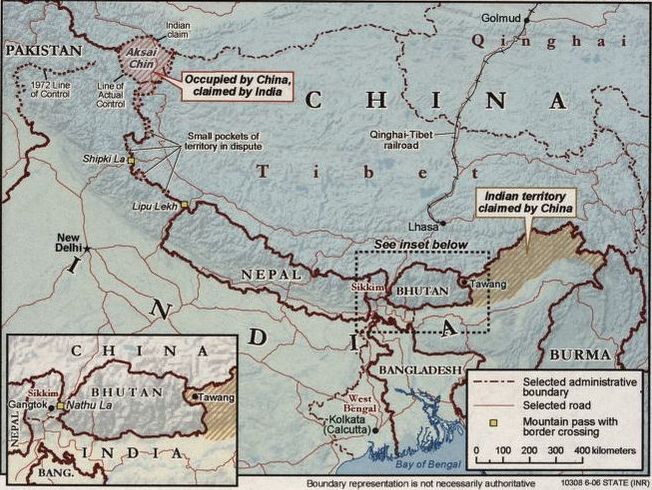
Western Sector: Aksai Chin
Aksai Chin, an area approximately the size of Switzerland, is one of the primary disputed regions between India and China. Currently controlled by China, India claims this territory based on historical maps and administrative boundaries established during the British colonial period. The region's strategic importance cannot be overstated, as it connects Tibet to Xinjiang, facilitating Chinese military and logistical movements.
Eastern Sector: Arunachal Pradesh
Arunachal Pradesh, covering approximately 90,000 square kilometers, is another critical area of contention. China refers to it as "South Tibet," asserting historical claims over the territory. India, however, administers Arunachal Pradesh and regards it as an integral part of its sovereign nation. This dispute has been a major flashpoint, contributing to ongoing border skirmishes and diplomatic tensions.
3. Core Areas of Dispute
a. Border Disputes
Line of Actual Control (LAC)
The Line of Actual Control (LAC) serves as the de facto border between India and China but remains undefined and ambiguous in several sections. This lack of clear demarcation has been a consistent source of friction, leading to multiple standoffs and military confrontations over the decades.
Galwan Valley Clash (2020)
The Galwan Valley clash in June 2020 marked the first deadly encounter between Indian and Chinese forces in decades. The violent skirmish resulted in the deaths of 20 Indian soldiers and an undisclosed number of Chinese casualties, significantly deteriorating bilateral relations and leading to increased military deployments along the LAC.
Ongoing Standoffs
Despite various rounds of diplomatic talks and confidence-building measures, tensions persist in regions like the Depsang Plains, Pangong Lake, and Hot Springs areas. These ongoing standoffs underscore the deep-seated and unresolved nature of the border disputes.
b. Geopolitical Tensions
Belt and Road Initiative (BRI)
China's Belt and Road Initiative (BRI) aims to enhance global trade and infrastructure connectivity. India has consistently opposed the BRI, particularly the China-Pakistan Economic Corridor (CPEC), which traverses Pakistan-occupied Kashmir (PoK), a region India claims as its own. This opposition is rooted in concerns over sovereignty, security, and the strategic implications of increased Chinese presence in the region.
String of Pearls Strategy
The "String of Pearls" strategy refers to China's development of ports and infrastructure across the Indian Ocean, including in Sri Lanka, Pakistan, and the Maldives. India perceives this as a strategic encirclement meant to enhance China's military and economic foothold in critical maritime regions, thereby challenging India's own maritime security and influence.
Tibet and Dalai Lama
India’s support for the Tibetan government-in-exile and the continued residence of the Dalai Lama in India remain significant points of contention. China's administration views this support as interference in its internal affairs, exacerbating diplomatic strains between the two nations.
4. Economic Relations
Bilateral Trade Dynamics
Despite political tensions, India and China have maintained robust economic ties. Bilateral trade reached a record $136 billion in 2024, highlighting significant economic interdependence. However, the trade balance remains heavily skewed in China's favor, with India running a substantial trade deficit. This imbalance has prompted India to seek diversification of its supply chains and reduce dependency on Chinese imports.
Technological Dependence and Diversification
India’s technological landscape remains reliant on Chinese imports, particularly in the electronics, telecommunications, and machinery sectors. Efforts under the “Atmanirbhar Bharat” (Self-Reliant India) initiative aim to bolster local manufacturing and reduce this dependency. Nonetheless, the transition towards self-reliance is gradual and faces challenges due to established supply chains and technological gaps.
Trade Restrictions and Boycotts
In response to ongoing geopolitical tensions, India has implemented several restrictions on Chinese companies. Notably, the ban on platforms like TikTok and increased scrutiny of Chinese investments in critical sectors reflect India’s strategy to counterbalance Chinese economic influence. These measures are part of broader efforts to safeguard national security and promote domestic industries.
5. Recent Developments
a. Border Negotiations
In October 2024, new rounds of military and diplomatic talks were concluded with the aim of de-escalating tensions along the LAC. While some agreements were reached regarding patrolling protocols and disengagement mechanisms, broader territorial disputes remain unresolved. These negotiations signify a continued commitment to dialogue but highlight the challenges in achieving comprehensive resolutions.
b. Leadership Diplomacy
Indian Prime Minister Narendra Modi and Chinese President Xi Jinping have engaged in multiple high-level meetings since 2020, striving to build trust and negotiate on contentious issues. These interactions have led to small-scale agreements, such as confidence-building measures and joint efforts to manage border disputes. However, significant breakthroughs that could transform the bilateral relationship have yet to be realized.
c. Military Posturing
Both India and China continue to fortify their military presence along the disputed borders. India is focused on enhancing infrastructure near the LAC and modernizing its armed forces to better respond to potential conflicts. Concurrently, China is actively increasing its military footprint in disputed areas, including the construction of roads and military installations, thereby escalating the militarization of the border regions.
d. Multilateral Forums
India and China interact within various multilateral organizations such as BRICS and the Shanghai Cooperation Organization (SCO). However, their conflicting positions often impede meaningful cooperation. For instance, India opposes China’s efforts to block its candidacy for groups like the Nuclear Suppliers Group (NSG), reflecting broader strategic disagreements that influence their interactions in multilateral settings.
6. Global Context
a. China’s Rising Power
China’s assertive expansion in the Indo-Pacific region has prompted India to strengthen its alliances with other regional powers. India's participation in the Quad—an informal strategic dialogue involving the United States, Japan, and Australia—serves as a counterbalance to China's growing influence. This alignment reflects the broader geopolitical competition shaping regional stability.
b. The Russia Factor
Both India and China maintain robust ties with Russia. However, Russia's closer alignment with China following the Ukraine conflict has implications for the traditional neutrality Russia maintains in the India-China rivalry. This shift influences the strategic calculations of both India and China, as they navigate their relationships with a more assertive Russian partner.
c. US-China Rivalry
The intensifying US-China rivalry has significant repercussions for India-China relations. India's strategic partnership with the United States, especially in defense and technology, heightens China's perception of India as a regional competitor. This alignment has further entrenched the strategic competition between India and China, impacting their bilateral and multilateral engagements.
7. Challenges in India-China Relations
a. Border Disputes and Military Confidence
Ongoing border disputes remain the most significant challenge in India-China relations. The lack of a clearly demarcated LAC leads to frequent military stand-offs and skirmishes, undermining bilateral trust. Confidence-building measures, while beneficial, have yet to address the root causes of these disputes effectively.
b. Economic Imbalances and Dependence
The substantial trade deficit India experiences with China poses economic challenges. India's dependence on Chinese imports for critical sectors like electronics and telecommunications hampers its economic sovereignty. Efforts to diversify supply chains are ongoing but are constrained by existing dependencies and global economic dynamics.
c. Strategic Encirclement and Maritime Security
China’s “String of Pearls” strategy aims to establish a network of ports and infrastructure across the Indian Ocean, which India perceives as an attempt to encircle and contain its maritime capabilities. This strategic maneuvering intensifies maritime security concerns, prompting India to bolster its naval presence and engage in regional security alliances.
d. Water Security and Resource Control
Control over transboundary rivers, particularly the Brahmaputra, remains a contentious issue. China’s upstream control over these water sources poses significant threats to India's water security, essential for agriculture, industry, and domestic use. This environmental and resource-based tension adds another layer of complexity to the bilateral relationship.
e. Cybersecurity Threats
Cybersecurity has emerged as a critical domain of competition between India and China. India faces persistent cyber threats emanating from China, necessitating robust defensive measures. The increasing reliance on digital infrastructure magnifies the risks associated with cyber espionage and cyber warfare, impacting national security and economic stability.
8. Recent Negotiations and Agreements
Confidence-Building Measures
Over the years, India and China have established various confidence-building measures (CBMs) to manage and mitigate border tensions. These include regular military-to-military dialogues, established hotlines between military commanders, and protocols for disengagement in conflict zones. While these measures have helped prevent large-scale conflicts, they have not resolved the underlying territorial disputes.
Economic Agreements and Trade Facilitation
Both countries continue to engage in economic dialogues aimed at enhancing trade facilitation and reducing barriers. Agreements on trade protocols, investment facilitation, and mutual recognition of standards are part of ongoing efforts to stabilize and grow bilateral trade. However, political tensions sometimes overshadow these economic engagements, leading to uncertainties and regulatory challenges.
Environmental and Cultural Cooperation
Parallel to strategic and economic interactions, India and China engage in environmental and cultural cooperation initiatives. Joint efforts in addressing climate change, promoting sustainable development, and facilitating cultural exchanges contribute to a multifaceted relationship. These cooperative endeavors offer avenues for building goodwill and fostering mutual understanding amidst broader strategic rivalries.
9. Strategic and Economic Initiatives
Atmanirbhar Bharat and Self-Reliance
India's "Atmanirbhar Bharat" initiative emphasizes self-reliance in critical sectors, including defense, technology, and manufacturing. By reducing dependence on Chinese imports, India aims to strengthen its economic sovereignty and enhance domestic industrial capabilities. This initiative aligns with broader strategic objectives to mitigate vulnerabilities and promote sustainable economic growth.
China’s Technological Expansion
China continues to advance its technological prowess through substantial investments in sectors like artificial intelligence, 5G telecommunications, and renewable energy. These efforts bolster China’s competitive edge and pose challenges to India's technological development and innovation capabilities. The technological race between the two nations is a critical aspect of their strategic competition.
Renewable Energy and Climate Change Cooperation
Both India and China recognize the importance of addressing climate change and are investing in renewable energy sources. Collaborative projects in solar energy, wind power, and sustainable infrastructure can serve as areas of mutual benefit, promoting environmental sustainability while reducing reliance on fossil fuels. This cooperation is essential for global climate goals and aligns with national sustainability agendas.
10. Outlook and Future Prospects
Short to Medium-Term Outlook
In the near to medium term, India-China relations are expected to remain complex and multifaceted. Territorial disputes and geopolitical competition will likely continue to overshadow cooperative endeavors. While economic interdependence provides a framework for engagement, political and strategic tensions present significant obstacles to normalization.
Long-Term Prospects
Long-term prospects for India-China relations hinge on the ability of both nations to manage and resolve their disputes through sustained dialogue and diplomatic engagement. Confidence-building measures, strategic transparency, and mutual concessions will be crucial in moving towards a more stable and cooperative relationship. Additionally, evolving global dynamics, such as shifting alliances and economic trends, will influence the trajectory of bilateral relations.
Potential for Regional and Global Cooperation
Despite ongoing tensions, there remains potential for India and China to collaborate on regional and global issues of mutual interest. Areas such as climate change, pandemic response, and regional security frameworks offer opportunities for constructive engagement. Building a foundation of trust and addressing shared challenges can pave the way for more balanced and cooperative relations in the future.
Conclusion
India-China relations are characterized by a delicate balance of historical ties, economic interdependence, and strategic competition. The enduring border disputes and geopolitical rivalries present significant challenges to bilateral cooperation and regional stability. However, economic engagements and potential areas of collaboration offer pathways for mitigating tensions and fostering a more stable relationship. Achieving lasting peace and cooperation will require sustained diplomatic efforts, mutual concessions, and a commitment to addressing both historical grievances and contemporary strategic interests.
References
- China–India Relations - Wikipedia
- India-China Relations Post-Galwan - Carnegie Endowment
- India-China Tensions - Hudson Institute
- Status and Trajectory of Relations - GMF
- Economic Relations - Beijing Embassy
- Sino-Indian War - Britannica
- India-China Border Tensions - Al Jazeera
- India-China Conflict History - Wall Street Journal
- India-China Border Dispute - The Guardian
- India-China Relations - Testbook
Last updated January 27, 2025