
Unveiling the Miniature Marvels: A Deep Dive into Insect Pollinator Classification
Discover the diverse orders of insects responsible for plant reproduction and ecosystem health, backed by scientific insights.
Essential Insights: Key Takeaways
- Diverse Workforce: Insect pollinators are primarily classified into four major orders: Hymenoptera (bees, wasps, ants), Lepidoptera (butterflies, moths), Diptera (flies), and Coleoptera (beetles), each with unique contributions.
- Bees Lead the Charge: While many insects contribute, bees (Order Hymenoptera) are widely recognized as the most specialized and efficient pollinators, possessing unique adaptations for pollen collection and transport.
- Ancient Origins & Critical Roles: Insect pollination is an ancient ecological process, with evidence dating back millions of years, and it remains vital for the reproduction of approximately 80% of the world's flowering plants, including numerous essential food crops.
The Grand Tapestry of Insect Pollinators
Defining Pollinators and Their Vital Role
Pollinators are animals, predominantly insects, that play a fundamental role in the life cycle of flowering plants. They facilitate pollination by transferring pollen grains from the male part of a flower (the anther) to the female part (the stigma). This transfer is crucial for fertilization, leading to the production of seeds, fruits, and ultimately, the continuation of plant species. Insect pollination is a cornerstone of biodiversity, supporting entire ecosystems and underpinning much of the world's agricultural output. Without these often-tiny agents, many plant communities and the food webs they support would collapse.

A lush garden designed to attract a variety of insect pollinators, showcasing the beauty and importance of pollinator-friendly habitats.
Major Orders of Insect Pollinators
The classification of insect pollinators primarily revolves around four dominant insect orders, each characterized by distinct anatomical features, behaviors, and ecological niches. Understanding these orders provides insight into the complex web of interactions between insects and flowering plants.
Order Hymenoptera: The Masters of Pollination (Bees, Wasps, Ants)
The order Hymenoptera is arguably the most significant group of insect pollinators, containing over 20,000 species of bees alone, alongside wasps and ants. Insects in this order typically possess two pairs of membranous wings (though some, like worker ants, are wingless) and often exhibit complex social behaviors.

A bumble bee (Hymenoptera) diligently gathering nectar and pollen.
Key Examples:
- Bees (Superfamily Apoidea): This group includes honey bees (Apis mellifera), bumblebees (Bombus spp.), and a vast diversity of solitary bees (e.g., mason bees, leafcutter bees). Bees are considered the quintessential pollinators.
- Wasps (various families): While many wasps are predatory or parasitic, some adult wasps visit flowers for nectar and can inadvertently transfer pollen. Their contribution is generally less efficient than bees.
- Ants (Family Formicidae): Ants can occasionally pollinate certain low-growing flowers, but they are often considered less effective. Their smooth bodies are not ideal for pollen adhesion, and some ants produce antimicrobial secretions that can damage pollen.
Pollination Role:
Bees are the workhorses of pollination. They actively collect pollen as a primary food source for their larvae, alongside nectar for energy. This intentional gathering makes them highly reliable and efficient. Studies indicate that Hymenoptera, particularly bees, are responsible for pollinating a vast majority of commercial crops and wild plants, significantly enhancing yield and quality. For example, bees are estimated to pollinate about 75% of global food crops.
Distinctive Characteristics:
Many bees possess specialized anatomical features for pollen collection, such as branched hairs (plumose hairs) that trap pollen, and pollen baskets (corbiculae) on their hind legs or scopal hairs on their abdomen or legs. They often exhibit "flower constancy," meaning they repeatedly visit flowers of the same species during a foraging trip, which increases the efficiency of pollen transfer to receptive stigmas.
Order Lepidoptera: The Graceful Fliers (Butterflies and Moths)
Lepidoptera, comprising butterflies and moths, are well-known for their large, scaled wings and their method of feeding via a long, coiled proboscis. With over 140,000 species described, many contribute to pollination as they visit flowers to sip nectar.

A butterfly (Lepidoptera) feeding on nectar, its wings displaying intricate patterns.
Key Examples:
- Butterflies (Suborder Rhopalocera): Typically active during the day (diurnal), butterflies are attracted to brightly colored, often red, yellow, or blue, flowers that may have a landing platform.
- Moths (Suborder Heterocera): Many moths are nocturnal or crepuscular (active at dawn and dusk). They are often attracted to pale or white flowers that are fragrant, especially in the evening, and may not offer a landing platform, requiring hovering.
Pollination Role:
As butterflies and moths probe flowers for nectar, pollen grains adhere to their bodies and proboscis, and are subsequently transferred to other flowers. Butterflies tend to be less efficient per visit than bees because their slender bodies and legs make less contact with anthers and stigmas. However, they can travel longer distances, potentially facilitating outcrossing between distant plant populations. Moths, including hawkmoths, can be very important pollinators for specific plants, particularly those with deep floral tubes or that open at night.
Distinctive Characteristics:
Their long proboscis allows them to access nectar from flowers with deep corolla tubes, which might be inaccessible to other insects. Butterflies often prefer flowers that are open during the day and have a faint, fresh odor, while moths are drawn to strongly scented, night-blooming flowers. The scales on their wings and bodies can also carry pollen.
Order Diptera: The Unsung Heroes (Flies)
Diptera, or true flies, are characterized by having only one pair of functional wings, with the hind wings reduced to small, club-like structures called halteres, which aid in balance. This diverse order includes many important pollinators, often overlooked but crucial in various ecosystems.
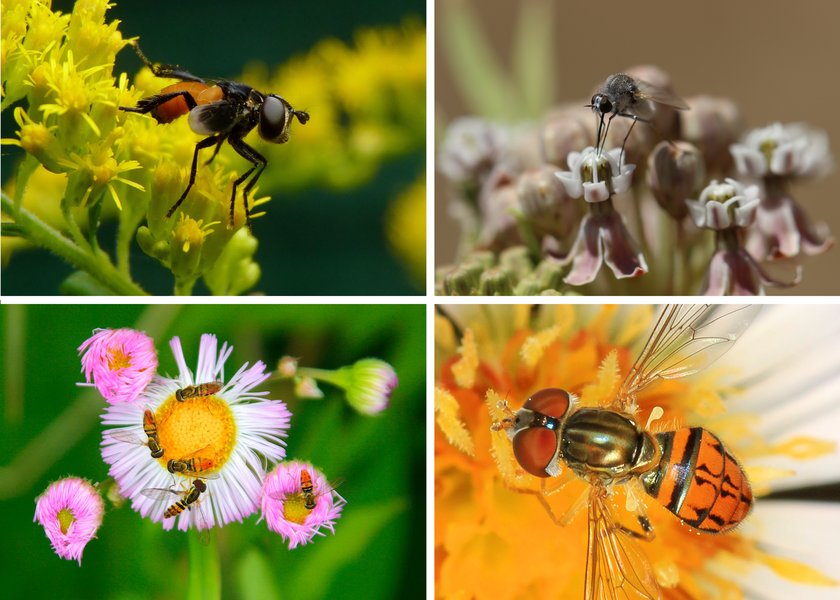
A hoverfly (Diptera), an important pollinator often mistaken for a bee.
Key Examples:
- Hoverflies (Family Syrphidae): Also known as flower flies, these are significant pollinators. Many species mimic bees or wasps in appearance (Batesian mimicry). Adults feed primarily on nectar and pollen.
- Bee Flies (Family Bombyliidae): These fuzzy flies also resemble bees and are effective pollinators, hovering to feed on nectar with their long proboscises.
- Other Flies: Various other fly families, including Muscidae (house flies and relatives) and Calliphoridae (blow flies), contribute to pollination, especially for flowers with strong, sometimes fetid, odors or easily accessible nectar/pollen. Midges (e.g., Ceratopogonidae) are crucial for pollinating some specific crops like cacao.
Pollination Role:
Flies are surprisingly important pollinators, especially in environments where bees are less active, such as high altitudes or cooler climates. Some studies suggest that non-bee insects, with flies being a major component, account for a substantial percentage (e.g., around 39%) of visits to crop flowers globally. They are particularly important for plants with small, inconspicuous flowers or those that produce yeasty or carrion-like scents.
Distinctive Characteristics:
Flies have lapping or sponging mouthparts (though some, like bee flies, have piercing-sucking proboscises adapted for nectar). They are attracted to a wide array of floral signals, including scent, color, and shape. Their diversity means they pollinate a broad spectrum of plants, from wild alpine flowers to cultivated crops.
Order Coleoptera: The Ancient Architects (Beetles)
Coleoptera is the largest order of insects, characterized by their hardened forewings, known as elytra, which protect the membranous hind wings used for flight. Beetles are considered among the earliest insect pollinators, with a history stretching back over 150 million years.
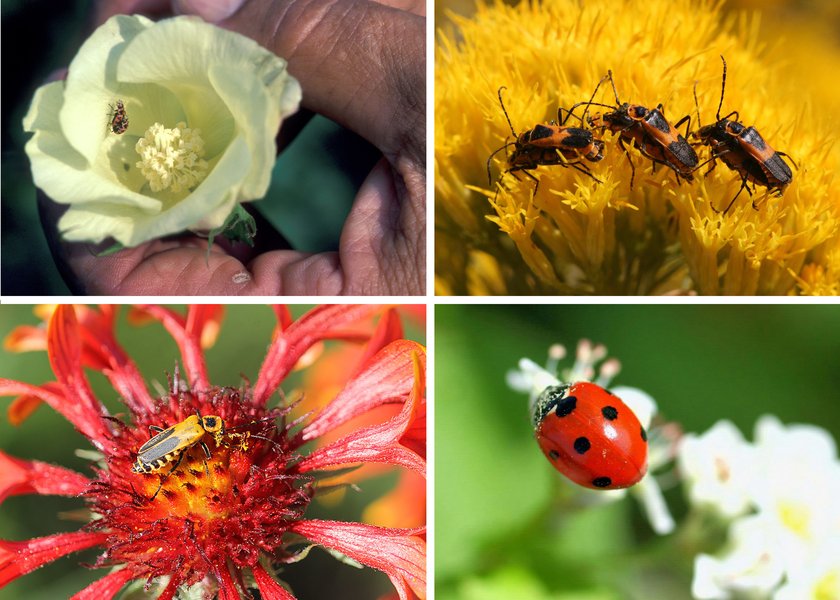
A beetle (Coleoptera) visiting a flower, representing one of the most ancient groups of pollinators.
Key Examples:
- Soldier Beetles (Family Cantharidae): Often found on flowers, feeding on pollen and nectar, and sometimes small insects.
- Scarab Beetles (Family Scarabaeidae): Some species are important pollinators, particularly for large, bowl-shaped flowers.
- Long-horned Beetles (Family Cerambycidae): Many adult long-horned beetles feed on pollen.
- Rove Beetles (Family Staphylinidae): While many are predatory, some visit flowers.
Pollination Role:
Beetle pollination, also known as cantharophily, is often associated with "primitive" or ancient lineages of flowering plants, such as magnolias, water lilies, and spicebush. These flowers are typically large, robust, bowl-shaped, and often pale or dull in color, with strong, fruity, or spicy scents. Beetles are often "mess-and-soil" pollinators; they crawl around on flowers, feeding on pollen, petals, or other floral tissues, and in the process, transfer pollen. While they might damage some floral parts, their sheer numbers and diversity make them important contributors, especially in certain ecosystems.
Distinctive Characteristics:
Beetles have chewing mouthparts. Flowers pollinated by beetles often provide ample pollen as a food reward and may have protected ovules to prevent damage from the beetles' feeding habits. Their attraction to strong scents and robust floral structures reflects their ancient co-evolutionary relationship with certain plant groups.
Beyond the Big Four: Other Insect Contributors
While the four orders detailed above encompass the vast majority of insect pollinators, other insect groups can also play a role, albeit often more incidentally or for specific plant species. For example, some species of thrips (Order Thysanoptera) and even certain true bugs (Order Hemiptera) have been observed transferring pollen. Some male mosquitoes (Order Diptera, Family Culicidae), which feed on nectar, may also contribute to pollination in a minor capacity for certain plants.
Visualizing Pollinator Contributions: A Comparative Look
To better understand the relative roles and characteristics of the primary insect pollinator orders, the following chart provides a comparative visualization. This radar chart scores each order (Hymenoptera, Lepidoptera, Diptera, Coleoptera) across several key attributes related to their pollination activities. The scores are qualitative assessments based on general ecological understanding, where a higher score indicates a stronger presence or effectiveness in that attribute. For example, "Pollination Efficiency" reflects how effectively an average member of that order transfers pollen leading to fertilization, while "Species Diversity (Pollinators)" indicates the breadth of species within that order known to engage in pollination.
This chart highlights the dominance of Hymenoptera in pollination efficiency and crop importance, while also showcasing the high species diversity among pollinating Coleoptera and Diptera, and the significant nocturnal activity of Lepidoptera (moths).
The Interconnected World of Pollination
The classification of insect pollinators reveals a complex network of interactions vital for ecological stability and human sustenance. The following mindmap illustrates the relationships between the major insect orders, their key characteristics as pollinators, and their broader ecological and evolutionary significance. It provides a visual summary of how these diverse groups contribute to the crucial process of pollination.
Specialized (Scopae)"] id1a2["Flower Constancy"] id1a3["Social & Solitary Species"] id1b["Wasps"] id1b1["Nectar Feeders"] id1b2["Generally Less
Efficient than Bees"] id1c["Ants"] id1c1["Occasional Pollinators"] id1c2["Ground-dwelling,
Smooth Bodies"] id2["Lepidoptera"] id2a["Butterflies"] id2a1["Diurnal Activity"] id2a2["Long Proboscis for Nectar"] id2a3["Attracted to Bright Colors"] id2b["Moths"] id2b1["Nocturnal/Crepuscular"] id2b2["Pollinate Night-blooming,
Scented Plants"] id3["Diptera"] id3a["Flies"] id3a1["Hoverflies (Syrphidae)
Bee Mimics"] id3a2["Bee Flies (Bombyliidae)"] id3a3["Important in Cool/High
Altitude Environments"] id3b["Diverse Feeding Habits
(Nectar, Pollen, Sap)"] id4["Coleoptera"] id4a["Beetles"] id4a1["Ancient Group of Pollinators"] id4a2["'Mess-and-Soil' Pollination"] id4a3["Attracted to Strong Scents,
Robust Flowers"] id4a4["Feed on Pollen/Floral Parts"] id5["Ecological & Economic Significance"] id5a["Aids ~80% of Flowering Plants"] id5b["Essential for Crop Production
& Food Security"] id5c["Maintains Biodiversity"] id6["Evolutionary Context"] id6a["Origins in Upper Jurassic
(~163 million years ago)"] id6b["Co-evolution with Angiosperms"] id6c["Fossil Evidence on Insect Bodies"]
This mindmap encapsulates the primary orders of insect pollinators, highlighting their distinct features and roles, and connecting them to their broader impact on ecosystems and evolutionary history. Each branch reveals the specialization and importance of these insect groups in the intricate dance of pollination.
A Glimpse into Pollination in Action
To further appreciate the mechanics and importance of pollination, the following video provides an excellent overview of how pollination occurs, distinguishing between insect-mediated and wind-mediated processes. It highlights the adaptations of both flowers and insects that make this symbiotic relationship so effective. Understanding these fundamental processes underscores why the classification and conservation of insect pollinators are critical.
The video "Pollination Explained" effectively demonstrates the journey of pollen from anther to stigma, facilitated by various agents, including insects. It visually reinforces the concepts discussed, showing how different flower structures are adapted for specific pollinators and how insects interact with these flowers to achieve pollination, a process fundamental to life on Earth.
Summary of Insect Pollinator Orders
The following table provides a concise summary of the four main insect orders involved in pollination, highlighting their key examples, primary pollination roles, and notable characteristics that make them effective (or sometimes incidental) pollinators.
| Insect Order | Key Examples | Primary Pollination Role | Notable Characteristics & Adaptations |
|---|---|---|---|
| Hymenoptera | Bees (honey bees, bumblebees, solitary bees), Wasps, Ants | Most important and efficient pollinators, especially bees. Essential for a wide range of crops and wild plants. | Branched hairs (plumose hairs) for pollen collection, pollen baskets (corbiculae) or scopae, flower constancy behavior, often social. Bees actively collect pollen as food. |
| Lepidoptera | Butterflies, Moths | Important for plants with tubular flowers or those blooming at night (moths). Can facilitate long-distance pollen transfer. | Long proboscis for nectar feeding, scales on body/wings can carry pollen. Butterflies attracted to bright colors; moths to strong scents and pale/white nocturnal flowers. |
| Diptera | Hoverflies (Syrphidae), Bee flies (Bombyliidae), Muscid flies, Midges | Significant pollinators, especially in diverse or challenging environments (e.g., high altitude, cool climates). Pollinate a wide variety of plants, including some crops. | Lapping/sponging mouthparts (some with proboscis), attracted to diverse floral signals including scents (sweet to fetid). Hoverflies often mimic bees/wasps. |
| Coleoptera | Soldier beetles, Scarab beetles, Long-horned beetles | Among the earliest insect pollinators ("mess-and-soil" pollinators). Important for ancient plant lineages and robust, scented flowers. | Chewing mouthparts, often feed on pollen and floral tissues. Attracted to strong fruity or spicy scents. Elytra (hardened forewings) cover flight wings. |
Ancient Pollinators: A Look into the Fossil Record
The relationship between insects and flowering plants is ancient. Fossil evidence indicates that insect pollination dates back at least to the Upper Jurassic period, approximately 163 million years ago, predating the widespread diversification of angiosperms (flowering plants). Early pollinators likely included beetles and primitive flies. The criteria for identifying a fossil insect as a pollinator include the presence of pollen grains attached to its body in a manner suggesting transfer to a flower's reproductive organs, or its classification within a lineage known to include modern pollinators. This long evolutionary history has shaped the intricate co-dependencies we observe today between specific insects and the plants they pollinate.
The Economic and Ecological Significance of Insect Pollinators
Insect pollinators are indispensable for ecosystem health and human well-being. Ecologically, they are keystone species, supporting the reproduction of a vast majority (around 80%) of the world's flowering plants. This underpins terrestrial biodiversity, providing food and habitat for countless other animal species. Economically, their contribution is immense. A significant portion of global food production, including many fruits, vegetables, nuts, and seeds, relies on insect pollination. The value of this ecosystem service is estimated to be hundreds of billions of dollars annually. Declines in pollinator populations, driven by habitat loss, pesticide use, climate change, and disease, therefore pose a serious threat to both natural ecosystems and agricultural productivity.
Frequently Asked Questions
What makes bees (Hymenoptera) such effective pollinators?
Bees are highly effective pollinators due to several specialized adaptations and behaviors. Many bee species have branched hairs (plumose hairs) all over their bodies that are excellent at trapping pollen grains. Female bees also possess specialized structures for carrying large amounts of pollen, such as pollen baskets (corbiculae) on their hind legs (like honey bees and bumblebees) or dense arrays of hairs called scopae on their legs or abdomen (like many solitary bees). Crucially, bees actively collect pollen as a primary food source for their larvae, meaning they visit many flowers specifically to gather it. They often exhibit "flower constancy," visiting the same plant species repeatedly during a single foraging trip, which increases the chances of successful cross-pollination.
Are all flies (Diptera) good pollinators?
Not all flies are equally effective pollinators, but many species play a significant role. Hoverflies (Syrphidae) are among the most important fly pollinators, as adults feed on nectar and pollen and their hairy bodies can transfer pollen effectively. Bee flies (Bombyliidae) are also good pollinators. Other flies, like some muscids and calliphorids, visit flowers for nectar or other secretions and can incidentally transfer pollen. Flies are particularly important in environments where other pollinators like bees are less abundant, such as high-altitude regions or during cooler weather. Some plants are specifically adapted for fly pollination, often emitting scents that mimic decaying matter or fungi to attract them.
Why are beetles (Coleoptera) considered ancient pollinators?
Beetles are considered ancient pollinators because fossil evidence suggests they were among the first insects to engage in pollination, long before bees and butterflies evolved. Their association with plants dates back to the Mesozoic Era, potentially over 150 million years ago. Many "primitive" or basal angiosperm lineages (early diverging flowering plants) like magnolias, water lilies, and spicebush exhibit characteristics consistent with beetle pollination (cantharophily). These flowers are often large, robust, bowl-shaped, and may produce strong, fruity, or spicy scents, providing ample pollen, which beetles consume along with other floral parts. This "mess-and-soil" pollination method, where beetles crawl around and feed, is thought to reflect an early stage in the evolution of insect-plant pollination relationships.
How important are non-bee insects for crop pollination?
While bees, particularly honey bees and bumblebees, are renowned for their role in crop pollination, non-bee insects also make substantial contributions. Studies have shown that insects like flies (especially hoverflies), beetles, moths, and butterflies are responsible for a significant percentage of flower visits to many important crops worldwide. For instance, some research indicates that non-bee insects contribute to about 39% of visits to crop flowers globally. Their importance can be particularly high for certain crops or in regions where managed or wild bee populations are insufficient. Maintaining a diversity of pollinators, including these non-bee groups, is crucial for resilient agricultural systems and stable food production.
Recommended
- What are the specific adaptations of bees for pollen collection?
- How do moths contribute to nocturnal pollination and which plants do they prefer?
- Explore the role of hoverflies as biocontrol agents and pollinators in agricultural systems.
- What is the evolutionary history of beetle pollination and its significance for ancient flowering plants?
References
 cdn.buglife.org.uk
Last updated May 9, 2025