
Beyond the Veil: What Truly Lies Within a Black Hole's Depths?
Unraveling the extreme physics governing the most mysterious objects in the cosmos.
Black holes represent the ultimate cosmic enigma, regions where gravity reigns supreme, warping spacetime so intensely that nothing, not even light, can escape its grasp once past a critical boundary. While we cannot send a probe inside and report back, the laws of physics, particularly Albert Einstein's theory of general relativity, combined with sophisticated simulations, offer compelling insights into the bizarre reality lurking within these gravitational prisons. Our understanding is based on theoretical physics and indirect observations, pushing the limits of current scientific knowledge.
Highlights: Peering into the Abyss
- The Event Horizon: This isn't a physical surface, but an invisible boundary marking the point of no return. Cross it, and escape becomes impossible due to the overwhelming gravitational pull.
- The Singularity: At the heart lies a theoretical point (or ring) of infinite density and zero volume, where all the black hole's mass is concentrated and known physics breaks down.
- Theoretical Framework: Our knowledge relies heavily on general relativity, but a complete picture likely requires a quantum theory of gravity to resolve paradoxes and infinities.
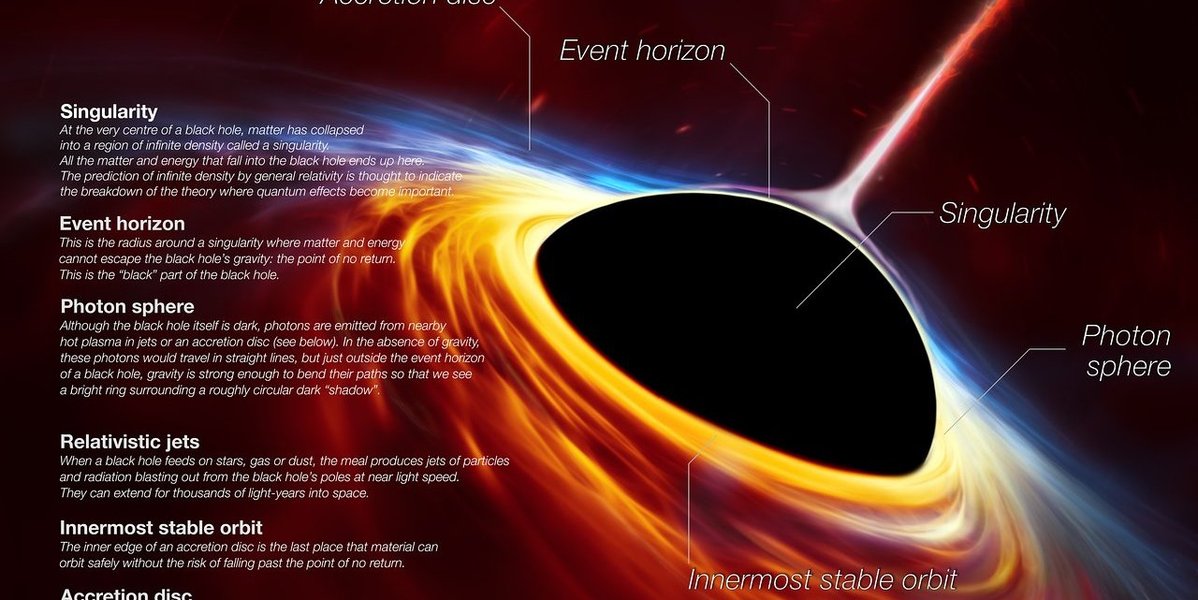
A diagram illustrating the key components often associated with a black hole, including the event horizon and the central singularity.
The Boundary of No Return: The Event Horizon
Every black hole is defined by its event horizon. Imagine it as a one-way membrane surrounding the central mass. Outside this boundary, objects can potentially orbit or escape the black hole's influence if they have sufficient velocity. However, the moment anything – matter, light, information – crosses the event horizon, its fate is sealed. The escape velocity required exceeds the speed of light, an impossibility according to physics as we know it. From the perspective of an external observer, objects falling in appear to slow down and fade as they approach the horizon due to extreme time dilation, never quite seeming to cross. For the object falling in, however, crossing the event horizon might initially seem uneventful (especially for supermassive black holes where tidal forces are weaker at the horizon), but the path inevitably leads inward.
Journey Towards the Center: Descent into Extreme Gravity
Once inside the event horizon, the fabric of spacetime itself is distorted in an extreme way. Space is thought to flow inwards towards the singularity faster than light, dragging everything with it. There is no standing still; all paths lead inexorably towards the center.
Tidal Forces and Spaghettification
The Ultimate Stretch
As an object or astronaut falls deeper into the black hole, they would experience increasingly powerful tidal forces. Gravity pulls more strongly on the parts of the object closer to the singularity than on the parts farther away. This differential pull stretches the object vertically while compressing it horizontally. This process, graphically termed "spaghettification," would tear apart anything from stars to atoms long before reaching the center, reducing matter to a stream of fundamental particles.
The Inner Horizon (Rotating Black Holes)
A More Complex Interior
While the simplest models describe non-rotating (Schwarzschild) black holes, most black holes in the universe are expected to rotate, having inherited angular momentum from the stars that collapsed to form them or from matter they accreted. These rotating (Kerr) black holes possess a more complex internal structure. Inside the event horizon, they are predicted to have an additional boundary known as the inner horizon, or Cauchy horizon.
Beyond the inner horizon, the bizarre nature of spacetime predicted by general relativity becomes even more extreme. Some interpretations suggest that time might loop back on itself, or that predictability breaks down completely. However, theoretical studies also indicate that the inner horizon is likely catastrophically unstable. Infalling radiation and matter would get infinitely blueshifted (energized) as they approach this boundary, potentially creating a firewall or chaotic region that prevents passage or drastically alters the spacetime structure described by the idealized Kerr solution.
The Enigmatic Core: The Singularity
Regardless of the path taken inward, all matter and energy that fall into a black hole are believed to end up at the central singularity. This is the defining feature of the black hole's interior according to classical general relativity.
Infinite Density, Zero Volume
Where Physics Stumbles
The singularity is theorized to be a region where the entire mass of the black hole is crushed into a point of zero volume and therefore infinite density. At this point, the gravitational pull becomes infinitely strong, and the curvature of spacetime becomes infinite. Our current understanding of physics, including general relativity, cannot adequately describe the conditions at the singularity itself; the equations yield infinities, signaling a breakdown of the theory.
Point vs. Ring Singularities
Shape Matters
The nature of the singularity depends on whether the black hole is rotating.
- Schwarzschild Black Hole (Non-Rotating): The singularity is thought to be a single point at the geometric center.
- Kerr Black Hole (Rotating): The singularity is theorized to be smeared out into a ring shape, confined to the plane of rotation. This ring singularity presents even more theoretical complexities and potential pathways, though the extreme conditions likely remain.
Visualizing the Black Hole Interior Structure
While we cannot see inside, theoretical models allow us to map the key concepts and regions within a black hole. The following mindmap outlines the primary components and phenomena associated with the interior, based on our current understanding derived largely from general relativity.
This mindmap illustrates the journey from the event horizon inwards, highlighting the increasing extremity of conditions and the theoretical nature of structures like the inner horizon and the singularity, along with the fundamental questions addressed by quantum physics.
Beyond Classical Physics: Quantum Quandaries and Theories
The concept of an infinitely dense singularity is problematic for physicists. Infinities often signal that a theory is incomplete or being applied outside its domain of validity. It is widely believed that a theory of quantum gravity – one that successfully merges general relativity (governing gravity and large scales) with quantum mechanics (governing small scales) – is needed to truly understand the center of a black hole.
The Information Paradox
Where Does Information Go?
A major puzzle is the black hole information paradox. Quantum mechanics dictates that information about a system cannot be permanently destroyed. However, classical black holes seem to destroy the information contained within the matter they consume, as Hawking radiation (the faint thermal radiation predicted to be emitted by black holes) appears to be random and contain no details about what fell in. Resolving this paradox is a key driver in developing quantum gravity theories, with ideas like the holographic principle suggesting information might be encoded on the event horizon.
Quantum Gravity's Role
Resolving the Singularity
Quantum gravity theories, such as string theory or loop quantum gravity, propose alternatives to the classical singularity. They suggest that at the incredibly small scales (Planck scale) near the center, quantum effects become dominant, preventing the formation of an infinitely dense point. Instead, matter might be compressed into an exotic state of matter or a highly energetic region, sometimes theorized as a "Planck star" or a "fuzzball," effectively smearing out the singularity and resolving the infinities predicted by general relativity.
Theoretical Possibilities: Wormholes and Beyond
Tunnels Through Spacetime?
Some solutions within general relativity, particularly for rotating black holes, theoretically permit the existence of wormholes – hypothetical tunnels connecting different points in spacetime or even different universes – potentially accessible beyond the inner horizon. However, these wormholes are generally considered highly unstable. Even tiny amounts of infalling energy would likely cause them to collapse instantly, making them impractical for travel or observation. While mathematically intriguing, there is no evidence that such structures exist or are physically possible within real black holes.
Assessing Our Understanding: A Conceptual Radar
This chart provides a conceptual overview comparing different regions associated with a black hole based on several factors. The scores are relative estimations reflecting the consensus in theoretical physics, where '1' represents the lowest value (e.g., zero observability) and '10' the highest (e.g., high certainty based on classical physics).
The chart illustrates how our classical certainty decreases and the influence of quantum effects likely increases as one approaches the singularity. Observability drops to zero past the event horizon, while spacetime complexity dramatically increases towards the center.
Comparing Black Hole Interiors: Rotating vs. Non-Rotating
The internal structure predicted by general relativity differs significantly depending on whether the black hole possesses angular momentum (rotation). This table summarizes the key theoretical differences between the interiors of simple Schwarzschild (non-rotating) and more complex Kerr (rotating) black holes.
| Feature | Schwarzschild Black Hole (Non-Rotating) | Kerr Black Hole (Rotating) |
|---|---|---|
| Rotation | No angular momentum | Possesses angular momentum |
| Singularity Type | Point singularity (at r=0) | Ring singularity (in the equatorial plane) |
| Horizons | One Event Horizon | Outer Event Horizon, Inner (Cauchy) Horizon |
| Ergosphere | No | Yes (a region outside the event horizon where spacetime is dragged along with the rotation) |
| Internal Structure Complexity | Simpler; paths lead directly to the point singularity | More complex; includes inner horizon, potentially unstable regions, more intricate spacetime geometry |
| Theoretical Stability Issues | Singularity itself represents breakdown of GR | Singularity breakdown, plus potential instabilities associated with the Inner Horizon |
| Wormhole/Exotic Path Possibility (Theoretical) | Generally no | Mathematically possible in idealized solutions (but likely physically unstable) |
Note: The ergosphere is technically outside the event horizon but is intrinsically linked to the rotation influencing the black hole's structure. The stability issues and exotic possibilities within Kerr interiors are subjects of ongoing theoretical debate.
Visualizing the Plunge: A Simulated Journey
To help conceptualize the experience of approaching and theoretically crossing the event horizon, NASA scientists created an immersive simulation. This video visualizes the extreme warping of light and spacetime from the perspective of a camera falling towards a supermassive black hole, offering a glimpse into the distorted reality near these cosmic objects. While it doesn't show the interior *past* the point of no return (as that's unseeable), it dramatically illustrates the effects just outside and at the threshold.
This simulation showcases phenomena like gravitational lensing (the bending of light from background stars) and the appearance of the photon ring, offering a scientifically grounded visual interpretation of the journey towards the event horizon based on general relativity.
Frequently Asked Questions (FAQ)
Can we ever see inside a black hole?
No, not directly. The event horizon acts as a one-way barrier. Since the escape velocity inside exceeds the speed of light, no light or any other information can travel from the inside back out to external observers. Our understanding is based purely on theoretical physics (like general relativity), mathematical models, and indirect observations of the black hole's effects on its surroundings.
What happens to time inside a black hole?
According to general relativity, time and space are heavily distorted inside a black hole. From the perspective of someone falling in, time might continue to pass locally. However, the theory suggests that inside the event horizon, the roles of time and space coordinates can effectively switch, meaning that movement forward in time inevitably means movement towards the singularity, just as movement towards the center of the Earth is inevitable once you jump off a building. Near the singularity, the concept of time as we understand it breaks down completely.
Is a black hole just empty space inside, apart from the singularity?
This is complex. Classically, once matter falls in, it's destined for the singularity. This might imply that much of the volume inside the event horizon is "empty" warped spacetime, with all the mass concentrated at the center. However, quantum theories might suggest a different picture, possibly replacing the singularity with an exotic ultra-dense state or structure that isn't a single point. Additionally, infalling radiation and particles continuously cross the horizon, so the interior isn't static or necessarily devoid of energy fields, especially near unstable regions like the inner horizon in rotating black holes.
Could black holes contain wormholes to other universes?
Mathematically, certain idealized solutions of general relativity (especially for rotating or charged black holes) allow for the possibility of wormholes connecting to other regions of spacetime or potentially other universes. However, these theoretical wormholes are widely believed to be extremely unstable. Even the slightest perturbation (like a single photon entering) would likely cause them to collapse instantly, making them untraversable. There is currently no observational evidence supporting the existence of stable wormholes inside black holes.
What's the main difference between a rotating and non-rotating black hole's interior?
The biggest differences lie in the singularity and the presence of an inner horizon. A non-rotating (Schwarzschild) black hole has a single event horizon and a point-like singularity at the center. A rotating (Kerr) black hole has both an outer event horizon and an inner (Cauchy) horizon, and its singularity is theorized to be ring-shaped instead of a point. This more complex structure leads to different theoretical possibilities and stability issues within the interior.
Recommended Investigations
- Explore the profound puzzle questioning whether information is truly lost inside black holes.
- Delve into Einstein's theory and its predictions about the extreme curvature at a black hole's core.
- Compare the properties and structures of non-rotating versus rotating black holes.
- Investigate how theories like string theory or loop quantum gravity might resolve the infinities predicted by classical physics.
References
Last updated May 4, 2025