
Unveiling the Mysteries: What Would the Inside of a Wormhole Truly Look Like?
Journey into the theoretical heart of spacetime's most enigmatic shortcuts, exploring what science suggests lies within.
Key Insights: Peering into a Wormhole
- A Tunnel Through Spacetime: Theoretically, a wormhole's interior is a passage with extreme spacetime curvature, connecting two distant points.
- Visual Ambiguity: The inside might appear as utter darkness due to light being trapped or severely diffracted, or it could present a distorted, spherical view of the light from the exit region.
- Exotic Conditions: Traversable wormholes would require "exotic matter" with negative energy density to remain stable, a concept still deep in theoretical physics.
What is a Wormhole, Theoretically Speaking?
A wormhole, a fascinating concept rooted in Albert Einstein's theory of general relativity, is a hypothetical structure or passage that could create a shortcut through spacetime. Imagine the fabric of the universe as a vast sheet of paper; if you wanted to get from one point on the sheet to another, you could travel across the surface. A wormhole, in this analogy, would be like punching a hole through the paper and creating a tunnel directly connecting these two points, potentially reducing travel time and distance significantly. While no wormhole has ever been directly observed, they remain a compelling subject for astrophysicists exploring the nature of space, time, and gravity.
Gazing into the Abyss: The Theoretical Interior View
Venturing into the hypothetical interior of a wormhole would be unlike any experience known. Scientists speculate on its appearance based on the laws of physics, particularly how extreme gravity would warp spacetime and affect light.
A Tunnel Through Spacetime
The most common visualization of a wormhole's interior is that of a tunnel or a tube. However, this isn't a simple, straight passage. Due to the immense gravitational forces at play, spacetime itself would be incredibly curved and distorted. This curvature would define the "walls" and geometry of the wormhole. As you traverse it, the very notions of direction and distance might become fluid and counterintuitive.
A Realm of Darkness or Distorted Light?
There's ongoing debate and speculation about what one might actually see.
Total Darkness
Some theories suggest the interior could be completely black. The extreme warping of spacetime might be so severe that light from the outside universe cannot propagate normally within the wormhole. Visible light could be entirely diffracted, absorbed, or redshifted out of the visible spectrum, leaving an observer in profound darkness, with only the gravitational forces to indicate their passage.
Distorted Visions
Alternatively, if the wormhole is traversable and connects to another region of space (or another time), light from the "exit" mouth could penetrate the interior. This wouldn't be a clear window, though. The intense gravity would act as a powerful gravitational lens, bending and distorting the light dramatically. You might see the destination universe as a warped, shimmering image, possibly appearing as a spherical "window" that expands as you approach it. Objects would appear stretched, compressed, or multiplied, creating a bizarre and disorienting panorama.
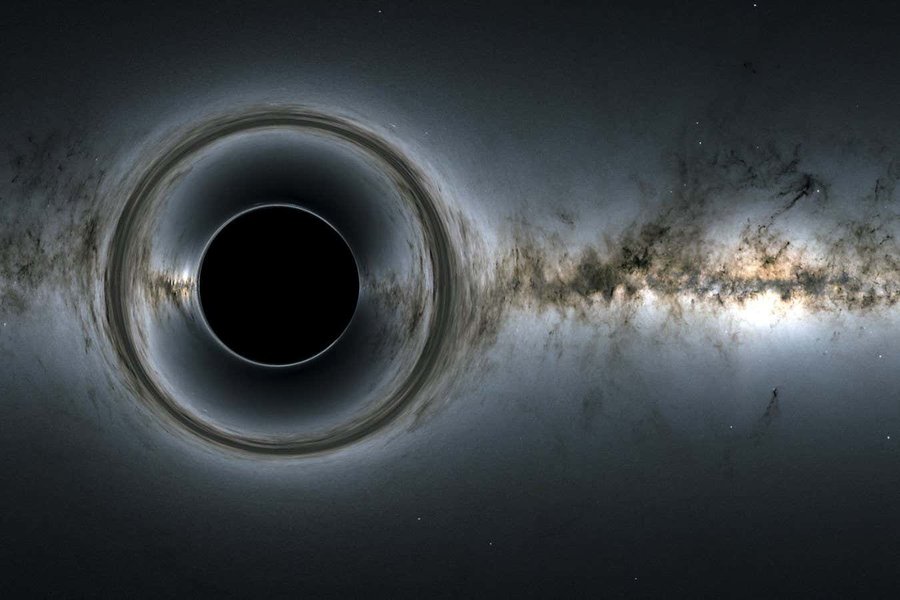
An artistic representation illustrating a wormhole as a glowing portal connecting two separate points in the cosmos.
The Spherical Portal: Approaching the Exit
If light from the destination is visible, physicists like Kip Thorne, who consulted on the movie *Interstellar*, have described the view. As one travels through the wormhole's "throat" (its narrowest point), the destination might initially appear as a small, distorted sphere of light. As the traveler moves closer to the exit, this sphere would appear to grow larger, eventually engulfing their entire field of view as they emerge into the new region of spacetime. The light from the origin universe would simultaneously appear to shrink behind them into a similar receding sphere.
Visualizing the Unseen: Cinematic and Scientific Perspectives
Since direct observation is impossible, our understanding of a wormhole's interior is shaped by theoretical models, scientific simulations, and artistic interpretations, most notably in cinema.
The Interstellar Model: Science Meets Art
The 2014 film *Interstellar* provided one of the most scientifically-grounded cinematic depictions of a wormhole. Physicist Kip Thorne's work heavily influenced its external appearance as a calm, spherical distortion in space. However, the journey *through* the wormhole's interior in the film involved significant artistic license to create a dynamic and visually engaging experience for the audience. While the external view was modeled on Thorne's equations for gravitational lensing, the internal "tunnel" with its flowing, colorful textures was more interpretive than a direct simulation of what physics equations strictly predict for the interior visual experience. It aimed to convey the distortion of spacetime and the connection between two distant points.
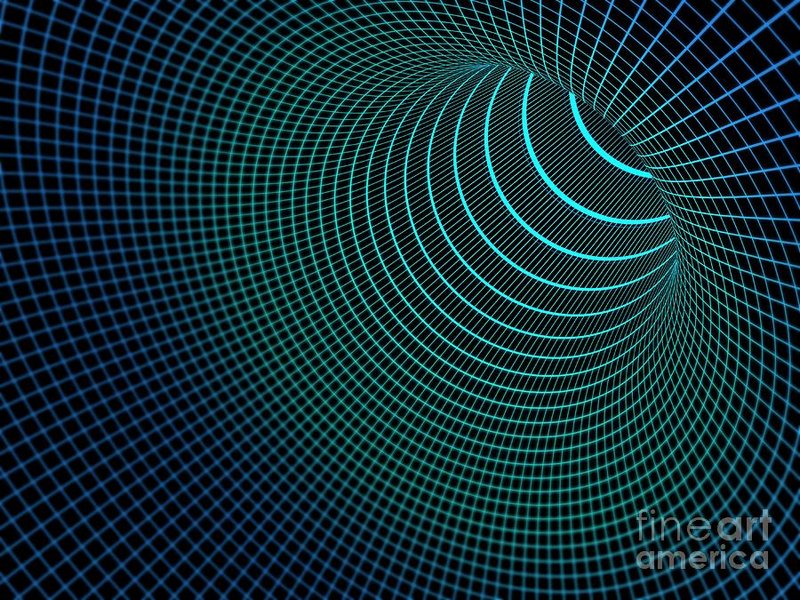
An artist's conception of the vibrant and distorted passage through a wormhole's interior, showcasing complex light patterns and textures.
Modern Simulations: Refining the Vision
Recent scientific simulations, using powerful computers to solve the complex equations of general relativity, attempt to provide more rigorous visualizations. These simulations often depict the gravitational lensing effects in detail, showing how light rays from distant stars and galaxies would be bent and warped around and through the wormhole. They often confirm the idea of seeing the exit as an expanding sphere of distorted light. However, the precise texture, color, or "feel" of the interior remains speculative, heavily dependent on the specific mathematical model of the wormhole used.
The Fabric of a Wormhole: Geometry and Conditions
The nature of a wormhole's interior is inextricably linked to its geometry and the exotic physics required for its existence and stability.
The Crucial "Throat"
A key feature of a wormhole is its "throat" – the narrowest part of the tunnel connecting the two "mouths" in different regions of spacetime. The geometry of this throat is critical. For a traversable wormhole (one that something could pass through), the throat must remain open. In many theoretical models, if a wormhole were formed from ordinary matter or energy, its throat would pinch off and collapse into a singularity almost instantaneously, making passage impossible.
The Stability Conundrum: Exotic Matter
To keep a wormhole's throat open and traversable, theoretical physics posits the need for "exotic matter." This isn't matter in any conventional sense; it's a hypothetical substance that possesses negative mass or, more precisely, negative energy density. Such matter would exert a kind of gravitational repulsion, propping open the wormhole against its natural tendency to collapse. While negative energy density is known to occur at a quantum level (e.g., the Casimir effect), whether enough could be harnessed to stabilize a macroscopic wormhole is unknown. Without such stabilization, any object attempting to pass through would likely be crushed, or the wormhole would radiate immense energy, destroying anything within.
Comparative Analysis of Wormhole Interior Properties
The hypothetical nature of wormholes leads to varied predictions about their internal characteristics. The radar chart below offers a speculative comparison of different types of wormhole interiors based on several key properties. "Idealized Traversable" refers to a theoretically perfect, stable wormhole. "Highly Unstable" represents a wormhole prone to collapse. "Cinematic Depiction" reflects how wormholes are often portrayed in films like *Interstellar*, balancing scientific plausibility with dramatic effect. The scores (from a minimum of 2 to a maximum of 10) are illustrative and not based on empirical data.
Interconnected Concepts of Wormhole Interiors
Understanding the inside of a wormhole involves grasping several interconnected theoretical concepts. The mind map below illustrates these key relationships, from the foundational principles in general relativity to the speculative visual experiences and conditions required for traversability.
(Light Diffraction/Absorption)"] id2d["Distorted Light from Exit
(Gravitational Lensing)"] id2e["Expanding/Contracting
View of Destination/Origin"] id3["Key Physical Features"] id3a["Extreme Spacetime Curvature"] id3b["The 'Throat'
(Narrowest Point)"] id3c["Non-Euclidean Geometry"] id4["Traversability & Stability"] id4a["Exotic Matter Requirement
(Negative Energy Density)"] id4b["Casimir Effect (Theoretical Support)"] id4c["Stability Issues
(Rapid Collapse without Exotic Matter)"] id4d["Potential Dangers
(Radiation, Tidal Forces, Collapse)"] id5["Depictions & Visualizations"] id5a["Cinematic (e.g., *Interstellar*)
- Scientific Input & Artistic License"] id5b["Scientific Simulations
(Ray-tracing in Curved Spacetime)"] id5c["Mathematical Models"]
Perspectives on Wormhole Characteristics
The table below synthesizes various theoretical characteristics of a wormhole's interior, combining insights from different aspects of physics research. It highlights how the structure, spacetime properties, light behavior, and stability requirements all contribute to the hypothetical experience of being inside a wormhole.
| Feature | Theoretical Description | Visual Implication for an Observer Inside | Basis in Physics Principles |
|---|---|---|---|
| Overall Structure | A topological tunnel connecting two distinct, potentially distant, points in spacetime. | Experience of traversing a passage or conduit, not ordinary space. | General Relativity (e.g., Einstein-Rosen bridge solutions). |
| Spacetime Geometry | Extremely curved and warped spacetime; non-Euclidean geometry. | Severe distortion of perceived space, directions, and distances; possibly disorienting. | Solutions to Einstein's field equations describing gravitational fields. |
| Light Propagation | Light paths are severely bent by gravity (gravitational lensing) or light may be unable to propagate normally. | Potentially complete darkness, or highly distorted, warped, and possibly magnified/minified views of the exit region. | General Relativity, optics in curved spacetime. |
| View of Entrance/Exit | Light from the destination (or origin) might appear as a roughly spherical "window" or portal. | The exit point could appear as an expanding sphere of light as approached, while the entry point recedes into a shrinking sphere. | Ray-tracing simulations based on general relativistic models. |
| Stability & Traversability | Requires exotic matter (possessing negative energy density) to counteract gravitational collapse of the throat. | A stable wormhole might allow smooth passage; an unstable one would collapse violently, likely preventing traversal and destroying anything within. | Theoretical concepts in quantum field theory (e.g., Casimir effect as a source of negative energy) and general relativity. |
| Internal Environment | Potentially subject to extreme tidal forces, high radiation levels (especially if unstable or from infalling matter). | Hostile conditions, unless specific types of "benign" wormholes are theorized. | Gravitational physics, particle physics in strong fields. |
Visualizing a Journey Through a Wormhole
While purely theoretical, scientists and artists have attempted to visualize what traveling through a wormhole might look like. The video below presents one such simulation, aiming to depict the relativistic effects on light and perception during such a hypothetical journey. It showcases how views of the outside universe might be warped and how the "tunnel" itself could appear based on mathematical models.
This simulation attempts to incorporate principles of general relativity to illustrate the profound distortions of light and space one might encounter. Notice how the light from the "exit" seems to engulf the view as the observer approaches it, and how the surrounding space appears incredibly warped due to gravitational lensing effects. Such visualizations, while speculative, help us imagine the extraordinary environments predicted by theoretical physics.
Frequently Asked Questions About Wormhole Interiors
Is the inside of a wormhole always dark?
Not necessarily. While one theory suggests extreme spacetime warping could prevent light from propagating normally, leading to darkness, another posits that light from the wormhole's exit could be visible. This light would be heavily distorted by gravitational lensing, appearing perhaps as a warped, spherical view of the destination.
Would you see stars inside a wormhole?
It's unlikely you'd see stars in the conventional sense *lining the walls* of the wormhole. If the wormhole is traversable, you might see a distorted view of the stars and galaxies located at the exit mouth of the wormhole. This view would be subject to extreme gravitational lensing, so stars might appear as streaks, multiple images, or part of a warped spherical vista.
What does the "throat" of a wormhole look like?
The "throat" is the narrowest part of the wormhole. From the inside, approaching or passing through the throat would likely involve seeing the light from the destination (or origin) concentrated and heavily distorted. In three spatial dimensions, the opening of the throat is often theorized to be spherical. The visual experience would be one of extreme spatial distortion.
How big is a wormhole on the inside?
The size of a wormhole's interior is purely theoretical and depends on the specific model. For a wormhole to be traversable by humans or spacecraft, its throat would need to be sufficiently large – perhaps kilometers in diameter, as suggested in some models for *Interstellar*. However, naturally occurring wormholes, if they exist, could be microscopic, or vast. The "length" of the tunnel is also model-dependent and doesn't necessarily correspond to a simple Euclidean distance.
Could you survive a trip through a wormhole?
This is highly speculative. Survival would depend on several factors:
1. Stability: The wormhole must be stabilized by exotic matter to prevent it from collapsing.
2. Tidal Forces: The gravitational forces might be so extreme that they would rip apart any object (spaghettification). A very large wormhole would have gentler tidal forces.
3. Radiation: Interaction with matter or energy entering the wormhole could produce intense radiation.
Currently, the conditions required for a safe, traversable wormhole are beyond our technological capabilities and understanding.
Explore Further
- What is exotic matter and how could it stabilize a wormhole?
- How does gravitational lensing affect light near massive objects like wormholes?
- Are there different theoretical types of wormholes and how do their interiors differ?
- What are the main challenges in detecting or creating a wormhole?
References
Last updated May 7, 2025