

Key Insights into Their Interplay
- Integral transforms are broad mathematical tools that convert functions between different domains using a kernel, primarily simplifying complex operations like differentiation.
- Transmutation operators are a specialized class of operators that specifically intertwine two differential operators, mapping solutions from one differential equation to another.
- The fundamental relationship lies in integral transforms often serving as the building blocks and explicit constructions for transmutation operators, facilitating the solution of otherwise intractable problems.
In the expansive realm of advanced mathematical analysis, integral transforms and transmutation operators stand as two distinct yet intricately connected concepts. Both are instrumental in simplifying and solving formidable challenges, particularly within the domain of differential equations and spectral theory. While integral transforms offer a general framework for function manipulation, transmutation operators represent a more specialized application, often constructed through the very mechanisms provided by integral transforms.
Understanding the foundational role of kernels in function space transformations.
An integral transform is a mathematical operator that transforms a function from its original domain into a different function space. This transformation is achieved through an integration process involving a specific "kernel" function. The general mathematical representation of an integral transform \(T\) applied to a function \(f\) is given by:
\[ (Tf)(u) = \int_{t_1}^{t_2} f(t) K(t,u) \, dt \]Here, \(K(t,u)\) is the unique "kernel" of the transform, which dictates the nature of the transformation. Famous examples include the Fourier Transform and the Laplace Transform, which are widely employed to convert complex differential or integral equations into simpler, often algebraic, forms. This simplification makes the equations more tractable, after which an inverse transform can be applied to revert the solution back to the original domain.
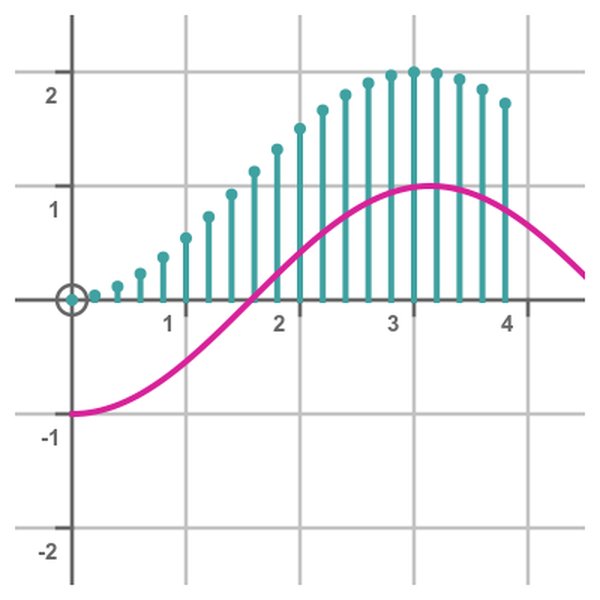
An illustration of an integral, a core component of integral transforms.
The utility of integral transforms lies in their ability to streamline mathematical operations. For instance, differentiation in the original domain often corresponds to multiplication in the transform domain, significantly simplifying the process of solving differential equations. This characteristic makes them indispensable tools across various scientific and engineering disciplines.
The specialized role of intertwining operators in mathematical physics.
Transmutation operators, also known as transformation or intertwining operators, serve a distinct and powerful purpose: they relate two different differential operators, say \(L_1\) and \(L_2\), in such a way that specific structural properties are preserved. This relationship is typically expressed as:
\[ T L_1 = L_2 T \]This equation signifies that applying \(L_1\) to a function and then applying \(T\) yields the same result as applying \(T\) first and then \(L_2\). This property allows for the mapping of solutions from one differential equation (governed by \(L_1\)) to solutions of another (governed by \(L_2\)). Such operators are particularly valuable in scenarios where one differential equation is easier to solve than another, enabling mathematicians to transform a complex problem into a more manageable one.
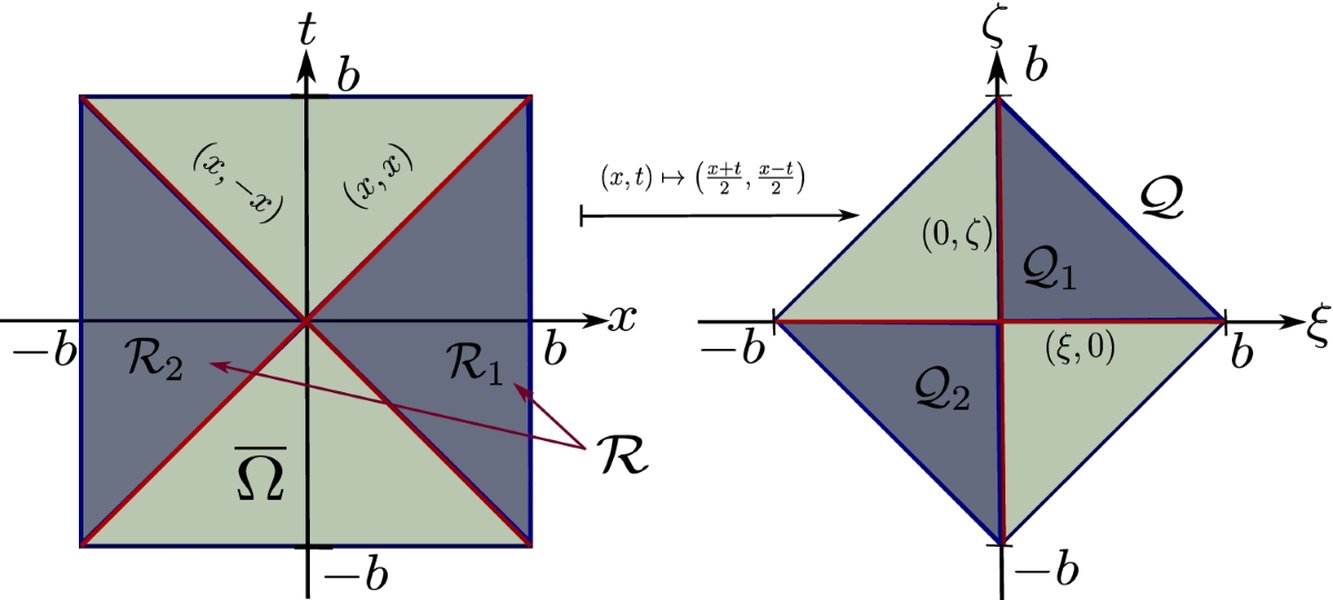
A visual representation often associated with mathematical operators, hinting at the complexity transmutation operators simplify.
Transmutation operators often take the form of integral operators, much like integral transforms, utilizing a specific kernel function designed to achieve the desired intertwining property. Their applications extend to areas such as inverse problems, scattering theory, and the derivation of connection formulas for solutions of singular differential equations.
From foundational tools to explicit constructions.
The relationship between integral transforms and transmutation operators is profound and multifaceted. While integral transforms provide the broad machinery for transforming functions, transmutation operators often leverage this machinery to achieve their specialized goal of relating differential operators. In essence, transmutation operators can be viewed as a specialized subset or application of integral transforms.
Here's a breakdown of their interconnectedness:
- Shared Mechanism: Both concepts frequently involve integral operators characterized by specific kernel functions. This shared integral form is a key point of overlap.
- Construction via Integral Transforms: Many transmutation operators can be explicitly constructed using methods derived from integral transforms. The Integral Transform Composition Method (ITCM) is a notable technique that systematically uses compositions of integral transforms to build transmutation operators. This highlights how integral transforms serve as foundational building blocks.
- Problem Simplification: Both tools aim to simplify mathematical problems. Integral transforms do so by moving to a more convenient domain, while transmutation operators achieve simplification by transforming a difficult differential equation into an easier one, or by revealing hidden connections between them.
- Intertwining Property: A crucial distinction is that while any integral transform transforms a function, only those that satisfy the specific intertwining property \(T L_1 = L_2 T\) can be classified as transmutation operators in that context. This means some integral transforms can indeed act as transmutation operators when they fulfill this condition.
The synergy between these concepts is particularly evident in their application to solving complex boundary value problems, inverse problems, and spectral theory. By transforming problems into more tractable forms, often through the meticulous design of specific integral kernels, they collectively unlock solutions to challenges that would otherwise be insurmountable.
Visualizing the Conceptual Connections
To further illustrate the intricate relationships and functionalities of integral transforms and transmutation operators, consider the following mindmap. It visualizes how these concepts branch out and connect within the broader landscape of mathematical analysis and problem-solving.
A mindmap illustrating the core concepts and their relationships.
This mindmap clearly shows that while integral transforms are a broader category, transmutation operators are deeply rooted in their principles, often employing integral transform techniques for their construction and application.
Bridging theory with real-world problem-solving.
The combined power of integral transforms and transmutation operators finds extensive applications in various fields of mathematical physics and engineering. From understanding wave propagation to analyzing heat conduction, these tools provide robust frameworks for developing exact solutions and theoretical insights.
| Feature | Integral Transforms | Transmutation Operators |
|---|---|---|
| Primary Function | Converts functions from one domain to another to simplify operations. | Relates different differential operators and maps solutions between them. |
| Key Component | General kernel function \(K(t,u)\). | Specific kernel designed to satisfy intertwining relation. |
| Scope | Broad, general mathematical tool. | Specialized, often a form of integral operator. |
| Core Relation | \((Tf)(u) = \int f(t) K(t,u) \, dt\) | \(T L_1 = L_2 T\) |
| Typical Applications | Solving differential equations, signal processing, convolution problems. | Solving boundary value problems, inverse scattering problems, spectral theory. |
| Interconnectedness | Can serve as the basis for constructing transmutation operators. | Often implemented or constructed using integral transform methods (e.g., ITCM). |
A comparison of key characteristics and applications.
One compelling example is in heat conduction problems, where the transmutation operator method, often derived via integral transforms, provides exact solutions to initial boundary value problems. Similarly, in wave equations, integral transforms are composed to create transmutations that facilitate problem-solving. This interplay is not just theoretical; it underpins many advanced numerical and analytical techniques in computational spectral theory and inverse problems.
A visual journey into their foundational principles.
To further contextualize the power and intricacies of integral transforms, particularly the Laplace Transform, which is often crucial in the construction of transmutation operators, consider watching the following video. It provides an insightful look into how such transforms are applied to differential equations, a domain where both integral transforms and transmutation operators play pivotal roles.
Lecture on The Laplace Transform and Differential Equations, highlighting integral transform applications.
This video delves into the practical application of the Laplace Transform in solving differential equations, demonstrating the very simplification process that underlies the utility of integral transforms and, by extension, the methods used to construct transmutation operators. Understanding the mechanics of such transforms is essential for appreciating how they can be adapted to fulfill the more specialized role of intertwining different differential operators.
Frequently Asked Questions (FAQ)
What is the primary difference between an integral transform and a transmutation operator?
Can an integral transform also be a transmutation operator?
What is the Integral Transform Composition Method (ITCM)?
Where are these mathematical tools primarily applied?
Conclusion: A Powerful Symbiosis in Advanced Mathematics
The relationship between integral transforms and transmutation operators is a testament to the elegant interconnectedness within advanced mathematics. Integral transforms provide the broad, flexible framework for manipulating functions across different domains, offering a foundational mechanism for simplifying complex problems. Transmutation operators, building upon this foundation, offer a more specialized and profound capability: the ability to bridge disparate differential equations, revealing hidden connections and enabling the solution of otherwise intractable problems. This synergistic relationship underscores their indispensable role in pushing the boundaries of analytical and computational solutions across various scientific and engineering disciplines.
Recommended Further Exploration
- Advanced applications of Laplace transforms in differential equations
- Construction methods for transmutation operators using integral kernels
- Role of spectral theory in understanding operator relationships
- Integral transform composition method and its impact on solving PDEs