
Streamlining EPC Projects: Integrating NCR Tracking and Enhancing Stakeholder Communication
Ensuring quality and transparency through seamless document control and proactive notifications.
In the complex world of Engineering, Procurement, and Construction (EPC) projects, managing deviations from standards is crucial. Non-Conformance Reports (NCRs) are vital tools for identifying, documenting, and resolving these issues. This response details how integrating NCR tracking with document control systems and establishing clear client notification protocols enhances project management, ensures quality, and maintains stakeholder trust, particularly emphasizing the EPC contractor's responsibilities.
Key Highlights
- Integrated Systems: Full integration of NCR tracking into the project's Document Control System (DCS) is essential for centralized management, version control, automated workflows, and comprehensive audit trails.
- Proactive Client Notification: A specific provision mandates notifying the client promptly when an NCR impacts project timelines or deliverables, detailing the issue, impact, and corrective actions.
- EPC Accountability: The EPC contractor guarantees proper notification to all concerned parties (client, internal teams, subcontractors) regarding impactful NCRs, fostering transparency and collaborative problem-solving.
The Imperative of Integrated NCR Management
Non-Conformance Reports serve as the formal mechanism within a Quality Management System (QMS) to document any product, service, or process that fails to meet specified requirements. Effectively managing these reports is not just about compliance; it's about maintaining project integrity, controlling costs, and ensuring timely delivery. Integrating NCR tracking directly into the project's central document control system transforms it from a reactive measure into a proactive quality assurance strategy.
Integrating NCR and Corrective Action Report (CAR) processes with document control software streamlines quality management.
Why Integrate NCR Tracking with Document Control?
Siloed NCR processes, often managed through spreadsheets or disparate emails, are prone to errors, delays, and lack of visibility. Integration with a robust Document Control System (DCS) provides numerous advantages:
Centralized Management and Accessibility
A DCS provides a single source of truth for all project documentation, including NCRs. This ensures that NCRs are properly recorded, assigned unique identifiers, linked to relevant specifications or drawings, and easily retrievable by authorized personnel. Centralization eliminates version conflicts and ensures everyone works with the most current information.
Automated Workflows and Efficiency
Modern DCS platforms can automate the NCR lifecycle – from initiation and review to approval, corrective action tracking, and closure. Automated workflows ensure tasks are routed to the correct individuals promptly, reducing administrative overhead and accelerating resolution times. Notifications within the system keep stakeholders informed of progress.
Enhanced Traceability and Audit Trails
Integration provides a complete, auditable history of each NCR. Every action, decision, and revision is logged, creating a transparent record essential for quality audits, compliance checks, and demonstrating due diligence. This traceability also facilitates root cause analysis and the identification of recurring issues.
Improved Collaboration and Standardization
A DCS facilitates collaboration among different teams (engineering, procurement, construction, QA/QC) involved in the NCR process. It can enforce the use of standardized NCR templates, ensuring consistent data capture and reporting across the project.
Impact Assessment: Integrated vs. Non-Integrated NCR Systems
The transition from a manual or siloed NCR tracking method to a fully integrated system within the Document Control System yields significant improvements across key performance areas. The radar chart below visually compares these aspects, illustrating the substantial benefits realized through integration. A higher score indicates better performance in that dimension.
As depicted, an integrated system significantly outperforms a non-integrated one, particularly in enhancing transparency, risk mitigation, client confidence, and overall auditability. Automation drives efficiency, while centralized data improves accuracy and compliance adherence.
Establishing Robust Notification Protocols
Timely and transparent communication is paramount when deviations occur, especially those impacting project milestones. The EPC contractor must establish and adhere to a formal notification process for NCRs.
Provision for Client Notification
A critical component of the NCR process is the mandatory notification of the client when a non-conformance has the potential to affect agreed-upon project timelines or the specifications of key deliverables. This is not merely a courtesy but a crucial aspect of risk management and maintaining a collaborative client relationship.
Triggering Client Notifications
Notifications should be triggered as soon as the impact assessment phase of the NCR process determines a likely effect on schedule or deliverables. The integrated DCS can facilitate this by flagging NCRs based on severity or impact criteria.
Content of Client Notifications
The notification to the client must be clear, concise, and comprehensive. It should typically include:
- A clear reference to the NCR identifier.
- A description of the non-conformance.
- An assessment of the potential impact on project timelines and/or deliverables.
- The proposed corrective and preventive actions.
- An estimated timeline for resolution and recovery, if applicable.
EPC's Responsibility: Notifying All Concerned Parties
The EPC contractor's responsibility extends beyond just notifying the client. When an NCR, particularly one affecting project timelines, is identified, the EPC must ensure that all relevant stakeholders are promptly informed. This includes:
- Internal project teams (Engineering, Procurement, Construction, QA/QC).
- Relevant subcontractors or suppliers whose work may be affected or who are involved in the corrective action.
- Any other parties contractually stipulated or relevant to the specific non-conformance.
This broader notification ensures alignment, facilitates coordinated action, and prevents misinformation or delays cascading through the project. The integrated DCS plays a vital role here by managing distribution lists and tracking notification acknowledgments.
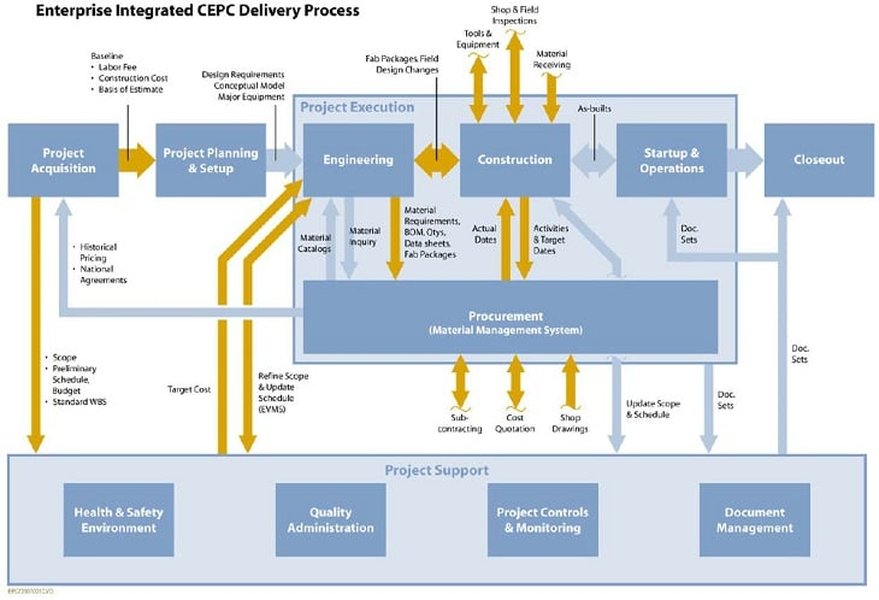
Effective communication and process control are vital in large-scale EPC projects.
Visualizing the Integrated NCR Workflow
The mindmap below illustrates the key stages of an integrated NCR process within an EPC project, highlighting the connection to the Document Control System and the crucial notification steps involving the client and other stakeholders.
(Product, Process, Service)"] id2["NCR Documentation & Logging"] id2_1["Create NCR in DCS"] id2_2["Assign Unique ID"] id2_3["Link to Specs/Drawings"] id2_4["Standardized Template Used"] id3["Initial Assessment & Impact Analysis"] id3_1["Severity Evaluation"] id3_2["Root Cause Analysis (RCA)"] id3_3["Assess Impact on:
- Timeline
- Deliverables
- Cost
- Quality/Safety"] id4["Stakeholder Notification (EPC Responsibility)"] id4_1["Impact on Timeline/Deliverables?"] id4_1_1["YES: Notify Client & All Concerned Parties"] id4_1_1_1["Formal Notification via DCS"] id4_1_1_2["Include: Issue, Impact,
Proposed Actions, Timeline"] id4_1_2["NO: Notify Internal Teams Only (as needed)"] id5["Corrective & Preventive Action (CAPA) Plan"] id5_1["Develop Action Plan"] id5_2["Assign Responsibilities"] id5_3["Set Deadlines"] id5_4["Document in DCS"] id6["Action Implementation & Tracking"] id6_1["Execute CAPA"] id6_2["Monitor Progress (via DCS)"] id7["Verification & Closure"] id7_1["Verify Effectiveness of Actions"] id7_2["Obtain Approvals"] id7_3["Close NCR in DCS"] id8["Lessons Learned & Reporting"] id8_1["Analyze Trends"] id8_2["Update Procedures/Training"] id8_3["Generate QMS Reports"] id9["Document Control System (DCS) Integration"] id9_1["Central Repository"] id9_2["Automated Workflows"] id9_3["Version Control"] id9_4["Audit Trail"]
This mindmap outlines the flow from identifying a non-conformance to its resolution and analysis, emphasizing the integration points with the DCS and the critical decision branch for notifying stakeholders based on assessed impact.
Key Components Summary
The following table summarizes the essential elements of the integrated NCR tracking and notification system discussed:
| Component | Description | Responsibility | Key Benefit |
|---|---|---|---|
| NCR Process Integration | Incorporating NCR creation, tracking, management, and closure within the project's primary Document Control System (DCS). | EPC Project Management / QA/QC Team | Efficiency, Centralization, Auditability |
| Document Control System (DCS) | The software platform used for managing all project documents, including NCRs, facilitating workflows, version control, and access management. | EPC IT / Project Controls | Single Source of Truth, Automation |
| Standardized NCR Form | A consistent template used for documenting all non-conformances, ensuring all necessary information is captured. Enforced via DCS. | EPC QA/QC Team | Consistency, Data Quality |
| Impact Assessment | A defined step in the NCR workflow to evaluate the potential effect on project timelines, deliverables, cost, and quality. | Assigned NCR Investigator / Project Manager | Informed Decision-Making, Risk Identification |
| Client Notification Protocol | A formal procedure requiring prompt notification to the client if an NCR impacts timelines or deliverables. | EPC Project Manager | Transparency, Client Relations, Risk Mitigation |
| Stakeholder Notification Protocol | A formal procedure requiring prompt notification to all concerned parties (internal and external) if an NCR impacts timelines. | EPC Project Manager / Relevant Leads | Alignment, Coordinated Action |
| Automated Workflows | Using the DCS to automatically route NCRs for review, approval, action, and notification according to predefined rules. | EPC IT / Project Controls | Speed, Reduced Admin Burden |
This structured approach ensures that non-conformances are handled systematically, communication is proactive, and the EPC contractor fulfills its obligations for quality management and stakeholder engagement.
Frequently Asked Questions (FAQs)
Why is integrating NCR tracking with the Document Control System so important?
What constitutes an NCR 'affecting project timelines or deliverables'?
Who are the 'concerned parties' the EPC needs to notify besides the client?
How does this integrated system help in preventing future non-conformances?
Recommended Further Exploration
- What are the best practices for implementing document control systems specifically within EPC projects?
- How can EPC teams conduct effective root cause analysis for non-conformances discovered during construction?
- Can you provide examples of automated NCR workflows achievable with modern document management software?
- What are effective strategies for managing communication with clients when project delays arise due to quality issues or non-conformances?
References
Last updated April 29, 2025