
Unlocking Emotional Freedom: How Somatic Experiencing Elevates Talk Therapy for Avoidance
Discover a holistic path to healing by addressing not just the mind, but the body's wisdom in overcoming emotional avoidance.
Core Insights: Bridging Mind and Body
- Emotional avoidance is often rooted in unprocessed trauma and stress stored physiologically, which talk therapy alone may not fully access.
- Somatic Experiencing (SE) offers a "bottom-up" approach, focusing on bodily sensations to release trapped survival energy and regulate the nervous system.
- Integrating SE with talk therapy creates a comprehensive treatment that addresses both cognitive patterns and embodied experiences of avoidance, leading to more profound and sustainable healing.
The Challenge of Emotional Avoidance
Emotional avoidance is a natural, yet often unhelpful, strategy where individuals consciously or unconsciously steer clear of uncomfortable thoughts, feelings, memories, or physical sensations. This might involve suppressing emotions, distracting oneself, or even dissociating from experiences that feel overwhelming. While it can provide temporary relief, long-term emotional avoidance can exacerbate distress, contribute to conditions like anxiety and PTSD, and prevent genuine healing. It's often a learned response, particularly in the aftermath of trauma, where the body's natural fight, flight, or freeze responses were thwarted or incomplete, leaving a residue of unresolved physiological activation.

A therapy session illustrating the dialogue central to talk therapy, which can be enhanced with somatic approaches.
Limitations of Traditional Talk Therapy
Traditional talk therapies, such as Cognitive Behavioral Therapy (CBT), excel at exploring the cognitive aspects of emotional avoidance. They help individuals identify thought patterns, beliefs, and narratives that contribute to avoidance and develop cognitive strategies to challenge them. This is often termed a "top-down" approach, focusing on changing thoughts to influence feelings and behaviors. However, because emotional avoidance is frequently deeply intertwined with the body's physiological responses to stress and trauma, talk therapy alone may not reach the somatic roots of these patterns. The body can hold onto traumatic imprints and survival stress, leading to a dysregulated nervous system that talk therapy might not fully address, potentially leaving individuals still feeling stuck despite cognitive insights.
Introducing Somatic Experiencing (SE)
Somatic Experiencing (SE), developed by Dr. Peter Levine, is a body-oriented therapeutic approach designed to heal trauma and alleviate chronic stress. It operates on the principle that trauma isn't just an event that happened in the past, but rather an injury to the body's psychophysiological systems. SE posits that traumatic symptoms, including emotional avoidance, arise when residual energy from the trauma experience gets "stuck" or "frozen" in the nervous system because the survival responses (fight, flight, or freeze) were not fully completed or discharged.
Core Principles of Somatic Experiencing
The Felt Sense and Body Awareness
SE prioritizes the "felt sense"—the internal, physical sensations, imagery, behaviors, affects (emotions), and meanings that constitute an individual's experience. Therapy involves gently guiding clients to develop awareness of these bodily sensations connected to their emotional states and traumatic memories, without being overwhelmed by them.
Nervous System Regulation
A primary goal of SE is to help individuals restore their nervous system's natural capacity to self-regulate. Trauma can lead to a chronically dysregulated nervous system, stuck in states of hyperarousal (anxiety, panic) or hypoarousal (numbness, depression). SE techniques aim to support the nervous system in returning to a balanced state of equilibrium.
Bottom-Up Processing
Unlike the "top-down" approach of many talk therapies, SE is primarily a "bottom-up" modality. It begins with the body's physical sensations and responses, working upwards to impact emotional and cognitive processing. This approach acknowledges that deep-seated trauma responses are often held in the non-verbal, instinctual parts of the brain and body.
The Power of Integration: SE and Talk Therapy Combined
Integrating Somatic Experiencing into talk therapy offers a holistic and often more effective pathway for addressing emotional avoidance. This synergistic approach acknowledges that mind and body are inextricably linked, and that true healing often requires addressing both cognitive narratives and physiological imprints.
Why This Combination is Effective for Emotional Avoidance
Emotional avoidance is frequently a strategy to bypass distressing bodily sensations associated with difficult emotions or traumatic memories. By incorporating SE, therapy can directly address these underlying physiological states. Clients learn to notice, tolerate, and process the physical sensations they've been avoiding, which in turn reduces the need for emotional avoidance at a cognitive level. The integration allows for a dual pathway: talk therapy provides the space for verbal processing, meaning-making, and cognitive restructuring, while SE provides the tools to work with the embodied aspects of the experience, facilitating the release of trapped survival energy and restoring nervous system regulation.
Key Somatic Experiencing Techniques in an Integrated Session
When SE is woven into talk therapy, the therapist might incorporate several core techniques:
- Tracking Sensation: The therapist guides the client to pay close attention to physical sensations as they arise during the discussion of emotionally charged topics. This might include noticing changes in breathing, muscle tension, heart rate, temperature, or subtle movements. This helps to anchor the client in their present-moment bodily experience.
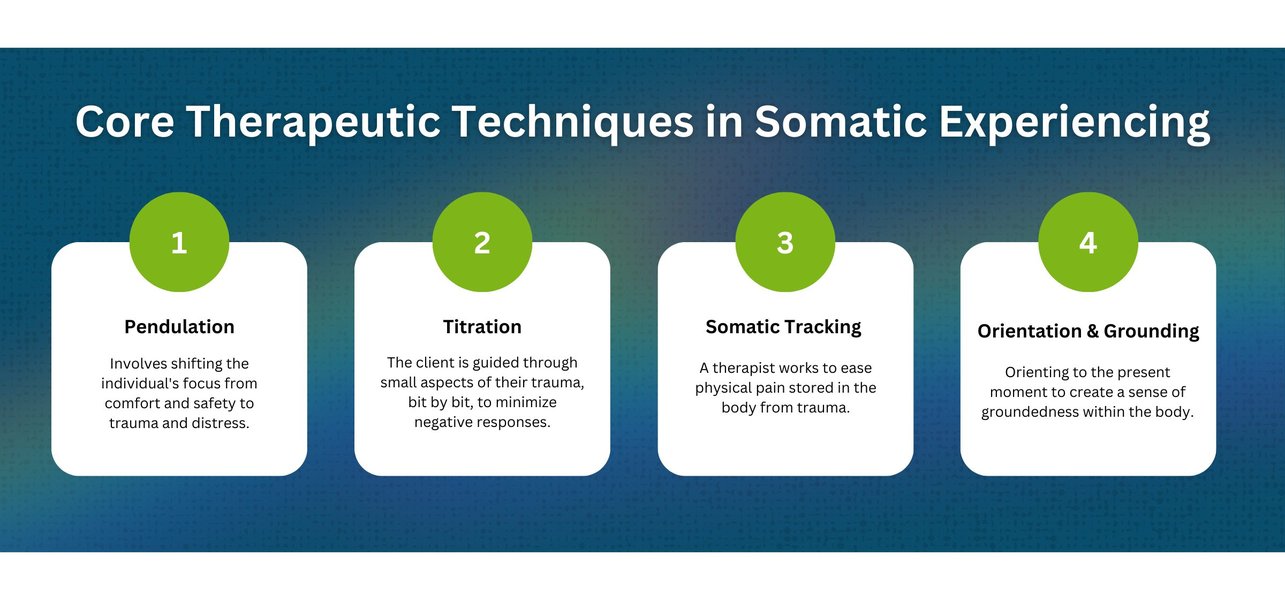
- Titration: This involves working with small, manageable amounts of distressing material or sensation at a time. Instead of flooding the client with overwhelming emotions or memories, the therapist helps them touch into the difficult experience briefly and then return to a state of relative calm and safety. This gradually builds the nervous system's capacity to process the challenging material without becoming dysregulated.
- Pendulation: This is the rhythmic shifting of attention between sensations associated with distress or trauma and sensations associated with resource, safety, or calm in the body. Pendulation helps the nervous system to process and integrate difficult experiences by alternating between activation and rest, promoting a natural flow and release of energy.
- Resourcing: The therapist helps the client identify and cultivate internal or external resources that evoke a sense of strength, safety, grounding, or well-being. These resources can be somatic (e.g., a feeling of groundedness in the feet), imaginal (e.g., a safe place visualization), or relational. Resources provide an anchor and a counterpoint to distressing sensations, enhancing the client's capacity to stay present with difficult material.
- Discharge: SE recognizes that the body has natural ways of releasing bound energy, such as trembling, shaking, heat, or spontaneous deep breaths. In a safe therapeutic environment, the therapist may support the client in allowing these natural physiological discharges to occur, facilitating the completion of thwarted survival responses.
By using these techniques within the framework of a talk therapy session, the therapist can help the client move beyond simply talking *about* their emotional avoidance to directly experiencing and transforming the underlying somatic patterns that drive it.
Somatic therapy emphasizes the profound connection between mind and body in healing.
Visualizing Therapeutic Focus: Talk Therapy vs. SE vs. Integrated Approach
To better understand the distinct yet complementary roles of traditional talk therapy, Somatic Experiencing, and an integrated approach in addressing emotional avoidance, the following radar chart illustrates their primary areas of focus and impact. An integrated approach aims to leverage the strengths of both, offering a more comprehensive path to healing. The scores are illustrative, representing relative emphasis rather than absolute measures.
This chart highlights how an integrated approach seeks to provide robust support across cognitive, emotional, and somatic domains, offering a more holistic framework for overcoming emotional avoidance by addressing its multifaceted nature.
The Integrated Therapeutic Journey
The process of integrating Somatic Experiencing with talk therapy is a collaborative journey between therapist and client. It typically unfolds in stages, allowing for a gentle yet profound exploration of emotional avoidance.
Phases of Integrated Therapy
- Assessment and Psychoeducation: The therapist begins by understanding the client's patterns of emotional avoidance through dialogue. Concurrently, they introduce the concept of mind-body connection and how trauma or stress can manifest physically. Psychoeducation about the nervous system and the principles of SE helps the client understand the rationale behind the integrated approach.
- Building Safety and Somatic Resources: Before delving into difficult emotional material, the focus is on establishing a sense of safety and stability. The therapist guides the client in identifying and strengthening somatic resources – pleasant or neutral bodily sensations, grounding techniques, or visualizations that promote calm and regulation.
- Gentle Exploration and Titration: As trust and resources build, the client is gently guided to notice bodily sensations associated with avoided emotions or experiences. Using titration, the therapist ensures that this exploration happens in small, manageable doses, preventing overwhelm. The client learns to "dip a toe" into challenging sensations and then return to their resources.
- Verbal Processing and Somatic Integration: Insights gained from tracking bodily sensations are then discussed and integrated with the client's cognitive understanding and emotional narrative. For instance, a client might notice tightness in their chest when discussing a particular fear (somatic awareness) and then explore the thoughts and beliefs connected to that fear (cognitive processing).
- Facilitating Completion and Discharge: Where appropriate, the therapist supports the natural completion of defensive responses and the discharge of pent-up survival energy. This might involve encouraging micro-movements or noticing shifts in the body as energy is released.
- Consolidation and Empowerment: As clients become more adept at navigating their internal landscape—both thoughts and sensations—they gain a greater sense of self-regulation and empowerment. The goal is to reduce reliance on avoidance and increase capacity to experience a fuller range of emotions with resilience.
Comparative Overview of Approaches
The following table provides a comparative overview of traditional talk therapy, Somatic Experiencing as a standalone modality, and an integrated approach when addressing emotional avoidance:
| Feature | Traditional Talk Therapy | Somatic Experiencing (SE) | Integrated SE & Talk Therapy |
|---|---|---|---|
| Primary Focus | Cognitions, emotions, behaviors, narratives | Bodily sensations, nervous system regulation, physiological responses | Holistic: Cognitions, emotions, behaviors, narratives, bodily sensations, nervous system |
| Approach Type | Primarily "Top-Down" (mind to body) | Primarily "Bottom-Up" (body to mind) | Combines "Top-Down" and "Bottom-Up" |
| View of Emotional Avoidance | Maladaptive coping strategy, often linked to unhelpful thought patterns | Protective mechanism rooted in nervous system dysregulation and incomplete survival responses | Multifaceted: A coping strategy with cognitive, emotional, and physiological roots |
| Key Techniques for Avoidance | Cognitive restructuring, behavioral experiments, exposure (often imaginal or situational) | Tracking sensations, titration, pendulation, resourcing, facilitating discharge | Combination of verbal processing, cognitive techniques, tracking, titration, pendulation, resourcing, discharge |
| Handling of Bodily Sensations | May be discussed, but not primary focus of intervention | Central to the therapeutic process; directly engaged with | Actively explored and integrated with cognitive and emotional understanding |
| Goal for Avoidance | Reduce avoidance behaviors through cognitive and behavioral change | Resolve underlying physiological dysregulation, increasing capacity to feel without overwhelm, thus reducing need for avoidance | Reduce avoidance through integrated change in thoughts, feelings, behaviors, and physiological responses |
Mapping the Healing Process: SE and Talk Therapy Integration
This mindmap visually outlines the key components involved in integrating Somatic Experiencing with talk therapy to address emotional avoidance. It illustrates how different elements of these therapies come together to support a holistic healing journey, from understanding the problem to applying combined techniques for resolution and fostering long-term well-being.
Steering clear of
uncomfortable internal experiences"] id1b["Manifestations:
- Suppression
- Distraction
- Numbing
- Dissociation"] id1c["Roots:
- Trauma
- Stress
- Overwhelm"] id2["Talk Therapy (Top-Down)"] id2a["Focus:
- Thoughts, beliefs, narratives
- Verbal processing"] id2b["Techniques:
- Cognitive Restructuring
- Behavioral Analysis"] id2c["Limitations for Avoidance:
- May not access physiological roots"] id3["Somatic Experiencing (SE) (Bottom-Up)"] id3a["Core Principles:
- Felt Sense
- Nervous System Regulation
- Trauma stored in body"] id3b["Key Techniques"] id3b1["Tracking Sensations"] id3b2["Titration"] id3b3["Pendulation"] id3b4["Resourcing"] id3b5["Discharge"] id4["The Integrated Approach"] id4a["Synergy:
Mind & Body Healing"] id4b["Process:"] id4b1["Assessment & Psychoeducation"] id4b2["Building Safety & Resources"] id4b3["Gentle Somatic Exploration"] id4b4["Verbal & Somatic Integration"] id4b5["Facilitating Completion"] id4c["Benefits:"] id4c1["Enhanced Emotional Regulation"] id4c2["Reduced Physiological Distress"] id4c3["Increased Resilience"] id4c4["Deeper Trauma Resolution"]
Somatic Experiencing in Action: Understanding the Nervous System
The following video provides an excellent overview of Somatic Experiencing and its focus on healing the nervous system from trauma. Understanding how trauma impacts the nervous system is crucial for appreciating why integrating SE with talk therapy can be so effective for emotional avoidance, as avoidance is often a direct response to nervous system dysregulation.
"Healing the Nervous System From Trauma: Somatic Experiencing" by Therapy in a Nutshell.
This video explains how traumatic experiences can disrupt the natural rhythms of the nervous system, leading to states of being "stuck" in fight, flight, or freeze responses. Somatic Experiencing helps individuals gently process and release this trapped survival energy, allowing the nervous system to return to a state of balance and resilience. When this somatic work is combined with the cognitive and emotional processing of talk therapy, individuals can achieve a more complete and integrated healing from trauma and its associated avoidance patterns.
Frequently Asked Questions (FAQ)
What is emotional avoidance?
Emotional avoidance is any action, thought process, or behavior used to prevent, escape from, or reduce the intensity of unwanted internal experiences, such as difficult emotions (sadness, anger, fear), memories, thoughts, or physical sensations. It's a common response to perceived threats or overwhelming feelings, often stemming from past trauma or stress.
How does Somatic Experiencing (SE) differ from traditional talk therapy?
Traditional talk therapy primarily focuses on cognitive and emotional processing through verbal dialogue (a "top-down" approach). Somatic Experiencing, on the other hand, is a "bottom-up" approach that emphasizes body awareness and the release of trapped trauma energy stored in the nervous system. SE works directly with physical sensations to help regulate the nervous system, whereas talk therapy primarily engages thoughts and emotional narratives.
Why is integrating SE helpful for emotional avoidance?
Emotional avoidance is often driven by an attempt to escape uncomfortable bodily sensations linked to underlying trauma or stress. Integrating SE allows therapy to address these physiological roots directly. By helping clients gently process and tolerate these sensations, SE reduces the body's alarm signals, thereby decreasing the impetus for avoidance. Combining this with the cognitive insights from talk therapy provides a more comprehensive and often more effective treatment.
What happens in an integrated SE and talk therapy session?
An integrated session blends verbal dialogue with guided attention to bodily sensations. For example, while discussing an avoided emotion or memory, the therapist might ask the client to notice any physical sensations arising (e.g., tension, warmth, tingling). Techniques like titration (working with small amounts of distress), pendulation (shifting between distress and resources), and resourcing (accessing feelings of safety or calm) are used to help the client process the experience without overwhelm. The insights from somatic awareness are then discussed and integrated with cognitive understanding.
Is this approach suitable for everyone?
Integrating SE with talk therapy can be highly beneficial for individuals struggling with emotional avoidance, especially those with a history of trauma or chronic stress, or those who find that talk therapy alone hasn't fully addressed their issues. However, suitability depends on individual needs and preferences. A therapist trained in both modalities can assess if this approach is appropriate. Some individuals may initially find focusing on bodily sensations unfamiliar, but this often improves with gentle guidance and practice.
Recommended Further Exploration
- What are the specific techniques used in Somatic Experiencing to address nervous system dysregulation?
- How can I find a therapist trained in both Somatic Experiencing and talk therapy?
- What is the role of the 'felt sense' in healing trauma through somatic therapies?
- Are there any self-help Somatic Experiencing exercises I can try for managing stress and emotional overwhelm?
References
Last updated May 9, 2025