
Interstate Compacts: Understanding the Federal Approval Process
A comprehensive guide to how states collaborate through formally recognized agreements with congressional oversight
Key Insights About Interstate Compacts
- Constitutional Foundation - Interstate compacts derive their legal authority from Article I, Section 10, Clause 3 of the U.S. Constitution, which both enables and restricts state agreements.
- Federal Law Status - When congressional consent is granted, interstate compacts are elevated to federal law status under the Supremacy Clause, making them enforceable in federal courts.
- Consent Flexibility - Congressional consent can be explicit through legislation, implicit through actions indicating approval, or conditional with specific requirements attached.
Understanding Interstate Compacts
Interstate compacts are formal, legally binding agreements between two or more states that address issues crossing state boundaries. These powerful governance tools enable states to collaborate on regional challenges while maintaining their sovereignty within the federal system. Compacts cover diverse policy areas including water resource management, transportation infrastructure, professional licensing, environmental protection, and criminal justice.
Each compact requires legislative approval from all participating states, creating a contractual relationship that binds states to mutual obligations. While simple in concept, the process of creating, approving, and implementing interstate compacts involves complex legal and legislative mechanisms, particularly when congressional action is required.
Constitutional Foundation and Legal Framework
The U.S. Constitution explicitly addresses interstate agreements in Article I, Section 10, Clause 3, commonly known as the "Compact Clause," which states:
"No State shall, without the Consent of Congress, enter into any Agreement or Compact with another State, or with a foreign Power."
This clause establishes both the states' right to form compacts and the potential requirement for congressional consent. However, the Supreme Court has interpreted this clause to mean that congressional consent is only required for compacts that may:
- Enhance state power in a way that encroaches upon federal supremacy
- Interfere with federal authority or the full and free exercise of federal responsibilities
- Prevent or unduly burden the interstate commerce
- Alter the political balance within the federal system
Historic Development of Compact Jurisprudence
The Supreme Court's interpretation of the Compact Clause has evolved significantly over time. In Virginia v. Tennessee (1893), the Court established that not all interstate agreements require congressional consent—only those that increase state political power in ways that might interfere with federal sovereignty. This principle was further refined in U.S. Steel Corp. v. Multistate Tax Commission (1978), which held that compacts dealing with matters that don't impinge on federal authority can proceed without congressional consent.
Congressional Consent Mechanisms
When congressional consent is required, it can take several forms, each with distinct legal implications:
| Consent Type | Description | Legal Effect | Examples |
|---|---|---|---|
| Explicit Consent | Formal legislation passed by Congress and signed by the President specifically approving the compact | Transforms compact into federal law; provides federal court jurisdiction | Port Authority of NY/NJ, Colorado River Compact |
| Implicit Consent | Actions by Congress that demonstrate approval without formal legislation | May be recognized by courts as sufficient for validity | Recognition in federal funding or programs |
| Advance Consent | Blanket approval given before states negotiate specific terms | Allows states flexibility in developing compacts within parameters | Crime Control Consent Act |
| Conditional Consent | Approval with specific requirements or modifications imposed by Congress | States must accept conditions or compact cannot take effect | Low-Level Radioactive Waste Policy Amendments Act |
Legislative Process for Obtaining Congressional Consent
The process for securing congressional approval typically follows these procedural steps:
- Compact Development: States negotiate and draft the compact language
- State Enactment: Participating states pass identical legislation approving the compact
- Congressional Introduction: The compact is introduced as a bill in Congress
- Committee Review: Relevant congressional committees review the compact's provisions
- Hearings: Public hearings may be held to consider the compact's impact
- Floor Vote: Both chambers of Congress vote on the consent legislation
- Presidential Approval: The President signs the consent legislation into law
- Implementation: The compact becomes operational, often through creation of a compact commission
Factors Influencing Congressional Review
When considering whether to grant consent, Congress typically evaluates:
- Potential impact on federal interests and national policy
- Consistency with existing federal law
- Effects on non-member states
- Political considerations and stakeholder interests
- Administrative feasibility and implementation requirements
Legal Implications of Congressional Consent
This radar chart compares the legal characteristics and implications of interstate compacts with and without congressional consent, illustrating the enhanced legal standing that congressional approval provides across key dimensions.
The Transformative Effect of Congressional Consent
When Congress consents to an interstate compact, it transforms the agreement from a contract between states into federal law. This transformation has several significant legal implications:
Federal Law Status
The Supreme Court firmly established in Cuyler v. Adams (1981) that "where Congress has authorized the States to enter into a cooperative agreement, and where the subject matter of that agreement is an appropriate subject for congressional legislation, the consent of Congress transforms the States' agreement into federal law under the Compact Clause." This federal law status means:
- The compact supersedes conflicting state laws under the Supremacy Clause
- Federal courts have jurisdiction over disputes involving the compact
- The compact cannot be unilaterally amended or repealed by member states
Congressional Conditions
Congress can impose conditions on its consent, provided these conditions are constitutional. States accepting a compact with congressional conditions are deemed to have accepted those conditions as part of the compact itself. These conditions become integral parts of the agreement and are enforceable as federal law.
The Compact Development Process
This mindmap illustrates the complete lifecycle of interstate compact development, highlighting the key phases from problem identification through implementation, including the critical congressional review stage that may transform a compact into federal law.
Key Examples of Interstate Compacts
Congressionally Approved Compacts
These interstate compacts received formal congressional consent, elevating them to federal law status:
The Port Authority of New York and New Jersey
Created in 1921, this compact established a bi-state agency to manage the region's transportation infrastructure, including bridges, tunnels, airports, and seaports. Congressional approval was necessary because the compact significantly affected interstate commerce and created a powerful agency with broad authority.
Colorado River Compact
This 1922 compact allocates water rights to the Colorado River among seven western states. Congressional consent was essential due to the national importance of water resource management and the interstate nature of the river system.
Interstate Compact for Adult Offender Supervision
This compact provides a framework for tracking and supervising offenders who move between states. Congressional approval ensures consistent application across state lines and establishes federal enforcement mechanisms.
Compacts Without Congressional Consent
These compacts operate without formal congressional approval because they don't significantly impact federal interests:
Emergency Management Assistance Compact
This compact facilitates mutual aid between states during emergencies and disasters, allowing states to share resources and personnel. It operates without congressional consent because it primarily coordinates existing state powers rather than creating new authority that might encroach on federal domains.
Driver License Compact
This agreement allows states to exchange information about traffic violations and driver's license suspensions. It functions without congressional consent as it primarily addresses administrative cooperation without affecting federal interests.
Visual Resources on Interstate Compacts
Interstate Compacts 101 - A comprehensive introduction to interstate compacts from The Council of State Governments National Center for Interstate Compacts
Illustrative Examples of Interstate Compacts

Nurse Licensure Compact (NLC) Map - This image shows the states participating in the Nurse Licensure Compact, which allows nurses to practice in multiple states with a single license. This compact received congressional consent and illustrates how interstate agreements can facilitate professional mobility across state lines.
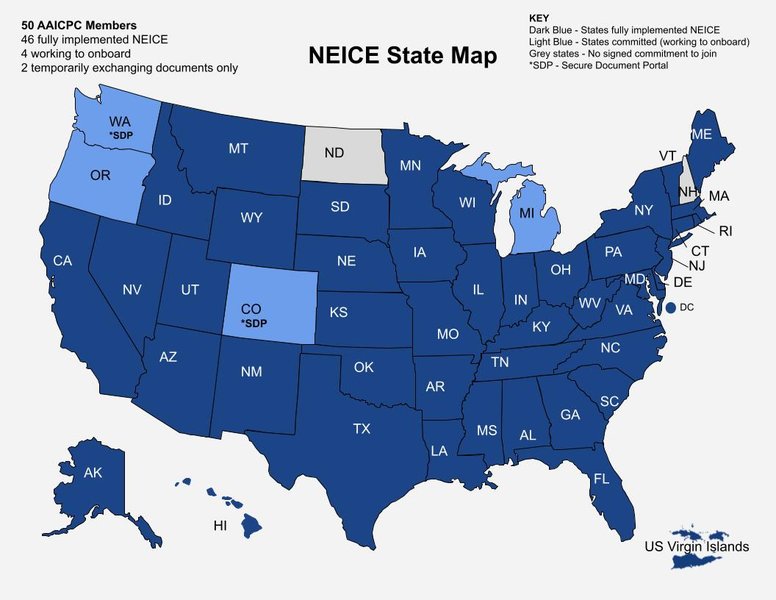
National Electronic Interstate Compact Enterprise (NEICE) Map - This image displays the states participating in the electronic system that supports the Interstate Compact on the Placement of Children, demonstrating how technology facilitates the implementation of interstate compacts with congressional approval.
Frequently Asked Questions
References
- Interstate Compacts in the United States - Library of Congress
- When Consent is Required - Interstate Commission for Adult Offender Supervision
- Implications of Congressional Consent - Interstate Commission for Adult Offender Supervision
- FAQ - National Center for Interstate Compacts
-
Congressional Consent and the Permission for States to Enter into Interstate Compacts - CSG Knowledge Center
-
Constitutionality of Interstate Compacts - Connecticut General Assembly
- Interstate Compacts Database - The Council of State Governments
Recommended Queries
Last updated April 3, 2025